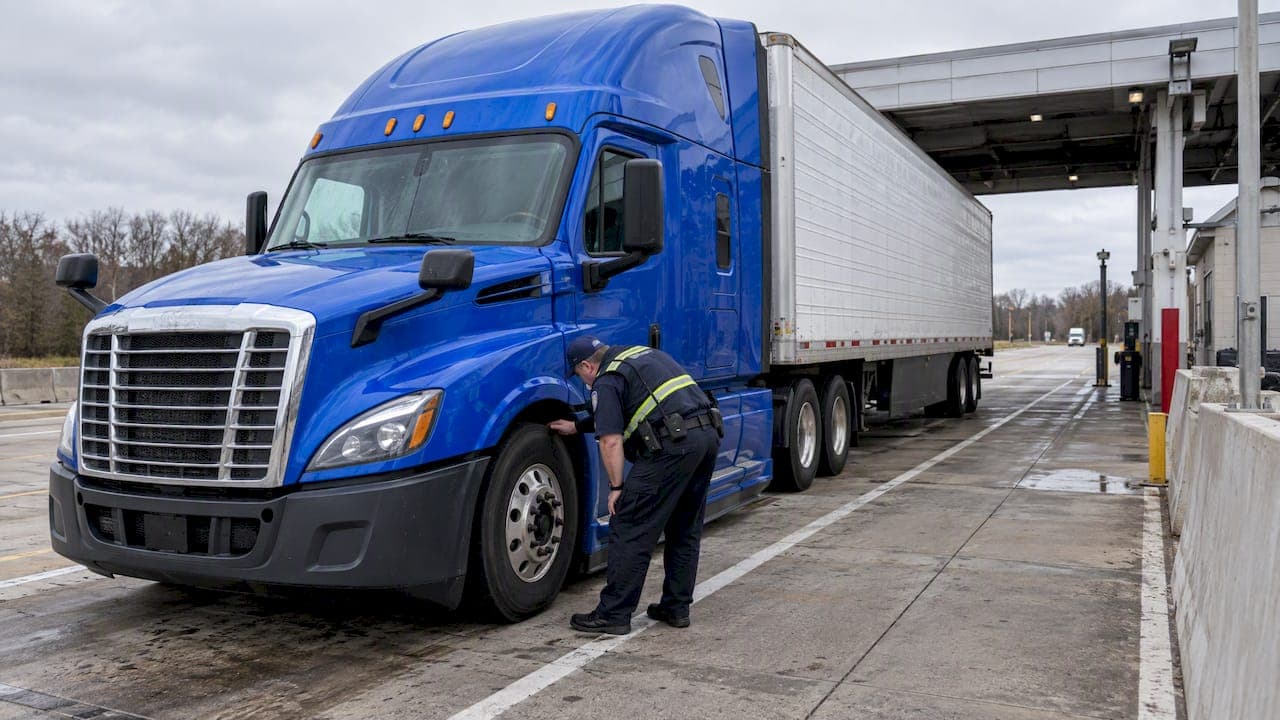
Federal trucking regulations are the safety rules the U.S. Department of Transportation sets for commercial trucks and the companies that run them. The Federal Motor Carrier Safety Administration (FMCSA) writes and enforces most of them. They cover how long a driver may work, who may drive, how trucks are maintained and how cargo is secured. If you were hurt in a truck crash, these rules also set the standard a trucking company is measured against.
This guide walks through the rules that come up most often, in order, and then explains how a possible violation can connect to an injury claim.
TL;DR
- The FMCSA, part of the U.S. Department of Transportation, is the lead federal agency overseeing commercial trucking safety.
- Core rules cover hours of service, driver qualifications under 49 CFR Part 391, vehicle maintenance and cargo securement.
- Property-carrying drivers face daily driving limits, a 30-minute break rule and 60/70-hour weekly caps.
- A regulation violation does not automatically win a claim, but it can be important evidence of negligence.
- If you were injured, you can request a free case evaluation with us and be matched with an attorney.
Table of Contents
- Who makes and enforces federal trucking regulations
- Hours-of-service rules
- Driver qualification requirements
- Inspections, maintenance and cargo securement
- Do state and local rules apply too?
- What a violation can mean after a crash
- Evidence that points to a regulation problem
- Our perspective
- Get a free evaluation of your truck accident
- FAQ
- Sources
Who makes and enforces federal trucking regulations
The FMCSA is an agency within the U.S. Department of Transportation. It is the lead federal agency for regulating and overseeing the safety of commercial motor vehicles, and it covers more than 500,000 commercial trucking companies according to the department's own description (figure from 2018).
The rules themselves are published as the Federal Motor Carrier Safety Regulations (FMCSRs), found in Title 49 of the Code of Federal Regulations, mainly Parts 350 to 399. You will see citations such as 49 CFR Part 391 (driver qualifications), Part 392 (driving rules), Part 393 (parts and accessories) and Part 395 (hours of service).
A few practical points about how the system works:
- New carriers are watched closely. Under the New Entrant Safety Assurance Program, a carrier that applies for a DOT number to start interstate operations is monitored during its first 18 months. It must operate safely, keep current records, inspect and maintain its vehicles and pass a safety audit.
- Drivers' histories are available to employers. The Pre-employment Screening Program gives carriers electronic access to a driver's five-year crash history and three-year inspection history from the FMCSA database.
- Complaints go to the FMCSA. Under 49 CFR 386.12, anyone alleging a substantial violation of a regulation under the Motor Carrier Safety Act of 1984 must file a written complaint within 90 days, and a qualifying, non-frivolous complaint is investigated.
Hours-of-service rules
Fatigue is one of the most closely regulated parts of trucking, and hours of service (HOS) is the rule set people ask about most. Here is how it works for property-carrying drivers, meaning those hauling freight rather than passengers.
| Rule | What it says |
|---|---|
| Daily driving | A driver may not drive more than 11 hours after 10 consecutive hours off duty |
| Driving window | Driving must happen within a 14-hour window after coming on duty |
| Rest break | A 30-minute break is required after 8 cumulative hours of driving without a 30-minute interruption |
| Weekly limit | 60 hours on duty in 7 consecutive days, or 70 hours in 8 consecutive days, depending on the carrier's schedule |
| Restart | Weekly clocks can be reset after at least 34 consecutive hours off duty |
The FMCSA's summary of hours-of-service regulations sets out the daily limits and the 30-minute break requirement. The Interstate Truck Driver's Guide to Hours of Service confirms the 60/70-hour limits and the 34-hour restart. The guide is a 2022 edition, and the rules have exceptions and special provisions (for example, for short-haul drivers and adverse driving conditions), so check the FMCSA's current pages for the details that apply to a specific driver.
Why the logs matter
Most trucks must record duty status electronically. Those records show when a driver was driving, resting or on duty, which makes them one of the first things an attorney asks to preserve after a crash. Trucking companies are not obliged to keep records forever, so speed matters. Our guide to company vehicle accident steps explains what to do early to protect your claim.
Driver qualification requirements
Not just anyone can take a loaded tractor-trailer onto an interstate. Under 49 CFR Part 391, Subpart B, a driver must meet several conditions, which the eCFR text of Subpart B lists:
- Be at least 21 years old.
- Be physically qualified under the rules in Subpart E.
- Hold a currently valid commercial motor vehicle operator's license from one state or jurisdiction.
- Be able to operate the vehicle safely, through experience or training.
- Read and speak English well enough for the listed safety tasks.
- Pass a road test, or present a license or certificate accepted as its equivalent.
The age rule applies to interstate driving. Many states let drivers 18 and older operate within their own borders, so a driver under 21 can be legal on an in-state route and not on an interstate one.
Carriers also have duties of their own. They must verify that a driver is qualified before putting them on the road, and they are expected to keep a qualification file. When a carrier hires a driver with a poor record and a crash follows, the hiring decision itself can become part of the case.
Inspections, maintenance and cargo securement
A truck can weigh up to 80,000 pounds when loaded, so mechanical failures and shifting loads are serious hazards. Several parts of the FMCSRs address them.
Vehicle maintenance
Federal rules in 49 CFR Parts 392, 393 and 396 address keeping commercial vehicles in safe condition and preventing defects such as inoperative brakes or lights and worn tires. The FMCSA's Vehicle Maintenance factsheet says carriers should maintain their vehicles, repair defects that could hinder safe operation before use, and train drivers to conduct pre-trip and post-trip inspections.
Cargo securement
The same guidance says drivers should be trained to load vehicles so that cargo does not shift, spill or drop, and so that the truck is not overloaded. The rule on checking a load is specific. Under 49 CFR 392.9, a driver must inspect cargo and securement devices within the first 50 miles of a trip. The driver must check again whenever duty status changes, or after 3 hours or 150 miles of driving, whichever comes first.

The FMCSA also encourages carriers to ask whether a loading or securement problem was one person's error or a breakdown in the company's safety-management process, according to its Safety Management Cycle guidance. That question matters in an injury case too. A pattern of problems points toward the company, not only the driver.
Underride crashes
When a car slides under the rear or side of a trailer, the results are often catastrophic. Equipment and maintenance rules are part of that picture, and we cover liability, damages and deadlines in our guide to truck underride accident claims.
Do state and local rules apply too?
Yes. Federal rules apply across the country to carriers operating in interstate commerce, but states add their own layer. Participating states receive federal safety grants under the Motor Carrier Safety Assistance Program (MCSAP), and to qualify they must adopt and enforce rules that are substantially similar to the FMCSRs for intrastate carriers, according to a legal overview of the topic. That is why a truck driving only within one state is often held to nearly the same standards.
States and cities also regulate things that federal rules leave open, such as local speed limits, weight limits on particular roads, and truck routes. State law also governs the injury claim itself: negligence standards, deadlines to file and how fault is shared differ from state to state. If a government road defect played a part in your crash, special notice deadlines may apply, as we explain in our article on road defect liability.

What a violation can mean after a crash
Breaking a federal regulation is not, by itself, a guaranteed win in an injury case. But a violation can be strong evidence that a driver or company failed to act with reasonable care. Examples include a driver who exceeded the hours limit, a carrier that skipped a required inspection, or a load that was not properly secured.
Three legal points are worth knowing:
- Federal law gives injured people a route to court. Under 49 U.S. Code 14704, a person injured because a carrier or broker fails to obey an order may bring a civil action to enforce it, and a carrier or broker is liable for damages resulting from an act or omission that violates that part.
- Brokers can be sued for negligent hiring. In Montgomery v. Caribe Transport II, LLC, decided May 14, 2026, the Supreme Court held that the federal safety exception allows a state negligent-hiring claim against a broker that selected a carrier, where the claim concerns the trucks used in transportation. The plaintiff there argued that the broker knew or should have known from the carrier's conditional safety rating that hiring it was reasonably likely to result in crashes with injuries.
- More than one party may be responsible. The driver, the trucking company, a broker, a maintenance contractor or a loader might share fault. Our article on vicarious liability explains how employer responsibility is proven, and the basics of fault are covered in negligence in car accidents.
A correction to the last link is not needed here, because the negligence guide lives at its listed address: negligence in car accidents.
When a family loses someone in a truck crash, the same regulations often shape a wrongful death case. See why trucking companies face wrongful death suits and our family guide to truck accident wrongful death claims.
Evidence that points to a regulation problem
If you suspect a rule was broken, certain records are worth preserving quickly. An attorney can send a preservation request, but you can start by writing down the truck's company name, the USDOT number on the door and the plate number.
- Driver logs and electronic logging data
- Inspection, repair and maintenance records
- The driver's qualification file and training records
- Bills of lading and load documents
- Dashcam footage and engine control module data
- Police report and photos of the scene and cargo
Our evidence best practices guide covers what you can gather yourself, and our look at car accident settlement factors shows how those details can affect value. For a sense of how outcomes vary, see our breakdown of truck accident settlements.
Our perspective
Most people hurt by a truck never read a single page of the federal regulations, and they should not have to. What they need is someone to ask the right questions: Was the driver within the hours limit? Was the load secured? Who hired this carrier?
That is why we built our free evaluation around the type of accident and injury, not a one-size-fits-all form. A crash with a tractor-trailer raises different issues than a fender bender, and a good match with an attorney who handles trucking cases starts with those details.
We do not tell you what your claim is worth, and we do not replace a lawyer. We make the first step simple and free, with no obligation, so you can find out where you stand while the evidence still exists.
Gerard
Get a free evaluation of your truck accident
If a commercial truck hurt you or someone in your family, we can help you take the first step. Tell us what happened and the kind of injury involved, and our free, no-obligation evaluation will help you understand whether you may be entitled to compensation. We then work to connect you with a local attorney suited to your situation.
Start your free case evaluation. There is no published fee for the evaluation.
FAQ
Which agency enforces federal trucking regulations?
The Federal Motor Carrier Safety Administration, part of the U.S. Department of Transportation, is the lead federal agency for commercial truck safety. State agencies take part in enforcement as well, including roadside inspections carried out under federal grant programs.
How many hours can a truck driver drive in a day?
A property-carrying driver may drive up to 11 hours after 10 consecutive hours off duty, within a 14-hour window. A 30-minute break is required after 8 cumulative hours of driving without an interruption. Exceptions exist, so the FMCSA's current guidance is the place to confirm details.
Can I file a complaint about a trucking company?
Yes. A written complaint alleging a substantial violation under the Motor Carrier Safety Act of 1984 must be filed with the FMCSA within 90 days. A complaint is separate from an injury claim, which has its own state deadlines, so speak with an attorney promptly.
Does a regulation violation mean I will win my claim?
Not automatically. A violation can be strong evidence of negligence, but you still need to show it contributed to the crash and your injuries. An attorney can review logs, maintenance files and other records to see what they show.
Sources
- FMCSA overview, U.S. Department of Transportation
- 49 CFR 386.12, Complaints
- FMCSA Summary of Hours of Service Regulations
- Interstate Truck Driver's Guide to Hours of Service
- 49 CFR Part 391 Subpart B, Qualification of Drivers
- FMCSA Vehicle Maintenance BASIC Factsheet
- 49 CFR 392.9, Inspection of cargo
- FMCSA Safety Management Cycle for the Vehicle Maintenance BASIC
- Federal vs. state motor carrier safety regulations overview
- 49 U.S. Code 14704, Rights and remedies of persons injured
- Montgomery v. Caribe Transport II, LLC, Supreme Court