
A truck accident wrongful death claim is a civil lawsuit that surviving family members file when a loved one dies because of a commercial truck driver's or trucking company's negligence. Legally, this action is called a wrongful death action, and it gives families the right to seek financial compensation for their losses. The claim is separate from any criminal charges the driver may face. Time is the most critical factor in these cases. Evidence disappears fast, and most states enforce strict filing deadlines that can end your right to sue if missed. Carcollisionlawyer connects grieving families with experienced wrongful death attorneys who understand the full complexity of trucking litigation.
Who is eligible to file a truck accident wrongful death claim?
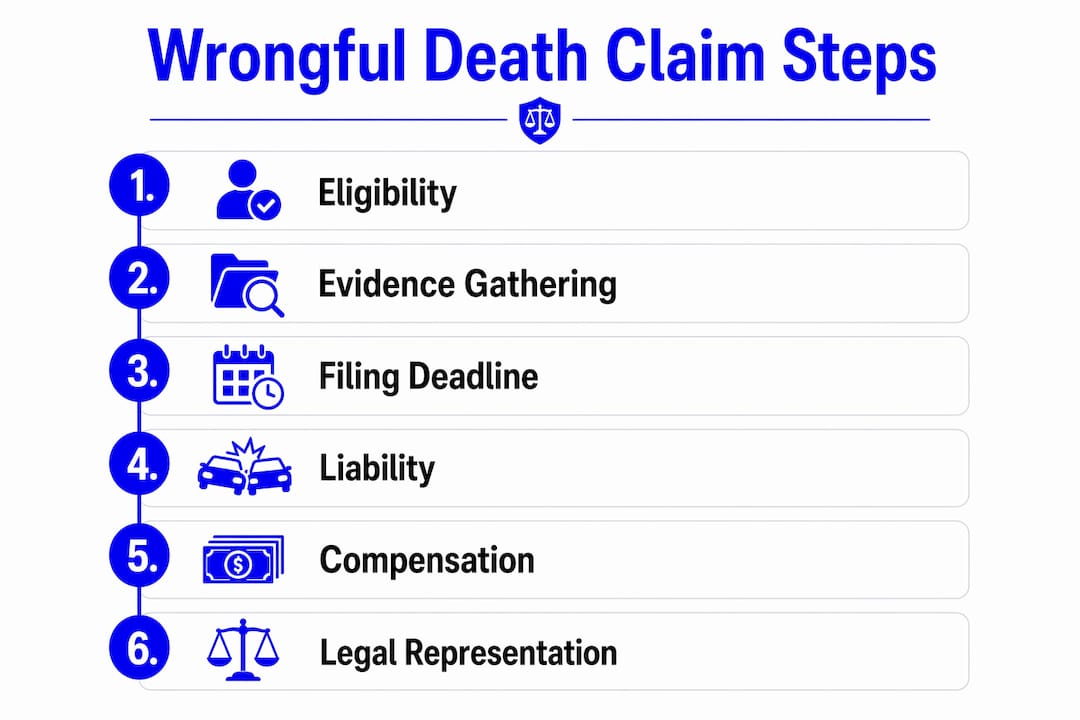
Eligibility follows a clear priority order in most states. Surviving spouses, children, and domestic partners stand first in line to file. Parents may qualify when no spouse or children survive. That hierarchy matters because only one wrongful death action is typically filed on behalf of all eligible survivors.
When no immediate family member is available or willing to act, a personal representative or estate executor steps in. This person files on behalf of the estate and distributes any recovery to the rightful heirs under intestate succession laws. The role carries legal responsibility, so courts often require formal appointment before the claim proceeds.
State law controls eligibility rules, and they vary significantly. Some states allow siblings or financial dependents to file under certain conditions. A few states permit the deceased's parents to file even when adult children exist. Consulting a wrongful death attorney early confirms exactly who holds legal standing in your state.
- Surviving spouse or registered domestic partner: First priority in nearly every state
- Children of the deceased: Biological and legally adopted children qualify
- Parents: Eligible when no spouse or children survive
- Personal representative of the estate: Files when no qualifying family member acts
- Other heirs: Allowed in select states under specific circumstances
Acting quickly protects your legal standing. Delays can complicate the appointment of a personal representative and create disputes among potential claimants.
What are the legal deadlines for filing a wrongful death lawsuit?
Deadlines in wrongful death cases are absolute. Most states set a 2-year statute of limitations for wrongful death claims, measured from the date of death. Miss that window, and courts will almost certainly dismiss your case regardless of how strong the evidence is.
The deadline shrinks when a government entity is involved. If the truck was operated by a municipal, state, or federal agency, the filing window can drop to as little as 6 to 12 months. Government claims also require a formal notice of claim before any lawsuit can be filed. Missing that notice requirement eliminates the case entirely.
Beyond the statute of limitations, families must act fast to preserve evidence. Electronic Control Module data from the truck's black box records speed, braking, and engine activity. That data is overwritten within 8 days of the crash. A spoliation letter, sent by your attorney to the trucking company immediately after the accident, legally obligates them to preserve that data. Without it, critical proof disappears permanently.
- Contact a wrongful death attorney within days of the accident. Early legal action triggers evidence preservation steps before data is lost.
- Confirm the applicable statute of limitations in your state. The 2-year standard does not apply in every jurisdiction.
- Identify all potential defendants. The driver, trucking company, cargo loader, and vehicle manufacturer may all carry liability.
- Send a spoliation letter. Your attorney sends this formal notice to prevent the trucking company from destroying records.
- File the formal wrongful death complaint. This document initiates the lawsuit and must be filed before the deadline expires.
Pro Tip: Request the truck driver's logbooks, inspection records, and drug test results through your attorney immediately. Trucking companies are not required to retain these records indefinitely, and they will not volunteer them.
How is liability established in truck accident wrongful death cases?
Liability in a fatal truck crash requires proving four elements: duty of care, breach of that duty, causation, and damages. Every licensed commercial truck driver owes a duty of care to other road users. Proving breach means showing the driver or company acted negligently, whether through speeding, fatigue, improper loading, or regulatory violations.
Truck accident wrongful death investigations go far beyond what a typical car crash requires. Attorneys examine the trucking company's hiring practices, driver qualification files, hours-of-service logs, vehicle maintenance records, and compliance with Federal Motor Carrier Safety Regulations (FMCSR). A single violation of FMCSR standards can establish negligence per se, meaning the violation itself proves the breach without additional argument.
"Wrongful death cases involving trucks differ fundamentally from car accidents. Multiple parties can share liability, regulatory requirements add layers of complexity, and the trucking company's insurer will deploy experienced defense teams from day one. Families need equally experienced legal representation to level that playing field."
Trucking companies fight these claims aggressively. Their most common defense is comparative negligence, arguing that the deceased driver caused or contributed to the crash. In states that follow a modified comparative fault rule, if the deceased is found more than 50% at fault, the trucking company avoids all liability. That finding eliminates the family's entire recovery. Expert witnesses, including accident reconstructionists and FMCSR compliance specialists, counter these arguments with technical analysis of the crash.
Key evidence categories in a fatal truck crash case include:
- Electronic Control Module (black box) data: Speed, braking force, throttle position, and engine hours at the time of impact
- Driver logs and hours-of-service records: Proof of fatigue or falsified rest periods
- Trucking company maintenance records: Evidence of ignored mechanical defects
- Dashcam and surveillance footage: Visual confirmation of the crash sequence
- Drug and alcohol test results: Required post-accident testing under FMCSR rules
- Cargo loading documentation: Overloaded or improperly secured cargo shifts liability to shippers
Understanding why trucking companies face wrongful death suits at such high rates comes down to the scale of harm their vehicles cause and the regulatory obligations they routinely violate.
What compensation can families expect from a fatal truck crash claim?
Wrongful death compensation divides into two categories: economic damages and non-economic damages. Economic damages are calculable losses. They include the deceased's projected lifetime earnings, medical bills incurred before death, funeral and burial costs, and the value of household services the deceased provided. These figures are calculated using actuarial data and expert economic testimony.

Non-economic damages address losses that have no price tag. Loss of companionship, parental guidance, emotional support, and consortium all qualify. Courts and juries assign dollar values to these losses based on the strength of the relationship and the age of the survivors. A young child who loses a parent typically receives a higher non-economic award than an adult child.
| Damage Type | What It Covers |
|---|---|
| Lost future income | Projected earnings the deceased would have provided to the family |
| Medical expenses | Bills for treatment between the crash and death |
| Funeral and burial costs | All reasonable final expense costs |
| Loss of companionship | Emotional and relational loss suffered by surviving spouse and children |
| Loss of parental guidance | Value of parenting the deceased would have provided to minor children |
Families often file both a wrongful death claim and a survival action to maximize total recovery. The wrongful death claim compensates survivors for their ongoing losses. The survival action compensates the estate for pain, suffering, and losses the deceased experienced between the crash and death. Filing both is the standard approach in states that allow it.
Attorney fees in these cases follow a contingency structure. Most wrongful death claims operate on a contingency fee basis, meaning the attorney collects a percentage of the recovery only if the case succeeds. Families pay nothing upfront. Initial consultations are also typically free. That structure removes the financial barrier to legal representation at the worst possible time.
Pro Tip: Ask your attorney how settlements are distributed among multiple heirs before signing any agreement. State law governs distribution, but the allocation can be negotiated in some circumstances, particularly when heirs disagree.
What challenges do families face and how can they navigate the process?
Insurance companies for large trucking fleets are not neutral parties. Attorneys act as a protective shield for grieving families, handling all communications and negotiations so families are not pressured into accepting inadequate early settlements. Insurers often contact families within days of a crash with settlement offers that sound generous but fall far short of actual lifetime losses.
The emotional weight of grief makes families vulnerable to these tactics. Accepting an early settlement waives all future claims, including those for long-term financial losses that have not yet been calculated. A wrongful death attorney evaluates the full scope of damages before any settlement discussion begins.
Steps families should take immediately after a fatal truck accident:
- Preserve all physical evidence. Do not allow the family vehicle to be repaired or scrapped before an attorney inspects it.
- Document everything. Save all medical records, police reports, and correspondence from the trucking company or its insurer.
- Avoid recorded statements. Do not speak to the trucking company's insurance adjuster without an attorney present.
- Gather witness information. Names and contact details of eyewitnesses are critical for reconstruction experts.
- Seek a free legal consultation. Understanding your rights costs nothing and protects everything.
Choosing the right legal representation matters as much as the evidence itself. The wrongful death attorney evaluation guide at Carcollisionlawyer outlines exactly what to look for in an attorney who handles trucking cases specifically.
Pro Tip: Never sign any document from a trucking company or its insurer without attorney review. Even documents framed as routine paperwork can contain liability waivers.
Key takeaways
A truck accident wrongful death claim requires fast action, thorough evidence preservation, and experienced legal representation to overcome trucking companies' aggressive defenses and maximize compensation for surviving families.
| Point | Details |
|---|---|
| Filing deadlines are strict | Most states allow 2 years to file; government defendants may cut that to 6 months. |
| Evidence disappears fast | Black box data is overwritten within 8 days; a spoliation letter must be sent immediately. |
| Eligibility follows a priority order | Spouses and children file first; estate representatives act when no family member qualifies. |
| File both claim types | A wrongful death claim covers survivors; a survival action covers the estate's losses. |
| Attorneys work on contingency | No upfront fees; attorneys collect only if compensation is recovered. |
What I've learned from watching families navigate these cases
Grief and legal deadlines are a brutal combination. Families are asked to make consequential legal decisions at the exact moment they are least equipped to think clearly. What I've seen consistently is that the families who act within the first two weeks after a fatal crash preserve far more options than those who wait even a month.
The trucking industry's legal defense apparatus is not something most families anticipate. These companies carry substantial insurance policies and retain experienced defense firms before the crash scene is even cleared. The asymmetry is real. A family without specialized legal counsel is negotiating against a team that handles these cases every week.
The detail that surprises most families is how much liability can rest with the trucking company itself, not just the driver. Negligent hiring, inadequate training, falsified maintenance records, and pressure on drivers to violate hours-of-service rules all create direct corporate liability. That corporate liability is often where the largest recovery comes from. Focusing only on the driver misses the bigger target.
My honest advice: trust the legal process, but choose an attorney who has handled trucking cases specifically. General personal injury experience is not the same as understanding FMCSR compliance, ECM data analysis, and the tactics trucking company insurers use. The difference in outcome between a generalist and a specialist in these cases is significant.
— Gerard
Carcollisionlawyer is here for your family
Losing someone in a fatal truck crash is devastating. The legal process that follows should not add to that burden.
Carcollisionlawyer connects families with experienced wrongful death attorneys who handle trucking cases specifically. These attorneys understand FMCSR regulations, ECM evidence, and the defense tactics large trucking insurers use. Every consultation is free, and attorneys work on a contingency basis, meaning your family pays nothing unless compensation is recovered. Start with a free evaluation at Carcollisionlawyer and get matched with an attorney who can protect your family's rights from day one.
FAQ
Who can file a wrongful death claim after a truck accident?
The surviving spouse, children, or domestic partner of the deceased holds first priority to file. When no immediate family member qualifies, a personal representative of the estate files on behalf of all heirs.
How long do families have to file a wrongful death lawsuit?
Most states enforce a 2-year statute of limitations from the date of death. Claims against government-operated trucks may require action within 6 to 12 months.
What is a survival action and how does it differ from a wrongful death claim?
A wrongful death claim compensates surviving family members for their ongoing losses. A survival action compensates the estate for pain, suffering, and losses the deceased experienced before death. Filing both maximizes total recovery.
What does it cost to hire a wrongful death attorney?
Most wrongful death attorneys work on contingency, collecting a percentage of the recovery only if the case succeeds. Initial consultations are typically free, so families face no upfront financial risk.
What is a spoliation letter and why does it matter?
A spoliation letter is a formal legal notice your attorney sends to the trucking company requiring them to preserve all evidence, including black box data. ECM data is overwritten within 8 days of a crash, making this letter one of the most time-sensitive steps in any truck accident case.