
Wrongful death suits against trucking companies are legal claims filed when a truck driver's negligence kills someone and the company that employed or controlled that driver shares legal responsibility. This area of law, formally called trucking wrongful death litigation, sits at the intersection of federal safety regulations, state tort law, and employment doctrine. Trucking companies face these suits because the law holds them accountable not just for what their drivers do, but for the hiring decisions, training failures, and maintenance shortcuts that made a fatal crash possible. Recent 2026 rulings have expanded that accountability further, pulling freight brokers into the liability net alongside carriers.
Why trucking companies face wrongful death suits: the legal foundation
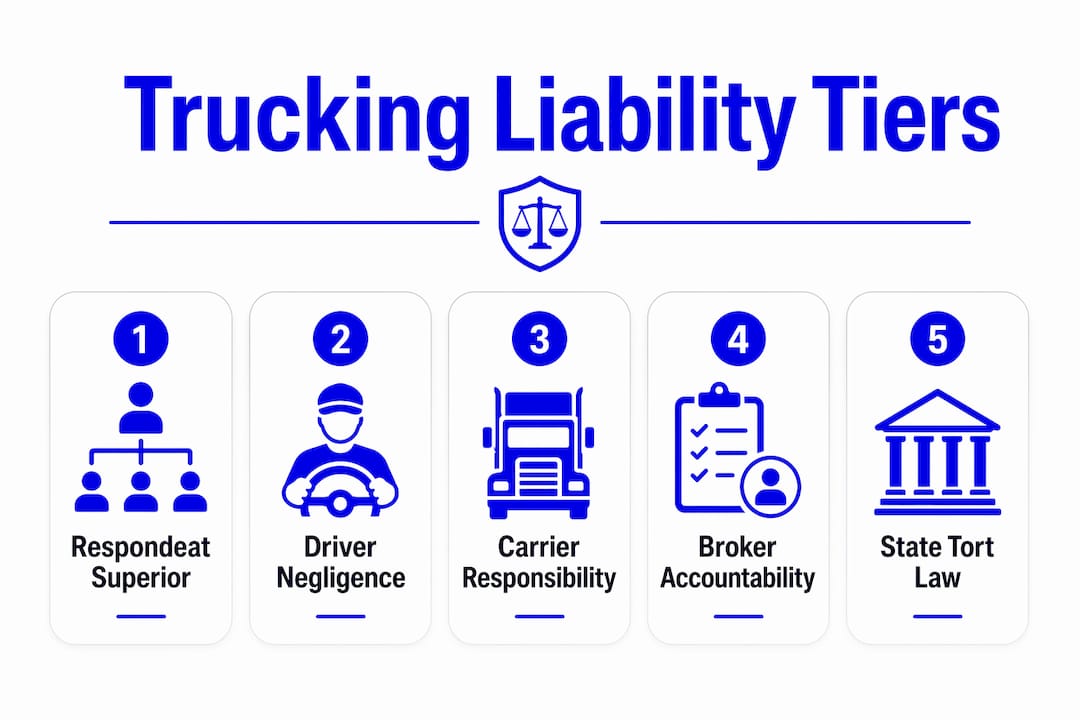
Trucking companies carry legal responsibility for their drivers under a doctrine called respondeat superior, which means "let the master answer." Under this rule, employers answer for negligence committed by employees acting within the scope of their job duties. A driver who causes a fatal crash while making a scheduled delivery is acting within that scope. The company does not need to have directly caused the crash to be named in a wrongful death suit.

Beyond vicarious liability, trucking companies face direct liability for their own decisions. Negligent hiring, retention, and training are three of the most common bases for wrongful death claims. If a company hired a driver with a history of serious traffic violations, kept a driver on the road after warning signs emerged, or skipped required safety training, those failures become independent grounds for a lawsuit.
Federal regulations add another layer. The Federal Motor Carrier Safety Administration (FMCSA) sets hours-of-service rules that limit how long a driver can operate without rest. Operational pressure to exceed safe driving limits is a documented contributing factor in fatal truck crashes. When a company pushes drivers past those limits to meet delivery deadlines, it creates direct exposure to wrongful death liability.
- Respondeat superior holds the company liable for a driver's negligent acts during employment.
- Negligent hiring applies when the company failed to screen a driver's record before hiring.
- Negligent retention applies when warning signs existed and the company kept the driver anyway.
- Negligent training applies when the company failed to teach required safety procedures.
- Maintenance failures apply when a mechanical defect caused or contributed to the crash.
Pro Tip: If you are researching a wrongful death claim, request the trucking company's driver qualification file early. Federal regulations require companies to keep these records, and gaps in that file are powerful evidence of negligent hiring.
How do federal and state laws shape trucking liability in 2026?
The legal framework governing trucking wrongful death claims shifted significantly in may 2026. The U.S. Supreme Court issued a unanimous ruling in Montgomery v. Caribe Transport II, confirming that federal law does not preempt state-law negligence claims against freight brokers who knowingly select unsafe carriers. That ruling closed a defense that brokers had used for years to escape liability entirely.
The case centered on the Federal Aviation Administration Authorization Act (FAAAA), which brokers argued blocked state tort claims against them. The Court disagreed, finding a safety exception that preserves state claims when a broker knowingly hires a carrier with a dangerous safety record. The practical effect is that the chain of liability now runs from the driver through the carrier and, in many cases, through the broker who arranged the load.
State tort law continues to play a central role. States set their own standards for negligence, damages, and comparative fault, which means the value and complexity of a wrongful death claim varies significantly by jurisdiction. Federal regulations like FMCSA hours-of-service rules set a floor for safety standards, but state courts determine how violations of those rules translate into damages for a grieving family.
| Legal framework | What it covers | Impact on wrongful death claims |
|---|---|---|
| Respondeat superior | Employer liability for employee acts | Attaches company liability to driver negligence |
| FMCSA hours-of-service rules | Driver rest and driving time limits | Violations become evidence of negligence |
| Montgomery v. Caribe Transport II (2026) | Broker liability for carrier selection | Expands the pool of liable defendants |
| FAAAA safety exception | State tort claims against brokers | Preserves plaintiffs' right to sue brokers |
| CSA BASIC scores | Carrier safety performance metrics | Used as evidence of known safety risks |
CSA BASIC scores and inspection histories are now scrutinized in liability assessments. A broker or carrier that ignored a poor safety rating before hiring a driver has a much harder time arguing it had no reason to expect a crash.
Pro Tip: Pull the carrier's CSA BASIC score from the FMCSA's Safety Measurement System before filing. A score in the alert category is documented evidence that the company knew or should have known about the safety risk.
What operational practices increase the risk of wrongful death lawsuits?
Certain business decisions inside trucking companies create predictable legal exposure. These are not freak accidents. They are the foreseeable results of choices companies make under financial pressure.
- Unrealistic delivery deadlines. Companies that schedule loads knowing drivers cannot complete them within legal hours-of-service limits are setting up violations before the truck leaves the dock. Fatigue is one of the leading causes of fatal truck crashes.
- Inadequate driver vetting. Hiring a driver without reviewing their commercial driver's license history, medical certification, or prior employer records is a textbook negligent hiring failure. Federal regulations require this review, and skipping it is both a regulatory violation and a tort.
- Deferred maintenance. Brake failures, tire blowouts, and lighting defects are preventable. Companies that delay required inspections or ignore driver-reported defects face direct liability when those defects contribute to a fatal crash.
- Driver misclassification. Labeling drivers as independent contractors does not automatically shield a company from liability. Courts pierce this classification when the company controls key aspects of the driver's work, including schedules, routes, and equipment. The label matters less than the reality of control.
- Unsafe subcontracting. In California, courts have found that motor carriers owe non-delegable safety duties even when they subcontract operations. Three trucking firms were found jointly liable in one California verdict precisely because subcontracting did not transfer the underlying duty to operate safely.
Each of these practices leaves a paper trail. Dispatch records, maintenance logs, driver qualification files, and electronic logging device data all become evidence in wrongful death litigation.
What defenses do trucking companies use, and why do they often fail?
Trucking companies typically raise several defenses in wrongful death suits. Understanding these defenses helps you anticipate what the litigation will look like and where the strongest arguments lie.
- Independent contractor status. This is the most common defense. Companies argue that because the driver was classified as a contractor, the company bears no liability. Courts reject this argument when the company controlled the driver's schedule, required specific equipment, or set the route. Control, not the contract label, determines liability.
- Lack of knowledge. Companies argue they had no reason to know a driver was unsafe. This defense weakens significantly when CSA BASIC scores, prior complaints, or failed drug tests existed in the driver's file. Documented safety metrics are now central to proving what the company knew or should have known.
- Intervening cause. Companies sometimes argue that another driver's actions, road conditions, or the victim's own behavior broke the chain of causation. This defense can reduce damages under comparative fault rules but rarely eliminates liability entirely.
- Compliance as a shield. Some companies argue that following FMCSA regulations proves they acted reasonably. Courts generally reject this as a complete defense. Regulatory compliance sets a minimum standard, not a ceiling on the duty of care.
Pro Tip: Request the company's electronic logging device (ELD) data immediately after a fatal crash. ELD records are time-stamped and difficult to alter. They show exactly when the driver was moving, resting, and whether hours-of-service rules were violated.
Key Takeaways
Trucking companies face wrongful death suits because the law holds them directly responsible for negligent hiring, inadequate training, maintenance failures, and operational pressure that pushes drivers past safe limits.
| Point | Details |
|---|---|
| Respondeat superior is the foundation | Companies are liable for driver negligence that occurs within the scope of employment. |
| Direct liability is separate and powerful | Negligent hiring, retention, and training each create independent grounds for a wrongful death claim. |
| The 2026 Supreme Court ruling expanded liability | Freight brokers can now be sued under state law for knowingly selecting unsafe carriers. |
| Misclassification rarely works as a defense | Courts look at actual control over the driver, not the label on the contract. |
| Safety documentation is now central to litigation | CSA BASIC scores, ELD data, and maintenance logs determine what companies knew and when. |
The accountability gap is finally closing
I have watched trucking wrongful death litigation evolve for years, and the 2026 Montgomery v. Caribe Transport II ruling is the most significant shift I have seen in over a decade. For too long, freight brokers sat in a comfortable middle position. They arranged loads, collected fees, and pointed at carriers when crashes happened. That insulation is gone now.
What strikes me most is how predictable these crashes are in hindsight. The driver qualification file is incomplete. The CSA score was in the alert range for months. The maintenance log shows a brake defect that was reported and never fixed. These are not mysteries. They are documented failures that companies made conscious decisions to ignore. The law is finally catching up to that reality.
The challenge for families pursuing these claims is that trucking companies are well-resourced and move quickly after a crash. Evidence disappears. Logs get "lost." Drivers get reclassified. The families who get the best outcomes are the ones who act fast, secure the evidence, and work with attorneys who understand both the federal regulatory framework and the state tort system. That combination is not common, but it is the difference between a settlement that reflects the actual harm and one that does not.
— Gerard
Carcollisionlawyer connects you with attorneys who handle these cases
Wrongful death claims against trucking companies are among the most legally complex injury cases in American courts. They involve federal regulations, multiple defendants, and defense teams that specialize in minimizing payouts.
Carcollisionlawyer connects families with attorneys who have direct experience handling trucking wrongful death claims and understand how to build liability cases against carriers, brokers, and their insurers. The free evaluation process lets you understand your legal options without any upfront commitment. If a fatal truck crash has affected your family, you can start your claim review at Carcollisionlawyer today and get matched with a specialist who knows this area of law.
FAQ
What is a wrongful death suit in a trucking accident?
A wrongful death suit is a civil claim filed by surviving family members when a truck driver's negligence causes a fatal crash. The claim seeks financial compensation for the loss, including lost income, funeral costs, and emotional harm.
Why are trucking companies named in wrongful death suits instead of just the driver?
Trucking companies are named because they are legally responsible for their drivers' actions under respondeat superior, and because their own hiring, training, and maintenance decisions often contributed directly to the crash.
How does the 2026 Supreme Court ruling affect wrongful death claims?
The Montgomery v. Caribe Transport II ruling confirmed that freight brokers can be sued under state negligence law for knowingly selecting unsafe carriers, expanding the number of defendants available in wrongful death litigation.
Can a trucking company avoid liability by calling its driver an independent contractor?
Not reliably. Courts look at whether the company actually controlled the driver's work. If it did, liability attaches regardless of how the driver was classified on paper.
What evidence is most important in a trucking wrongful death case?
The driver qualification file, electronic logging device data, CSA BASIC scores, and maintenance records are the most critical documents. They show what the company knew, what it ignored, and whether federal safety rules were followed.