
Most truck accident settlements land far below the headline averages you see quoted online, but a small share of catastrophic cases pull those averages up dramatically. A dataset of more than 400 U.S. truck accident settlements found an average around $103,654 and a median near $30,000. The gap between those two numbers comes down to injury severity, how much insurance coverage is actually available, and how clear the liability picture is. Start by getting medical care, preserving evidence, and getting a free case evaluation before you talk numbers with an insurer.
TL;DR:
- Most truck accident settlements for serious injuries can range from $200,000 to several million dollars, with catastrophic cases often settling in the millions.
- The average settlement is around $103,654, but median claims are closer to $30,000, heavily influenced by a small number of high-value cases.
- Evidence preservation within the first two weeks, including medical records and black box data, significantly impacts the case value and potential settlement.
- Cases resolve faster when injury severity is minor and liability clear, but complex, severely injured, or multi-party claims can take one to three years or more.
- An experienced attorney can identify additional insurance layers, gather strong evidence, and negotiate from a fully documented case to maximize compensation.
Table of Contents
- Truck Accident Settlement Amounts: The National Snapshot
- What's the Settlement Range for Different Injury Severities?
- What Factors Most Affect a Truck Accident Settlement?
- What Evidence Increases a Truck Crash Injury Settlement?
- How Long Does It Take to Settle a Truck Accident Claim?
- How Does a Lawyer Change Your Truck Accident Settlement?
- What I'd Tell Someone Facing This Right Now
- Get a Free Truck Accident Case Evaluation
- Primary Sources Behind This Article
- Sources
- FAQ
Truck Accident Settlement Amounts: The National Snapshot
An average of roughly $103,654 sounds like a lot until you learn the median sits closer to $30,000. That split isn't a contradiction. It's math doing exactly what it's supposed to do when a small number of massive settlements sit next to a much larger group of modest ones.
Picture 400 truck accident cases lined up by value. The midpoint of that line sits near $30,000, which means half of all settlements come in below that figure and half come in above it. But a handful of cases involving paralysis, brain injury, or death settle for $1 million, $3 million, or more. Add those into the mix and the average balloons well past what a typical claimant should expect.
Here's roughly how that spread breaks down in practice:
- Minor injury claims (soft tissue, short recovery) often settle in the $10,000 to $40,000 range.
- Moderate injury claims (fractures, short-term surgery) frequently land between $50,000 and $200,000.
- Severe and catastrophic claims (spinal injury, amputation, traumatic brain injury) commonly reach $500,000 to several million dollars.
- Wrongful death claims often settle in seven figures, depending on the victim's earnings and family circumstances.
These figures aren't a promise. They're a map of where past cases have landed, built from a real dataset rather than a guess. The reason truck accident settlements often outpace typical car accident payouts (which frequently land in the $20,000 to $30,000 range) comes down to scale. A fully loaded commercial truck can weigh 20 to 30 times more than a passenger car, and FMCSA crash data consistently shows that collisions involving large trucks produce a higher rate of serious and fatal injuries than typical passenger vehicle crashes. That physics gap is the entire reason truck claims tend to carry more value than a fender bender between two sedans.
If your case involves anything beyond a minor injury, the national averages matter less than where your specific injury tier lands and how strong your evidence is. Both of those get more specific attention below.
What's the Settlement Range for Different Injury Severities?
Settlement value tracks injury severity almost linearly, but the multipliers inside each tier vary based on permanence, medical cost, and how the injury affects future earning capacity. Here's how the tiers generally break out.
Minor injuries (whiplash, bruising, minor cuts, short-term soft tissue damage) typically resolve within weeks to a few months. Settlements here often run $10,000 to $40,000, largely reflecting modest medical bills and limited lost wages. Insurers move fast on these because the exposure is small and the medical record tells a clean story.
Moderate injuries (broken bones, torn ligaments, injuries requiring one surgery and a defined recovery period) tend to settle between $50,000 and $200,000. The range widens here because recovery time varies so much. A broken wrist that heals in eight weeks settles differently than a shattered femur requiring rods, screws, and months of physical therapy.
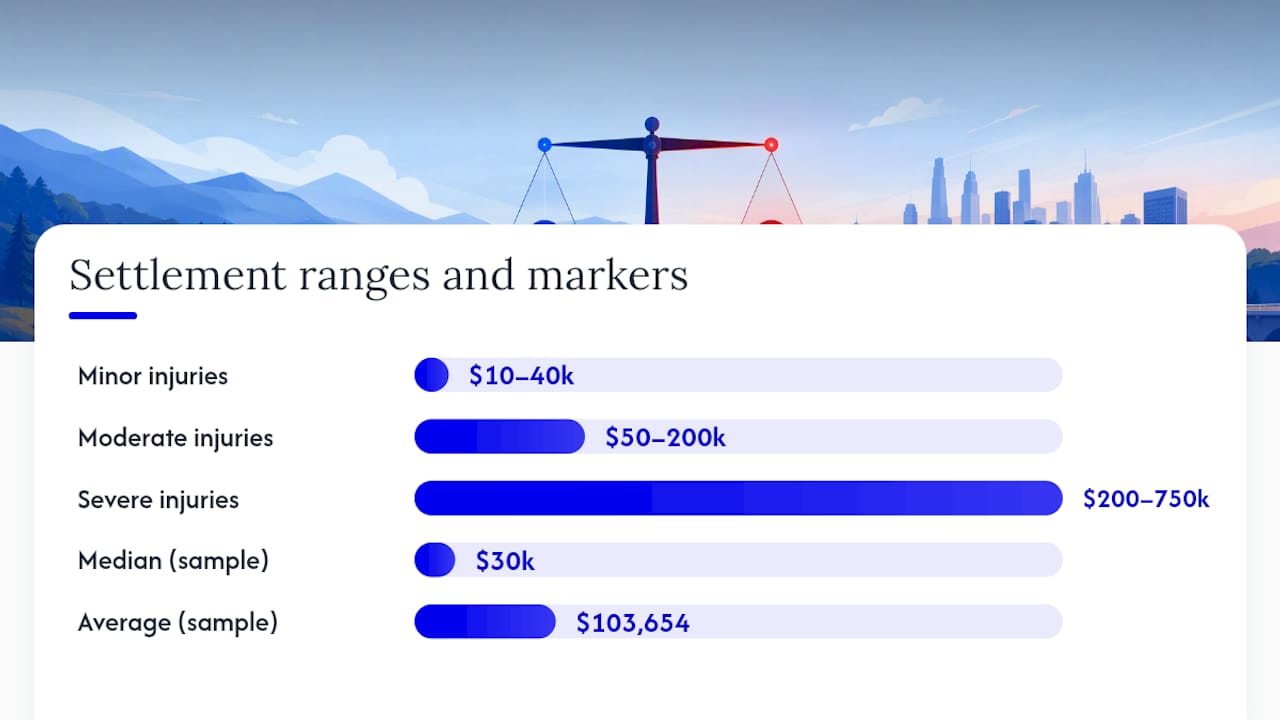
Severe injuries (multiple fractures, significant nerve damage, injuries requiring several surgeries or leaving lasting impairment) usually land between $200,000 and $750,000. At this tier, future medical care and diminished ability to work start driving the number more than the initial hospital bill.
Catastrophic injuries (spinal cord damage, traumatic brain injury, amputation, severe burns) commonly settle from $750,000 into the multiple millions. These cases almost always involve lifetime care costs, permanent disability, and a person whose earning capacity has been altered forever.
Wrongful death claims frequently settle in the seven figure range, driven by the victim's lost future income, funeral costs, and the surviving family's loss of companionship and support. Multi-defendant trucking wrongful death suits (trucking company, driver, and sometimes a maintenance contractor or cargo loader) can push values higher still, since multiple parties often share liability in ways a single-vehicle car accident never does.
| Injury tier | Typical settlement range | Key value drivers |
|---|---|---|
| Minor | $10,000–$40,000 | Fast recovery, low medical cost, minimal lost work |
| Moderate | $50,000–$200,000 | Surgery, weeks of missed work, ongoing therapy |
| Severe | $200,000–$750,000 | Multiple surgeries, lasting impairment, future care |
| Catastrophic | $750,000 and up | Permanent disability, lifetime care, lost earning capacity |
| Wrongful death | $1,000,000 and up | Lost lifetime income, multiple liable parties, family loss |
The tier ranges provided indicate typical settlement values but can vary substantially based on liability, insurance coverage, and timing of settlement acceptance.
What Factors Most Affect a Truck Accident Settlement?
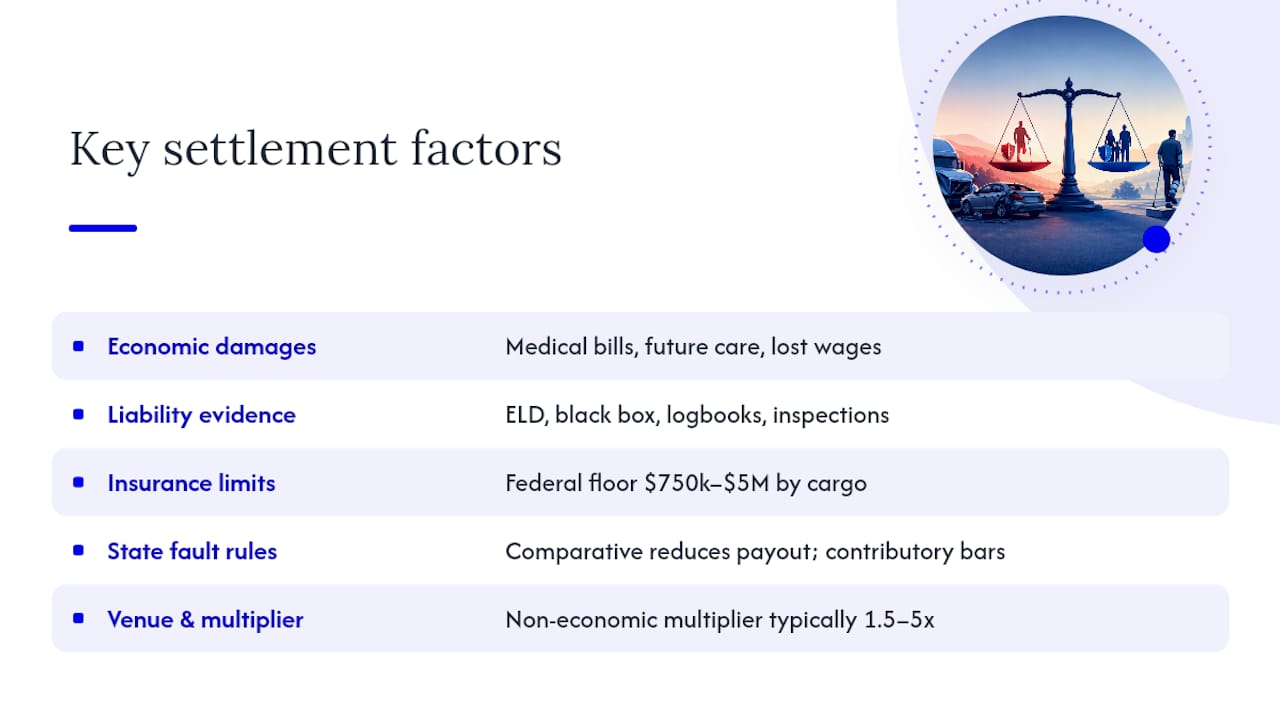
Five variables do most of the heavy lifting in any negotiation, and understanding which ones you can influence changes how you approach the claim.
Economic damages come first. Medical bills, projected future care, lost wages, and diminished earning capacity form the financial backbone of every settlement demand. A claim with a documented $150,000 in past and future medical costs starts a negotiation in a completely different place than one with $8,000 in bills, regardless of how the crash happened.
Liability evidence decides who pays. Electronic logging device (ELD) data, event data recorder ("black box") downloads, driver logbooks, vehicle inspection reports, and dispatch records either confirm or contradict the trucking company's version of events. A driver who exceeded federal hours of service limits before the crash hands your attorney a fatigue argument that insurers struggle to counter.
Insurance limits set the ceiling. Under 49 CFR §387.9, interstate carriers must carry a minimum of $750,000 in public liability coverage for most general freight, $1,000,000 for some oil haulers, and up to $5,000,000 for carriers hauling specified hazardous materials, which is explained in detail in Commercial Vehicle Insurance articles. That federal floor is one reason truck settlements often exceed car accident payouts. No matter how catastrophic your injury, a policy can only pay out up to its limit, which is why attorneys spend real time identifying every layer of coverage (the trucking company, the broker, sometimes an umbrella policy) before settling.
State fault rules can shrink your recovery. Most states apply some version of comparative negligence, reducing your payout by whatever percentage of fault a jury or insurer assigns to you. A few states still use contributory negligence, which can bar recovery entirely if you're found even 1% at fault. Knowing which rule governs your state changes how aggressively your attorney needs to fight the liability argument early.
Venue and the pain and suffering multiplier matter more than people expect. Attorneys commonly value non-economic damages (pain, suffering, loss of enjoyment of life) using a multiplier applied to economic damages, often somewhere between 1.5 and 5 depending on injury severity and how sympathetic a jury in that jurisdiction tends to be.
Pro Tip: Ask any attorney you're considering how they identify additional insurance layers beyond the primary carrier policy. That single question separates a firm that settles fast from one that digs for every available dollar.
Readers who want a deeper breakdown of these variables in the context of standard car accident claims can also check this settlement factors guide, which covers many of the same principles that apply in trucking cases.
What Evidence Increases a Truck Crash Injury Settlement?
The strength of your case often comes down to what got preserved in the first two weeks after the crash, before records disappear or get overwritten.
- Complete medical records, including surgeon notes, imaging, and a written prognosis for future care needs. Vague documentation invites a lowball offer.
- ELD and black box data, which many trucking companies are only required to retain for a limited window. A spoliation letter sent early can legally require preservation before it's erased.
- Driver qualification and hours of service files, which can reveal fatigue, licensing problems, or prior safety violations.
- Maintenance and inspection logs, showing whether the truck had known mechanical issues the company failed to fix.
- Dispatch records, which sometimes reveal pressure to meet unrealistic delivery windows, a common contributor to speeding and fatigue.
- Third-party evidence, including dash cam footage, nearby business surveillance video, and witness statements gathered before memories fade.
- Vocational and lost-wage assessments, connecting the injury to reduced future earning capacity, not just missed paychecks.
| Evidence type | Why it matters | Best time to collect |
|---|---|---|
| Medical records and prognosis | Anchors economic damages and future care costs | Ongoing, finalized near recovery |
| ELD/black box data | Shows speed, braking, and hours of service violations | Within days, before data is overwritten |
| Maintenance logs | Reveals known defects or neglected repairs | Early in the claim, via formal request |
| Witness and video evidence | Corroborates fault and sequence of events | Immediately after the crash |
| Vocational assessment | Supports lost earning capacity claims | Once the medical picture stabilizes |
Readers building their own evidence file might also find this step-by-step evidence guide useful, and anyone documenting missed income should look at this lost wages recovery guide for the paperwork insurers actually accept.
How Long Does It Take to Settle a Truck Accident Claim?
Most truck accident claims resolve within a range from several months up to a couple of years, while more complex or severe cases may take longer. That range feels long compared to a routine car accident claim, and there's a specific reason for it.
- Simple, low-injury claims with clear liability and full insurance cooperation can resolve in as little as 3 to 6 months.
- Moderate injury claims requiring surgery and extended treatment often take 9 to 18 months, largely because your attorney needs to wait for treatment to stabilize before valuing the case.
- Severe or catastrophic cases with multiple insurers, corporate defendants, or disputed liability commonly run 12 to 36 months or longer.
The biggest delay factor is something called maximum medical improvement, the point at which your doctors determine your condition has stabilized and won't meaningfully improve further. Settling before reaching that point risks accepting a number that doesn't account for a future surgery, permanent limitation, or chronic pain that hadn't fully revealed itself yet. Experienced attorneys routinely advise clients to wait, even when an early offer looks tempting.
Discovery against trucking companies also takes longer than a typical car accident case. Corporate defendants fight harder over ELD data, maintenance records, and driver personnel files, and expert witnesses (accident reconstructionists, medical specialists, vocational experts) need time to build credible reports. Every state also enforces a statute of limitations, commonly two years from the date of the crash for personal injury claims, though the exact deadline varies by state and by whether a government entity is involved. Confirming your state's specific deadline early protects your right to file at all. Readers wanting a broader look at how these timelines play out can check this claim timeline breakdown.
How Does a Lawyer Change Your Truck Accident Settlement?
A qualified truck accident attorney changes outcomes by doing the things an injured person recovering from surgery simply doesn't have the time, access, or leverage to do alone.
- Sending preservation letters immediately to lock down ELD data and black box downloads before they're overwritten or lost.
- Hiring expert witnesses, including accident reconstructionists and medical specialists, whose reports carry weight insurers can't easily dismiss.
- Identifying every liable party, since trucking crashes often involve the driver, the carrier, a leasing company, a cargo loader, or a maintenance contractor, each potentially holding separate insurance.
- Layering insurance coverage, digging past the primary policy to umbrella or excess coverage that raises the total available for recovery.
- Negotiating from documented value, rather than accepting the first number an adjuster offers, which is almost always below what the file supports.
Pro Tip: Insurance adjusters are trained to make an early offer sound generous. If you haven't finished treatment or don't know your total medical costs yet, that "generous" number is almost certainly a fraction of what your case is worth.
Most truck accident attorneys work on contingency, meaning they only get paid if you recover a settlement, typically as a percentage of the final amount. That fee structure means an attorney's incentive lines up with yours: a bigger settlement benefits both of you. Readers curious about exactly how those fees get calculated can review this breakdown of legal fees in accident cases.
This gap is why free case evaluations exist—to connect injured claimants with attorneys based on injury type and crash circumstances, often at no cost and with no obligation to move forward. Before requesting one, gather your crash date, a short medical summary, and any photos you've taken. That's usually enough to start a meaningful conversation with an attorney about what your case might actually be worth.
What I'd Tell Someone Facing This Right Now
If there's one thing worth repeating from everything above, it's this: don't let the pressure of medical bills push you into settling before you know the full scope of your injury. Document everything, resist the urge to accept the first number that lands in your inbox, and get a free evaluation early enough that an attorney can actually influence the outcome rather than clean up after a mistake.
Here's the short version to act on today:
- See a doctor, and keep every record, even for injuries that feel minor at first.
- Don't sign anything or accept an offer until you understand your treatment's full trajectory.
- Request a free case evaluation before the trucking company's insurer builds its file first.
— Gerard
Get a Free Truck Accident Case Evaluation
If you've made it this far, you already know settlement value depends on evidence, injury severity, and insurance layers that a solo claimant rarely has the time or access to sort out alone. Carcollisionlawyer's free case evaluation matches you with a vetted attorney based on your specific injury and crash circumstances, with no upfront cost and no obligation to move forward.
Before you start, have a few basics ready: the date and location of the crash, a brief summary of your injuries and treatment so far, and any photos or documents you've collected. That short list is usually enough for an attorney to give you a realistic read on where your case might land within the ranges covered above, whether that's a straightforward moderate injury claim or something closer to catastrophic. The evaluation itself doesn't guarantee representation or a specific outcome. What it does is put you in front of someone who can tell you, specifically, what your evidence supports. Start your free evaluation and get that answer before the insurance company's deadline pressure sets in.
Primary Sources Behind This Article
- LawyerDamages settlement dataset — average/median settlement figures
- 49 CFR Part 387 — federal insurance minimums
- FMCSA Large Truck and Bus Crash Facts 2021 — crash and injury statistics
- FMCSA hours-of-service summary — driver fatigue regulations
- BLS occupational injury data — commercial driving risk context
Sources
- How much is the average truck accident settlement? — LawyerDamages
- Electronic Code of Federal Regulations — 49 CFR Part 387
- FMCSA — Large Truck and Bus Crash Facts 2021
- FMCSA — Summary of hours-of-service regulations
- Bureau of Labor Statistics — Occupations with high fatal work-injury rates
FAQ
How much of a $25,000 settlement will I actually receive?
After a contingency fee and reimbursement of case costs like medical record fees or expert reports, the net recovery varies depending on the agreement and expenses incurred during the claim.
How much will I get from a $100,000 settlement?
After attorney fees and case costs are deducted, the net recovery varies based on fee percentages and any outstanding medical liens, which are paid before the claimant receives the balance.
How long does it take to settle a semi truck accident claim?
Most semi truck accident claims resolve within several months up to a couple of years, though catastrophic injuries or multi-defendant cases can take longer. Waiting until you reach maximum medical improvement generally protects the final settlement value.
Do medical injections increase your settlement?
Documented treatment, including injections, physical therapy, or other interventional care, tends to strengthen a settlement demand because it shows ongoing, medically necessary treatment rather than a minor complaint. It doesn't guarantee a higher number on its own, but it supports the medical record that any strong settlement demand depends on.
What does Carcollisionlawyer charge for a case evaluation?
The case evaluation is free, with no obligation to hire an attorney afterward. It's designed to help you understand whether you have a viable claim before you commit to anything.