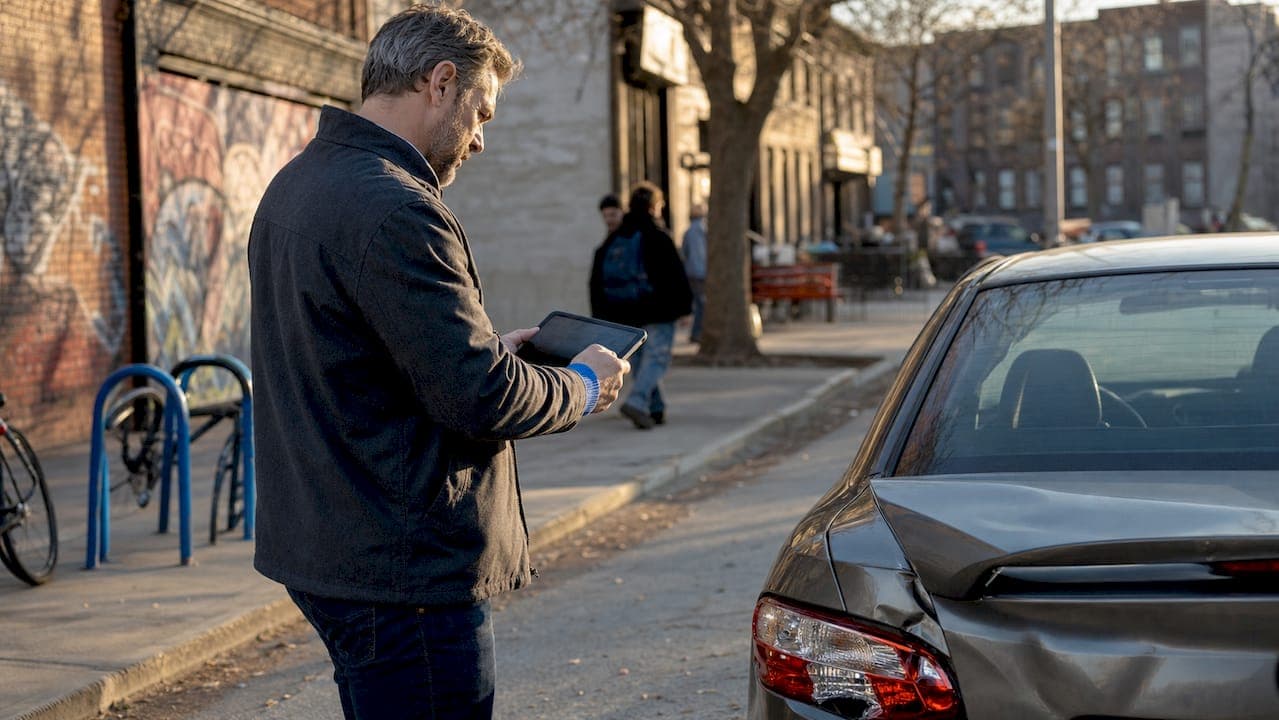
Car accident evidence best practices are defined as the systematic collection, documentation, and legal preservation of physical, digital, and medical data from a crash scene to support a liability or injury claim. The 24-72 hour window after a collision is the most critical period. Surveillance footage overwrites, skid marks fade, and witnesses scatter. What you do in the first few hours directly determines the strength of your case. This guide covers the ten steps that protect your claim from the moment the crash happens.
1. Car accident evidence best practices start at the scene
The first rule of accident scene investigation is to document everything before anything moves. Use your phone to photograph all four sides of every vehicle, the license plates, the road surface, skid marks, debris, traffic signs, and the surrounding environment. Take wide shots to establish context, then close-ups to capture damage detail.
Video is even more powerful than photos. A slow, steady walk-around video captures spatial relationships that still images miss. Record the weather, lighting, and road conditions out loud as you film. This narration becomes part of the timestamped record.
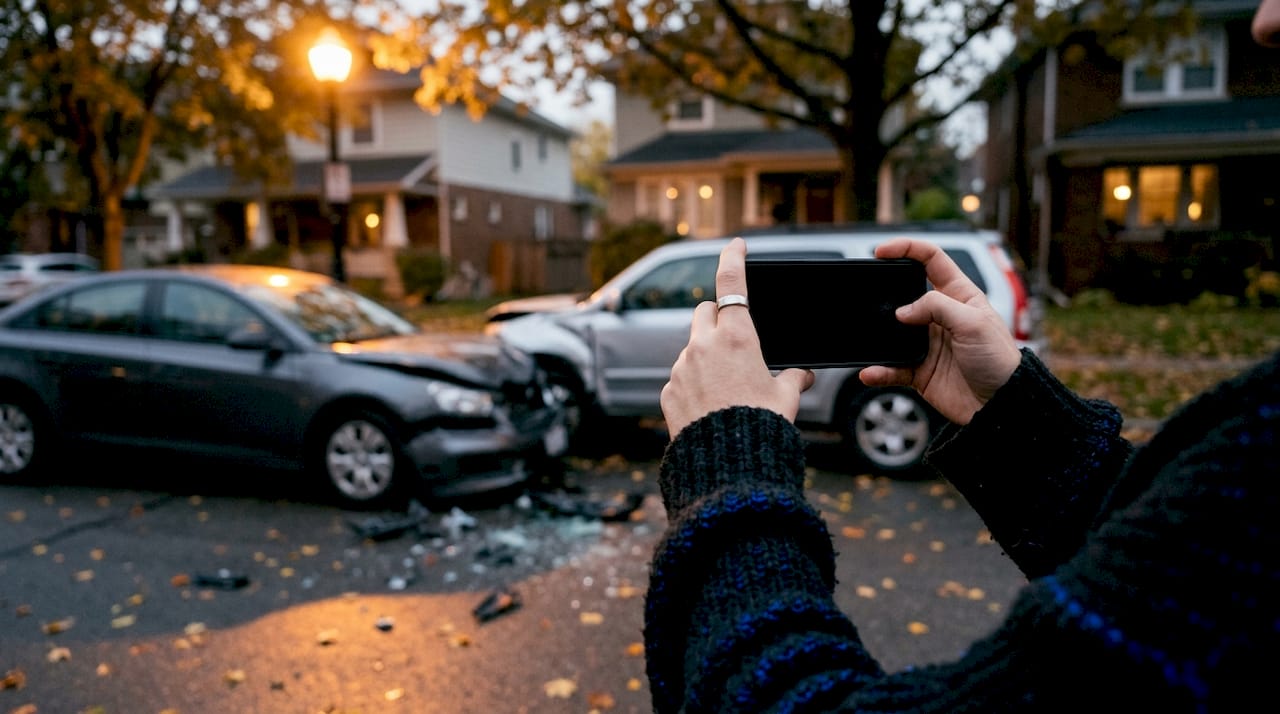
Pro Tip: Turn on your phone's location services before shooting. GPS metadata embedded in each photo creates an automatic, court-ready timestamp and location record.
2. Collect witness contact information immediately
Witnesses are the most underused asset in accident claims. Get the full name, phone number, and email address of every bystander who saw the crash. Do this before police arrive, because officers often clear the scene quickly and witnesses leave.
Ask each witness to describe what they saw in their own words while the memory is fresh. A brief voice memo recorded with their permission is far more useful than a written note taken hours later. Independent witness accounts carry significant weight precisely because they have no financial stake in the outcome.
3. Request the police report and check it for errors
Police reports contain errors more often than most people realize. Officers rely on party statements and initial observations, and they frequently omit witness details or misstate contributing factors. A report is foundational, but it is not conclusive.
Request the report as soon as it becomes available, typically within a few days of the crash. Read it carefully against your own notes. If you find inaccuracies, document the discrepancy in writing and notify your attorney. You have the right to submit a written supplement to the record in most states.
4. Preserve Event Data Recorder (EDR) data before repairs
Every modern vehicle contains an Event Data Recorder, commonly called a black box. Federal standard 49 CFR Part 563 requires EDRs to log speed, braking force, throttle position, steering input, and seat belt status at the moment of impact. This data is objective and nearly impossible to dispute.
The problem is that EDR data is lost the moment the vehicle is repaired, totaled, or driven extensively after the crash. Do not authorize any repairs until an attorney has arranged for data extraction. This single step has changed the outcome of countless liability disputes.
5. Secure dashcam and surveillance footage fast
Dashcam footage and business surveillance recordings overwrite on a loop, often within 24 to 72 hours. Once that window closes, the footage is gone permanently. Identifying nearby cameras is one of the first tasks after a crash.
Look for cameras on traffic signals, gas stations, ATMs, parking lots, and storefronts within a block of the scene. An attorney can send a formal preservation letter to the business or municipality within hours, creating a legal obligation to retain the footage. Acting the same day is not an abundance of caution. It is a necessity.
6. Seek medical attention within 24 hours
Medical attention within 24 hours of a crash is the standard that injury attorneys call the "Golden Hour" rule. Insurance adjusters treat gaps in treatment as evidence that injuries were not serious or were caused by something else. A same-day medical record eliminates that argument entirely.
Document every symptom, no matter how minor it seems. Whiplash, concussion, and soft tissue injuries often worsen over 48 to 72 hours. Consistent follow-up appointments and a personal symptom journal create the continuous medical record that links your injuries directly to the collision.
7. Write your own detailed account within hours
Memory degrades fast. Write down your account of the crash within two to three hours while the details are still sharp. Include the sequence of events, road and weather conditions, what each driver did, any statements made at the scene, and how you felt physically immediately after impact.
This personal account is not just for your attorney. It protects you from inconsistencies that opposing counsel will exploit if your story shifts over time. Keep this document private and share it only with your legal representative.
8. Avoid social media until your claim is resolved
Defense teams monitor social media after accidents to find posts that contradict injury claims. A photo of you at a family barbecue, a check-in at a hiking trail, or even a comment saying you feel fine can be used to undermine a legitimate claim for serious injuries.
The safest rule is to post nothing about your physical condition, activities, or the accident itself until your case is fully resolved. This applies to all platforms, including private accounts. Defense attorneys routinely subpoena social media records. For a deeper look at how online activity affects claims, the lawsuit mistakes guide from Carcollisionlawyer covers this in detail.
9. Send a spoliation letter to preserve digital evidence
A spoliation letter, also called a preservation letter, is a formal written notice that demands a specific party retain evidence relevant to a potential claim. Sending a spoliation letter stops routine data overwriting by placing a legal duty on the holder. It does not require a lawsuit to be filed first.
Targets for spoliation letters include the other driver's employer (if a commercial vehicle was involved), businesses with surveillance cameras, cell phone carriers holding call and data logs, and the vehicle manufacturer if a defect is suspected. An attorney can draft and send these letters within hours of being retained.
10. Organize all records in a single, secure file
A disorganized evidence file loses cases. Create one folder, physical or digital, that holds every document related to your accident. This includes the police report, all medical records and bills, repair estimates, photos and videos, witness contact information, your personal account, insurance correspondence, and any employment records showing lost wages.
Settlement outcomes are directly tied to the quality and completeness of documentation. Attorneys who receive organized files move faster, make stronger arguments, and negotiate from a position of documented fact rather than assertion.
Why the 24-72 hour window changes everything
The first three days after a crash are when the most valuable evidence either gets preserved or disappears forever. Surveillance footage loops. Skid marks get driven over. Witnesses forget details or become unreachable. Physical debris gets cleared from the road.
Cell phone records are subpoenaable for 12 to 18 months, which gives you more time on that front. But footage and physical scene evidence follow a much shorter clock. The legal principle behind this urgency is codified in statutes like California Evidence Code § 412, which allows juries to draw adverse inference conclusions when a party fails to produce available evidence. Losing evidence does not just weaken your case. It can actively make you look responsible for hiding something.
A preservation letter sent on the day of the accident creates a binding legal obligation. A preservation letter sent two weeks later, after footage has already overwritten, creates nothing but regret.
The practical steps are straightforward. Call an attorney the same day. Identify every source of digital footage within a block of the scene. Do not authorize vehicle repairs. Seek medical care before the day ends. These four actions alone prevent the most common and most damaging forms of evidence loss.
How to document physical and injury evidence thoroughly
Strong documentation goes beyond snapping a few photos. Photograph your vehicle from all four corners, the interior, the airbag deployment status, and any personal property damaged in the crash. Capture the other vehicle from the same angles. Include road markings, traffic control devices, and any environmental factors like wet pavement or sun glare.
For injury documentation, photograph every visible injury on the day of the crash and every day for the first two weeks. Bruising, swelling, and lacerations change significantly over time, and that progression tells a story. Keep every medical bill, prescription receipt, and treatment summary in your evidence file.
Financial impact documentation is equally important and often overlooked. Save pay stubs showing missed work, written statements from your employer confirming lost hours, and every out-of-pocket expense tied to the accident. These records directly support the damages calculation in your claim. Accident photos and financial records together give your attorney the full picture.
Pro Tip: Keep a daily symptom journal starting the night of the accident. Note pain levels, sleep disruption, mobility limitations, and emotional impact. This journal becomes medical evidence when your attorney presents it alongside clinical records.
What legal tools protect your evidence and your case
Attorneys play a specific, time-sensitive role in evidence preservation that goes beyond courtroom advocacy. The first task is issuing preservation letters to every relevant party before routine data destruction occurs. The second is arranging EDR extraction before the vehicle is moved to a repair facility.
When cell phone use is suspected in causing the crash, attorneys can subpoena carrier records showing call and data activity at the time of impact. Crash reconstruction specialists provide objective, expert analysis in cases where liability is disputed or the accident was severe. Their findings carry significant weight with insurance adjusters and juries alike.
Do not give a recorded statement to the other driver's insurance company before speaking with an attorney. Adjusters are trained to ask questions that produce answers useful to the insurer, not to you. Everything you say becomes part of the record. Early legal advice on why to hire an attorney after a crash is one of the most practical steps you can take.
Key takeaways
The strongest car accident claims are built in the first 24 hours through systematic documentation, immediate medical care, and prompt legal preservation of digital evidence.
| Point | Details |
|---|---|
| Act within 24-72 hours | Surveillance footage and physical evidence disappear fast; this window is non-negotiable. |
| Preserve EDR data | Do not authorize vehicle repairs until an attorney extracts black box data. |
| Send a spoliation letter | A formal preservation letter creates legal obligations before any lawsuit is filed. |
| Seek same-day medical care | A same-day medical record directly links your injuries to the crash and counters adjuster skepticism. |
| Avoid social media | Defense teams monitor public posts to contradict injury claims; stay off all platforms until the case closes. |
What I've learned from watching strong cases fall apart
After years of watching accident cases play out, the pattern that stands out most is not the complexity of the crash. It is the gap between what happened and what got documented. Claimants with clear liability on their side still lose ground because they waited three days to see a doctor, posted a photo at a birthday party two weeks later, or let the car go to the shop before anyone pulled the EDR data.
The evidence that wins cases is almost always the evidence collected in the first few hours. Dashcam footage. A witness who stayed at the scene. A same-day emergency room record. These are not lucky breaks. They are the result of knowing what to do before the accident happens.
The mistake I see most often is treating evidence collection as something that can wait until after the shock wears off. It cannot. The shock is actually useful. The adrenaline keeps you moving. Use it to document the scene, get witness names, and call an attorney before you leave the parking lot or the roadside.
One more thing: do not underestimate the police report. It is a starting point, not a verdict. Officers make mistakes, miss witnesses, and sometimes get the sequence of events wrong. Your job is to build a body of evidence that stands on its own, with or without the report supporting you.
— Gerard
Carcollisionlawyer connects you with attorneys who act fast
The evidence steps in this article require speed, and speed requires legal support from day one. Carcollisionlawyer specializes in connecting accident victims with attorneys who know how to issue preservation letters, arrange EDR extraction, and secure digital footage before it disappears.
The process starts with a free evaluation. You describe your accident and injuries, and Carcollisionlawyer matches you with a specialized attorney suited to your specific situation. There is no upfront commitment. If you were injured in a car, truck, or motorcycle accident, get your free case evaluation now and find out what compensation you may be entitled to. The clock on your evidence is already running.
FAQ
What is the most important evidence to collect after a car accident?
Timestamped photos and video of the scene, witness contact information, and EDR data from the vehicle are the highest-priority items. Medical records from same-day treatment are equally critical for injury claims.
How long does surveillance footage last after an accident?
Most surveillance systems overwrite footage within 24 to 72 hours. A formal preservation letter sent the same day as the accident creates a legal obligation for the holder to retain the recording.
Can social media posts hurt my car accident claim?
Yes. Defense attorneys monitor public and private social media accounts and routinely subpoena records. Posts showing physical activity can directly contradict injury claims, even when the activity occurred weeks after the crash.
What is a spoliation letter and when should it be sent?
A spoliation letter is a formal notice demanding that a specific party preserve evidence relevant to a potential claim. It should be sent the same day as the accident, before any routine data deletion occurs.
Do I need an attorney to preserve car accident evidence?
An attorney is not legally required, but attorneys can issue preservation letters, subpoena records, and arrange EDR extraction in ways that individuals cannot do alone. Early legal involvement prevents the most common and costly forms of evidence loss.