
Photographic evidence is the single most reliable tool for proving fault and damages after a motorcycle crash. Understanding how motorcycle accident photos help cases gives you a concrete advantage before you ever speak to an insurer or step into a courtroom. Photos provide objective, timestamped records of vehicle positions, road conditions, and injuries that no verbal account can replicate. When authenticated correctly, they carry full probative weight in court and can directly contradict false witness statements. The sections below explain exactly what to photograph, how to preserve digital authenticity, and how to use images to maximize your compensation.
How do motorcycle accident photos help cases?
Photos are the foundation of motorcycle accident evidence because they capture details that memory distorts and witnesses miss. Insurance companies and courts rely on comprehensive imagery to determine fault and calculate damages. A photo of skid marks, for example, tells an accident reconstructionist how fast a vehicle was traveling before impact. That single image can shift liability entirely.
Photos also serve as a direct check on false testimony. A witness may claim the road was dry, but a photo showing wet pavement contradicts that statement in a way no verbal rebuttal can match. Juries respond to visual evidence because it feels concrete and unambiguous. That psychological weight translates into stronger settlements and better verdicts.
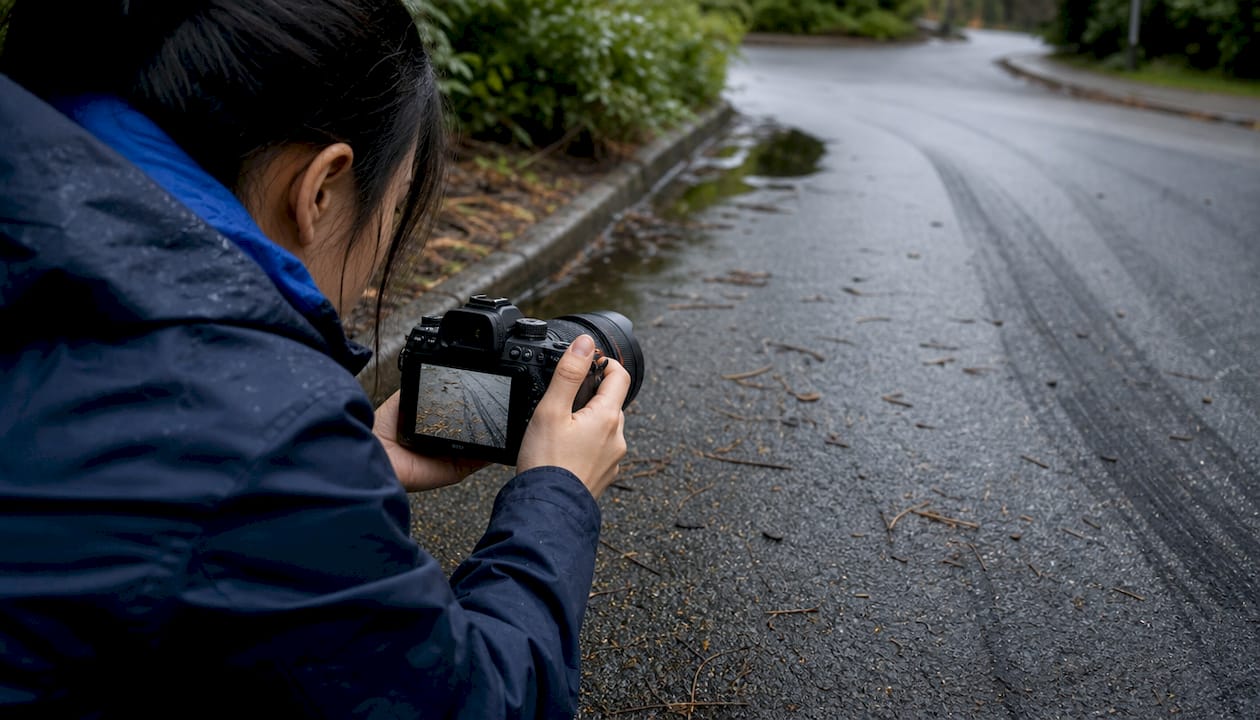
The legal term for this type of evidence is "photographic evidence," and courts treat it as a category of documentary evidence subject to specific authentication rules. Knowing those rules before you file a claim separates a strong case from a weak one.
What types of accident photos are most helpful?
The most useful photos cover three distinct layers: the scene, the vehicles, and your body.
Scene photos document the physical environment that caused or contributed to the crash:
- Vehicle positions immediately after impact, before anything is moved
- Skid marks, debris fields, and gouge marks on the pavement
- Road conditions including potholes, missing signage, or faded lane markings
- Weather and lighting conditions at the time of the crash
- Traffic signals, stop signs, and any obstructions to visibility
Vehicle photos establish the severity and point of impact:
- Wide shots showing both vehicles in relation to each other
- Close-ups of every area of damage on your motorcycle
- The other driver's license plate, insurance card, and vehicle identification number
- Any mechanical failures visible on either vehicle
Injury photos are often the most persuasive evidence for damages. Photograph every visible injury immediately at the scene, then again at 24 hours, 48 hours, and one week later. Bruising and soft tissue injuries often appear worse in the days following a crash. That progression documents the true severity of your harm and directly supports injury compensation claims.
Pro Tip: Take both wide-angle and close-up shots of every subject. Wide shots establish context and location; close-ups capture specific damage details that matter in court.
How does photo metadata authenticate accident photos in court?
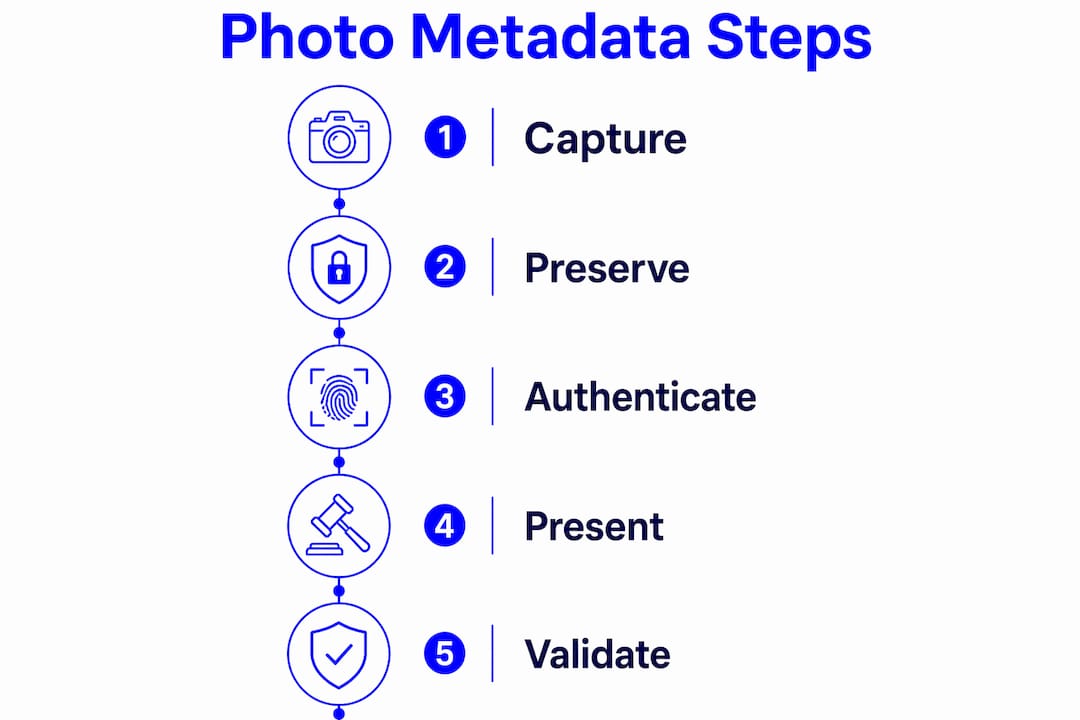
Every digital photo contains EXIF data, a layer of embedded information recorded automatically by your phone or camera at the moment of capture. Courts increasingly require original photo metadata to authenticate accident photos, particularly as AI-generated imagery raises new concerns about fabricated evidence. EXIF data includes the timestamp, GPS coordinates, device make and model, and camera settings. That combination creates an objective digital fingerprint that ties a photo to a specific time and place.
Insurance adjusters use metadata as a fraud detection tool. Inaccurate or manipulated timestamps can undermine an entire claim, even when the underlying facts are accurate. A photo taken three hours after the crash but presented as an immediate scene photo loses credibility the moment an adjuster runs a metadata check.
The table below shows what EXIF data captures and why each field matters legally.
| EXIF Field | What It Records | Legal Relevance |
|---|---|---|
| Timestamp | Date and exact time of capture | Confirms photo was taken at the scene |
| GPS coordinates | Latitude and longitude | Verifies the photo location matches the crash site |
| Device information | Phone or camera make and model | Links the photo to a specific device |
| Camera settings | Aperture, shutter speed, ISO | Supports authenticity against editing claims |
The most common way metadata gets destroyed is through social media and messaging apps. Sharing photos via WhatsApp or Messenger strips EXIF data entirely. The image looks identical, but the digital fingerprint is gone. Transfer photos using direct file sharing, AirDrop, or cloud storage services that preserve original file data.
Pro Tip: Back up your original photo files to a cloud service immediately after the crash. Do not share them through any messaging app until your attorney has reviewed and preserved the originals.
What legal requirements make accident photos admissible in court?
Admissibility is not automatic. A photo must clear several procedural hurdles before a judge allows it into evidence.
-
Lay a foundation. Under Federal Rule of Evidence 901(b)(1), an authentication witness familiar with the scene must testify that the photo accurately represents what they observed. Without this step, a photo risks exclusion regardless of its content. This witness can be you, a bystander, or a first responder.
-
Distinguish illustrative aids from admitted exhibits. A photo used to help a witness explain their testimony is an illustrative aid. A photo formally admitted as an exhibit becomes part of the court record and carries greater evidentiary weight. Your attorney decides which designation serves your case better.
-
Pursue certified forensic acquisition. For high-stakes cases, certified forensic acquisition with a cryptographic hash value and timestamp creates a tamper-proof record. A cryptographic hash is a unique digital code generated from the photo file. Any alteration to the file changes the hash, making tampering immediately detectable. Certified evidence carries full probative effect and can only be challenged through a formal legal process.
-
Anticipate AI-related challenges. The rise of AI-generated imagery means courts and opposing counsel now scrutinize digital photos more aggressively. Providing metadata-backed or forensically certified photos preempts those challenges before they arise.
-
Work with your attorney on timing. Photos introduced too late in litigation may face procedural objections. Your attorney needs access to your full photo library early in the case to build the evidentiary record correctly. Attorneys who understand how motorcycle accident lawyers win cases treat photo authentication as a first-week priority, not an afterthought.
Common mistakes that weaken your photo evidence
Most evidentiary problems with accident photos are avoidable. The errors below consistently damage claims.
- Sharing photos on social media before consulting an attorney. Posting accident photos publicly gives opposing counsel access to images they can use to challenge your account of events. An insurer may argue that your behavior in a photo contradicts your claimed injury severity.
- Sending photos through messaging apps. This strips EXIF metadata and eliminates the digital fingerprint courts rely on for authentication.
- Delaying injury documentation. Injuries photographed days after a crash may look less severe than they actually were at the time of impact. Photograph injuries at the scene, then document the progression daily for the first week.
- Relying on photos alone. Photos are indispensable but not standalone proof. Successful cases combine photographic evidence with witness testimony, medical records, and police reports. A photo without corroboration is easier to challenge.
- Failing to photograph the full scene. Riders often focus on their motorcycle and forget road conditions, signage, and the other vehicle's position. Those environmental details frequently determine fault.
How to use accident photos to maximize your compensation
Organized, well-preserved photos give your attorney the tools to build a stronger argument and negotiate from a position of strength.
-
Organize photos chronologically. Sort your images by timestamp from the moment of the crash forward. This creates a clear narrative of events that an attorney, adjuster, or jury can follow without confusion.
-
Keep originals separate from copies. Store original files in a dedicated folder that you never edit or share. Make copies for sharing with your attorney and insurer. This preserves the metadata chain of custody.
-
Share strategically with your attorney first. Your attorney reviews photos before they go to an insurer. This prevents you from inadvertently providing images that complicate your claim. Attorneys who understand motorcycle accident compensation know exactly which photos to present and when.
-
Use injury photos to document the full impact. A single photo of a wound taken at the scene is useful. A series of photos showing the wound's progression over two weeks is far more persuasive for pain and suffering damages.
-
Let your attorney present photos to insurers. Adjusters are trained to minimize payouts. When an attorney presents organized, metadata-intact photos with a clear liability narrative, the negotiating dynamic shifts. The insurer knows the evidence will hold up in court.
Key takeaways
Photographic evidence wins motorcycle accident cases when it is taken immediately, preserved with metadata intact, authenticated through witness testimony, and presented by an attorney who understands the evidentiary rules.
| Point | Details |
|---|---|
| Photograph everything at the scene | Capture vehicle positions, road conditions, injuries, and signage before anything is moved. |
| Preserve EXIF metadata | Transfer original files via cloud storage or direct transfer, never through messaging apps. |
| Authenticate photos properly | A witness familiar with the scene must testify under FRE 901(b)(1) to lay the evidentiary foundation. |
| Avoid social media posting | Public posts give opposing counsel access to images that can be used against your claim. |
| Combine photos with other evidence | Photos work best alongside witness statements, medical records, and police reports. |
What I've learned about photos and motorcycle accident cases
After years of watching motorcycle accident claims succeed and fail, one pattern stands out. Riders who photograph everything at the scene, including details that seem irrelevant in the moment, consistently build stronger cases. The skid mark that looks unimportant turns out to be the key piece of evidence that proves the other driver ran a red light.
The metadata issue is where I see the most preventable damage. Riders take excellent photos, then text them to a family member through a messaging app, and the digital fingerprint disappears. Courts in 2026 are more skeptical of digital evidence than ever before, precisely because AI-generated images are now convincing enough to fool the untrained eye. That skepticism works against claimants who cannot prove their photos are authentic originals.
My honest recommendation is this: treat your phone's photo library as a legal document from the moment of the crash. Do not edit, filter, or share those images until your attorney has reviewed them. The few minutes you spend photographing the scene thoroughly, and the discipline you show in preserving those files, can be worth tens of thousands of dollars in your final settlement. Photographic evidence is not a backup to your case. It is the case.
— Gerard
When professional legal support makes the difference
Knowing what to photograph is only part of the equation. Knowing how to authenticate, organize, and present that evidence in a way that maximizes your payout requires legal expertise.

Carcollisionlawyer connects motorcycle accident victims with attorneys who specialize in photographic evidence and accident injury claims. These attorneys know how to preserve metadata, lay the evidentiary foundation courts require, and use your photos to build a liability narrative that insurers take seriously. The free evaluation process at Carcollisionlawyer means you can understand your compensation options without any upfront commitment. Early legal consultation prevents the common photo evidence mistakes that cost riders money. Get your case assessed by a specialist before you share a single image with an insurer.
FAQ
What photos should I take immediately after a motorcycle accident?
Photograph vehicle positions, skid marks, road conditions, debris, and all visible injuries before anything at the scene is moved. Wide-angle and close-up shots of every subject give your attorney the most complete evidentiary record.
Does photo metadata really matter in court?
Yes. Courts increasingly require original EXIF metadata to confirm when and where accident photos were taken, particularly as AI-generated imagery raises authenticity concerns. Metadata that has been stripped or altered can cause photos to be excluded from evidence.
Can I post accident photos on social media?
Posting accident photos publicly before consulting an attorney is a serious mistake. Opposing counsel and insurance adjusters can access those images and use them to challenge your injury claims or contradict your account of events.
What is "laying a foundation" for photo evidence?
Laying a foundation means having a witness testify under Federal Rule of Evidence 901(b)(1) that a photo accurately represents what they observed at the scene. Without this step, a court may exclude the photo from evidence entirely.
Do I need an attorney to use photos in my motorcycle accident claim?
An attorney is not legally required, but attorneys who handle motorcycle accident cases know how to authenticate photos, present them strategically to insurers, and use them to support the full value of your claim, including pain and suffering damages.