
Motorcycle accident lawyers win cases by building a trial-ready evidentiary record that proves fault, establishes damages, and neutralizes bias against riders. The formal term for this process is personal injury litigation, and it follows a disciplined sequence: preserve evidence, retain experts, document losses, and negotiate from strength. Understanding how motorcycle accident lawyers win cases gives you a clear picture of what your attorney should be doing from day one. The difference between a fair settlement and a denied claim almost always comes down to preparation, not luck.
How do motorcycle accident lawyers win cases through evidence gathering?
Lawyers quickly assemble evidence such as police reports, medical records, scene photos, and crash accounts to prove what happened, who is at fault, and how injuries caused losses. This evidence-gathering phase is the foundation of every winning motorcycle accident claim. Without it, even a clear-cut crash becomes a credibility contest.

Police reports are the starting point, but they are rarely enough on their own. Officers document surface facts: location, time, visible damage, and initial statements. They do not analyze physics, measure skid marks precisely, or interview every witness. A skilled attorney treats the police report as a lead, not a conclusion.
Medical records carry equal weight. They connect your injuries directly to the crash date, document treatment history, and establish the severity of harm. Scene photos and videos, especially from traffic cameras, dashcams, or nearby businesses, capture road conditions, vehicle positions, and visibility at the moment of impact.
Evidence preservation is time-sensitive; attorneys send legal preservation notices to lock in data before it disappears. These are formal written demands sent to businesses, insurers, and government agencies requiring them to retain footage, maintenance logs, and electronic records. Once that window closes, critical proof can vanish permanently.
- Police reports, crash scene photos, and dashcam footage establish the physical facts of the collision.
- Medical records from emergency rooms, specialists, and physical therapists document injury severity and treatment costs.
- Witness statements and the victim's personal account build a coherent narrative that humanizes the claim.
- Spoliation preservation notices protect electronic data, surveillance footage, and vehicle event recorder data from deletion.
Pro Tip: Write a detailed personal account of the crash within 48 hours while memory is fresh. Your attorney will use it to identify gaps in the police report and prepare deposition questions.
How do expert analyses and accident reconstruction support winning motorcycle accident cases?
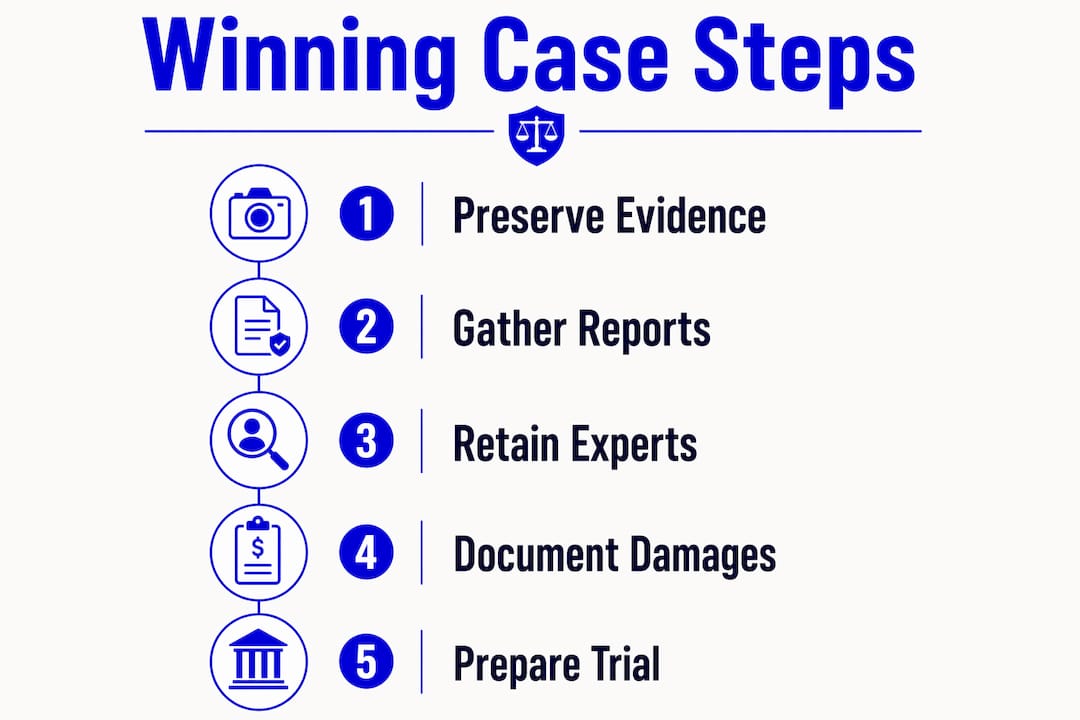
Accident reconstruction specialists analyze vehicle damage patterns, road and weather conditions, skid marks, and electronic data to strengthen liability arguments beyond police reports. This technical layer is what separates a strong case from a weak one. Defense attorneys routinely challenge police conclusions, and reconstruction experts provide the scientific counterargument.
A reconstruction expert can calculate the speed of both vehicles at impact, determine which driver had the right of way, and identify whether a road defect contributed to the crash. That analysis directly counters the most common defense tactic: blaming the rider.
"A multi-expert damages package is more persuasive than a simple medical bill list." This principle applies equally to liability. One expert proves fault. Another proves injury. A third proves financial loss. Together, they build a case that is difficult to dismiss.
Expert witnesses in medical causation, biomechanics, vocational rehab, and economics establish injury linkage and quantify future losses like life-care costs. A medical causation expert testifies that your spinal injury resulted directly from the crash, not a prior condition. A vocational rehabilitation expert calculates how that injury limits your earning capacity for the next 20 years.
- Accident reconstruction experts counter defense narratives about speed, lane position, and sight lines.
- Medical causation experts link specific injuries to the crash, defeating pre-existing condition arguments.
- Biomechanics experts explain how the body responds to specific impact forces, supporting injury severity claims.
- Vocational and economic experts quantify lost earning capacity and future care costs with documented precision.
Pro Tip: Ask your attorney which experts they plan to retain before signing a representation agreement. A lawyer with an established expert network is better positioned to build a persuasive case quickly.
What strategies do lawyers use to document and present damages effectively?
Damages are documented in economic and noneconomic categories; lawyers use formulas or jury verdict comparisons to quantify noneconomic damages. Economic damages are straightforward: medical bills, lost wages, future care costs, and property damage. Noneconomic damages, including pain and suffering, emotional distress, and loss of enjoyment of life, require a different approach.
Attorneys use two primary methods to calculate noneconomic damages. The multiplier method multiplies total economic damages by a factor, typically between 1.5 and 5, based on injury severity. The per diem method assigns a daily dollar value to pain and suffering and multiplies it by the number of days affected. Both methods are supported by comparable jury verdicts from similar cases in the same jurisdiction.
The presentation of damages matters as much as the calculation. Insurers and juries respond to organized, well-documented packages. A disorganized stack of medical bills signals a weak case. A structured presentation with a life-care plan, expert-supported future cost projections, and a clear causation timeline signals a serious one.
| Damage Category | Documentation Method | Key Evidence |
|---|---|---|
| Past medical expenses | Itemized billing records | Hospital bills, pharmacy receipts, therapy invoices |
| Future medical costs | Life-care plan by expert | Physician projections, rehabilitation estimates |
| Lost wages | Pay stubs and employer letters | Tax returns, HR records, time-off documentation |
| Lost earning capacity | Vocational expert report | Career trajectory analysis, labor market data |
| Pain and suffering | Multiplier or per diem formula | Journal entries, psychological evaluations, testimony |
- Gather all medical bills, pharmacy receipts, and therapy invoices from the date of the crash forward.
- Obtain a life-care plan from a certified life-care planner to project future medical and rehabilitation costs.
- Document lost wages with pay stubs, employer letters, and tax returns covering the period of disability.
- Commission a vocational expert report if the injury affects your ability to work in your current or future career.
- Maintain a daily pain journal to support noneconomic damage calculations with concrete, dated entries.
How do negotiation tactics and trial readiness improve settlement outcomes?
Settlement leverage comes from building a trial-ready, evidence-rich case early, shifting insurer negotiation dynamics. Insurers settle cases they expect to lose at trial. When your attorney presents a fully documented claim with expert reports, a life-care plan, and a reconstruction analysis, the insurer's risk calculation changes immediately.
The strongest drivers of settlement value are seriousness of injuries, insurance coverage limits, and clarity of fault. Settlement value is often lower than trial value. That gap is the reason trial readiness matters. An insurer that believes your attorney will actually go to trial will offer more than one that expects a quick, discounted resolution.
Layering insurance coverages such as bodily injury limits, underinsured motorist, MedPay, and health insurance can maximize compensation recovered. Most riders do not realize that multiple policies can apply to a single crash. A thorough attorney identifies every available coverage layer and pursues each one systematically.
Rider bias is a real obstacle. Jurors and adjusters sometimes assume motorcyclists were speeding or riding recklessly. Trial readiness combats bias against riders by preparing evidence that disproves negative stereotypes and anticipates defense claims. Attorneys address lane positioning, helmet use, and speed disputes before the defense raises them, removing the sting from those arguments.
- Policy-limit demands are sent when injuries clearly exceed coverage, triggering bad faith exposure for insurers who delay.
- Comparative fault arguments are countered with reconstruction data and witness testimony before negotiations begin.
- Summary judgment motions argue that the opposing side lacks sufficient evidence, affecting strategic case posture during litigation.
- Large verdicts, such as a $44.7 million award in Washington, demonstrate the scale of compensation possible with persuasive fault and injury proof at trial.
Pro Tip: Never accept a first settlement offer without a full damages calculation in hand. Insurers open with low figures. A trial-ready case gives your attorney the leverage to push back with documented justification.
Key Takeaways
Winning motorcycle accident claims requires a disciplined sequence: preserve evidence immediately, retain technical experts, document every damage category, and build a trial-ready case that forces insurers to negotiate seriously.
| Point | Details |
|---|---|
| Evidence preservation is urgent | Send spoliation notices within days of the crash to lock in footage and electronic data. |
| Expert witnesses drive case value | Reconstruction, medical, and economic experts build a package that is harder to dispute than bills alone. |
| Damages need structured documentation | Use life-care plans, vocational reports, and jury verdict comparisons to quantify every loss category. |
| Trial readiness increases settlements | Insurers offer more when they believe the attorney will actually take the case to a jury. |
| Rider bias must be addressed early | Proactively counter speed, lane position, and helmet arguments before the defense raises them. |
What I've learned watching motorcycle cases win and lose
The cases I have seen fall apart almost always share one trait: the rider waited too long to get an attorney. Surveillance footage gets deleted after 30 days. Witnesses forget details. Vehicle damage gets repaired. The physical evidence that makes a case winnable disappears quietly while the injured rider is still focused on recovery.
The second pattern I notice is underestimating rider bias. Adjusters and jurors carry assumptions about motorcyclists. The attorneys who win consistently do not ignore that bias. They address it head-on, with evidence, before it becomes a narrative the defense controls.
Contingency fee arrangements typically charge between 33% and 40% of recovery, increasing with case complexity and trial work. That structure matters because it aligns your attorney's financial interest with yours. They only get paid when you do. That is a powerful motivator for thorough preparation.
The riders who get the best outcomes are the ones who stay engaged. They keep their pain journal. They attend every medical appointment. They respond to their attorney's requests quickly. A lawyer builds the legal case. You supply the human evidence that makes it real to a jury.
— Gerard
Carcollisionlawyer connects you with attorneys who build winning cases
Recovering from a motorcycle accident is hard enough without worrying about legal fees. Carcollisionlawyer offers a free evaluation that connects you with trusted attorneys who work on contingency, meaning you pay nothing unless your case is won.
The attorneys in the Carcollisionlawyer network gather evidence fast, retain the right experts, and build fully documented injury claims designed to maximize your compensation. Whether your case resolves in settlement negotiations or goes to trial, you get representation built for both outcomes. Start your free evaluation at Carcollisionlawyer and find out what your claim may be worth.
FAQ
What is the first thing a motorcycle accident lawyer does?
A motorcycle accident lawyer's first step is preserving evidence. Attorneys send formal spoliation notices to retain surveillance footage, vehicle data, and records before they are deleted or lost.
How long does a motorcycle accident case take to settle?
Most motorcycle accident cases settle within several months to two years, depending on injury severity, insurance coverage disputes, and whether litigation is required. Cases with clear fault and documented injuries typically resolve faster.
What percentage do motorcycle accident lawyers take from a settlement?
Contingency fees typically range from 33% to 40% of the total recovery, with higher percentages applying when a case goes to trial due to increased attorney work and risk.
How do lawyers counter rider bias in motorcycle accident cases?
Attorneys address rider bias by presenting reconstruction data, witness testimony, and speed analysis that disprove assumptions about reckless riding before the defense raises those arguments in negotiations or at trial.
Can a motorcycle accident case go to trial?
Yes. When insurers refuse to offer fair compensation, attorneys file a lawsuit, conduct discovery, and take the case to a jury. Large verdicts, including a $44.7 million award in Washington, show that trials can produce significantly higher compensation than settlements.