
Most car accident settlements in the United States land somewhere between $20,000 and $30,000, though the number that matters is your own injury tier, not the national average. Insurer-paid data puts bodily-injury payouts in the mid-$20,000s to high-$20,000s, while property-damage-only claims average well under $10,000. Where your case falls depends almost entirely on injury severity and the at-fault driver's policy limits.
TL;DR:
- settlement amounts vary significantly based on injury severity, fault allocation, insurance policy limits, and documentation quality, with serious injuries often reaching six figures.
- claims involving soft tissue injuries settle in the low five figures, while fractures requiring surgery often settle in the mid to low six figures; wrongful death settlements tend to be the largest.
- settlement timing ranges from a few weeks for property-only claims to over a year for complex injury cases or disputed liability.
- hiring a lawyer is advisable if injuries require surgery, damages exceed policy limits, or liability is contested, as attorneys recover higher settlements on average.
Table of Contents
- What Is the Average Car Accident Settlement Amount?
- What Factors Affect a Car Accident Settlement Amount?
- How Are Car Accident Settlements Calculated?
- Car Accident Settlement Amounts by Injury Type
- How Long Does It Take to Settle a Car Accident Claim?
- Do You Need a Lawyer for a Car Accident Settlement?
- Do You Have to Pay Taxes on a Car Accident Settlement?
- How Insurance Adjusters Negotiate Settlements
- How Location Affects Your Settlement Amount
- Why the "Average Settlement" Question Misses the Point
- Get a Free Case Evaluation for Your Accident Claim
- Sources
What Is the Average Car Accident Settlement Amount?
Ask five sources for the "average" car accident settlement and you'll get five different numbers, and that's not a flaw in the data. It's a reflection of who got asked and how the claim was measured.
Insurer-paid-claim figures from the Insurance Information Institute show average bodily-injury liability payouts of roughly $26,501, with property-damage claims averaging around $6,551, based on 2022 data. More recent compiled paid-claim figures put bodily-injury averages in the high twenty-thousands and property-damage averages in the mid six-thousands, reflecting rising medical costs and repair expenses.
Claimant surveys tell a slightly different story. A widely cited Martindale-Nolo reader survey put the typical overall payout near $23,900, with injury-only averages closer to $29,700. The gap between insurer-paid data and claimant-survey data isn't a contradiction. Insurer datasets capture every claim they pay out, while surveys skew toward people who remember and report their settlements, often those with more severe injuries.
Here's how the major figures stack up:
| Data Source | Claim Type | Average Amount |
|---|---|---|
| III (insurer-paid, 2022) | Bodily injury | ~$26,501 |
| III (insurer-paid, 2022) | Property damage only | ~$6,551 |
| Compiled paid-claim data | Bodily injury | high twenty-thousands |
| Compiled paid-claim data | Property damage only | mid six-thousands |
| Martindale-Nolo survey | Overall settlement | ~$23,900 |
| Martindale-Nolo survey | Injury-only claims | ~$29,700 |
Median figures often run higher than these means suggest for injury claims, since a small number of catastrophic cases can pull an average number in either direction depending on the sample. That's why a single "average" tells you less than the injury-tier breakdowns further down this page.
What Factors Affect a Car Accident Settlement Amount?
Two people in nearly identical crashes can walk away with wildly different settlement checks. The gap almost always traces back to a handful of variables that insurance adjusters weigh, whether the claimant realizes it or not.
- Liability and fault allocation. If you're found even partially responsible, your state's comparative or contributory negligence rules can reduce or eliminate your recovery.
- Available insurance limits. A driver with a $25,000 policy can't pay out $80,000 in damages no matter how strong your case is, unless you pursue their personal assets or your own underinsured motorist coverage.
- Medical costs and future care. Documented bills, surgical records, and projected future treatment costs carry more weight than pain descriptions alone.
- Lost wages and earning capacity. Pay stubs, employer letters, and vocational assessments turn a vague claim into a calculable one.
- Pain and suffering. Adjusters and attorneys estimate this using formulas tied to your economic damages, covered in detail in the next section.
- Documentation quality. Photos, a police report, and consistent medical visits materially change how an adjuster values a file. Reviewing evidence best practices before you talk to an insurer can prevent early undervaluation.
- State-law modifiers. No-fault states cap certain claims through PIP coverage, while comparative negligence rules vary sharply from one state to the next.
Pro Tip: Keep a simple folder, physical or digital, with every medical bill, wage-loss document, and photo from day one. Adjusters value organized claims higher because gaps in documentation give them room to argue your damages are unproven.
A deeper breakdown of how these variables interact lives in this settlement factors guide.
How Are Car Accident Settlements Calculated?
Every settlement is built from two buckets: economic damages and non-economic damages. Economic damages are the numbers you can put a receipt behind, medical bills, future care costs, lost wages, and property repair. Non-economic damages cover pain and suffering, and they're harder to pin down because there's no invoice for a bad shoulder that aches every winter.
Adjusters and attorneys often estimate pain and suffering using a multiplier method, applying a factor of roughly 1.5 to 5 against your total economic damages depending on injury severity, or a per-diem method, assigning a daily dollar value for every day you're symptomatic. Neither method is a fixed formula insurers must follow, but both give negotiators a starting point.
Policy limits cap what an insurer will pay regardless of how the math works out. If your damages exceed the at-fault driver's coverage, you may need to tap your own underinsured motorist policy, or in rare cases, pursue the at-fault driver's personal assets through a lawsuit.
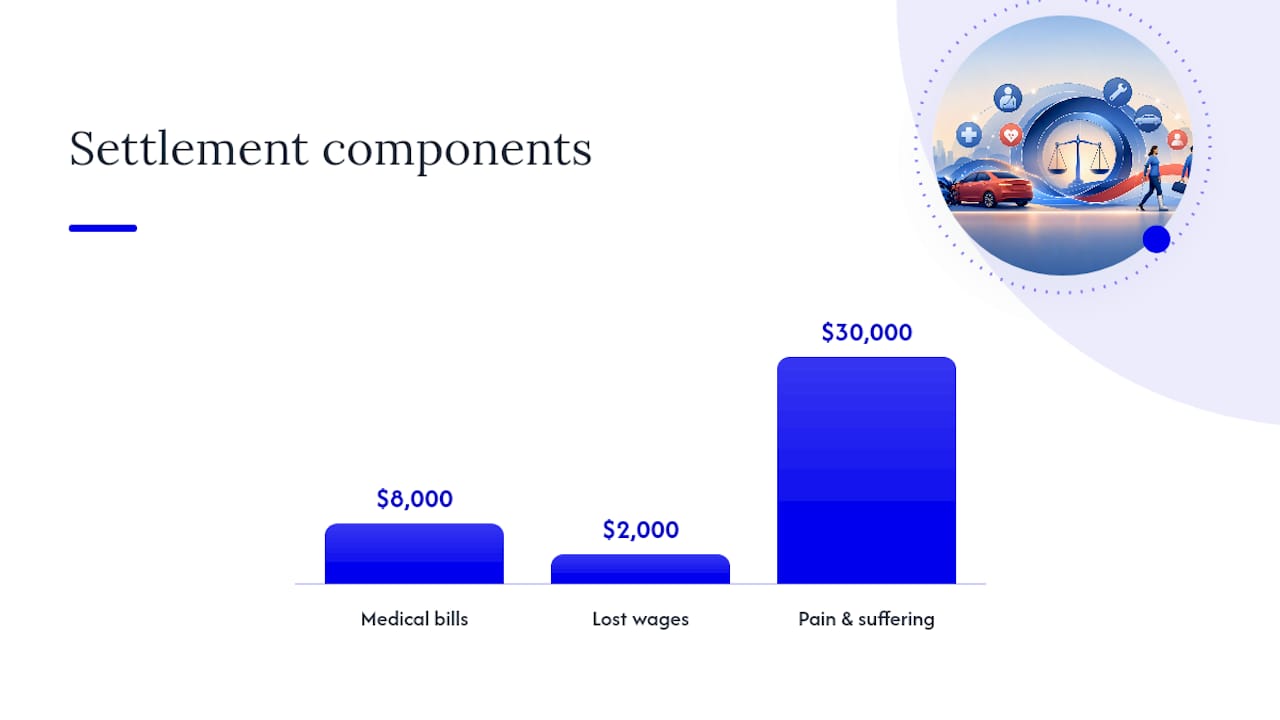
Here's a simplified example of how a settlement figure gets assembled:
- Medical bills total $8,000, and lost wages add $2,000, for $10,000 in economic damages.
- A multiplier of 3 is applied for a moderate soft-tissue injury with lingering symptoms.
- Pain and suffering is estimated at $30,000 ($10,000 x 3).
- The initial demand totals $40,000, then gets negotiated down or up based on liability disputes and policy limits.
More detailed math and worked examples are available through this injury compensation breakdown from a personal injury law firm.
Because medical costs are the single biggest driver of economic damages, the size of your treatment file often predicts the size of your settlement more reliably than any other factor.
Car Accident Settlement Amounts by Injury Type
Averages flatten out the real story, which is that your settlement range depends heavily on which injury category you fall into. These archetypes, drawn from tiered settlement data, give you a more useful benchmark than a single national figure.
- Vehicle damage only, no injury. Payouts typically track close to the repair cost or the vehicle's actual cash value if it's totaled, generally landing near the property-damage average of $6,500 to $6,800.
- Soft-tissue injuries and whiplash. These claims commonly resolve in the low five figures. Treatment duration matters enormously here. A whiplash claim that wraps up in six weeks settles for less than one requiring three months of physical therapy.
- Fractures requiring surgery. These cases often move into the mid five figures to low six figures, depending on whether the fracture leaves permanent limitations or requires hardware like plates and screws.
- Disabling or spinal cord injuries. Settlements here frequently reach six figures, though they're often constrained by the at-fault driver's policy limits, which pushes some victims toward structured settlements or underinsured motorist claims.
- Wrongful death. These typically produce the largest settlements of any category, often built from policy limits plus additional recovery through umbrella policies or multiple liable parties, though the variance between cases is enormous.
Real client-facing recovery examples across these tiers are broken down further in actual damages recovered case examples.
How Long Does It Take to Settle a Car Accident Claim?
Timing depends almost entirely on injury severity and how contested liability is. A property-damage-only claim with clear fault can wrap up in a few weeks. A soft-tissue injury claim usually takes a few months, since most attorneys wait until you finish treatment before demanding a settlement. Serious injury cases or ones with disputed liability can run 6 to 18 months or longer, especially if the case heads toward litigation.
Several things slow insurers down during investigation:
- Verifying medical records and cross-checking treatment against the reported accident
- Subrogation reviews, where the insurer checks whether another party (like a health insurer) has a lien on the settlement
- Liability disputes, particularly in states with comparative negligence rules
You can speed things up on your end by getting prompt, consistent medical care and keeping bills and wage-loss records organized from day one, points covered in more depth in this claim timeline guide. Most claims never reach a courtroom, since the overwhelming majority resolve through settlement rather than trial.
Do You Need a Lawyer for a Car Accident Settlement?
Represented claimants tend to recover meaningfully more than those who negotiate alone, particularly when a case involves surgery, disputed liability, or significant future care needs. That gap tends to widen as claims get more complicated.
Consider legal representation if any of these apply:
- You needed surgery or expect ongoing medical treatment
- The insurer disputes who caused the crash
- Your damages may exceed the at-fault driver's policy limits
- The case involves a wrongful death
A free evaluation typically asks for your accident date, a brief injury summary, and any medical bills or police report you have on hand, and the American Bar Association advises against accepting an early offer before you understand the full scope of your damages. More on when representation makes sense is available in this guide on hiring a lawyer.
Do You Have to Pay Taxes on a Car Accident Settlement?
Compensation for physical injuries is generally not taxable at the federal level. The IRS excludes settlement money paid for physical injury or physical sickness from gross income, which covers most of what a car accident settlement pays for: medical bills, pain and suffering tied to a physical injury, and lost wages that stem directly from that injury.
There are exceptions worth knowing. If part of your settlement compensates for emotional distress unrelated to a physical injury, that portion can be taxable. Punitive damages, which are rare in car accident cases but occasionally awarded for particularly reckless conduct, are almost always taxable regardless of the underlying injury. And if you deducted medical expenses on a prior tax return related to the accident, recovering those same costs through a settlement can trigger a tax obligation on that specific amount, since you can't claim the deduction and the compensation both.
Property-damage reimbursements for your vehicle typically aren't taxable either, since they're reimbursing a loss rather than generating income. The practical takeaway: most accident victims won't owe federal tax on their settlement, but the structure of your settlement agreement matters. How a settlement allocates money between physical injury, emotional distress, and punitive damages can change your tax picture, which is one more reason a detailed, well-documented settlement agreement is worth getting right the first time rather than accepting a vague lump-sum offer.
How Insurance Adjusters Negotiate Settlements
Insurance adjusters aren't neutral evaluators. Their job is to close claims for the lowest amount that avoids litigation, and they're trained in a handful of predictable tactics.
The most common opening move is a lowball initial offer, often issued quickly, before you've finished treatment or fully documented your losses. Adjusters know that accepting an early offer closes the file cheaply, and many claimants accept out of financial pressure or simple unfamiliarity with claim values. Another tactic involves disputing causation, arguing that your injury predates the crash or resulted from something else, which shifts the burden onto you to prove otherwise with medical documentation.
Adjusters also lean on recorded statements, asking seemingly casual questions early in a claim that can later be used to minimize liability or injury severity. And they routinely apply internal software formulas that weigh your medical codes and treatment gaps against a database of similar claims, which is why consistent, uninterrupted treat0ment tends to produce a stronger settlement number than sporadic visits.
Negotiation from your side works best when you counter with organized documentation rather than emotional appeals. A demand letter that itemizes economic damages, cites comparable settlement ranges, and anticipates the adjuster's likely objections tends to move the number faster than back-and-forth phone calls.
How Location Affects Your Settlement Amount
Where your accident happened can shift your settlement value as much as the injury itself. State law sets the rules of the game, and the rules vary enormously.
Comparative and contributory negligence rules are the biggest lever. Most states use some form of comparative negligence, reducing your recovery by your percentage of fault. A handful of states still use pure contributory negligence, where being just 1% at fault can bar recovery entirely. Knowing which rule applies in your state changes how aggressively an adjuster will fight over liability.
No-fault states add another layer. In these states, your own Personal Injury Protection (PIP) coverage pays your initial medical bills regardless of fault, but PIP caps limit how much is available before you can step outside the no-fault system and pursue the at-fault driver directly, which usually requires meeting a injury severity threshold set by state law.
Jury verdict trends and cost of living also play a role. Urban jurisdictions with higher costs of living and historically larger jury verdicts tend to produce higher settlement offers, since insurers factor in what a local jury might award if the case went to trial. Rural jurisdictions with more conservative verdict histories tend to see more modest settlement offers for comparable injuries. This is one more reason two people with nearly identical injuries in different states can walk away with very different checks, and one more reason state-specific deadlines matter, covered in this statute of limitations breakdown.
Why the "Average Settlement" Question Misses the Point
Most people asking about average car accident settlements are really asking one thing: "Am I being lowballed?" And the honest answer is that a national average can't tell you that. Your case isn't a statistic, it's a specific set of medical records, wage documents, and liability facts that either support a number or don't.
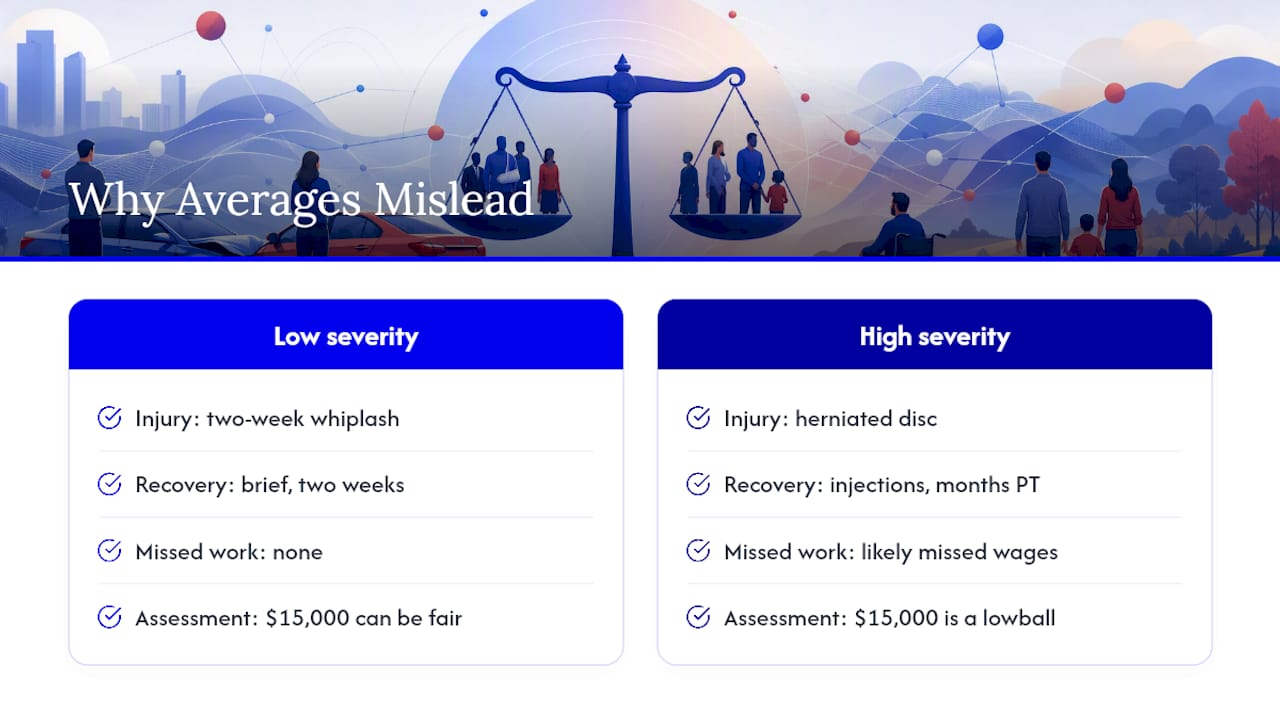
What frustrates me about how this topic usually gets covered is the implication that if your offer is below the average, something's wrong, or if it's above average, you should just take it. Neither is true. A $15,000 settlement for a two-week whiplash recovery with no missed work might be perfectly fair. A $15,000 offer for a herniated disc requiring injections and months of physical therapy is a lowball, regardless of what any national average says.
The bigger pattern worth understanding is this: insurers count on claimants not knowing their own leverage. Comparative negligence rules, PIP caps, policy limits, and multiplier methods all sound technical, but they're the actual mechanics behind every offer you'll receive. Once you understand which of those mechanics apply to your case, you stop negotiating from a position of hoping the number is fair and start negotiating from a position of knowing what it should be.
Carcollisionlawyer connects accident victims to attorneys precisely because that gap between "hoping" and "knowing" is where most underpaid claims come from, not from a lack of case merit, but from a lack of leverage at the negotiating table.
— Gerard
Get a Free Case Evaluation for Your Accident Claim
Carcollisionlawyer's free case evaluation gives you a straight answer about whether your accident claim is worth pursuing, with no obligation and no upfront cost. The intake process is built around your specific situation, whether that's a car crash, motorcycle wreck, or truck accident, and it connects you with attorneys who handle cases like yours instead of a generic referral list.
Before you start, have three things ready: the date of your accident, a brief summary of your injuries, and any medical bills or a copy of the police report if you have them. That's enough to get a meaningful read on your case's value and whether legal representation makes sense for your situation. Start your free evaluation and find out what your claim might actually be worth before you accept any offer from an insurance adjuster.
Sources
Figures in this article draw from insurer-paid-claim data (III), claimant surveys (Forbes Advisor/Martindale-Nolo), tiered injury data (FairSettlement), and injury-cost context from the CDC. Insurer-paid figures reflect claims insurers actually paid; survey figures reflect self-reported claimant recollections.
This article is general information, not a substitute for advice from a qualified lawyer. Consult a qualified legal professional about your own circumstances before acting on anything here.
- Insurance Information Institute: facts & statistics — auto insurance
- Forbes Advisor: Typical car settlement amounts
- Centers for Disease Control and Prevention: Injury