
Most car accident injury lawsuits must be filed within a few years of the crash, though a handful of states cut that to a shorter period and a few allow a longer one. Property damage claims, wrongful death suits, and cases against government agencies often run on separate, shorter clocks. Missing any of these deadlines usually means the courthouse door closes for good, so the safest move is to confirm your state's exact deadline and file, or start a free case review, well before it arrives.
TL;DR:
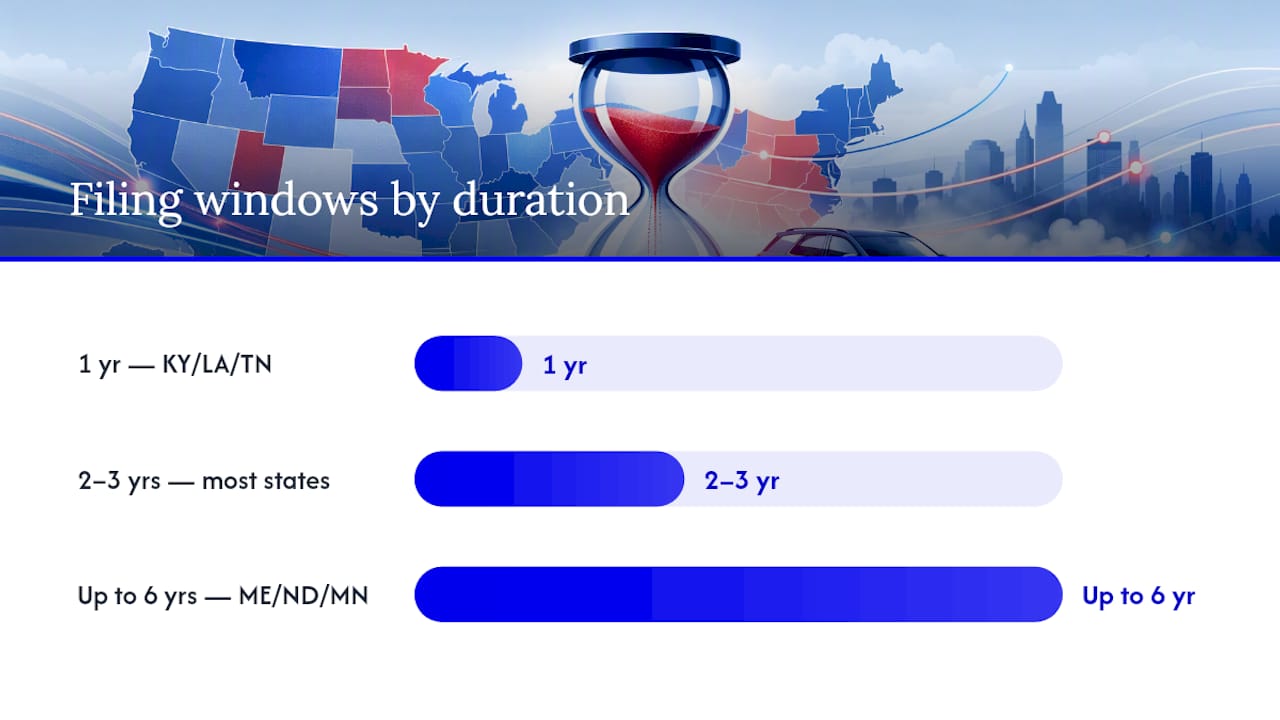
- Most states give injured individuals two to three years to file a personal injury claim, but Kentucky, Louisiana, and Tennessee only allot one year.
- The filing deadline generally starts on the date of the crash, except in wrongful death cases and if the discovery rule applies for hidden or late-developing injuries.
- Deadlines can be paused or extended for minors, incapacitated claimants, or when the defendant leaves the state, but not during settlement negotiations.
- Claims against government agencies require notice of claim within 30 to 180 days, and federal claims have a two-year filing window with additional steps.
- Filing with your insurance company does not pause the legal deadline; only court filings do, so early legal review is essential to preserve your rights.
Table of Contents
- What Is the Statute of Limitations for a Car Accident, State by State?
- When Does the Clock Actually Start Ticking?
- Can the Filing Deadline Be Paused or Extended?
- What About Claims Against Government Agencies?
- Property Damage and Wrongful Death Run on Different Clocks
- Reporting to Your Insurer Is Not the Same as Filing a Lawsuit
- What Should You Do Right Now to Protect Your Claim?
- Why Early Legal Intake Changes the Outcome
- The Deadline Map Doesn't Match What People Assume
- Get a Free Deadline Check Before You Assume You Have Time
- Where to Verify These Deadlines Yourself
- Sources
What Is the Statute of Limitations for a Car Accident, State by State?
A statute of limitations is the legal deadline for filing a lawsuit. Once it passes, the defendant can ask a judge to throw your case out, and in nearly every instance, the judge will grant that motion regardless of how strong your evidence is. That single fact drives everything else in this article.
For car accidents, most states give injured people two to three years to file a personal injury lawsuit against the at-fault driver. But "most states" isn't "all states," and the outliers matter more than the average.
Kentucky, Louisiana, and Tennessee give you just one year. If you're hurt in a crash in one of those states, the countdown moves fast, and there's little room for waiting to see how your injuries develop before talking to an attorney. On the other end, Maine, North Dakota, and Minnesota allow up to six years in certain personal injury claims, giving residents far more breathing room.
Property damage claims frequently run on their own separate timeline. California, for example, applies a three-year deadline to certain property-damage actions under its Code of Civil Procedure, which can differ from the injury deadline that applies to the same crash. That means you could theoretically lose your right to sue over your medical bills while still having time to pursue the cost of fixing your bumper, or vice versa, depending on your state's specific statute.
Here's a general reference for personal injury filing windows. Always verify against your state's current code, since legislatures amend these periodically.
Twelve states also operate under no-fault insurance systems, where your ability to sue the other driver directly may hinge on meeting a serious-injury threshold, not just filing on time. If you live in a no-fault state, the statute of limitations is one hurdle among several, and it's worth confirming both at once.
For an example of how state-specific procedural quirks stack on top of the basic deadline, Florida's rules on filing after a crash show how insurance requirements and filing windows interact in practice.
When in doubt, pull the actual statute. Every state publishes its code online, and a five-minute search for "[your state] personal injury statute of limitations" alongside the code section number will get you the current, authoritative language faster than most blog summaries, including this one.
When Does the Clock Actually Start Ticking?
For the overwhelming majority of car accident claims, the clock starts on the date of the crash. Simple as that. If you were hit on March 3, your deadline is calculated from March 3, not from when you first saw a doctor or when your pain became unbearable.
Two situations change that default:
- Wrongful death claims typically start the clock on the date of death, not the date of the accident, which matters when a victim survives for weeks or months before passing.
- The discovery rule can delay the start date in narrow cases where an injury wasn't and couldn't reasonably have been discovered at the time of the crash, such as certain internal injuries or traumatic brain injuries that surface later.
Courts apply the discovery rule sparingly, and only with solid medical documentation connecting the delayed diagnosis to the crash. Don't count on it as a backup plan. If you feel fine after a fender bender but develop symptoms three months later, get evaluated immediately and have your doctor document the connection to the accident in your file.
Pro Tip: Ask your doctor to note the exact date of the crash in your medical records at your very first visit, even if you feel mostly fine. That single line can matter enormously if your case ever hinges on when your injury was, or should have been, discovered.

Can the Filing Deadline Be Paused or Extended?
Several legal doctrines can pause, or "toll," the statute of limitations. None of them apply automatically. You or your attorney has to raise them, and you'll usually need documentation to back it up.
- Minors. In many states, the clock pauses while the injured person is under 18 and doesn't start running until they turn 18, sometimes giving them a set window afterward to file. Illinois, for instance, tolls the statute for minors until they reach majority.
- Incapacity. If the injured person is legally incapacitated, whether from a coma, severe cognitive impairment, or another condition, the clock may pause until they regain capacity. This requires medical evidence establishing the incapacity and its duration.
- Defendant leaves the state. If the at-fault driver moves out of state before you can serve them with a lawsuit, some states pause the clock for the time they're absent, since you can't sue someone the court has no power to reach.
One thing tolling does not include: settlement talks. Negotiating with an insurance adjuster, exchanging demand letters, or even having an attorney "in discussions" with the other side does nothing to stop your deadline. Only filing the actual complaint in court preserves your right to sue.
What About Claims Against Government Agencies?
If a city bus, county vehicle, postal truck, or state-owned car caused your crash, forget everything you just read about two or three years. Government claims run on a much shorter, much stricter clock.
- Most states require a formal notice of claim filed with the government agency within 30 to 180 days of the accident, not years.
- California requires an administrative claim within six months for most tort claims against public entities.
- Miss that notice window, and you typically forfeit your right to sue the agency entirely, even if the ordinary statute of limitations hasn't expired yet.
Federal-employee crashes work differently still, under the Federal Tort Claims Act (FTCA). You must file an administrative claim with the responsible federal agency within two years of the accident. If the agency denies it (or doesn't respond within six months), you then have six months from that denial to file suit in federal court. This two-step structure trips up more claimants than any other rule in this guide, largely because government-vehicle notice deadlines aren't widely known and rarely get mentioned until it's too late.
If any government vehicle was involved, confirm your state's notice requirement this week, not this month.
Property Damage and Wrongful Death Run on Different Clocks
Your car accident might trigger three or four separate legal deadlines, not one. Treating them as a single countdown is how people accidentally forfeit part of their recovery.
- Property damage claims (vehicle repair, rental costs, diminished value) often have their own statute distinct from personal injury, and the two periods don't always match.
- Wrongful death suits generally run from the date of death, brought by a personal representative or specific surviving family members depending on state law.
- Survival actions, which let an estate recover for the deceased's pain and suffering before death, follow yet another set of rules and eligible parties.
Keep a simple written log of every deadline that applies to your situation, injury, property damage, wrongful death, government notice, with the exact date each one expires. A missed line item is still a missed deadline.
Reporting to Your Insurer Is Not the Same as Filing a Lawsuit
This trips up more people than any legal technicality. Reporting your crash to your insurance company satisfies your policy's terms. It does absolutely nothing to stop the statute of limitations from running.
- Most auto policies require notice within days or a few weeks of the accident, check your specific policy language for the exact number.
- Put your notice in writing when possible, and save every confirmation email or claim number the insurer sends back.
- Only filing an actual complaint in court pauses your legal deadline. Adjuster calls, recorded statements, and settlement offers don't count, no matter how close you are to a resolution.
Pro Tip: If your filing deadline is approaching and negotiations with the insurance company are still ongoing, file the lawsuit anyway. You can settle a filed case at any point before trial, but you can't un-expire a missed statute of limitations.
What Should You Do Right Now to Protect Your Claim?
- Get medical care immediately and follow through with recommended treatment. Gaps in care create openings for insurers to argue your injuries weren't serious or weren't caused by the crash.
- Document everything at the scene, or as soon as possible after: photos of vehicle damage, road conditions, visible injuries, and the other driver's information.
- Collect witness contact information before people scatter. Memories fade fast, and witnesses move.
- Request your police report and keep a copy along with every medical bill, prescription record, and lost-wage statement.
- If your deadline is close, file first, negotiate second. Filing a complaint costs you nothing in terms of settlement leverage, but it locks in your right to proceed. A free case evaluation can confirm your exact deadline before you lose the option to act on it.
Avoid the errors that quietly sink otherwise strong claims. Delayed reporting, thrown-away receipts, and unrecorded witness names are common mistakes that cost real money at settlement time, long before any deadline issue even comes up.
Why Early Legal Intake Changes the Outcome
The gap between a strong settlement and a mediocre one usually traces back to what happened in the first few weeks, not the final negotiation. Attorneys who see a case early can order the right medical evaluations, lock down evidence before it disappears, and calculate the exact filing deadline instead of relying on a rough guess.

Carcollisionlawyer's free case evaluation asks about your injury type, the date of the crash, and whether a government vehicle was involved, three details that determine which deadline actually applies to you. That intake is matched against attorneys who handle your specific type of case, whether it's a straightforward rear-end collision or a wrongful death claim against a municipal vehicle. Readers who submit an evaluation typically get a response fast enough to still have real options, rather than finding out weeks later that a shorter notice window already closed.
The Deadline Map Doesn't Match What People Assume
Here's the uncomfortable truth about statute of limitations advice on the internet: nearly all of it flattens fifty different legal systems into one number, usually "two years," and calls it a day. That's not wrong often enough to be dangerous by itself. It's wrong in exactly the cases where being wrong costs the most, government vehicles, minors, latent injuries, out-of-state defendants.
The conventional advice treats the statute of limitations as the single deadline that matters. In practice, it's often the deadline you have the most time on. The notice-of-claim rule for a government vehicle, the six-month FTCA denial window, the insurer's own reporting clause buried in your policy, those are the clocks that actually catch people, precisely because nobody mentions them until it's too late.
If you take one thing from this guide, take this: figure out within days, not months, whether a government entity was involved in your crash. Everything else, the ordinary two-or-three-year window, the discovery rule, tolling for minors, has more slack built in. The short government windows have almost none.
— Gerard
Get a Free Deadline Check Before You Assume You Have Time
Reading about statutes of limitations only helps if you know exactly where your specific case stands, and that's where a general article can't help you but a real case review can. Carcollisionlawyer's free case evaluation is built to answer one question fast: what deadline applies to your crash, and how much time is actually left.
The evaluation takes a few minutes. You'll share basic details, the date of your accident, what kind of vehicle was involved (including whether it belonged to a government agency), and the injuries you're dealing with. There's no cost and no obligation to move forward with any attorney you're matched with. Have your police report number and the accident date handy; those two details alone let an attorney flag urgent deadline issues almost immediately. Every submission is handled under Carcollisionlawyer's privacy policy, so your information isn't shared beyond the attorney-matching process itself.
If you suspect your deadline is close, don't wait for a follow-up call from an insurance adjuster to decide your next move. Start your free case evaluation now and find out exactly where you stand.
Where to Verify These Deadlines Yourself
State legislatures amend statutes periodically, so cross-check any deadline against the primary source before relying on it. The Cornell Legal Information Institute offers plain-language summaries of statute of limitations law, while the U.S. Department of Justice's FTCA page covers federal-employee claims directly. For government-notice specifics, consult your own state's government code section directly rather than a summary site.
This article is general information, not a substitute for advice from a qualified lawyer. Consult a qualified legal professional about your own circumstances before acting on anything here.
Sources
- Statute of limitations (Cornell Legal Information Institute)
- California Code of Civil Procedure § 338