
A car accident attorney free evaluation is a confidential, zero-cost legal consultation designed to assess your case's merit, explain your rights, and outline your compensation options with no obligation. Reputable personal injury firms offer these free case evaluations lasting 15–30 minutes, covering liability, potential settlement value, statutes of limitations, and litigation steps. The industry term for this service is a "free initial consultation," and it costs you nothing upfront. If you were recently in a crash, this evaluation is the fastest way to understand what your claim is actually worth before you commit to anything.
What does a car accident attorney free evaluation cover?
A free evaluation is not a deep legal analysis. It is a structured screening session where an attorney reviews the basic facts of your accident and tells you whether you have a viable claim. The attorney will assess liability, flag any deadlines that could affect your case, and explain the general litigation process if your case goes to court.
The scope is specific. Attorneys focus on four core areas during these sessions: who was at fault, what your injuries are worth, how long you have to file under your state's statute of limitations, and what the next steps look like if you move forward. Free evaluations cover liability, settlement potential, and litigation steps in a single session. That concentration of information in 15–30 minutes is what makes the evaluation so valuable immediately after a crash.

Contingency fee arrangements are also explained during this session. Under a contingency fee agreement, you pay zero attorney fees unless the firm secures a financial recovery for you. The firm advances litigation costs and recovers them as a percentage of your settlement. That structure eliminates your financial risk from day one.
What to prepare before your free car accident attorney evaluation
Preparation determines how much you get out of the session. Attorneys who receive organized, complete information can assess your case faster and more accurately. Clients who arrive unprepared often leave without the clarity they need.
Gather these documents before your evaluation:
- Police or crash report. This is the official record of the accident and establishes the basic facts.
- Medical records and bills. These document your injuries and form the foundation of your damages claim.
- Photos and video. Images of vehicle damage, injuries, road conditions, and the scene itself are powerful evidence.
- Insurance correspondence. Bring any letters, emails, or claim numbers from your insurer or the other driver's insurer.
- Witness contact information. Names and phone numbers of anyone who saw the crash.
- A written timeline. A one-page summary of what happened, when, and in what order.
| Preparation item | Why it matters |
|---|---|
| Police report | Establishes fault and official accident details |
| Medical records | Quantifies injury severity and treatment costs |
| Accident photos | Provides visual evidence of damage and conditions |
| Insurance documents | Shows coverage limits and any existing communications |
| Witness information | Supports your version of events independently |
| Written timeline | Helps the attorney assess liability quickly |
Pro Tip: Collect witness contact information within the first 24–48 hours. Witnesses become harder to locate quickly, and their statements carry significant weight when insurers dispute fault.
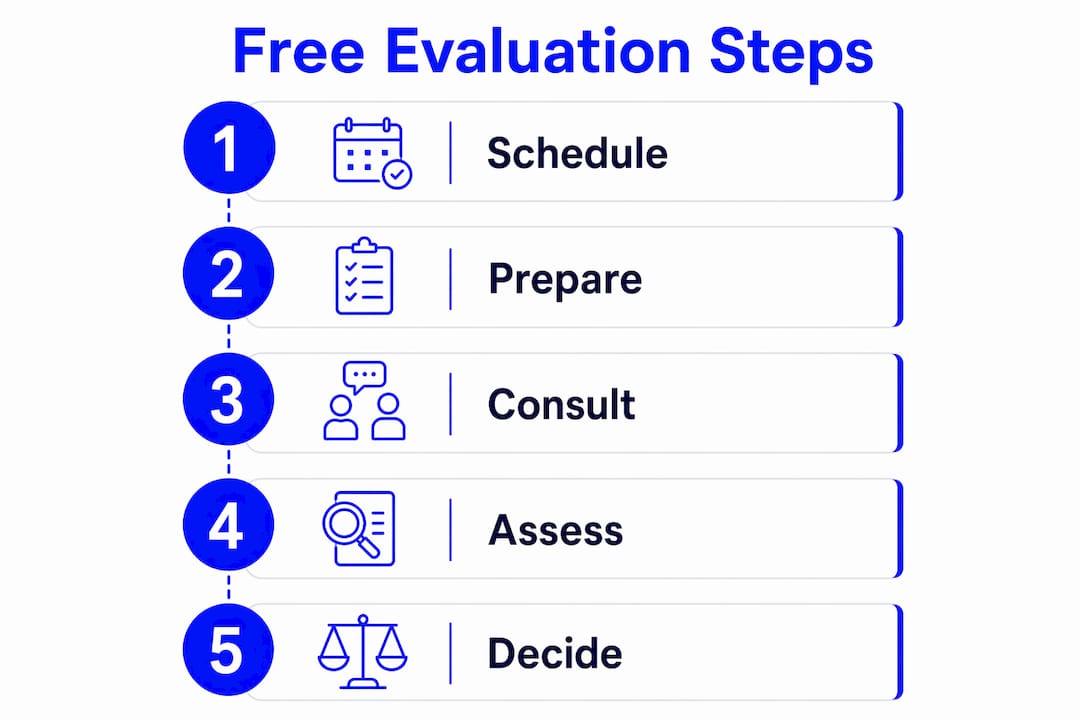
Preparation with documents and questions significantly improves evaluation outcomes. Attorneys can spend the session analyzing your case rather than gathering basic facts you could have brought with you.
How do free car accident evaluations typically work?
The session follows a predictable structure. Knowing what to expect helps you use the time well instead of reacting to questions you did not anticipate.
- Introduction and conflict check. The attorney confirms there is no conflict of interest before discussing your case.
- Fact gathering. You describe the accident, your injuries, and any treatment you have received. Keep your written timeline handy here.
- Liability assessment. The attorney identifies who is likely at fault based on the facts and any documentation you provide.
- Damages review. Medical costs, lost wages, pain and suffering, and future care needs are all factored into an initial estimate of claim value.
- Deadline discussion. The attorney flags your state's statute of limitations and any other filing deadlines that affect your case.
- Fee structure explanation. The contingency arrangement is explained, including what percentage the firm takes and how litigation costs are handled.
- Next steps. The attorney outlines what happens if you hire the firm and what the case timeline looks like.
Initial free consultations last only 15–20 minutes and serve as screening tools for firms, not deep legal analyses. That time constraint means you need to arrive focused and ready to ask direct questions.
Questions worth asking during the evaluation include: How many cases like mine have you taken to trial? What is your contingency fee percentage? Who will handle my case day to day? How do you communicate with clients, and how often? These questions reveal far more about a firm than any advertisement.
Pro Tip: Treat the evaluation as a two-way interview. The attorney is assessing your case, and you are assessing the attorney. Both sides are deciding whether to work together.
How to use the evaluation to select the right car accident attorney
The free evaluation is your best tool for comparing attorneys before you commit. Most accident victims speak with only one firm. Speaking with two or three gives you real data to compare.
Trial-ready lawyers with catastrophic injury experience consistently secure higher-value settlements and verdicts. Attorneys who only settle cases, without genuine litigation capability, give insurers no reason to offer full value. Ask every attorney you evaluate for their recent jury trial record on cases similar to yours.
Use a structured scorecard to rate each firm after the evaluation. A scorecard with 5–7 criteria removes emotion from the decision and gives you an objective comparison. Rate each firm on:
- Trial experience. Has the attorney taken similar injury cases to verdict?
- Communication style. Did the attorney explain things clearly without legal jargon?
- Fee transparency. Were the contingency percentage and litigation costs explained upfront?
- Case assessment quality. Did the attorney give you a realistic picture, not just a sales pitch?
- Responsiveness. How quickly did the firm respond to your inquiry?
- Staff and support. Who actually handles the day-to-day work on your case?
| Evaluation criterion | What to look for |
|---|---|
| Trial experience | Recent jury verdicts in similar injury cases |
| Communication | Clear explanations, no jargon, direct answers |
| Fee structure | Contingency percentage and cost recovery terms stated clearly |
| Case realism | Honest assessment of strengths and challenges |
| Responsiveness | Quick reply to your initial inquiry |
Settlement-focused lawyers without litigation capabilities often yield lower settlements. Insurers know which attorneys never go to trial, and they price their offers accordingly. A lawyer with a documented trial record changes that dynamic entirely.
Red flags to watch for during evaluations include: vague answers about fees, promises of specific settlement amounts before reviewing your records, reluctance to discuss trial history, and pressure to sign a retainer on the spot.
Common pitfalls when using a free legal evaluation
Most accident victims make at least one of these mistakes. Knowing them in advance puts you ahead of the majority of claimants.
- Arriving unprepared. Showing up without documents or questions wastes the session and leaves you with generic advice instead of case-specific guidance.
- Treating it as a formality. The evaluation is your primary opportunity to assess the attorney. Passive participation produces passive results.
- Choosing based on advertising. A firm's marketing budget has no relationship to its trial record or client outcomes.
- Ignoring communication signals. If the attorney was hard to reach before you hired them, that pattern will continue throughout your case.
- Accepting unclear fee terms. Any firm that cannot explain its contingency percentage and cost recovery policy in plain language is a firm to avoid.
- Waiting too long. The first 7–14 days post-accident are critical for securing dashcam footage, witness statements, and physical evidence. Delay destroys evidence.
"Moving quickly within the first two weeks after an accident is vital to secure evidence and strengthen claims."
Pro Tip: After each evaluation, write down what the attorney said about your case value, their fee structure, and their trial history. Request any fee agreement in writing before signing anything. Memory fades fast, and written records protect you.
Clients who don't prepare sufficiently lose out on potential compensation and clarity. The evaluation is only as useful as the effort you put into it.
Key Takeaways
A free car accident attorney evaluation is the single most effective first step for accident victims because it delivers case-specific legal clarity at zero cost and zero obligation.
| Point | Details |
|---|---|
| Prepare before the session | Bring your crash report, medical records, photos, and a written accident timeline. |
| Treat it as a two-way interview | You are evaluating the attorney as much as they are evaluating your case. |
| Ask about trial experience | Attorneys with jury trial records secure higher settlements than settlement-only firms. |
| Act within 7–14 days | Critical evidence like dashcam footage and witness statements disappears fast after a crash. |
| Use a scorecard to compare firms | Rate two or three attorneys on trial experience, communication, and fee transparency before deciding. |
What I've learned from watching accident victims use free evaluations
Most accident victims walk into a free evaluation hoping to be told everything will be fine. That instinct is understandable, but it leads to passive behavior at exactly the wrong moment. The evaluation is the most leverage you will ever have in the attorney selection process. Once you sign a retainer, your options narrow considerably.
The clients who get the most from these sessions are the ones who arrive with a written timeline, a folder of documents, and a list of direct questions. They treat the attorney like a contractor bidding on a job, not an authority figure to defer to. That posture produces better information and better decisions.
The most common mistake I see is choosing an attorney based on name recognition or a polished website. Marketing reflects a firm's budget, not its courtroom record. Ask for trial history. Ask who handles your file daily. Ask what happens if the case goes to litigation. An attorney who deflects those questions is telling you something important.
Use multiple evaluations. Two or three sessions with different firms costs you nothing and gives you real data to compare. The difference between a settlement-focused attorney and a trial-ready one can be tens of thousands of dollars in your final recovery. That difference is worth one extra hour of your time.
— Gerard
Carcollisionlawyer connects you with attorneys who offer free evaluations
Carcollisionlawyer specializes in connecting accident victims with trusted attorneys who provide genuine, no-cost case evaluations. The process is built around your specific injury and circumstances, so you are matched with legal support that fits your situation rather than a generic referral.
There are no upfront fees and no obligation after your evaluation. Attorneys in the Carcollisionlawyer network operate on a contingency basis, meaning you pay nothing unless your case results in a financial recovery. If you were recently injured in a car, motorcycle, or truck accident, get your free evaluation and find out what your claim is actually worth. You can also read more about injury claims and attorney representation before you take the next step.
FAQ
What is a car accident attorney free evaluation?
A free evaluation is a confidential, no-cost consultation where an attorney reviews your accident facts, assesses liability, and explains your compensation options. It typically lasts 15–30 minutes and carries no obligation to hire.
Do I have to pay anything for a free car accident consultation?
No. Reputable personal injury firms offer free initial consultations at zero cost. If you hire the attorney, they work on a contingency fee basis, meaning you pay only if they recover money for you.
How soon should I schedule a free legal evaluation after my accident?
Schedule your evaluation within the first 7–14 days after the crash. Critical evidence like dashcam footage and witness statements can disappear quickly, and early action strengthens your claim significantly.
Can I speak with more than one attorney before deciding?
Yes, and you should. Speaking with two or three firms during free evaluations gives you real data to compare on trial experience, communication, and fee structures before you commit to anyone.
What questions should I ask during a free car accident lawyer evaluation?
Ask about the attorney's recent jury trial record for similar cases, who handles your file daily, the exact contingency fee percentage, and how litigation costs are recovered. Clear answers to these questions separate capable attorneys from those focused only on quick settlements.