
Here's the short version: you hire a lawyer, build a medical-and-evidence file that proves what the crash cost you, send a demand letter, negotiate with the insurer, and either settle or escalate to a lawsuit if they won't pay fairly. That is the entire car accident claim process in one sentence. Everything else is detail.
But three things need to happen today, not next week:
- Get medical care and keep every record. Gaps in treatment give insurers an excuse to argue your injuries aren't serious or aren't related to the crash.
- Preserve the scene evidence and the police report. Photos, witness names, and the report number are hard to recover once time passes.
- Get a free case evaluation. A quick call to Carcollisionlawyer can tell you whether you have a claim worth pursuing and what deadline you're working against.
Timelines vary by state and by injury, and missing your state's statute of limitations can permanently bar you from recovering anything, no matter how strong your case is.
Key Takeaways
A successful car accident claim depends on early medical documentation, evidence preserved before it disappears, and legal representation before deadlines and lien issues become unmanageable.
| Point | Details |
|---|---|
| Act fast on evidence | Photos, police reports, and witness contacts are hardest to recover the longer you wait. |
| Wait for MMI before settling | Settling before your medical picture is clear risks leaving future costs uncovered. |
| Know your state's deadline | Statutes of limitations vary by state and government claims often require much shorter notice. |
| Watch for lien resolution | Health insurers and hospitals may have a right to reimbursement from your settlement. |
| Get a free case evaluation | Carcollisionlawyer matches crash victims with attorneys who handle documentation, negotiation, and liens on their behalf. |
Table of Contents
- The Car Accident Claim Process: Stage by Stage
- What Does a Car Accident Lawyer Actually Do?
- How Is a Car Accident Claim Valued?
- How Long Does the Car Accident Claim Process Take?
- What Evidence Do You Need for a Car Accident Claim?
- When Should You Hire a Car Accident Lawyer?
- Settlement Negotiation Tactics and Common Pitfalls
- The Insurance Company's Role and Dealing With Adjusters
- Liens and Subrogation: Who Gets Paid From Your Settlement
- What Most Guides Get Wrong About This Process
- Get a Free Case Evaluation From Carcollisionlawyer
- Frequently Asked Questions
- Sources
The Car Accident Claim Process: Stage by Stage
Most claims move through four predictable stages, though the pace and outcome depend heavily on how serious your injuries are and how cooperative the insurance company decides to be.
- Intake and free case evaluation. A lawyer will want the basics fast: when and where the crash happened, who was involved, what insurance is in play, and what injuries you've suffered so far. This conversation determines whether you have a viable claim and how urgently you need to act.
- Investigation and evidence-building. Your attorney pulls medical records, the police report, and witness statements, and may bring in experts like accident reconstructionists for disputed liability. This stage often runs parallel to your ongoing medical treatment.
- Demand letter and negotiation. Lawyers typically wait to send a formal demand until you reach Maximum Medical Improvement, the point where doctors can say with confidence what your injuries will and won't fully heal from, so the number reflects your actual losses instead of a guess. The demand letter lays out liability, damages, and a settlement figure, and negotiation follows.
- Filing suit, if needed. If the insurer won't offer a fair number, refuses to negotiate in good faith, or the policy limits are unclear, litigation opens the door to discovery, depositions, and sometimes mediation, tools that can pressure an insurer into a better offer even if the case never reaches trial.
Most personal injury cases settle before trial, but here's the part people miss: the cases that settle well are the ones prepared as if they were headed to court. Building a complete file with medical documentation, wage records, and expert input from the start gives your attorney real leverage at the negotiating table, not just a folder of good intentions.
Pro Tip: Don't assume "we're negotiating" means the insurer is acting in good faith. Ask your attorney for a copy of every offer and counteroffer in writing so you can see the pattern, not just the final number.
What Does a Car Accident Lawyer Actually Do?
A lawyer's job isn't just sending a letter and waiting. Over the life of your claim, an attorney typically handles:
- Evaluating your case and setting a strategy for liability and damages
- Collecting medical records, police reports, and witness statements, and retaining experts such as vocational specialists or accident reconstructionists when needed
- Negotiating directly with adjusters, drafting the demand letter, and filing suit if talks stall
- Managing your contingency fee agreement and tracking case expenses so you understand your likely net recovery
That last point matters more than most people realize. Contingency fees are standard in this field, meaning you pay nothing upfront and the attorney is paid a percentage of what's recovered, but expense practices vary by firm. Ask upfront whether costs like expert witness fees come out before or after the fee is calculated. Insurers also tend to negotiate differently once a lawyer is involved, since represented claimants are far more likely to pursue litigation if lowballed.
How Is a Car Accident Claim Valued?
Your claim's value comes down to two categories, and both need documentation to hold up.
- Economic damages are the countable losses: medical bills, future care costs, lost wages, and out-of-pocket expenses like medication or transportation to appointments.
- Non-economic damages cover pain and suffering and emotional loss. Attorneys often use a multiplier applied to your economic damages to estimate this figure, and stronger medical documentation typically supports a higher multiplier.
- Maximum Medical Improvement explains why many claims aren't valued early. Settling before you know your long-term prognosis risks leaving future medical costs uncovered.
- Coverage limits matter too. If the at-fault driver is underinsured or uninsured, your own policy's UM/UIM coverage may be the actual ceiling on what you can recover, regardless of how strong your case is.
Negligence is the legal basis for most car accident claims, meaning your attorney has to show the other driver failed to use reasonable care and that failure caused your injuries.
How Long Does the Car Accident Claim Process Take?
Simple, well-documented claims with clear liability can settle within a few months. Cases involving serious injury, disputed fault, or an insurer that won't budge often stretch past a year, especially once litigation starts.
- Settlements without a lawsuit typically move faster than cases that go to litigation, where discovery and depositions add months.
- Statutes of limitations vary by state, commonly falling between one and six years, and claims against a government entity often require formal notice within a much shorter window, sometimes just months after the crash.
- Waiting for MMI before settling protects you from underestimating future costs, but it also means patience is often the smarter play than a quick payout.
- Delayed medical care or late reporting gives insurers grounds to argue your injuries weren't caused by the crash, which can shrink or kill your recovery.
Pro Tip: If a government vehicle or employee was involved, tell your lawyer immediately. Government-claim notice deadlines can be as short as 60 to 180 days, far shorter than the general statute of limitations.
What Evidence Do You Need for a Car Accident Claim?
The strength of your file drives the strength of your negotiating position. Here's what matters most, organized by category:
| Evidence Category | What to Collect |
|---|---|
| Scene documentation | Photos from multiple angles, police report number, other driver's info, witness names and contacts |
| Medical documentation | ER notes, imaging, physical therapy records, prescriptions, all bills, and a pain journal |
| Financial proof | Pay stubs, employer letters confirming missed work, tax records, scheduling logs |
| Digital evidence | Dashcam footage, phone photos, nearby surveillance video |
A few habits make a real difference here:
- Back up digital evidence immediately, phones get lost or replaced, and cloud storage is cheap insurance.
- Keep originals of every medical bill and receipt, even ones your health insurance eventually covers.
- Log missed workdays as they happen rather than reconstructing them months later.
For a deeper walkthrough of what wins claims, this evidence collection guide covers the details step by step.
When Should You Hire a Car Accident Lawyer?
Earlier is almost always better. Hiring a lawyer soon after the crash preserves evidence before it disappears, puts you in a stronger negotiating position from day one, and makes sure nobody misses a filing deadline.
- Ask about experience with cases like yours. A firm that handles mostly minor fender-benders may not be the right fit for a serious injury claim.
- Ask about outcomes, not guarantees, but a track record of settlements and verdicts in similar cases.
- Ask about the fee structure. Confirm the contingency percentage and how case expenses are handled before you sign anything.
- Ask how often you'll get updates. Reputable firms don't go silent for months at a time.
Watch for red flags during intake: pressure to sign immediately, vague answers about fees, or a reluctance to explain the process in plain language. A solid free case evaluation should feel like a conversation, not a sales pitch, and Carcollisionlawyer is built to walk you through exactly that before you commit to anything.
Settlement Negotiation Tactics and Common Pitfalls
Insurance adjusters are trained negotiators, and their first offer is almost never their best one. A common tactic is offering a quick, modest settlement before you've finished treatment, betting that you'll take the cash rather than wait for a fuller picture of your injuries. Once you sign a release, that door closes for good, even if your condition worsens later.

Strong negotiation starts with a demand letter that's overbuilt, not just a bill total but a narrative supported by medical records, wage documentation, and sometimes expert opinions on long-term impact. Attorneys often anchor high, expecting the insurer's counteroffer to land somewhere in the middle, so an underprepared demand tends to produce an underwhelming result.
The most common pitfalls are self-inflicted. Accepting a fast settlement before reaching MMI is the biggest one, since it locks in a number before you know your real medical trajectory. Giving a recorded statement to the other driver's insurer without a lawyer present is another, adjusters ask pointed questions designed to get you to minimize your own injuries on tape. Posting about the crash or your recovery on social media can also undercut your claim; insurers routinely review public posts looking for anything that contradicts your stated injuries.
Patience is a genuine tactical advantage here. Cases prepared as though they're headed to trial, with a complete file and retained experts where needed, consistently produce better settlement outcomes than claims rushed toward an early number.
The Insurance Company's Role and Dealing With Adjusters
Two insurers are usually involved: the at-fault driver's carrier, which handles your third-party claim, and potentially your own insurer, if you're pursuing underinsured motorist coverage or med-pay benefits. Understanding which one you're dealing with, and when, matters for how you communicate.
Adjusters work for the insurance company, not for you, even when they sound friendly and helpful. Their job includes minimizing payouts, and that shapes every interaction, from the initial call asking "how are you feeling" to requests for a signed medical authorization that lets them dig through your entire medical history, not just crash-related records.
A few practical rules protect you here. Never give a recorded statement without your attorney's guidance. Don't sign a broad medical release; a narrower authorization limited to relevant treatment protects unrelated medical history from becoming part of the negotiation. And don't discuss fault or apologize for the crash, even reflexively, since adjusters note anything that sounds like an admission.
Once you have legal representation, most adjusters redirect all communication to your attorney, which is often the point where negotiations start moving instead of stalling. That shift alone is one of the practical reasons hiring counsel early changes how insurers respond to your claim from the outset.
Liens and Subrogation: Who Gets Paid From Your Settlement
Your settlement check rarely represents money that's entirely yours to keep the moment it arrives. Health insurers, Medicare, Medicaid, and hospitals that treated you on a lien basis often have a legal right to be reimbursed from your recovery for the medical costs they covered or fronted.
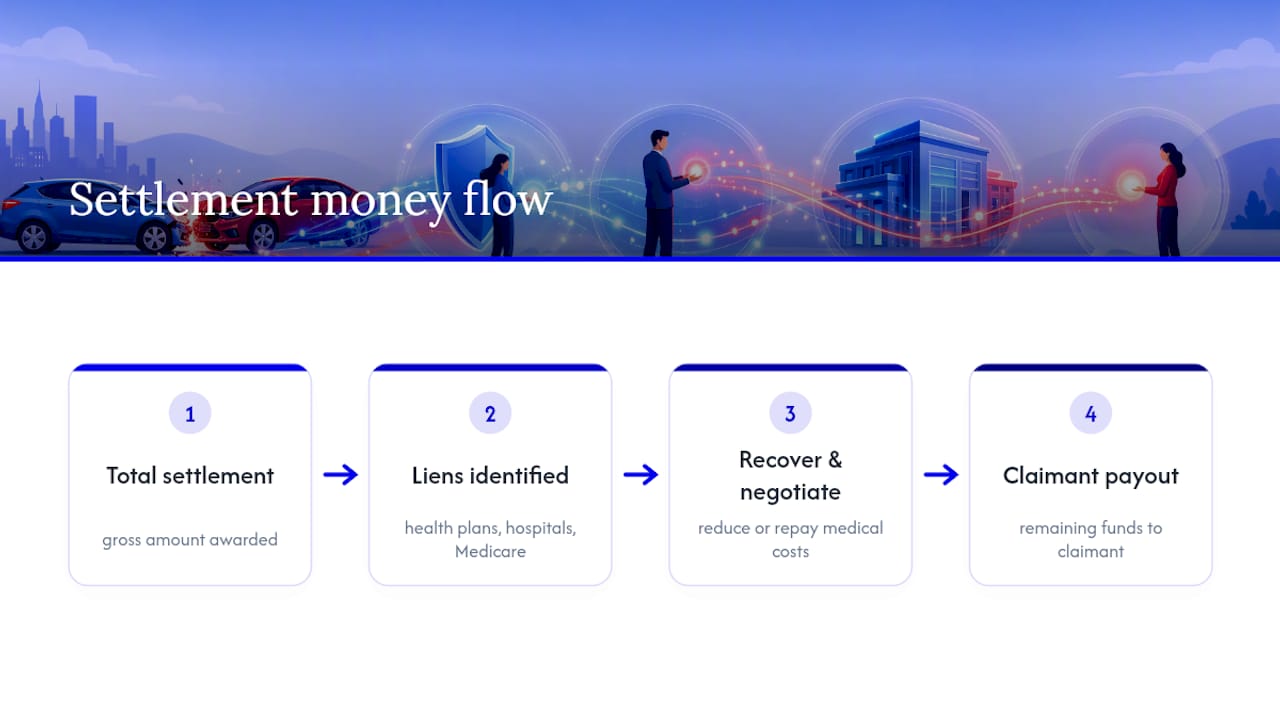
This is called subrogation, and it works like this: if your health plan paid $15,000 in treatment costs after the crash, it may have a contractual or statutory right to recover that amount from your settlement before you see a dime. Hospitals that treat crash victims without immediate payment sometimes file a formal lien directly against the case, which your attorney has to identify and resolve before funds are distributed.
Negotiating these liens down is a real and often underappreciated part of an attorney's job. Lienholders don't always insist on full reimbursement, especially when the attorney can show that a lower payout still gets money in the door faster than pursuing you directly. Skilled negotiation on liens can meaningfully increase what you actually take home, even when the total settlement number stays the same.
Ignoring a lien doesn't make it disappear. Unresolved liens can result in a lienholder pursuing you directly after the case closes, sometimes years later, which is exactly the kind of loose end a lawyer-handled claim is designed to close before you ever see a check.
What Most Guides Get Wrong About This Process
The conventional advice treats the car accident claim process like a checklist you complete once and forget. That's backward. The claims that end well are the ones treated as ongoing case-building from day one, not a series of boxes to tick after the fact.
Where most guidance falls short is timing. People are told to "document everything" and "call a lawyer," but rarely told why patience around MMI matters more than speed, or why a lien nobody mentioned at the start can quietly eat into a settlement months later. Those aren't edge cases. They're the norm.
If I had to pick one priority for someone reading this the week after a crash, it wouldn't be finding the perfect attorney. It would be getting consistent medical treatment and a free case evaluation started simultaneously, so the clock on evidence preservation and the clock on legal strategy start ticking together instead of one lagging behind the other by weeks that can't be recovered.
Get a Free Case Evaluation From Carcollisionlawyer
Handling a claim alone means negotiating against an adjuster whose entire job is minimizing what you're owed, with no one checking whether that lien on your settlement is even valid. Carcollisionlawyer removes that mismatch by connecting you with a vetted local attorney through a free case evaluation, at no cost and no obligation to move forward.
The intake process is built around your specific situation, whether that's a straightforward fender-bender with clear liability or a more complicated crash involving disputed fault, an underinsured driver, or serious injuries still being treated. You answer a short set of questions about the crash and your injuries, and Carcollisionlawyer matches you with an attorney equipped to handle exactly that kind of case. There's no upfront cost, and no pressure to commit to anything during the evaluation itself.
If you're still within your evidence-collection window and haven't spoken with an attorney yet, start your free case evaluation today and find out where you stand before any deadlines start working against you.
Frequently Asked Questions
How long does the car accident claim process usually take? Straightforward claims with clear liability and moderate injuries often settle within a short period. Cases involving serious injury, disputed fault, or litigation may take significantly longer, especially once discovery and depositions enter the picture.
Do I need a lawyer to file a car accident claim? It's not legally required, but represented claimants typically see different treatment from insurers, partly because a lawyer signals a willingness to litigate if the offer isn't fair. An attorney also handles deadlines, lien negotiations, and evidence preservation you might otherwise miss.
What's the biggest mistake people make when filing a claim? Accepting an early settlement offer before reaching Maximum Medical Improvement. Once you sign a release, you can't go back for more money even if your injuries turn out to be worse than initially expected.
What is MMI and why does it matter for my settlement? Maximum Medical Improvement is the point where your condition has stabilized and doctors can reasonably predict your long-term prognosis. Lawyers often wait until MMI to finalize a demand so the settlement accounts for future medical needs, not just current bills.
Will I have to go to court for my car accident claim? Most personal injury cases settle before trial. Litigation becomes more likely when the insurer won't offer a fair amount, liability is disputed, or policy limits are unclear, but even filed lawsuits frequently settle before reaching a courtroom.
This article is general information, not a substitute for advice from a qualified lawyer. Consult a qualified legal professional about your own circumstances before acting on anything here.
Sources
- How the Personal Injury Lawsuit Timeline Works (Nolo)
- Personal injury (Cornell Legal Information Institute)
- Car accident settlement process and timeline (FindLaw)
- Personal injury civil lawsuit basics (CA Courts Self-Help)