
Legal fees in accident cases are structured as contingency fee agreements, meaning you pay your attorney a percentage of any recovery and owe nothing if your case is unsuccessful. This model removes the financial barrier that would otherwise prevent most injured people from accessing quality legal representation. Understanding how legal fees are calculated, what additional costs arise, and how medical liens reduce your final payout gives you real negotiating power before you sign anything. This guide covers every layer of accident case legal costs, from the standard 33% contingency to expert witness bills and Medicare subrogation claims.
How legal fees work in accident cases: the contingency fee model
A contingency fee is a payment arrangement where your attorney collects a percentage of your settlement or court award, with no fee owed if the case produces no recovery. This is the standard fee structure for accident attorneys across the United States, and it exists specifically because most injury victims cannot afford hourly legal rates while recovering from a crash.
The standard contingency fee in personal injury cases follows a tiered structure based on how far the case progresses:
- Pre-suit settlement: 33.3% of the gross recovery, applicable when the case resolves before a lawsuit is filed.
- Post-suit settlement: 40% of the gross recovery, triggered once a complaint is filed in court.
- Trial verdict: 40% to 45%, reflecting the additional time and preparation required.
- Appeals: An additional 5% to 10% on top of the trial percentage.
To make this concrete: on a $100,000 settlement resolved before filing suit, a 33.3% fee equals $33,300 to the attorney. The same case resolved at trial could cost $40,000 to $45,000 in attorney fees alone. That difference of roughly $12,000 illustrates why most cases settle early.
One critical distinction affects your take-home amount more than most clients realize. Some contracts calculate the attorney's percentage on the gross settlement figure before deducting case costs. Others calculate on the net figure after costs are subtracted. On a $100,000 settlement with $10,000 in case costs, a gross-based 33.3% fee equals $33,300, leaving you $56,700. A net-based 33.3% fee equals $29,700, leaving you $60,300. The fee calculation basis must be spelled out in writing before you sign.

Some states impose caps or sliding scales. California's medical malpractice rules limit contingency fees to 25% of the first $500,000 recovered, with lower percentages above that threshold. Florida and other states have similar protections for certain case types. Always ask your attorney whether state law limits the fee in your specific situation.
What are case costs and expenses besides attorney fees?
Attorney fees and case costs are two separate categories, and clients frequently confuse them, leading to surprise deductions at settlement. The attorney fee is the percentage paid for legal representation. Case costs are the out-of-pocket expenses required to build and litigate your claim.
Common case costs include:
- Court filing fees: Typically $200 to $500 depending on the jurisdiction and court level.
- Medical record retrieval: $200 to $1,000 per provider, and complex cases may require records from multiple hospitals and specialists.
- Expert witnesses: The single largest cost variable, ranging from $2,000 for a basic medical expert to $50,000 or more for accident reconstruction specialists, economists, or neurosurgeons.
- Deposition costs: Court reporter fees, transcript preparation, and videography.
- Investigative expenses: Surveillance, scene documentation, and police report procurement.
Simple cases cost $500 to $2,000 in total expenses. Complex or catastrophic injury cases routinely run $5,000 to $25,000 or more. Most reputable law firms advance these costs on your behalf during representation, recovering them from the settlement proceeds at the end.
What happens if you lose? Most firms absorb case costs entirely when no recovery occurs, meaning you walk away owing nothing. Some contracts, however, include language that makes clients responsible for costs even without a recovery. Read this clause carefully before signing.
Pro Tip: Ask your attorney directly: "If we lose, do I owe anything for case costs?" Get the answer in writing. A reputable firm will confirm zero liability for both fees and costs on a losing case.
How do medical liens and subrogation affect your net settlement?
A medical lien is a legal claim placed on your settlement proceeds by a party that paid for your medical treatment. Subrogation is the related right of an insurer to recover what it paid on your behalf from any third-party settlement you receive. Both reduce what you actually take home, and both are often negotiable.
Common lien holders in accident cases include hospitals and trauma centers, private health insurers like UnitedHealthcare or Blue Cross Blue Shield, Medicare and Medicaid, workers' compensation carriers, and emergency medical service providers. Medicare liens are conditionally paid back from settlement proceeds, and the Centers for Medicare and Medicaid Services actively monitors settlements to recover its interest.
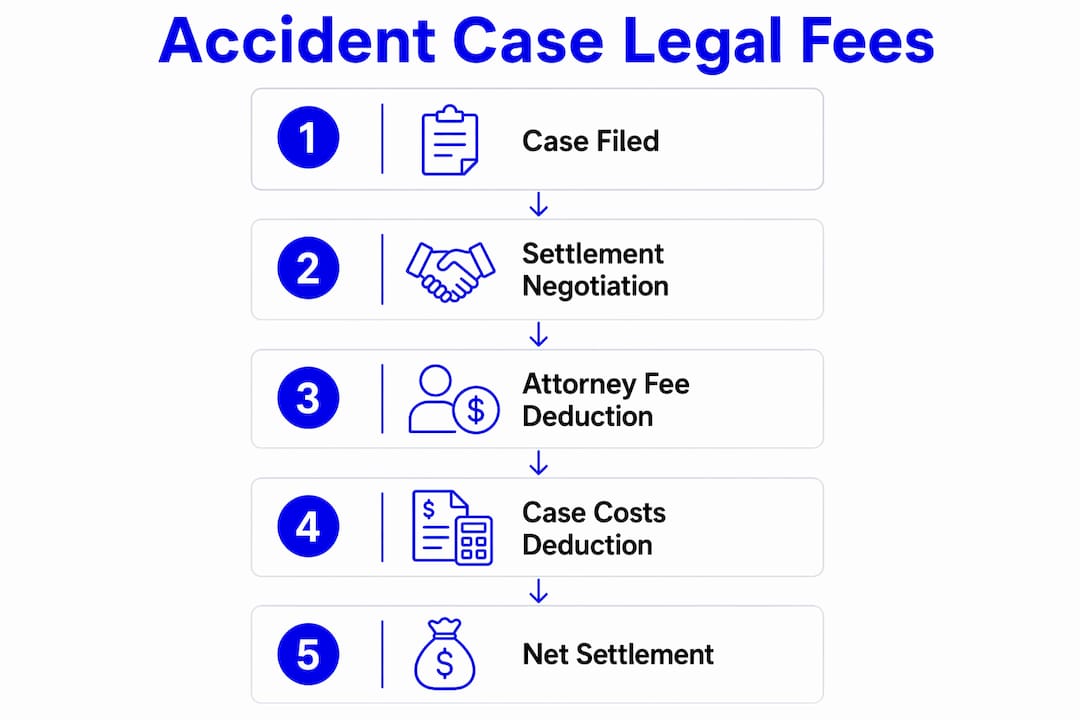
The math is sobering. A $100,000 settlement can net as little as $46,367 after a 33.3% attorney fee and case costs are deducted. Add a $15,000 hospital lien on top of that, and your actual recovery drops to roughly $31,000. That is why understanding lien exposure before accepting any settlement offer is not optional. It is the difference between a settlement that covers your losses and one that leaves you short.
Liens are negotiable in most cases. Hospitals frequently accept 50 cents on the dollar when presented with a clear picture of the total settlement and competing deductions. Medicare has a formal dispute and compromise process. An experienced attorney will negotiate each lien holder down, which directly increases your net payout.
Pro Tip: Before your attorney presents any settlement offer to you, ask for a written settlement distribution statement showing the gross amount, attorney fee, case costs, and every known lien. This document should exist before you sign a release.
What to look for in your fee agreement and how to negotiate legal fees
A written fee agreement is legally required in most states, and states like Arizona and California mandate disclosure of fee percentages, the timing of cost deductions, and client liability for costs if no recovery occurs. A verbal understanding is not enough. The contract governs everything.
Key terms to scrutinize in any fee agreement:
- Gross vs. net calculation: Confirm in writing whether the attorney's percentage applies before or after case costs are deducted.
- Cost liability clause: The contract should state explicitly that you owe zero fees and zero costs if the case produces no recovery.
- Stage-based fee schedule: Confirm the exact percentage at each stage: pre-suit, post-suit, trial, and appeal.
- Cost approval thresholds: Some agreements require attorney approval for any expense above a set dollar amount, protecting you from runaway expert fees.
- Lien negotiation responsibility: Confirm the attorney will negotiate medical liens as part of the representation.
"The most overlooked line in any contingency fee contract is whether fees are calculated on gross or net recovery. That single clause can shift thousands of dollars from your pocket to your attorney's." — Insight from Big Chad Law
Negotiation is possible and often overlooked. Contingency fees can be negotiated to lower percentages in high-value or clear-liability cases. A strong case with a settlement value above $500,000 might attract a 25% pre-suit fee instead of 33.3%. That difference on a $500,000 settlement equals $40,000 in your pocket. Some attorneys also offer hybrid fee arrangements that combine a reduced hourly rate with a lower contingency percentage, which can benefit clients in complex cases where significant attorney time is required before any settlement is reached.
How do legal fees differ by accident type and case complexity?
Not all accident cases carry the same fee and cost profile. The type of accident, severity of injury, and likelihood of litigation all shape what you will pay and what you will net.
| Case type | Typical attorney fee | Typical case costs | Notes |
|---|---|---|---|
| Standard car accident, settled pre-suit | 33.3% | $500 to $2,000 | Most common scenario; resolves within months |
| Motorcycle accident with serious injury | 33.3% to 40% | $2,000 to $10,000 | Higher medical costs; often disputed liability |
| Bicycle accident vs. commercial vehicle | 40% | $5,000 to $15,000 | Corporate defendants increase litigation complexity |
| Catastrophic injury or wrongful death | 40% to 45% | $10,000 to $25,000+ | Trial likely; expert-heavy; longer timeline |
| Appeal after adverse verdict | Trial fee + 5 to 10% | Additional $5,000+ | Rare but significant cost increase |
Car accident cases that settle quickly and involve clear liability are the least expensive to litigate. Motorcycle and bicycle accident cases often involve disputed fault, more severe injuries, and higher medical bills, pushing both fees and costs upward. Catastrophic cases involving traumatic brain injury, spinal cord damage, or wrongful death almost always require multiple expert witnesses, independent medical examinations, and extended litigation timelines.
State law also shapes the fee structure. Florida caps contingency fees in medical malpractice cases. California's sliding scale applies to medical negligence claims. For standard car, motorcycle, and bicycle accident cases in most states, the market rate of 33.3% pre-suit and 40% post-suit applies without a statutory cap. Knowing your state's rules before negotiating gives you a factual baseline.
Key takeaways
Legal fees in accident cases are governed by contingency agreements, and your net recovery depends on the fee percentage, case costs, and medical liens combined.
| Point | Details |
|---|---|
| Contingency fee tiers | Fees range from 33.3% pre-suit to 45% at trial; stage determines your cost. |
| Gross vs. net calculation | Whether fees apply before or after costs are deducted can shift thousands of dollars. |
| Case costs are separate | Expert witnesses, filing fees, and records cost $500 to $25,000+ depending on complexity. |
| Liens reduce net payout | Hospital, Medicare, and insurer liens must be negotiated to protect your take-home amount. |
| Fees are negotiable | High-value or clear-liability cases can often secure fees as low as 25% pre-suit. |
What I've learned about legal fees that most guides won't tell you
I have reviewed hundreds of fee agreements and settlement distributions over the years, and the single most consistent mistake I see is clients signing a contract without understanding the gross vs. net fee calculation. It sounds like a technical detail. It is not. On a $200,000 settlement with $20,000 in case costs, the difference between gross-based and net-based fee calculation is $6,666 out of your pocket. That is real money, and most clients never ask.
The second thing I would tell anyone entering an accident case: do not treat the contingency fee percentage as fixed. Attorneys negotiate their own fees more often than they advertise. If your case has strong liability, clear damages, and a high settlement value, you have leverage. Use it. Ask for 28% or 30% pre-suit. The worst answer is no.
The third reality is that represented claimants recover dramatically more than unrepresented ones. The Insurance Research Council found that represented claimants recover $77,600 on average compared to $17,600 for those without an attorney. Even after paying a 33.3% contingency fee on the higher number, the represented claimant nets roughly $51,700 versus $17,600. The math is not close. Paying a legal fee is not a cost. It is an investment with a documented return.
What I watch out for in any fee agreement: vague language around cost liability if the case loses, no mention of lien negotiation responsibility, and fee percentages that escalate without clear stage definitions. Those three red flags in a contract tell you more about an attorney's intentions than any sales pitch.
— Gerard
Get your accident case evaluated at no cost
Accident case legal costs should never be a reason to walk away from compensation you are owed. Carcollisionlawyer connects injured individuals with trusted attorneys who work on a contingency basis, meaning no fees unless your case wins.

Every attorney in the Carcollisionlawyer network advances all case costs during representation and provides a clear settlement distribution statement before you sign any release. Lien negotiation is part of the service, not an add-on. Whether your case involves a car, motorcycle, or bicycle accident, the free case evaluation takes minutes and carries no obligation. You will know where you stand before committing to anything. Start your evaluation at Carcollisionlawyer and get the clarity you need to move forward.
FAQ
What percentage do accident lawyers typically charge?
Accident attorneys typically charge 33.3% for pre-suit settlements, 40% after a lawsuit is filed, and 40% to 45% if the case goes to trial. These percentages apply to either the gross or net settlement depending on the contract terms.
Do I pay legal fees if I lose my accident case?
Reputable firms waive both attorney fees and case costs if no recovery is obtained, meaning you owe nothing. Always confirm this in writing before signing a fee agreement, as some contracts include cost liability clauses.
What is the difference between attorney fees and case costs?
Attorney fees are the contingency percentage paid for legal representation. Case costs are separate out-of-pocket expenses like filing fees, medical records, and expert witnesses, which typically range from $500 to $25,000 depending on case complexity.
Can I negotiate my accident attorney's fee percentage?
Yes. Contingency fees are negotiable, particularly in high-value or clear-liability cases. Strong cases valued above $500,000 have secured pre-suit fees as low as 25%, saving clients tens of thousands of dollars.
How do medical liens affect my settlement payout?
Medical liens placed by hospitals, Medicare, or private insurers are deducted from your settlement proceeds after attorney fees and case costs. These liens are often negotiable, and an experienced attorney should reduce each lien holder's claim to maximize your net recovery.