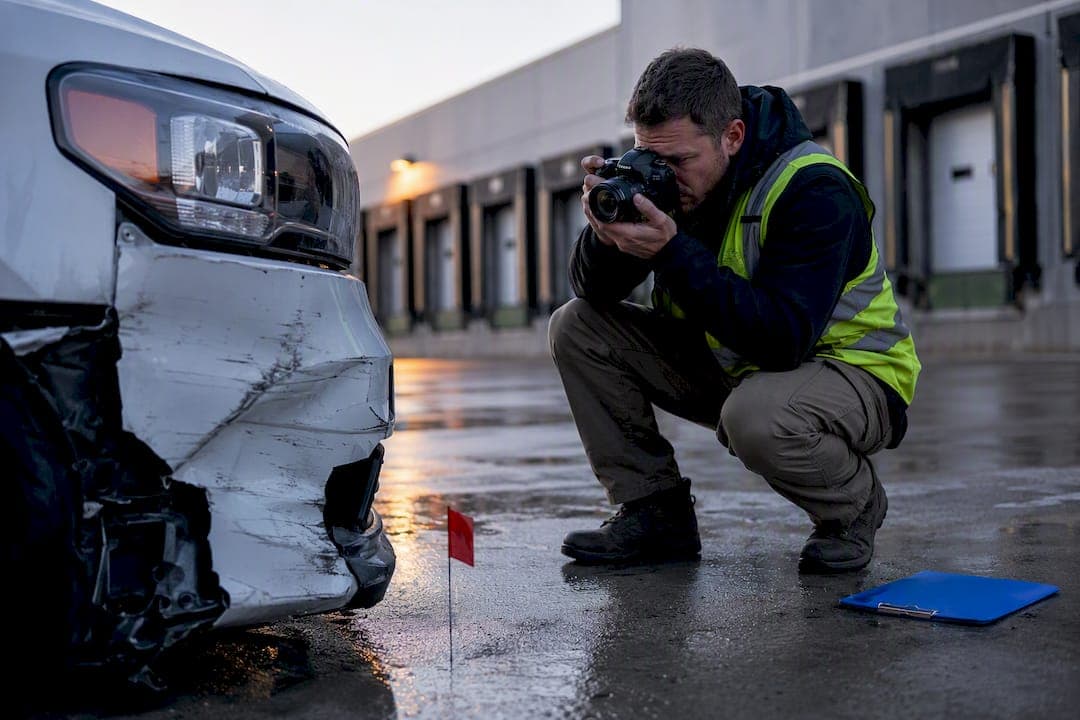
If a company vehicle hit you or you were driving one when a crash happened, the employer's commercial insurance is usually the primary target for a claim, not the driver's personal auto policy. That's because of a legal doctrine called respondeat superior, which holds employers responsible for what employees do on the job. Your first moves matter more than you think: get medical care documented immediately, and start preserving evidence before it disappears.
TL;DR:
- Insurance coverage for company vehicle accidents is typically primary and often involves higher limits than personal policies, especially for commercial carriers with minimum federal requirements exceeding one million dollars.
- Evidence preservation is crucial within the first few days, including securing surveillance footage, electronic logs, maintenance records, and witness statements before they are overwritten or lost.
- Liability usually falls under respondeat superior, making employers vicariously liable if the driver was acting within the scope of employment, but other claims like negligent hiring or negligent entrustment can also apply.
- Employees injured while driving a company vehicle generally have workers' compensation coverage, but if a third party is involved, they might also pursue a liability claim against the driver and employer.
- Early legal and documentation actions, such as sending preservation letters and contacting specialized attorneys promptly, significantly strengthen the chance of a successful claim.
Table of Contents
- What Do You Do After a Company Vehicle Accident?
- Who Can Be Held Liable for a Company Vehicle Accident?
- Which Insurance Policy Pays for a Company Vehicle Accident?
- Workers' Comp or a Lawsuit: Which Applies to You?
- Why Evidence Preservation Decides Company Vehicle Cases
- What Damages Can You Recover, and What Are the Deadlines?
- When Should You Contact an Attorney?
- How Companies Prevent Vehicle Accidents Through Training
- What Happens During the Company's Internal Investigation?
- How Should Companies Handle Driver Discipline After a Crash?
- Does a Company Vehicle Accident Threaten Your Job?
- Do OSHA or DOT Rules Apply to Your Accident?
- What Early Action Actually Changes in These Cases
- Get Matched With an Attorney Who Handles Company Vehicle Cases
- Sources
- FAQ
What Do You Do After a Company Vehicle Accident?
The first three days after a crash decide most of what happens later. Insurance adjusters move fast, companies sometimes move faster, and evidence that could prove fault has a short shelf life.
Here's the order that protects both your health and your claim:
- Call 911 and get medical attention, even if you feel fine. Adrenaline masks injuries, and a same-day medical record links your injuries to the crash in a way nothing else can.
- Document everything at the scene: the company name on the vehicle, the driver's license plate, any USDOT number printed on the door or trailer, and photos of damage, road conditions, and injuries.
- Get witness names and phone numbers before people scatter. A witness who leaves without contact information is gone for good.
- Avoid admitting fault or giving a recorded statement to the company's insurer without thinking it through first. Adjusters are trained to ask questions that sound casual but lock in language against you.
- Notify your own insurer, then ask the company's insurance carrier for a claim number so you have a paper trail from day one.
- Keep every receipt and medical record, from the ambulance bill to the prescription co-pay.
Surveillance footage from nearby businesses often gets overwritten within days. Electronic logs on commercial vehicles can be reset during routine maintenance. Witnesses forget details fast. Speed isn't optional here. For a deeper walkthrough of preservation tactics, this evidence checklist covers the ten steps that hold up in negotiations.
Pro Tip: Take a photo of the other driver's company ID badge or dashboard placard if you can do it safely. It often lists the employer's name and phone number faster than searching for it later.
Who Can Be Held Liable for a Company Vehicle Accident?
Most company vehicle claims run through one legal doctrine: respondeat superior. This principle makes an employer vicariously liable for an employee's negligent driving as long as that employee was acting within the scope of employment, according to the Legal Information Institute. You generally don't need to prove the company itself did anything wrong. You just need to show the driver was negligent while on the clock, making a delivery, running an errand, or driving between job sites.
Beyond vicarious liability, a few other paths can open up:
- Direct employer liability for negligent hiring (putting a driver with a history of DUIs behind the wheel), poor supervision, or failing to maintain the vehicle.
- Negligent entrustment, when a company hands keys to someone it knew or should have known was unfit to drive.
- Comparative negligence rules, which vary by state and can reduce your recovery if you share some fault for the crash.
- Special procedures for government vehicles, since suing a city bus, school district van, or federal agency vehicle triggers different notice rules than a private lawsuit, as Justia explains.
Understanding how liability gets allocated helps you anticipate how the company's insurer will try to shift blame back onto you.
Which Insurance Policy Pays for a Company Vehicle Accident?
Commercial auto insurance almost always pays first, and it usually carries far more coverage than a personal policy would. Federal law requires interstate commercial carriers to maintain minimum financial responsibility. Under 49 CFR § 387.9, that's $750,000 for trucks hauling nonhazardous freight, $1 million for certain hazardous materials carriers, and $5 million for buses seating 16 or more passengers.
By the Numbers: Many commercial auto policies for smaller company vehicles, like delivery vans and sales fleets, commonly start with coverage limits that are significantly higher than the liability minimums typical of personal auto policies in most states.
That gap changes everything about negotiation leverage. Higher limits mean:
- More room to negotiate a settlement that actually covers long-term medical care.
- A stronger incentive for the insurer to investigate aggressively rather than pay quickly.
- A real chance the company disputes coverage or claims the driver was "off duty," a common tactic when limits are large.
If a company claims it has no coverage or limited coverage, don't take that at face value. Ask for the policy declarations page in writing, and get an attorney involved before accepting any number.
Workers' Comp or a Lawsuit: Which Applies to You?
Which track applies depends entirely on your role in the crash.
If you were the employee driving the company vehicle when you got hurt, workers' compensation typically covers your medical bills and a portion of lost wages, and in most states it bars you from suing your own employer directly. If you were a third party, another driver, a pedestrian, a passenger in a different car, you can bring a standard injury claim (a tort claim) against the driver and the employer.
Some situations overlap. An employee driver injured by another company's negligent driver can pursue both workers' comp and a third-party claim against that outside driver, though the workers' comp insurer may claim a right to reimbursement (subrogation) from any settlement.
- Employee driver, injured on the job: file with workers' comp first.
- Third party hit by a company vehicle: pursue a liability claim against the driver and employer.
- Both apply: report to your employer immediately and let an attorney sort out the overlap.
Why Evidence Preservation Decides Company Vehicle Cases
Company vehicle crashes hinge on evidence that doesn't last. Event data recorders (the "black box" in most modern vehicles), electronic logging device records, maintenance logs, dispatch communications, and nearby surveillance video are the sources that most often determine who was really at fault.
The problem: companies sometimes repair vehicles or let systems overwrite data before anyone thinks to ask for it, whether intentionally or not. That's why attorneys send preservation letters within days of a crash, formal notices demanding the company hold onto ELD data, dashcam footage, and maintenance records before they vanish.
- Request preservation of electronic and video evidence in writing, immediately.
- Copy your own medical records and keep originals safe.
- Secure witness statements and scene photos while memories are fresh.
Pro Tip: If you suspect a nearby business has security cameras, call or visit within 48 hours. Most systems overwrite footage automatically after a few days to two weeks.
Preserved evidence doesn't just support your version of events. It directly shifts fault allocation and gives you real leverage at the negotiating table.
What Damages Can You Recover, and What Are the Deadlines?
Recoverable damages generally fall into a few buckets: medical expenses (past and future), lost income, reduced earning capacity if injuries affect your long-term work, pain and suffering, and property damage to your vehicle or belongings.
Deadlines are where claims quietly die. State statutes of limitations for personal injury typically run two to four years, but government claims move on a much tighter clock.
Deadline Alert: Claims against government-owned vehicles often require a notice of claim within 30 to 180 days, far shorter than standard injury deadlines, according to Justia's overview of employer liability. Federal claims under the Federal Tort Claims Act require an administrative claim within two years, followed by only six months to file suit if that claim is denied.
Start the process early. If a government entity owns the vehicle, confirm the notice deadline immediately, not after treatment wraps up. Keep a running file of every expense; it makes calculating settlement value far more accurate later.
When Should You Contact an Attorney?
Certain signs mean you shouldn't wait: a serious or long-term injury, an employer with thin or disputed coverage, evidence that's at risk of being lost or altered, a liability picture that's genuinely complicated, or an insurer pressuring you to settle fast or give a recorded statement.
Attorneys who handle these cases early typically send preservation letters, manage all communication with the company's insurer, build a negotiation strategy around the actual coverage limits, and file any required notices on time. That last piece alone, catching a 30-day government notice deadline, can save a case that would otherwise be barred entirely. Reviewing why hiring counsel changes outcomes is worth ten minutes before you talk to any adjuster.
A free evaluation and attorney match can get you in front of vetted local counsel within days, with no upfront cost and no obligation, right when preservation and notice deadlines matter most.
How Companies Prevent Vehicle Accidents Through Training
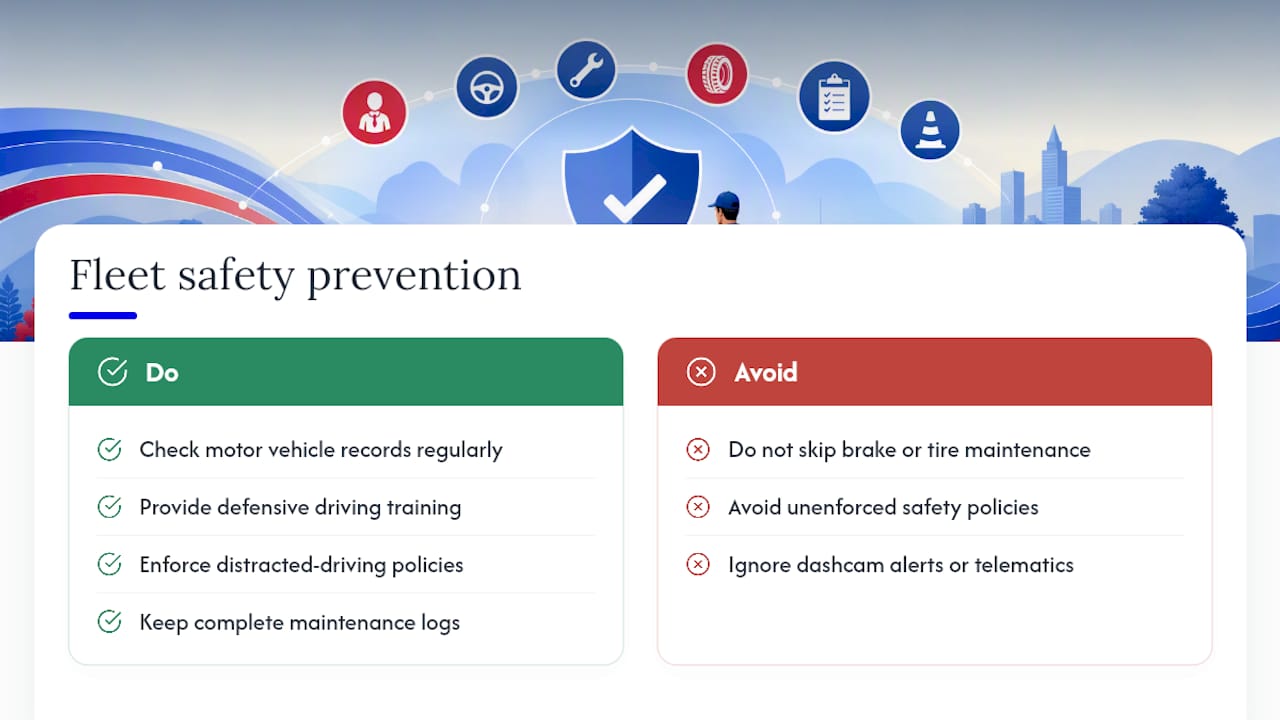
Companies that take fleet safety seriously build it into hiring, not just orientation. That starts with checking motor vehicle records before a candidate ever gets keys, and repeating that check periodically, not just once at hire.
Defensive driving training, distracted driving policies, and mandatory rest periods for drivers covered by Department of Transportation hours-of-service rules all reduce crash frequency. Many fleets now run dashcam programs that flag hard braking, speeding, and phone use in real time, letting supervisors intervene before a pattern becomes a crash.
Regular vehicle maintenance schedules matter just as much as driver training. A company that skips brake inspections or defers tire replacement to save money is building a negligent maintenance claim before a wheel ever leaves the driveway. Insurers and plaintiff attorneys both know this, which is why maintenance logs get pulled early in almost every serious company vehicle case.
The strongest fleet safety programs also build in accountability: incident review boards, driver scorecards tied to insurance premiums, and clear consequences for policy violations. Companies without a written safety policy, or one nobody enforces, tend to have worse outcomes when a crash happens and worse leverage when a lawsuit follows. If you're evaluating a company's fault after a crash, ask whether a written safety policy existed and whether it was actually followed. The gap between policy and practice often becomes the case.
What Happens During the Company's Internal Investigation?
Almost every company with a fleet runs its own investigation after a crash, and it starts fast, often within hours. A supervisor or safety officer typically documents the scene, pulls the vehicle for inspection, and downloads data from the event data recorder before the vehicle goes back into service.
This internal process serves the company's interests first. It's built to assess liability exposure, decide whether to report the incident to the insurer, and determine whether the driver violated policy. That doesn't make it dishonest, but it does mean the investigation isn't neutral, and its findings often become the foundation of the insurer's defense.
Larger companies with dedicated risk management or safety departments tend to move methodically: interviewing the driver, reviewing dashcam footage if equipped, checking the maintenance history, and comparing the incident against dispatch logs. Smaller companies sometimes skip steps entirely, which can work in a victim's favor if evidence isn't preserved before that gap becomes obvious in litigation.
This is exactly why sending your own preservation letter matters, even while the company runs its investigation in parallel. Waiting for the company to share its findings voluntarily rarely works out well for the victim; those findings surface during formal discovery, if at all, and often only after your own attorney forces the issue.
How Should Companies Handle Driver Discipline After a Crash?
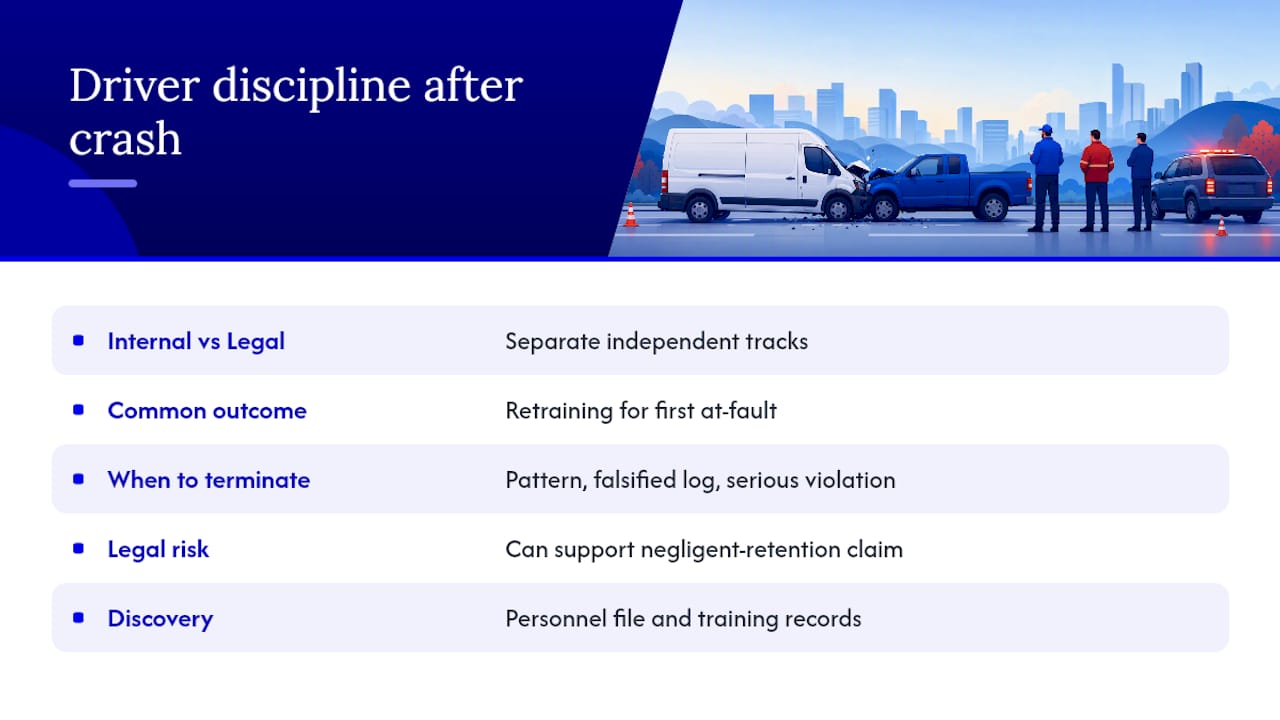
What happens to the driver internally rarely mirrors what happens legally, and that gap surprises a lot of people. A company can discipline or fire a driver for policy violations, speeding, phone use, missing a hours-of-service log, and while still disputing liability in the civil claim. The two processes run on separate tracks.
Retraining is the most common outcome for a first at-fault incident, especially when the driver's record was otherwise clean. That typically means a defensive driving refresher, a period of supervised driving, or reassignment to lower-risk routes. Termination usually follows only when the incident reveals a pattern: a prior warning ignored, a falsified log, or a violation serious enough to trigger automatic dismissal under company policy.
From a legal standpoint, how a company disciplines its driver afterward can actually become evidence. If a company retrains a driver with three prior at-fault accidents instead of removing them from the road, that decision can support a negligent retention claim, a cousin of negligent hiring that focuses on what the employer knew and did after the fact rather than before.
Victims rarely see this disciplinary process directly, but it's worth asking about during discovery if a case moves toward litigation. A driver's personnel file, including prior write-ups and training records, often becomes discoverable once a lawsuit is filed, and it can reveal whether the crash was a one-time lapse or the predictable result of a company looking the other way.
Does a Company Vehicle Accident Threaten Your Job?
If you're the employee who was driving, this question weighs on people almost as much as the injury itself, and the honest answer is: it depends heavily on fault, company policy, and whether you were following the rules at the time.
A crash that happened while you were following company policy, driving a properly maintained vehicle, during authorized work hours, rarely puts your job at direct risk on its own. Most employers distinguish between an unavoidable accident and a preventable one caused by a policy violation. If you were speeding, using a phone, or driving outside your authorized route, that changes the calculus considerably.
Workers' compensation laws in most states protect you from retaliation for filing a claim after a workplace injury, including a driving-related one. An employer that fires you specifically because you filed a workers' comp claim opens itself up to a retaliation claim, separate from the accident itself.
That said, job security concerns are real for a different reason: some companies quietly reassign drivers away from fleet duty after a crash, regardless of fault, simply to manage their own insurance premiums and risk exposure. That's a business decision, not a legal penalty, but it can feel identical from the employee's side. If you're worried about your job status after a crash, get the accident report and any internal correspondence about your standing in writing as early as possible. It protects you either way.
Do OSHA or DOT Rules Apply to Your Accident?
Whether federal safety regulations apply depends on the type of vehicle and the nature of the trip. The Occupational Safety and Health Administration doesn't regulate traffic safety directly, but it does require employers to maintain a workplace free of recognized hazards, and a poorly maintained fleet or a policy that pressures drivers to skip rest breaks can trigger an OSHA violation if a pattern of injuries follows.
The Department of Transportation's rules carry more direct weight for commercial vehicles. If the vehicle involved is a commercial motor vehicle crossing state lines, hours-of-service rules, driver qualification files, and vehicle inspection requirements under Federal Motor Carrier Safety Administration regulations all come into play. A violation of any of these, a driver who exceeded allowable hours, a truck that skipped a required inspection, becomes powerful evidence of negligence in a civil claim.
For crashes involving smaller company vehicles that never cross state lines, DOT's interstate rules typically don't apply, though state-level commercial vehicle regulations sometimes fill that gap. It's worth asking your attorney early whether the vehicle involved falls under federal DOT oversight, because that single fact can open up an entirely different set of records, driver qualification files, inspection reports, hours-of-service logs, that wouldn't otherwise be available.
What Early Action Actually Changes in These Cases
Writing about car collision law for this long teaches you one thing above all else: the cases that go well are decided in the first week, not the courtroom. Victims who call an attorney before talking to the company's insurer end up with dramatically stronger positions, because preservation letters go out while evidence still exists instead of after it's gone.
Carcollisionlawyer exists because that first week is exactly when most people feel least equipped to act. Prioritize your health, document what you can, and don't assume the company will play fair on its own timeline.
— Gerard
Get Matched With an Attorney Who Handles Company Vehicle Cases
You've just read what it takes to build a strong claim: fast documentation, early evidence preservation, and a clear read on which insurance policy actually pays. The gap most victims hit next is finding an attorney who handles commercial and company vehicle claims specifically, since these cases move differently than a routine two-car crash.
A free evaluation asks a few direct questions about your crash, your injuries, and the vehicle involved, then matches you with local attorneys who handle company and commercial vehicle claims. There's no cost and no obligation to move forward. Before you start, have your accident report, medical records so far, and any photos or witness information ready; it speeds up the matching process considerably.
If a company vehicle caused your crash, or you were driving one when it happened, start your free case evaluation now and find out what your claim could actually be worth before that early evidence disappears.
This article is general information, not a substitute for advice from a qualified lawyer. Consult a qualified legal professional about your own circumstances before acting on anything here.
Sources
FAQ
What Happens if I Get in an Accident in a Company Vehicle?
If you were driving and caused the crash, workers' compensation typically covers your injuries. If another driver caused it, you may have both a workers' comp claim and a separate liability claim against that driver.
Are Employees Responsible for Damage to Company Vehicles?
It depends on company policy and state law; some employers can seek reimbursement for damage caused by gross negligence or policy violations, but routine accidents rarely make the employee personally liable.
How Much Is a Company Vehicle Worth in Compensation?
There's no fixed figure; compensation depends on your medical expenses, lost income, and injury severity, and commercial policies often carry limits far above personal auto minimums, sometimes $1 million or more.
What to Do When a Company Vehicle Hits You?
Call 911, get medical attention, photograph the vehicle's company markings and license plate, gather witness information, and contact an attorney before giving any statement to the company's insurer.