
Liability in a car accident is the legal obligation of the at-fault driver to pay for damages and injuries caused to others in the crash. Understanding what does liability mean in a car accident context is the first step toward knowing who pays, how much, and through what process. The at-fault driver's liability insurance typically covers these costs, but when coverage runs short, personal assets become the target. Whether you caused the crash or were hit by someone else, liability determines your financial and legal exposure from the moment the collision happens.
What does liability mean in a car accident?
Liability is a legal conclusion, not just a word on a police report. Fault is determined by establishing negligence, which means proving that a driver failed their duty of care to others on the road. That failure, combined with a traffic violation or reckless behavior, is what courts and insurers use to assign responsibility.
Evidence drives every liability decision. Adjusters and attorneys examine police reports, traffic camera footage, witness statements, and physical damage patterns to reconstruct what happened. A citation for running a red light strongly suggests fault, but citations do not automatically establish legal liability. A driver can receive a ticket and still dispute fault in a civil claim.

Comparative negligence rules add another layer. In pure comparative negligence states, a plaintiff found 80% at fault can still recover 20% of their damages. This matters because many accidents involve shared fault, and your compensation can shrink significantly based on your own contribution to the crash.
Common fault scenarios include:
- Rear-end collisions: The following driver is almost always liable for failing to maintain a safe distance.
- Left-turn accidents: The turning driver typically bears fault unless the other driver ran a red light.
- Intersection crashes: Fault depends on right-of-way, signal compliance, and speed.
- Parking lot incidents: Liability often splits between drivers based on traffic flow rules.
Pro Tip: Take photos of the scene, skid marks, traffic signs, and vehicle positions immediately after a crash. This evidence is often the difference between a disputed claim and a clear liability finding.
In no-fault states like Florida, personal injury protection (PIP) covers your own medical bills up to $10,000 before liability claims against the other driver even begin. Knowing your state's system changes how you file and what you can recover.
What does liability insurance actually cover?
Liability insurance covers third-party bodily injury, property damage, and legal defense costs when you are found at fault. It does not cover your own medical bills or repairs to your vehicle. That distinction matters enormously when you are sitting in a hospital bed after a crash you caused.
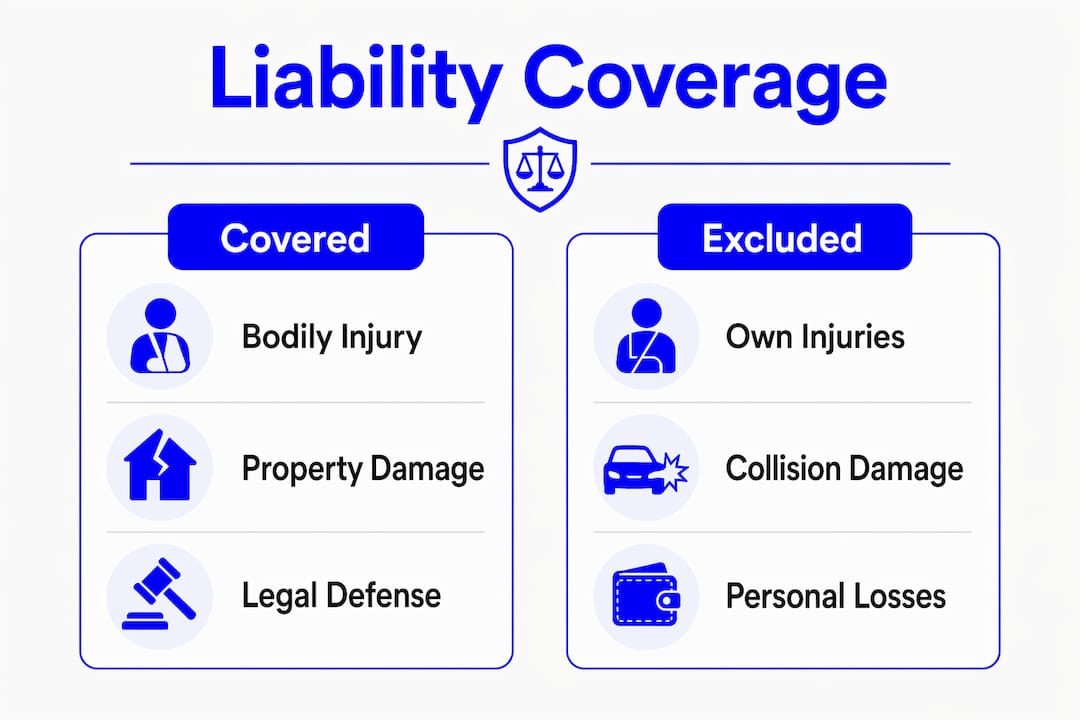
Here is a direct comparison of the main auto insurance types:
| Coverage Type | What It Pays For | What It Excludes |
|---|---|---|
| Liability | Other party's injuries and property damage | Your own injuries, your vehicle damage |
| Collision | Your vehicle repairs after a crash | Medical bills, other party's losses |
| Personal Injury Protection (PIP) | Your own medical expenses regardless of fault | Property damage |
| Uninsured Motorist | Your losses when the at-fault driver has no insurance | At-fault driver's costs |
Liability insurance excludes first-party losses, which are the costs you personally suffer. Those require collision and medical payment policies. Drivers who carry only liability coverage and cause a serious accident will find their own injuries and vehicle damage entirely out of pocket.
One underappreciated benefit: liability coverage includes legal defense costs even when claims against you have no merit. Your insurer is obligated to defend you in court regardless of whether the lawsuit is valid. That protection alone can be worth tens of thousands of dollars in attorney fees.
State minimum liability limits are dangerously low in most states. A $25,000 bodily injury limit sounds reasonable until a single emergency room visit costs $80,000. Drivers relying on minimum limits routinely face out-of-pocket exposure when real accident costs exceed those thresholds.
Pro Tip: Request a policy review with your insurer annually. Ask specifically what your per-person and per-accident bodily injury limits are, then compare them to average hospital costs in your state.
What financial risks arise when liability exceeds your coverage?
When a court judgment exceeds your policy limit, you personally owe the difference. A $50,000 policy limit against a $200,000 judgment leaves $150,000 as personal debt. That gap does not disappear. Creditors can pursue wage garnishment, bank levies, and property liens until the debt is satisfied.
The risks escalate quickly in serious accidents:
- Wage garnishment: Courts can order a portion of your paycheck directed to the injured party.
- Property liens: Your home or investment property can be encumbered until the judgment is paid.
- Bank levies: Savings accounts become accessible to creditors with a valid court order.
- Long-term collection: Judgments in most states remain enforceable for 10–20 years.
Punitive damages create a separate and often larger problem. Most liability policies exclude punitive damages, which courts award for especially reckless conduct like drunk driving or street racing. If a jury decides your behavior was egregious, you pay those damages entirely from personal funds.
"You can be personally sued if the insurer denies a claim or if a judgment exceeds your insurance policy limits, placing your personal assets at risk for compensation." — Personal Liability in Car Accidents
Underinsured drivers face a compounding problem. If the at-fault driver in your crash carries only minimum limits, uninsured and underinsured motorist coverage becomes your primary financial protection. Without it, you absorb losses the other driver cannot pay.
Who else can be held liable besides the driver?
Car accident liability in law extends well beyond the person behind the wheel. Several other parties can share or bear full responsibility depending on the circumstances.
-
Vehicle owners through negligent entrustment. Lending your car to a known unsafe driver creates liability for you as the owner. Courts require proof that you knew, or should have known, the driver was incompetent, intoxicated, or unlicensed before handing over the keys.
-
Employers under vicarious liability. When an employee causes a crash while performing work duties, the employer shares liability. A delivery driver hitting a pedestrian while on a route makes the company a defendant alongside the driver.
-
Vehicle manufacturers under crashworthiness doctrine. Manufacturers share liability when a defect worsens injuries even if they did not cause the accident. Airbags that fail to deploy or roofs that collapse in rollovers are classic examples. The manufacturer did not cause the crash, but their defective product made the injuries worse.
-
Government entities for road defects. A pothole, missing guardrail, or poorly designed intersection can make a city or state a liable party. These claims follow different rules and shorter filing deadlines than standard accident claims.
-
Bars and restaurants under dram shop laws. In many states, a business that serves alcohol to a visibly intoxicated person who then causes a crash can be held partially liable for the resulting damages.
Understanding who else may be liable is not a legal technicality. It directly affects how much total compensation is available to you after a serious crash.
Key takeaways
Liability in a car accident is the legal and financial responsibility of the at-fault party, and it extends from insurance coverage to personal assets when damages exceed policy limits.
| Point | Details |
|---|---|
| Liability defines who pays | The at-fault driver's insurance covers third-party injuries and property damage first. |
| Comparative negligence reduces recovery | Your share of fault directly lowers the compensation you can collect. |
| Liability insurance has clear limits | It covers others' losses but never your own injuries or vehicle repairs. |
| Judgments can exceed coverage | Personal assets like wages and property are at risk when verdicts surpass policy limits. |
| Liability reaches beyond the driver | Employers, vehicle owners, and manufacturers can all share legal responsibility. |
What i've learned after years of watching liability disputes play out
Most people assume that once the police report names the other driver, the liability question is settled. It is not. Police reports are evidence, not verdicts. Insurers routinely dispute fault even when a citation was issued, and they do it because the financial stakes justify the argument.
The misconception that bothers me most is the belief that "full coverage" means you are fully protected. Drivers hear that phrase from agents and assume they are covered for everything. What they actually have is liability plus collision plus comprehensive. None of that protects them from a judgment that exceeds their bodily injury limits. I have seen people lose significant savings over a single serious accident because they carried the state minimum and thought they were fine.
Document everything at the scene, even if you think the fault is obvious. Take photos, get witness names and numbers, and never admit fault verbally. What you say in the first minutes after a crash can be used against you in ways you will not anticipate. Insurers train adjusters to listen for admissions.
When liability is genuinely disputed, an attorney changes the outcome. Not because lawyers are magic, but because they know how to read policy language, challenge comparative fault assignments, and identify third-party defendants you would never think to name. If you are dealing with a serious injury and a contested liability claim, getting legal guidance on your rights is not optional. It is the practical move.
Review your coverage limits every year. Medical costs rise. Jury awards rise. The minimum limits set by your state were not designed to protect you from a serious accident. They were designed as a floor, not a ceiling.
— Gerard
Get the legal support your claim deserves
If you are dealing with a disputed liability claim or injuries from a car accident, the right attorney can make the difference between a fair settlement and a fraction of what you are owed.
Carcollisionlawyer connects accident victims with trusted attorneys who specialize in car, motorcycle, and truck collision claims. The process starts with a free evaluation so you understand your compensation options before committing to anything. Whether liability is clear or contested, having expert legal support on your side protects your financial recovery. Start your free injury evaluation today and find out what your claim is actually worth.
FAQ
What does liability mean in a car accident?
Liability in a car accident is the legal responsibility of the at-fault driver to pay for injuries and property damage caused to others. That responsibility is typically fulfilled through the driver's liability insurance policy.
Who determines who is liable after a car accident?
Insurance adjusters make the initial fault determination using police reports, witness statements, and physical evidence. Courts make the final determination if the case goes to litigation.
Does liability insurance cover my own injuries?
No. Liability insurance covers only third-party losses. Your own medical bills require personal injury protection (PIP) or medical payments coverage.
Can i be personally sued after a car accident?
Yes. If a court judgment exceeds your policy limits or your insurer denies the claim, you are personally liable for the remaining amount, which creditors can collect through wage garnishment or property liens.
What happens if both drivers share fault?
Comparative negligence rules apply. Your compensation is reduced by your percentage of fault. In some states, being more than 50% at fault bars you from recovering anything at all.