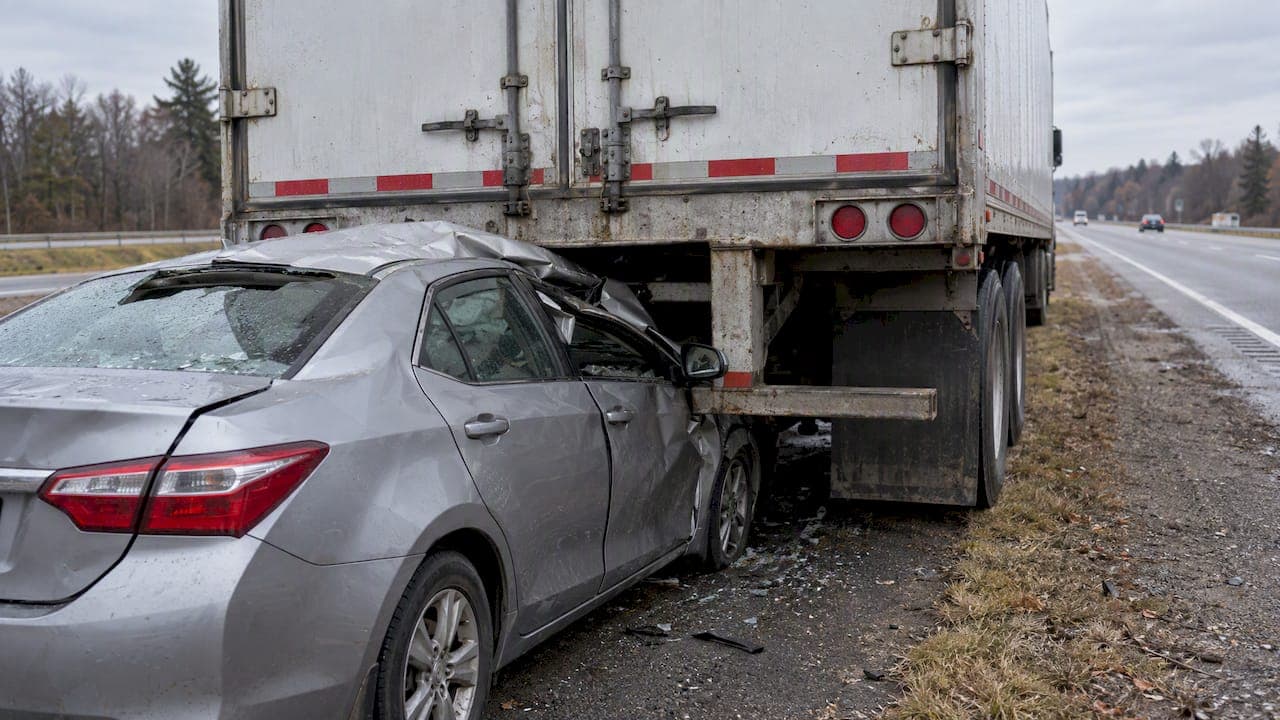
A truck underride accident claim is a personal injury or wrongful death claim that follows a crash in which a car slid beneath a tractor-trailer or other large truck. These claims often involve more than one defendant, evidence that disappears quickly and deadlines that differ by state. This guide explains what an underride crash is, who may be responsible, what compensation can include and what to do in the first days. We also show how a free case evaluation can connect you with a local attorney.
TL;DR
- An underride crash happens when a smaller vehicle slides under the rear or side of a truck or trailer. The passenger compartment can be crushed, so injuries are often catastrophic.
- Liability can reach the driver, the trucking company, the trailer owner, a maintenance contractor, the loader or the manufacturer, depending on the facts.
- Rear guards are federally required on most trailers. Side guards are not, and that gap shapes many claims.
- Filing deadlines vary by state and are shorter in some than people expect. Wrongful death deadlines can differ from injury deadlines.
- Preserve the police report, photos, medical records and the truck's identity early, then get a free evaluation before you talk to the trucking insurer.
Table of Contents
- What counts as a truck underride accident
- How common these crashes are, and why the numbers are low
- Rear guards, side guards and the gaps in the rules
- Who may be liable in an underride crash
- What compensation may be available
- Deadlines: the clock starts sooner than most people think
- What to do after an underride crash
- Perspective: why we match by injury and circumstance
- Get a free evaluation
- FAQ
- Sources
What counts as a truck underride accident
NHTSA describes an underride crash as one in which a car slides under a truck because of the difference in height between the two vehicles. Its underride crash pamphlet illustrates rear and side crashes. It also notes that the striking vehicle may pass completely under the struck vehicle and come out the other side, shearing off its roof along the way.
The two main types are worth knowing, because they lead to different legal arguments.
Rear underride
NHTSA's announcement on underride protection describes a rear underride as a crash in which the front of a vehicle hits the back of a larger vehicle, such as a trailer or semitrailer, and slides underneath it. These crashes often happen at night, in heavy traffic that slows suddenly, or when a trailer is stopped on a shoulder or in a lane with poor lighting.
Side underride
In a side underride, a passenger vehicle hits the side of a trailer, often when a truck is turning, crossing lanes or blocking a road. NHTSA's June 2024 Report to Congress addresses these crashes specifically. The trailer can intrude into the passenger compartment, and the report estimates an average of 89 light passenger vehicle occupant deaths per year in two-vehicle crashes with tractor-trailers where the vehicle underrides the trailer's side.
A fourth category, front underride, involves a smaller vehicle going beneath the front of a truck. It is less common, but it appears in the same federal discussions about guard requirements.
How common these crashes are, and why the numbers are low
The true count is uncertain. A Government Accountability Office review found that underride crashes likely occur more often than DOT data indicates, because police reports record them inconsistently. GAO pointed to differing state definitions and reporting procedures. NHTSA's pamphlet repeats the point and asks officers to write the word "underride" in crash narratives even when a form has no checkbox for it.
This matters for your claim in a practical way. If the report never says underride, the insurer may treat the crash as an ordinary rear-end or intersection collision. You or your attorney may need to build the underride record from photos, vehicle inspection and witness statements. Our guide to why rear-end accidents complicate claims covers how insurers lean on the "you hit them" assumption.
Rear guards, side guards and the gaps in the rules
Guards are steel bars or structures meant to stop a car from going under the trailer. Whether one existed, met the standard and was in working order is often the center of the case.
- Rear guards. NHTSA's final rule on FMVSS Nos. 223 and 224 upgrades the requirements for new trailers and semitrailers. They must have rear impact guards designed to prevent passenger compartment intrusion when a passenger vehicle hits at 35 mph, in both a full-width and a 50 percent overlap crash. The rule implements the Bipartisan Infrastructure Law.
- Side and front guards. GAO reports that there are no federal requirements for side or front underride guards. It also notes that single-unit trucks are not held to the same crash-tested rear guard requirements as tractor-trailers.
- Ongoing work. The Bipartisan Infrastructure Law directed an assessment of side underride guards, and NHTSA is facilitating an Advisory Committee on Underride Protection, according to the 2024 Report to Congress. That report describes a cost-benefit analysis covering feasibility, freight capacity and intermodal effects.
What does the missing federal rule mean for a victim? The absence of a mandate does not automatically end a claim. A driver can still be negligent, a company can still fail to maintain equipment, and a guard that was required can still be defective or damaged. But a lawyer will weigh how to frame the case, because "the truck had no side guard" is not by itself a violation of a federal standard. Rules and pending rulemakings change, so ask your attorney what applies to your crash date and vehicle type.
Who may be liable in an underride crash
Trucking cases rarely have one defendant. The question is who controlled the part of the system that failed. Possible parties include:
- The truck driver. Examples: stopping in a travel lane without warning devices, an unsafe turn across traffic, fatigue, distraction or driving too fast for conditions.
- The trucking company or carrier. Examples: pressure to meet delivery schedules, poor hiring or training, skipped inspections, and failing to repair a damaged or missing guard.
- The trailer owner or lessor. The company that owns the trailer may be a different business from the carrier pulling it.
- Maintenance or inspection contractors. A shop that signed off on a bent or weak guard may share fault.
- Shippers and loaders. If improper loading played a part in a lane blockage or loss of control, they may be pulled in.
- Manufacturers. A guard or trailer with a design or manufacturing defect can support a product liability claim.
- Other drivers or a road authority. Another motorist who forced the crash, or a poorly lit or designed roadway, can add defendants in some cases.
Our article on why trucking companies face wrongful death suits explains how company decisions create liability beyond the driver. For fatal crashes with several vehicles, see multi-vehicle wrongful death liability examples.
How fault is argued
Expect the defense to argue that the driver of the smaller vehicle was speeding, distracted or following too closely. States apply comparative fault rules differently, and in some a victim found mostly at fault may recover little or nothing. That is one reason early evidence matters. Evidence that tends to counter these arguments includes:
- Photos of the trailer's guard, lighting and reflective tape.
- The driver's logbook or electronic logging data, and the truck's event data.
- Maintenance and inspection records for the trailer.
- Dashcam or surveillance video, and witness names.
- The final police report, including whether it uses the word underride.
What compensation may be available
What you can recover depends on your state, the injuries and who is liable. Categories that commonly come up in injury claims include:
- Medical costs: emergency care, surgery, hospital stays, rehabilitation and future treatment.
- Lost income and reduced earning capacity if you cannot return to your job.
- Pain and suffering and emotional distress, including trauma after a violent crash.
- Property damage and the cost of home or vehicle modifications.
- In rare cases involving especially reckless conduct, punitive damages, where state law allows them.
Because of how underride crashes happen, injuries tend to be severe: head and spinal injuries, crush injuries, amputations and death. Treatment can run for years, so the value of a claim depends on future needs, not only bills to date. For context on general trucking outcomes, our piece on truck accident settlements, median versus average shows why a single average number says little about any one case. We cannot promise an outcome in your case.
Wrongful death claims
When someone dies, certain family members, or the estate, may bring a wrongful death claim. Who can sue and which damages are recoverable vary by state. The American Bar Association notes, for instance, that in New York wrongful death suits generally must be filed within two years of the death, and it stresses that the rules differ across states. Typical categories include funeral and burial costs, the income and benefits the person would have provided, loss of companionship and guidance, and in some states the pain the person suffered before death.
Two of our guides go deeper: the family guide to a truck accident wrongful death claim and what a wrongful death attorney does for families. If you need the official record, we also explain how to obtain a fatal accident police report.

Deadlines: the clock starts sooner than most people think
Every state sets a statute of limitations, the deadline for filing a lawsuit. The length varies widely by state and by claim type. Wrongful death deadlines may be measured from the date of death rather than the date of the crash. Claims against a government body, for example if a road defect contributed, can carry much shorter notice periods than a standard injury suit. Our state-by-state article, how short deadlines can kill car accident claims, is a good place to see how much the numbers differ.
Do not rely on a general rule of thumb. A missed deadline usually ends the claim no matter how strong the evidence is. Ask an attorney licensed in the state where the crash happened, and ask early. Evidence is the other clock: trucking companies may overwrite electronic data and repair or scrap damaged trailers in the ordinary course of business unless someone asks them in writing to keep it.

What to do after an underride crash
These steps protect your health first and your claim second. Follow your doctors' instructions above all.
- Call 911 and get medical care. Accept transport even if you feel fairly well. Spinal and head injuries can show up late, and records made right away tie your injuries to the crash.
- Ask that the report say underride. NHTSA asks officers to use that word. If you can, mention it to the responding officer and request the report number.
- Document the scene. If you are able, or a companion is, photograph the trailer's rear and sides, its guard, the plates, any DOT number on the cab, the lighting, road conditions and vehicle damage.
- Identify everyone involved. Get the driver's name, the carrier's name, the insurer and witness contact details.
- Keep records. Save medical bills, discharge papers, pay stubs and a short daily note on pain and limits.
- Be careful with insurers. Give basic facts to your own insurer, but do not give a recorded statement to the trucking company's insurer or sign a release before you understand your injuries and your rights.
- Get legal help quickly. A lawyer can send preservation letters so the carrier keeps the truck, trailer and electronic data.
For general guidance on reporting and documenting a crash with your own insurer, see these steps after an auto accident. Our article on car accident lawsuit mistakes that cost you compensation lists errors people make after the first week.
Perspective: why we match by injury and circumstance
We built our service around a plain observation: an underride claim is not a generic fender-bender claim, and a lawyer who handles one well should know trucking rules, evidence preservation and catastrophic injuries. That is why our intake asks about the type of crash and the nature of the injury, rather than collecting a name and a phone number and nothing else. The more specific the picture you give us, the better we can point you toward an attorney whose practice fits it.
We also think families deserve straight talk. Underride crashes are likely undercounted in the official data, which means insurers and defendants may play them down. If you suspect an underride was involved, say so early and in writing. And if someone you love died, the grief should not be the only clock running: filing deadlines are, too.
— Gerard
Get a free evaluation
If you or a family member was hurt or killed in a truck crash, our free case evaluation asks about the type of crash and the injuries, then connects you with an attorney who handles cases like yours. There is no cost to use it and no obligation to hire anyone.
We are not a law firm and we do not give legal advice. We help you reach local attorneys, and they decide whether they can take your case. You can start on our free evaluation page in a few minutes, or read more on our blog while you decide.
FAQ
Can I file a claim if the truck had no side underride guard?
Possibly. Federal rules do not currently require side or front guards, but a claim can still rest on driver negligence, unsafe company practices, poor maintenance or a defective product. An attorney can tell you which theories fit your crash and your state's law.
How long do I have to file an underride accident lawsuit?
It depends on the state and on whether the claim is for injury or wrongful death. Some states allow two years, others more or less, and claims involving government entities can have shorter notice periods. Confirm the deadline for your state with a licensed attorney as soon as possible.
Who can bring a wrongful death claim after a fatal underride crash?
That is set by state law. Often it is a surviving spouse, children or parents, or the estate's personal representative on their behalf. Recoverable damages also vary by state, so a local attorney can explain who qualifies in yours.
Does the police report need to say underride?
It helps, though a missing word does not end your claim. NHTSA asks officers to use the term, and federal reviewers have found that underride crashes are underreported. If the report leaves it out, photos, vehicle inspection and expert analysis can still show what happened.
What does it cost to find an attorney through your service?
Our evaluation is free for accident victims and carries no obligation. Any fee arrangement with an attorney is set between you and that attorney, so ask about it before you sign anything.
Sources
- NHTSA underride crash pamphlet
- NHTSA announcement on underride protection for truck trailers
- NHTSA Report to Congress on side underride protection, June 2024
- GAO, Truck Underride Guards: Improved Data Collection
- NHTSA final rule on FMVSS Nos. 223 and 224
- American Bar Association, wrongful death statutes across the United States