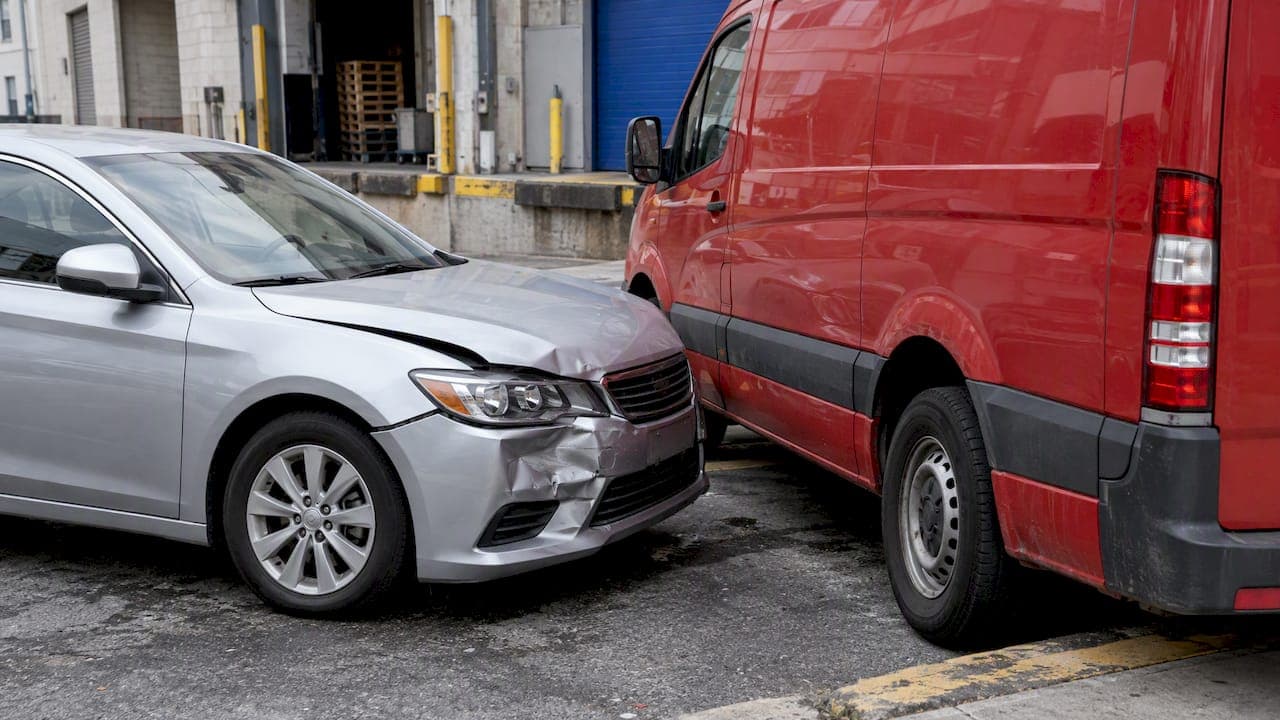
If a delivery driver hurt you in a crash, you can file a claim, but the right target is rarely obvious. Depending on the facts, the money may come from the driver's personal auto policy, the delivery company's commercial coverage, the employer directly, or a mix of them. The first step is the same in every case: protect your health and your evidence, then find out whether the driver was working at the moment of impact.
TL;DR
- A delivery driver accident claim is a normal injury claim with one extra question: was the driver on the job? That answer decides which insurance applies.
- An employer can be liable for an employee's negligence on the job, and many delivery companies say their drivers are independent contractors. Expect that argument.
- Coverage depends on the app status at the crash (offline, waiting, en route, on a delivery). Save trip data early, because platforms can overwrite records.
- Skip recorded statements to the other side's adjuster until you have advice, and check your state's filing deadline now.
- We offer a free evaluation that matches you with a local attorney based on your injury and situation.
Table of Contents
- Why delivery crashes are harder than ordinary ones
- What to do in the first hours after the crash
- Who may be liable for your injuries
- Which insurance can pay
- If you were the delivery driver
- Evidence that strengthens a delivery claim
- Be careful with the other side's insurer
- What compensation can include
- Fault rules and deadlines that can end a claim
- How the claim usually unfolds
- Our perspective
- Get a free evaluation
- FAQ
- Sources
Why delivery crashes are harder than ordinary ones
In a typical two-car collision, you deal with the other driver and their insurer. A delivery crash adds layers. The driver may be an employee of a courier or retailer, a gig worker using a personal car, or a subcontractor of a subcontractor. The vehicle may be a personal sedan, a leased van or a box truck. The insurer may be the driver's own, a commercial carrier, or a policy bought by an app.
Each layer has an incentive to point at another. A personal insurer may argue the driver was working and the commercial policy should pay. The company may argue the driver was a contractor and it owes nothing. Delivery companies commonly classify drivers as independent contractors, and that classification is one of the main reasons these claims get complicated.
None of this means your claim is weak. It means the facts about the driver's work status matter more than usual, and you should collect them early.
What to do in the first hours after the crash
The steps below follow guidance from insurance regulators and from the delivery platforms themselves.
- Get safe and call 911 if anyone is hurt. The National Association of Insurance Commissioners (NAIC) says to call 911 for injuries and to move a drivable vehicle out of traffic only if you can do it safely, according to its guidance on filing an auto claim.
- Get a police report. Write down the officer's name, badge number, contact details and the report number, and ask how to obtain the report.
- Exchange information. Collect the driver's name, address and insurance details, plus the vehicle's make, model, year and plate. Note any company name on the vehicle, uniform, bag or phone mount, and which app the driver was using.
- Document the scene. Photograph vehicle damage, the road, signals, skid marks and weather. The NAIC also suggests recording the time, date and location and sketching the scene.
- Collect witnesses. Names and phone numbers matter more than a vague promise to testify later.
- Get medical care and keep every record. Adrenaline hides injuries. A prompt exam protects your health and ties your injuries to the crash.
- Report to your own insurer. Reporting promptly is standard advice from the NAIC, and your policy may require it.
Platforms ask their own drivers to do similar things. Uber's crash guidance for drivers tells them to contact police when there are injuries or damage, save the police report number, photograph the damage, exchange insurance information and report the crash to the company. That means a company likely has its own record of the crash, which is useful to know when you later ask for it.
Who may be liable for your injuries
The driver
A driver who was speeding, distracted by a delivery app, double-parked, or backing out of a loading spot may be personally liable for negligence. The difficulty is money: a personal policy may be limited, and some personal policies exclude business use.
The employer
The American Bar Association explains that an employer can be responsible for an employee's negligence when the employee was acting within the scope of the job, a doctrine known as respondeat superior. Making a delivery is a textbook example. If the driver was a true employee, the company's insurance generally becomes part of the picture. For how GPS records and payroll data can show that link, see our guide on vicarious liability in car crash claims.
The company, when the driver is a contractor
If the driver is labeled an independent contractor, the company will likely say it is not responsible for the driver's driving. That is a defense, not the final word. Whether someone is really a contractor depends on the facts of the relationship, such as control over routes, schedules, uniforms and equipment, and the rules differ by state. Companies can also face their own negligence claims, such as negligent hiring or training, or pressure on drivers to meet unrealistic delivery times, if the evidence supports it. A local attorney can tell you which theories your state allows.
Others who may share fault
A vehicle owner who lent or leased the van, a maintenance contractor, a dispatcher, a staffing agency or a property owner with a dangerous loading zone can all enter the picture. Our overview of who owes what in a car accident walks through how fault is split.
Which insurance can pay
The Federal Trade Commission warns that personal auto insurance may not cover driving for a delivery job and that some companies provide no coverage or only cover certain periods. In practice, there are four sources to examine.
| Coverage source | What to know |
|---|---|
| Driver's personal auto policy | May deny the claim if the driver was working. Business-use exclusions are common. |
| Delivery company or app policy | Often depends on the driver's status in the app and on who was at fault. |
| Commercial auto policy of an employer | Usually applies to employee drivers and company vehicles. |
| Your own policy | Your collision, medical payments, personal injury protection or uninsured and underinsured motorist coverage may help, depending on your state. |
What the big apps say about their coverage
Published terms give you a sense of the ranges, but they come with conditions.
- Uber states that its delivery coverage depends on whether the driver was offline, online and available, en route or on a trip, and on fault. For an at-fault crash while en route or on a delivery, its third-party liability coverage may reach $500,000 or more where state law requires it.
- DoorDash says that during an active delivery its third-party liability insurance may cover up to $1,000,000 for bodily injury or property damage to others in most states.
These limits are not guaranteed payouts. They are ceilings, they depend on the driver's status and the policy's terms, and the insurer will test every condition. A crash while the app was open but no order was accepted can be treated very differently from one with food in the car. That is why trip data is central to your claim.
The Uber and DoorDash programs also include injury coverage for the drivers themselves. DoorDash's occupational accident program is aimed at the Dasher, not at the other party, so it matters mostly if the person hurt was the delivery driver.
If you were the delivery driver
Some readers searching this topic are the drivers. If you were hurt while working, you may have more than one path:
- Workers' compensation may apply if you are an employee and the employer carries it. Contractor status can block this path, and the status itself is often disputed.
- A third-party claim against another motorist who caused the crash is possible whether or not you receive other benefits.
- Platform injury coverage may provide medical or disability benefits subject to its terms and exclusions. DoorDash, for example, describes limits on medical expenses and weekly disability payments that are reduced by other income and subject to policy conditions.
- Your own insurance may respond if the app coverage does not.
Because these paths can interact, for instance when benefits you receive affect what you can recover elsewhere, talk to an attorney before signing releases or settlement papers.
Evidence that strengthens a delivery claim
Good evidence answers two questions: who caused the crash, and who was the driver working for. Beyond the basics the NAIC lists, delivery cases benefit from:
- App and trip data. Time stamps, GPS location, whether an order was active, and driver status. Platforms and fleets may overwrite electronic data on a schedule, so a prompt written preservation request from your attorney matters.
- Dashcam and nearby video. Businesses and traffic cameras often keep footage only briefly.
- Vehicle records. Branding on the car, rental or lease paperwork, maintenance logs, and, for larger trucks, driver logs and event data recorder information.
- Phone records. They can show whether the driver was handling the phone or app at impact.
- Your own paper trail. Medical records and bills, pay stubs showing missed work, repair estimates and receipts.
- Communications. Save every email, text and letter from insurers, and keep notes of calls.
Our guide to car accident evidence best practices covers the general checklist, and the page on company vehicle accidents covers the steps specific to work vehicles.
Be careful with the other side's insurer
Within days, an adjuster from the driver's insurer or the delivery company's carrier may call. They may sound friendly and ask for a recorded statement. Anything you say about pain, speed, or where you were looking can be used to reduce what they pay. You are generally not required to give a recorded statement to the other party's insurer, and it is wise to know your rights before you do. Read our walkthrough on handling a recorded statement first.
Two more cautions. Do not accept a quick settlement before you know the full extent of your injuries, because later treatment is not reimbursed once you sign a release. And do not post about the crash or your recovery on social media, since insurers look.
What compensation can include
A successful injury claim can recover economic losses and non-economic harm.
- Economic damages: current and future medical expenses, lost wages, reduced earning capacity and property damage.
- Non-economic damages: pain and suffering, emotional distress and loss of enjoyment of life.
- Wrongful death claims: when a family loses someone in a crash, certain relatives may be able to claim funeral costs, lost financial support and loss of companionship, under state law.
Amounts depend on injury severity, medical evidence, available insurance and fault. No article can honestly promise a number, and search results about a "100k settlement" cannot tell you what you would receive: that depends on your medical bills, your lost income, and how much insurance is on the table. Our page on damages recovered in car accident cases explains the categories with examples.
Fault rules and deadlines that can end a claim
Two state-law issues deserve attention early.
Shared fault. Most states reduce your recovery by your percentage of fault, but a few use a harsher rule. In a handful of jurisdictions, including Washington, DC, even a small share of fault can bar recovery. Check where your state stands in our explainer on contributory negligence states.

Filing deadlines. Every state sets a statute of limitations for injury lawsuits, and the period varies widely. Claims against government-run vehicles, such as a postal or city delivery truck, can carry much shorter notice requirements. Our state-by-state deadline guide is the place to start, and an attorney in your state can confirm the exact date for your case. Do not wait: evidence disappears long before a deadline does.
How the claim usually unfolds
- Treatment and documentation. You get care and gather records while the facts are fresh.
- Identifying the parties. Your attorney works out who employed the driver, which policies apply and which app status was active.
- Preservation letters. Formal requests go to the driver, the company and the platform to keep trip data, video and records.
- Demand. Once your medical picture is clear, a demand goes to the responsible insurers.
- Negotiation. Most claims resolve through negotiation with insurers.
- Lawsuit if needed. If insurers will not offer a fair amount, a lawsuit filed before the deadline preserves your rights.
The timeline depends on treatment length and how hard the insurers contest liability. Cases with a disputed contractor status or several policies take longer than a clear-cut one.
Our perspective
We talk with accident victims every day, and the pattern with delivery crashes is consistent: people assume the at-fault driver's insurance will simply handle it, then find that three companies are each pointing at each other. The most costly mistakes we see are avoidable. People give a recorded statement before they know the driver's status. They do not note the app or company name at the scene. They wait weeks, and the video and trip data are gone.
Our view is that you should not have to untangle this alone while you are hurt. That is why we built a free, no-obligation evaluation that asks about your specific injury and circumstances first, so the attorney you are matched with is one who handles your kind of case, whether that is a motorcycle rider hit by a van, a cyclist doored by a courier, or a family who lost someone. We do not decide who is liable and we are not a law firm. We help you reach someone who can, quickly.
— Gerard
Get a free evaluation
If you were hurt in a crash involving a delivery driver, you can request a free case evaluation. Tell us what happened and what injuries you have, and we will connect you with a local attorney suited to your situation. There is no cost to ask and no commitment to proceed. If you are still learning, our third-party claim guide explains when it makes sense to bring in a lawyer, and our rideshare accident overview covers a closely related situation.
FAQ
What happens if a delivery driver crashes into me?
Call 911 if anyone is hurt, get a police report, photograph the scene and note the company or app the driver was working for. Then seek medical care and report the crash to your own insurer. The question of who pays depends on whether the driver was working and which policies apply.
Can I sue a company if its driver hits me?
Possibly. An employer can be responsible when an employee causes harm while acting within the scope of the job. If the company calls the driver an independent contractor, the company will likely contest that, and whether it succeeds depends on the facts and state law. An attorney can assess both the employment relationship and any direct negligence by the company.
Does the driver's personal insurance cover a delivery accident?
Not always. Federal consumer guidance notes that personal auto policies may exclude business use, and some delivery companies provide coverage only during certain periods. That is why the app status at the moment of impact is so important, and why you should preserve trip data.
How long do I have to file a delivery accident claim?
It depends on your state, because each sets its own statute of limitations for injury lawsuits, and claims against government vehicles may have shorter notice rules. Check your state in our deadline guide and speak with a local attorney early, since evidence can disappear long before the deadline.
Do I need a lawyer for a delivery driver crash?
For a minor fender bender with no injuries, you may not. When you are injured, multiple companies are involved, or an insurer disputes whether the driver was working, an attorney can identify the right parties and preserve evidence. Our free evaluation can match you with one.
Sources
- NAIC: What you should know about filing an auto claim
- American Bar Association: Personal injury and negligence on the job
- FTC: Driving for extra cash? Check your car insurance first
- Uber: What to do after a car accident
- Uber: Delivery driver insurance
- DoorDash: Insurance basics for delivery drivers
- DoorDash: Occupational accident policy FAQ