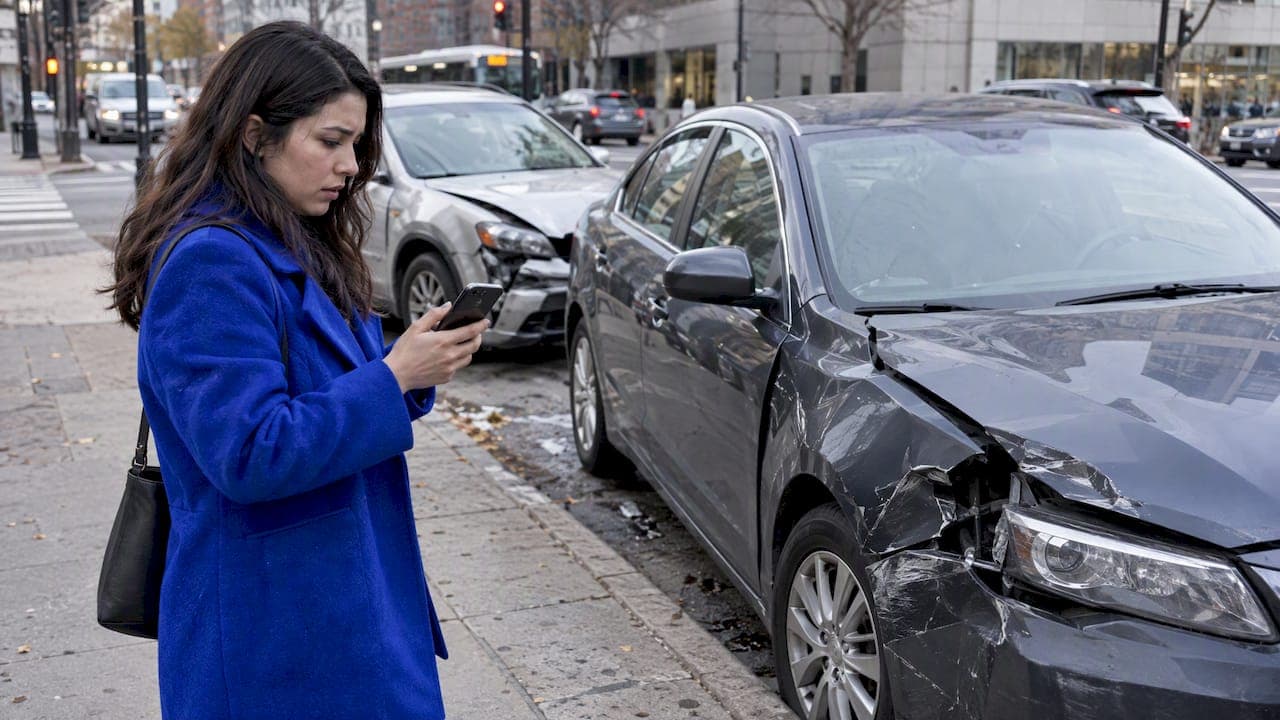
A rideshare accident claim usually goes through insurance, not a lawsuit against Uber or Lyft. Which policy pays depends on what the driver's app showed at the moment of impact: off, online and waiting, or on a trip. That status can decide whether the coverage behind your claim is the driver's personal policy or a commercial policy of at least $1 million. This guide covers how to read your situation, report the crash, protect your evidence and decide when to bring in an attorney.
TL;DR
- The driver's app status at the time of the crash decides which insurance applies. Get it pinned down early.
- When a driver is on the way to a pickup or has a passenger, the rideshare company's commercial coverage is primary. You do not need to wait for a personal insurer to deny the claim first.
- Suing Uber or Lyft directly is usually the exception. Most claims run through the insurance policies.
- Report the crash in the company's app or website, but treat that report as the start of your claim, not the end. Get medical care and keep your records.
- We offer a free, no-obligation evaluation that matches you with a vetted local attorney based on your injury and situation.
Table of Contents
- Who pays after a rideshare crash
- The three app periods that set your coverage
- The commercial policy does not wait for a denial
- Can you sue Uber or Lyft?
- How to report a rideshare accident
- What your claim can include
- Special situations
- Our perspective: what we see people get wrong
- Get a free evaluation
- How to choose an attorney for a rideshare case
- FAQ
- Sources
Who pays after a rideshare crash
A rideshare crash can involve three parties: the rideshare driver, another driver, and the company behind the app. The injured person might be a passenger, a pedestrian, a cyclist, a motorcyclist or the driver of another car. Each can have a claim, but against different policies.
The company side is regulated by state law. Most states have passed laws for transportation network companies (TNCs), the legal term for Uber, Lyft and similar services. The National Association of Insurance Commissioners (NAIC) explains that these laws require commercial insurance that protects passengers and other parties when a driver is working through the app. The details differ from state to state, so what follows is the general pattern. Your state's rules and limits control your case.
The three app periods that set your coverage
Insurers and attorneys sort rideshare crashes by what the driver's app was doing. In most states, it works like this, per the NAIC's overview of commercial ride-sharing:
| App status | What it means | Coverage that usually applies |
|---|---|---|
| Offline | Driver is not logged in | The driver's personal auto policy, like any ordinary crash |
| Online, available | Driver is logged in and waiting for a request | Limited commercial liability, often $50,000 per person, $100,000 per accident for bodily injury, and $25,000 for property damage |
| En route or on a trip | Driver accepted a ride, or has a passenger | Primary commercial liability of at least $1 million |
The middle row is where claims get messy. Personal auto policies often contain what the NAIC describes as exclusions for driving for hire. A driver without a rideshare endorsement can have a personal insurer that refuses to pay while the app was on. That is the "coverage gap," and it is why the exact status matters.
The top row is simpler than it sounds. If the app was off, you have an ordinary car accident claim, and our guide to mistakes that cost car accident victims compensation applies as written.
Why the timestamp matters so much
The company holds the data that proves status. State rules and insurers rely on it. Kentucky's regulation, for example, requires a TNC to maintain primary automobile insurance that recognizes the driver as a TNC driver. Attorneys typically request the app's timestamp and trip records to show which tier applied, because a few minutes can move a claim from one coverage level to another.

We go deeper on this in how the app timestamp decides Lyft accident claims, and the same logic applies to Uber.
The commercial policy does not wait for a denial
A common mistake is to file with the driver's personal insurer first and wait for a denial before going to the rideshare company. Under many state TNC laws, if the driver was online, the company's commercial coverage is meant to respond directly. Waiting just costs time while medical bills and the filing deadline run.
That does not mean the claim is quick. The commercial insurer will still investigate fault, your injuries and your treatment records. But you are not required to exhaust other options first.
Can you sue Uber or Lyft?
Sometimes, but it is not the usual route. These companies carry commercial liability policies that cover injuries and damages while drivers are on a trip, and that coverage is the main path to compensation. A direct lawsuit against the company is generally complicated, and tends to come up only where there is something beyond a driver's ordinary mistake, such as gross negligence or a safety failure by the company. Whether it is open to you depends on your state and your facts, which is a question for an attorney, not a rule of thumb.
For most people the useful question is not "Can I sue Uber?" but "Which policy covers my injuries, and is its limit enough?"
States keep changing the rules
California is a good example. Uber states that starting January 1, 2026, every passenger trip in California is covered by uninsured/underinsured motorist coverage of $60,000 per person and $300,000 per accident, on top of the commercial liability policy. Other states have different structures, so do not assume a limit you read about applies where you live.
How to report a rideshare accident
Both major platforms have an official process. Lyft's help center says you should call 911 for emergencies, then complete the accident report to submit a claim, which takes 10 to 15 minutes. Uber's help page says you are prompted to fill out a Crash Report, after which it notifies the appropriate insurance carriers, who investigate the claim.
A reasonable order of steps:
- Call 911 and get medical care. Even if you feel fine, some injuries show up later. Records from the first visit also link your injuries to the crash.
- Get a police report. Ask the officer for the report number.
- Photograph everything. Cars, plates, road, signs, your injuries, and the screen of the rideshare app if you were a passenger.
- Save the trip record. If you were a passenger, screenshot the receipt, the driver's name and the car details before anything changes in the app. Our piece on the one screenshot that can win an Uber accident claim explains why.
- File the platform's accident report. Stick to facts. Do not guess about fault or minimize injuries.
- Expect a call from an insurance carrier. Lyft's page says carrier contact usually comes within a few business days of the report. Take notes on every call.
- Talk to an attorney before you accept any offer or sign a release.
For a fuller checklist of what to collect, see our 10 steps for car accident evidence.
What to be careful about in recorded statements
The insurer calling you is not on your side, even when the call is friendly. Give your name, confirm basic facts, and say you will provide details after you have medical documentation and advice. A casual comment like "I'm fine" on day one can be quoted back when your injuries turn out to be serious.
What your claim can include
Compensation in a rideshare case follows the same categories as other injury claims. Which ones you can recover and any caps depend on your state.
- Medical bills, past and future
- Lost income and reduced earning ability
- Pain and suffering
- Property damage
- Emotional harm, including anxiety about riding or driving. See our guide on how accident phobia is diagnosed and documented for compensation.
- Wrongful death damages for surviving family members, where a crash was fatal
Policy limits shape what is realistic. A claim against a $1 million commercial policy has a very different ceiling from one against a minimal personal policy. Our article on Uber accident settlements looks at the range and how a match with an attorney works.
Special situations
You were a passenger
You usually have the strongest position, since the driver was on a trip and the primary commercial policy applies. Passengers are typically not blamed for the crash. You may still need to show who was at fault: the rideshare driver, the other driver or both.
You were in the other car, on a bike or on foot
Your claim is against whichever driver caused the crash. If that was the rideshare driver and the app was on, the commercial policy may be available. If you were on a bicycle, local traffic rules matter a lot, and our bicycle accident liability guide walks through them.
You were the rideshare driver
Drivers face a different set of issues. The NAIC notes that TNC coverage is not always a substitute for your own physical damage coverage, and your personal insurer may deny a claim if it finds the car was being used for rideshare without an endorsement. Check your own policy before the next shift, not after a crash.
The other driver rear-ended the rideshare car
Fault can look obvious and still be disputed. See why rear-end accidents complicate claims.
Our perspective: what we see people get wrong
We connect injured people with attorneys, so we see the first questions people ask, and they are rarely the right ones. People ask whether they can sue the company. What they should ask first is what the app showed when the crash happened, because that answer tells you which policy is in play and how much room you have.
The second thing we see is delay. People wait for a personal insurer's answer, or wait to feel better, or wait for the rideshare company to call. Meanwhile evidence goes stale and filing deadlines, which differ by state, keep running. We cannot tell you your deadline here, and nobody should guess at it. An attorney licensed in your state can.

The third is the quick offer. An early settlement can feel like relief, but once you sign a release the claim is over, even if your injuries turn out to be worse than they looked. Get your medical picture clear before you decide.
That is why we built our evaluation around the injury and the circumstances: a passenger with a fracture, a cyclist hit by a rideshare car and a family dealing with a death each need different expertise. We are not a law firm and we do not give legal advice. We help you take the first step and connect you with a vetted attorney who can.
— Gerard
Get a free evaluation
If you were hurt in a rideshare crash, you can request our free evaluation. You describe what happened and your injuries, and we match your request to a vetted local attorney who can review your options. There is no cost and no obligation to hire anyone. If you want to see how we work first, read the other guides on our blog.
How to choose an attorney for a rideshare case
Whatever route you take, ask these questions:
- Have you handled claims involving rideshare companies and their insurers?
- Are you licensed in the state where the crash happened?
- How do fees work? Many injury attorneys work on contingency, so ask what percentage applies and which costs come out of a settlement. Get it in writing.
- Who will handle my case day to day?
- Will you request the app and trip data early?
Be wary of anyone who promises a result. No honest attorney can.
FAQ
Does Uber cover car accidents?
Uber and Lyft carry commercial liability insurance that applies when a driver is working through the app, with the highest coverage when the driver is on the way to a pickup or has a passenger. When the app is off, the driver's personal insurance applies. The exact limits depend on your state.
How do I report a claim with Lyft?
Call 911 if there is an emergency, then complete Lyft's accident report, which takes about 10 to 15 minutes. You will need details about the vehicle, the driver, any riders and other parties. After that, expect contact from an insurance carrier.
How much can you get from a Lyft accident?
It depends on your injuries, who was at fault and which policy applies. The coverage limit is the ceiling: for example, a commercial policy of at least $1 million applies on a trip in most states, while the online-waiting tier is often much lower. No one can promise an amount before reviewing your medical records.
Can you sue Uber?
Sometimes, but most claims are resolved through the company's commercial insurance rather than a lawsuit against Uber itself. Direct suits are typically limited to situations involving more than ordinary driver negligence, and state law varies. An attorney in your state can tell you whether your facts support one.
How long do I have to file?
Every state sets its own deadline, called the statute of limitations, for filing an injury lawsuit. Some are as short as one or two years, so speak with an attorney quickly instead of waiting on the insurer.
Sources
- NAIC: Commercial ride-sharing insurance
- 601 KAR 1:113, Transportation Network Company (Legal Information Institute)
- Uber: Reforming insurance in California
- Lyft Help: Report an accident or collision
- Lyft: Report accident form
- Uber Help: How does the claim process work?