
Bicycle accident liability is the legal process of identifying who is responsible for causing a bike crash and who must pay for the resulting damages. Under U.S. negligence law, liability depends on duty, breach, causation, and damages. Drivers are the most common at-fault party, but liability can also fall on employers, government agencies, or equipment manufacturers. Knowing how fault is assigned protects your right to compensation and shapes every decision you make after a crash.
Bicycle accident liability explained: common fault scenarios
Drivers cause the majority of bicycle accidents through predictable, preventable violations. Drivers are found 70–100% at fault in intersection crashes and turning violations. That figure reflects how often a simple failure to check mirrors or yield properly ends with a cyclist in the emergency room.
The most common driver behaviors that create liability include:
- Failure to yield at intersections or when turning right across a bike lane
- Dooring, where a driver or passenger opens a car door into a cyclist's path
- Distracted driving, including phone use while passing a cyclist
- Speeding through areas with marked bike lanes or shared roadways
- Running red lights or stop signs at intersections where cyclists have the right of way
Cyclists can also be liable. Bicycles are treated as vehicles under statutes like Missouri Revised Statutes §300.347, meaning cyclists carry the same road responsibilities as drivers. A cyclist who rides against traffic, ignores a red light, or weaves between lanes without signaling can be assigned partial or full fault for a crash.
Pedestrian-related accidents add another layer. If a pedestrian steps into a bike lane without looking and a cyclist cannot stop in time, fault may be shared between the pedestrian and the cyclist depending on local traffic laws and the specific facts.

Pro Tip: Take photos of the exact position of every vehicle, bike, and person at the scene before anything is moved. That visual record is often the clearest proof of who violated traffic rules.
How is bicycle accident fault proven?
Proving fault in a bicycle accident claim follows the same four-part negligence framework used in most personal injury cases.
- Duty: Every road user owes a duty of reasonable care to others. Drivers must check for cyclists. Cyclists must obey traffic signals.
- Breach: The at-fault party violated that duty. A driver who ran a red light breached their duty to yield.
- Causation: The breach directly caused the crash and your injuries. A dooring incident that sends you over the handlebars satisfies causation.
- Damages: You suffered measurable harm, including medical bills, lost wages, or pain and suffering.
Evidence is what turns this legal framework into a winning claim. Insurance investigators move quickly to secure evidence after an accident. You need to move faster.
Key evidence types and their role in bicycle accident claims
| Evidence Type | What It Proves |
|---|---|
| Police report | Official record of the scene, violations cited, and initial fault assessment |
| Photographs and video | Physical positions, road conditions, traffic signals, and visible injuries |
| Witness statements | Independent accounts that corroborate or challenge each party's version |
| Medical records | Connects the crash directly to your injuries and documents severity |
| Traffic camera footage | Objective proof of signal violations, speed, or lane positioning |
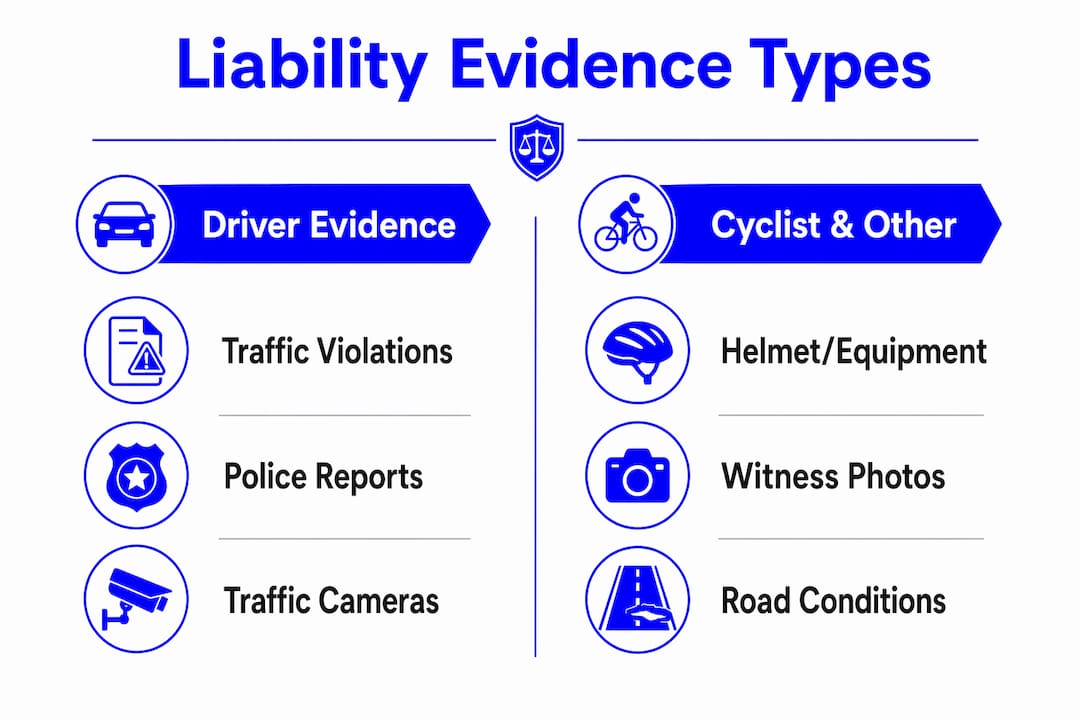
Comparative fault is a critical concept here. Many states follow a pure comparative fault rule that reduces your compensation by your percentage of fault. If you are found 20% responsible for a crash and your damages total $50,000, you recover $40,000. That math makes it worth fighting every percentage point of assigned fault.
Bicycle accident driver liability proof often comes down to traffic violation records. A driver cited for running a red light at the scene carries a strong presumption of fault. A driver who was texting, documented by phone records subpoenaed during litigation, faces near-certain liability.
Who else can be liable beyond the driver?
Bicycle accident liability examples often focus on the driver and cyclist, but three other parties can carry legal responsibility depending on the facts.
Government entities and road conditions
A city or county can be liable when a dangerous road condition contributes to a crash. Potholes, missing signage, broken traffic signals, and inadequate bike lane markings all fall under government liability via "dangerous condition" statutes. Claims against government entities follow stricter deadlines and notice requirements than standard personal injury claims, so acting quickly matters even more.
Employers of at-fault drivers
If the driver who hit you was working at the time of the crash, their employer may share liability under a legal doctrine called respondeat superior. Delivery drivers, rideshare drivers on active trips, and commercial vehicle operators are common examples. Employer liability often means access to larger insurance policies and deeper pockets for compensation.
Equipment manufacturers
A defective bike component can shift liability entirely away from road users. Faulty brakes, cracked frames, or failing wheel components fall under product liability law. The Consumer Product Safety Commission tracks hundreds of bike product recalls annually. If your crash involved a component failure, the manufacturer may owe you compensation regardless of how carefully you were riding.
Comparison: liability standards by party type
| Liable Party | Legal Standard | Key Requirement |
|---|---|---|
| Driver | Negligence | Proof of traffic violation or careless behavior |
| Cyclist | Negligence | Proof of traffic law violation or reckless riding |
| Government entity | Dangerous condition statute | Notice of defect and failure to repair |
| Employer | Respondeat superior | Driver acting within scope of employment |
| Manufacturer | Product liability | Defective design, manufacturing, or warning |
What should you do right after a bicycle accident?
The steps you take in the first 24–48 hours after a crash directly affect the strength of your claim. Evidence disappears fast. Memories fade. Insurance adjusters start building their defense before you leave the hospital.
Here is what to do immediately:
- Document the scene thoroughly. Photograph every angle of the crash site, road conditions, traffic signals, vehicle positions, and your injuries. Video is even better.
- Collect contact information. Get names, phone numbers, and insurance details from every driver involved. Ask witnesses for their contact information before they leave.
- Request the police report. If officers responded, get the report number and obtain a copy as soon as it is available. Review it for errors.
- Seek medical attention immediately. Even if you feel fine, some injuries appear hours or days later. A medical record dated the day of the crash is far stronger evidence than one from a week later.
- Avoid admitting fault. Do not apologize, speculate about what happened, or make statements about your speed or actions to anyone at the scene or to insurance adjusters.
- Consult a bicycle accident attorney early. Preserving evidence immediately and getting professional legal advice significantly improves your chances of fair compensation.
Pro Tip: When speaking with insurance adjusters, stick to basic facts only. Adjusters are trained to find statements that reduce your payout. For guidance on handling those conversations, the insurance adjuster guide from WreckMatch covers the most common traps.
Understanding bike accident claims is far easier with an attorney in your corner from the start. An experienced lawyer can identify liable parties you might overlook, calculate the full value of your damages, and push back when insurers undervalue your claim.
Key takeaways
Bicycle accident liability is determined by negligence law, and drivers bear primary fault in the majority of crashes, but shared fault, third-party liability, and evidence quality all shape the final outcome.
| Point | Details |
|---|---|
| Drivers are most often at fault | Drivers are found 70–100% liable in intersection and turning violation crashes. |
| Comparative fault reduces your payout | Your compensation is cut by your percentage of fault, making every detail of evidence count. |
| Liability can extend beyond the driver | Employers, government agencies, and manufacturers may all share legal responsibility. |
| Evidence must be collected immediately | Photos, police reports, and medical records are the foundation of any successful claim. |
| An attorney improves your outcome | Early legal representation helps identify all liable parties and maximize compensation. |
The part most cyclists get wrong about liability
Most cyclists I talk to assume the police report settles the question of fault. It does not. A police report is an officer's initial assessment based on a brief scene review. It carries weight, but it is not binding in civil court and it is frequently incomplete.
I have seen cases where a driver was not cited at the scene but was later proven liable through traffic camera footage and phone records. I have also seen cyclists assigned partial fault in police reports who successfully argued that down to zero percent once a full evidence picture emerged.
The biggest mistake injured cyclists make is waiting. They assume the legal process will unfold on its own timeline. Insurance companies do not wait. They assign adjusters, gather statements, and build their case within days of the crash. Every day you delay collecting evidence or consulting an attorney is a day the other side uses to strengthen their position.
Shared fault is the other area where cyclists consistently underestimate the stakes. A 25% fault assignment sounds minor until you do the math on a $100,000 claim. That is $25,000 you do not recover. An attorney who understands bicycle accident coverage and comparative negligence can often challenge those fault percentages with the right evidence.
The law is designed to be fair. Your job is to give it the facts it needs to work in your favor.
— Gerard
Get legal help for your bicycle accident claim
If you were injured in a bicycle accident and are trying to figure out who is liable and what your claim is worth, Carcollisionlawyer connects injured cyclists with experienced attorneys who handle exactly these cases.
Proving fault in a bike crash requires fast action, solid evidence, and a clear understanding of negligence law. The attorneys in the Carcollisionlawyer network know how to build that case, whether the liable party is a distracted driver, a negligent employer, or a government agency that ignored a dangerous road condition. Get a free injury evaluation today and find out what your claim is actually worth before you accept any settlement offer.
FAQ
Who is usually liable in a bicycle accident?
Motor vehicle drivers are most often liable, particularly in intersection crashes and turning violations where they are found 70–100% at fault. Cyclists, employers, government agencies, and manufacturers can also carry liability depending on the facts.
How is fault proven in a bicycle accident claim?
Fault is proven through the four elements of negligence: duty, breach, causation, and damages. Police reports, photographs, witness statements, medical records, and traffic camera footage are the primary tools for establishing each element.
Can a cyclist be partially at fault and still recover compensation?
Yes. Most states use comparative negligence rules that reduce your compensation by your percentage of fault rather than barring recovery entirely. A cyclist found 30% at fault on a $60,000 claim would recover $42,000.
What if a road defect caused my bicycle accident?
Government entities can be liable under dangerous condition statutes when potholes, missing signs, or broken signals contribute to a crash. These claims carry strict notice deadlines, so contacting an attorney quickly is critical.
Does liability insurance cover bicycle accidents?
A driver's auto liability insurance typically covers damages they cause to cyclists. Cyclists themselves are not required to carry liability insurance in most states, but homeowners or renters insurance policies sometimes include personal liability coverage for bike-related incidents.