Most Uber accident settlements in the U.S. fall between $10,000 for minor soft-tissue injuries and well into six figures for serious harm, with catastrophic cases sometimes reaching $1 million or more. The number that matters most isn't a national average. It's which insurance layer applies at the exact moment of the crash, based on the driver's app status, combined with how severe your injuries actually are. Document everything, get medical care immediately, and report the crash before you do anything else.
TL;DR:
- Settlements for Uber accidents range from around $10,000 for minor injuries to over $1 million for catastrophic cases, depending on injury severity.
- The applicable insurance policy depends on the driver’s app status at the crash moment, with Uber’s $1 million commercial coverage active during trips.
- Claim amount factors include documented medical costs, lost wages, pain levels, fault percentage, and quality of evidence like photos and police reports.
- Rapid reporting, thorough documentation, and prompt medical care significantly influence settlement size and claim success.
- A lawyer or free evaluation service is recommended for complex cases involving disputed fault, severe injuries, or policy limit issues.
Table of Contents
- How much does an Uber accident settlement typically pay?
- What factors determine your settlement value?
- How does Uber's insurance coverage actually work?
- Who can file a claim, and how does fault change the payout?
- What do real Uber accident settlements look like?
- How do you file a claim, and what's the deadline?
- When should you bring in a lawyer or matching service?
- What claimants get wrong after an Uber crash
- Get a Free Evaluation for Your Uber Accident Claim
- Sources
How much does an Uber accident settlement typically pay?
Settlement amounts break down fairly predictably once you sort cases by injury severity. Insurers don't value a whiplash claim the way they value a spinal fusion, and the gap between those two outcomes is enormous.
Here's roughly how the bands shake out, based on patterns reported across personal injury law firms handling rideshare cases:
- Minor soft-tissue injuries (whiplash, bruising, minor sprains): typically in the low tens of thousands
- Moderate injuries (fractures, injuries requiring surgery, herniated discs): typically tens of thousands or more
- Severe or catastrophic injuries (traumatic brain injury, paralysis, wrongful death): $250,000 to $1 million or more, depending on policy limits
One law firm's public breakdown lists minor claims in the $10,000 to $50,000 range and serious injury claims climbing past $100,000, sometimes well beyond it. A separate 2026 overview of Uber crash claims puts the full spread even wider, from around $15,000 to over $1 million, depending on injury severity and which insurance policy ends up responding.
Why such a wide spread? Two claims with nearly identical injuries can settle for wildly different amounts depending on who was clearly at fault, how well the injuries were documented, and whether the $1 million Uber commercial policy applies or a driver's personal auto policy caps the payout much lower.
What factors determine your settlement value?
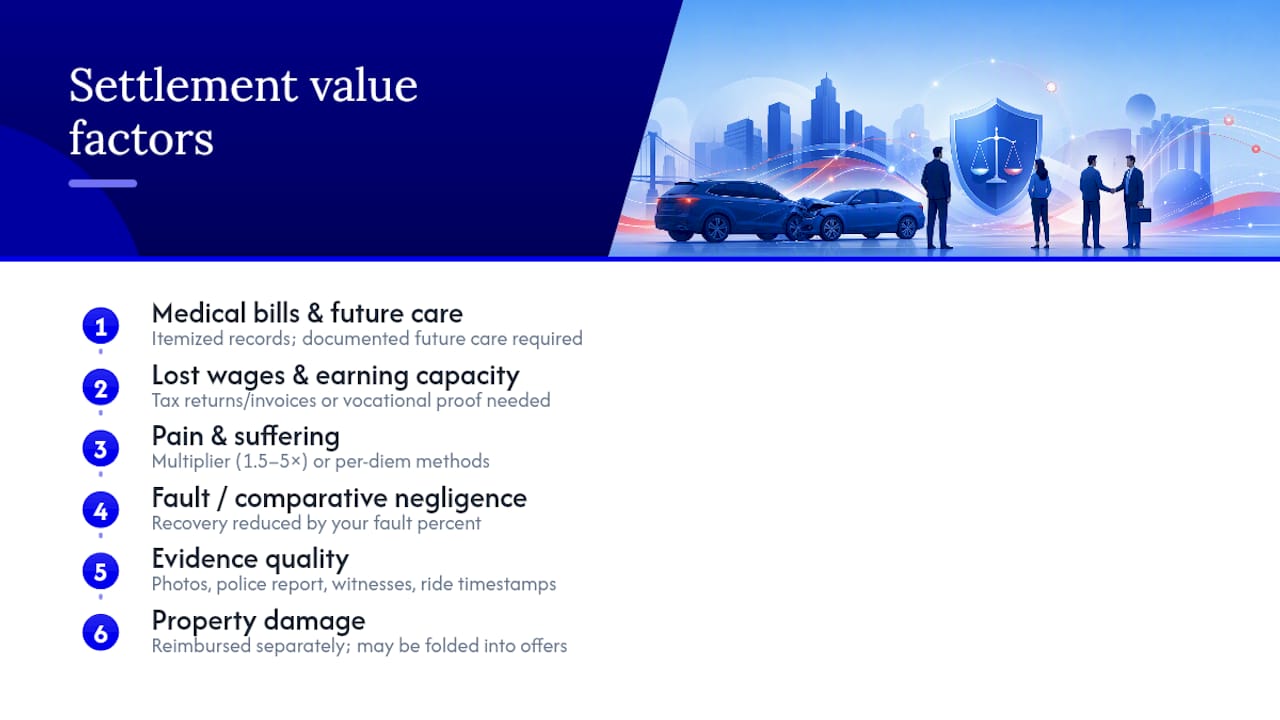
Insurance adjusters run every claim through a similar internal calculation, even if they never show you the math. Six categories drive nearly all of it.
Medical bills and future care carry the most weight. Adjusters want itemized records, not just an ER bill. If you'll need physical therapy for another year or surgery down the road, a life-care planner or treating physician needs to put that in writing. Undocumented future costs simply don't get paid.
Lost wages and earning capacity require proof beyond a pay stub. Self-employed claimants especially need tax returns, invoices, or a vocational expert's assessment showing how the injury affects future income, not just missed shifts this month.
Pain and suffering gets calculated one of two ways: a multiplier applied to your medical bills (often 1.5 to 5 times, scaled to injury severity) or a per-diem rate for each day you were symptomatic. Neither method is exact. Both give the insurer room to lowball you if your records are thin.
Fault and comparative negligence can gut a settlement fast. Most states reduce your recovery by your percentage of fault, so if you're found 20% responsible for a $100,000 claim, you walk away with $80,000.
Evidence quality ties all of this together. Photos, a police report, witness contact information, and preserved ride app timestamps either back up your numbers or leave the insurer free to dispute them.
Property damage gets reimbursed separately from injury damages and rarely moves the total much, but insurers sometimes try to fold it into a lump sum offer to make the number look bigger than it is.
Pro Tip: Ask your doctor to document not just what happened, but what your prognosis looks like six and twelve months out. A one-line note like "expected full recovery in 8 to 10 weeks" is worth more to your claim than three additional ER visits.
How does Uber's insurance coverage actually work?
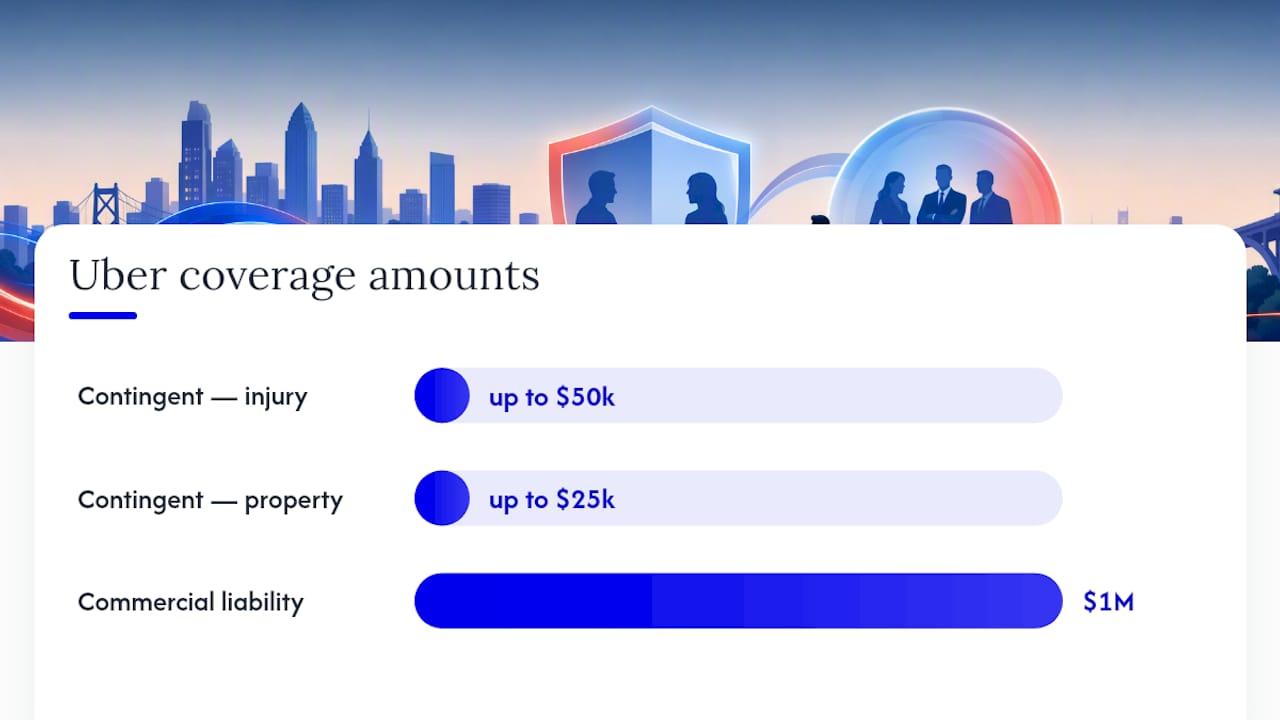
This is where most claimants get tripped up, because Uber doesn't carry one policy. It carries three tiers, and which one applies depends entirely on what the driver's app showed at the moment of impact.
- App off: The driver is using their personal vehicle with no ride app active. Only the driver's personal auto policy applies, and many personal policies exclude commercial use entirely, which can leave a real coverage gap.
- App on, waiting for a ride request: Uber provides contingent liability coverage, typically up to $50,000 per person for injury and $25,000 for property damage, filling in only where the driver's personal policy doesn't respond.
- En route to pick up a rider or during an active trip: This is when Uber's $1 million commercial liability policy kicks in, covering the driver, passengers, and third parties like other drivers or pedestrians.
That $1 million figure matters because personal auto minimums vary by state and are often far below what a serious injury actually costs, according to Massachusetts's own guidance on auto insurance basics. A driver carrying state-minimum coverage simply cannot pay out a six-figure claim on their own, which is exactly why proving Uber's commercial layer applied is often the difference between a real settlement and an uncollectible judgment.
Uber's own crash reporting guidance confirms that coverage depends on driver status and directs everyone involved, riders, drivers, and third parties, to report the crash so claims support can open a file. If the driver holds commercial livery or private-hire licensing on top of Uber's coverage, Uber also recommends notifying that commercial carrier directly.
Who can file a claim, and how does fault change the payout?
Three groups can typically pursue a claim after an Uber crash: the rider, a third party like another driver or a pedestrian, and in some cases the Uber driver themselves if another party caused the wreck. Each faces a slightly different path.
Passengers generally have the cleanest claims. As a rider, you didn't cause the crash, so your claim usually goes straight against whichever insurance layer applies to the trip. Third-party claims (say, you were driving your own car and an Uber driver hit you) work the same way, but you'll need to establish that the Uber driver was actually working at the time, which is where app status documentation becomes critical again.
Fault allocation is where things get complicated, and it varies significantly by state:
- Most states use comparative negligence, reducing your payout by your percentage of fault.
- A handful of states still use contributory negligence, which can bar you from recovering anything if you're found even 1% at fault.
- Some comparative negligence states cut off recovery entirely once your fault crosses 50% or 51%.
Avoid common scene mistakes that can hand the insurer ammunition against you: don't apologize reflexively, don't speculate about who caused the crash to police or witnesses, and don't sign anything from an insurance adjuster before speaking with a lawyer.
What do real Uber accident settlements look like?
Numbers get more useful with context. Here's how facts typically map to outcomes across the severity spectrum.
- Minor whiplash, clear liability: A rider sustains neck strain in a rear-end collision during an active trip. With clean medical records and no fault disputes, cases like this often resolve in the $15,000 to $30,000 range.
- Fractured wrist requiring surgery: A passenger breaks a wrist bracing during impact. Surgery, physical therapy, and a few weeks of lost work push cases like this into the $75,000 to $150,000 territory.
- Herniated disc with ongoing treatment: Chronic pain requiring injections and possible future surgery, combined with documented lost earning capacity, can land settlements well past $200,000.
- Traumatic brain injury: Catastrophic cases involving permanent cognitive impairment frequently approach or reach the $1 million Uber commercial policy limit, assuming that policy applies and liability is clear.
- Wrongful death: These claims often reach policy limits as well, though the amount families ultimately recover depends heavily on the decedent's earning history and state wrongful death statutes.
Most settlements are confidential, so the widely cited figures from law firm case results and news coverage tend to reflect the higher end of outcomes rather than the norm. And no matter how strong your evidence is, insurance policy limits act as a hard ceiling. A driver with only state-minimum coverage and no active trip can leave even a well-documented six-figure injury claim badly underpaid.
How do you file a claim, and what's the deadline?
Speed and documentation decide more outcomes than any negotiating tactic. Here's the sequence that protects your claim from day one.
- Get medical attention immediately, even if injuries seem minor. Untreated symptoms create gaps in your record that insurers exploit.
- Call the police and get a report. Make sure the ride ID or trip details get noted, since that record helps establish the driver's app status later.
- Photograph everything: vehicle damage, the accident scene, visible injuries, and the Uber app screen showing trip status if you can safely capture it.
- Collect witness contact information before people leave the scene.
- Report the crash to Uber through the app or its crash reporting portal, and separately notify your own insurer if you were a driver involved.
- Save every receipt tied to medical care, transportation, and any accommodations needed during recovery.
Insurers typically take two to six weeks to respond to an initial claim, and full negotiations can stretch several months, longer if litigation becomes necessary. State statutes of limitations for personal injury claims commonly run two to three years, though the exact window depends on your state and the type of claim, according to the 2026 rideshare claims overview. Miss that deadline and you lose the right to sue entirely, regardless of how strong your case was.
Pro Tip: Request your Uber ride history within the first few days after the crash. App data showing trip status can disappear from easy access over time, and it's often the single piece of evidence that determines which insurance policy responds to your claim.
When should you bring in a lawyer or matching service?
Some claims are simple enough to handle alone. A minor fender bender with clear fault and a quick recovery rarely needs legal representation. But several situations change that calculation fast.
- Surgery, hospitalization, or any injury with lasting or permanent effects
- Liability that's disputed or unclear, especially around driver app status
- A claim that could approach or exceed the $1 million Uber commercial policy
- An insurer denying coverage because the driver's personal policy excluded rideshare use, an issue uninsured motorist coverage sometimes resolves
A personal injury lawyer handling rideshare cases brings specific value: preserving evidence before it disappears, negotiating medical liens down so more of your settlement reaches you, bringing in economic experts to project future losses, and litigating when an insurer refuses a fair offer.
That's the gap a free evaluation service can help close. You submit the details of your crash and injuries, and the process matches you with a vetted local attorney suited to your specific situation, at no upfront cost. Most personal injury lawyers work on contingency, typically taking a percentage of the final settlement rather than charging hourly, so you're not paying out of pocket to find out where you stand.
What claimants get wrong after an Uber crash
The biggest mistake I see isn't a bad decision. It's inaction in the first 48 hours, when evidence is easiest to lose and hardest to recreate later. People wait to see a doctor because they feel "mostly fine," then spend months trying to convince an insurer that a symptom showing up two weeks later is actually connected to the crash.
The second mistake is treating app status as an afterthought. Whether the driver was en route or just idling with the app off changes which policy pays, sometimes by hundreds of thousands of dollars. Ask for that ride history early.
Submitting a free case evaluation doesn't commit you to anything, and the intake process doesn't play favorites between injury types or crash circumstances. It's a starting point, not a sales pitch.
— Gerard
Get a Free Evaluation for Your Uber Accident Claim
A free evaluation service gives you a faster path than researching insurance tiers and state deadlines on your own at a moment when you're recovering from an injury. You submit basic details about your crash, what happened, your injuries, and whether you were a rider, driver, or third party, and the free evaluation process matches you with a local attorney whose practice fits your specific situation, whether that's a straightforward passenger claim or a disputed liability case involving a driver's app status.
There's no cost to find out where your claim stands, and no obligation attached to submitting your information. If your injuries involved surgery, ongoing treatment, or a fault dispute, waiting to talk to someone rarely helps your case and can cost you leverage. Start your free case evaluation today and find out what your Uber accident settlement could actually be worth.
This article is general information, not a substitute for advice from a qualified lawyer. Consult a qualified legal professional about your own circumstances before acting on anything here.
Sources
- Uber — What to do in a crash / crash reporting (Uber)
- LawClaimant — Uber accident lawsuit: 2026 settlements and deadlines
- Brown & Crouppen — What is the average Uber accident settlement?
- Massachusetts government — Basics of auto insurance