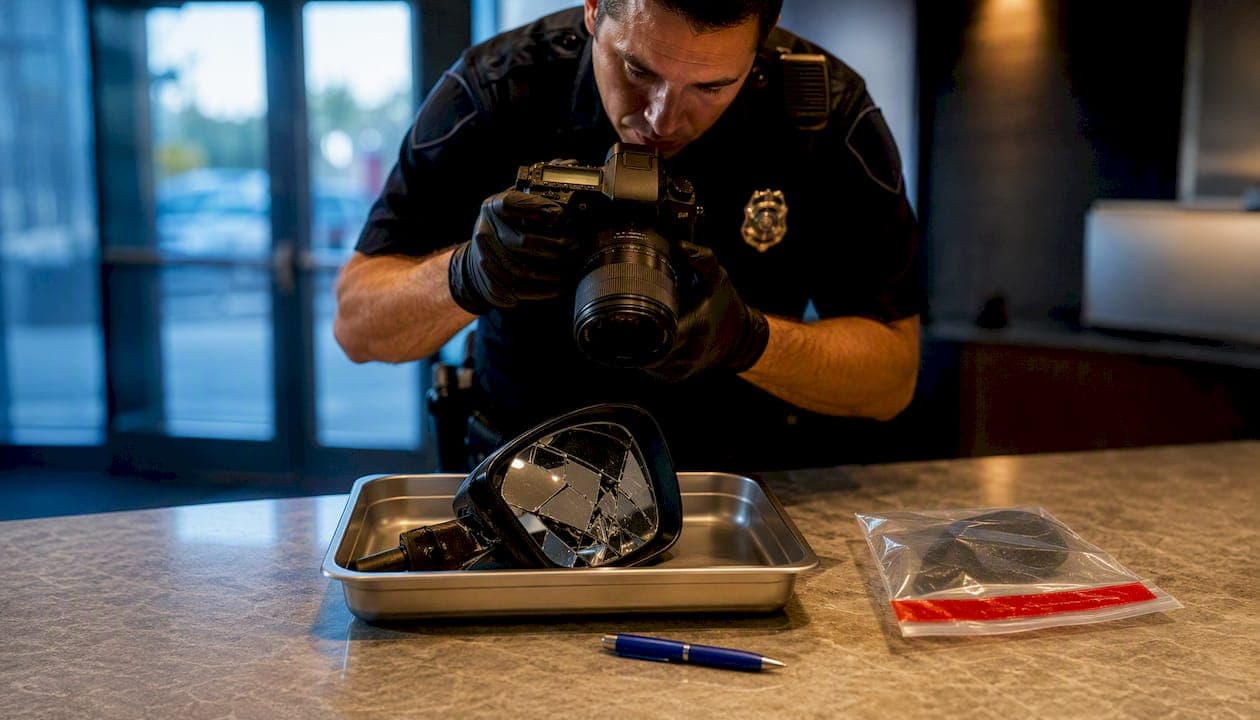
If you were injured or suffered significant loss in a hit-and-run, contact a personal injury attorney for a free evaluation now, before you talk further with any insurer. Preserve every piece of evidence you have and request a case review while details are still fresh. Insurers routinely lowball hit-and-run victims who don't have representation, and if medical treatment, disputed uninsured motorist coverage, or a stalled claim is part of your situation, you very likely need a lawyer in your corner.
TL;DR:
- Filing quickly and obtaining a police report within 24 to 72 hours is critical, especially in states with physical-contact rules for uninsured motorist claims.
- Evidence such as photos, videos, witness contacts, and medical records should be organized and collected immediately to strengthen your case.
- Most hit-and-run victims with serious injuries or losses see better outcomes by hiring an attorney to pursue uninsured motorist claims or civil suits.
- The right attorney will have experience with local rules, accident reconstruction, and insurer tactics, and will work on contingency fees if your case is successful.
- Prompt action within the first three days can significantly impact the likelihood of claim approval and a higher settlement, making early evidence collection crucial.
Table of Contents
- Who Needs a Hit-and-Run Personal Injury Lawyer?
- How Does an Attorney Pursue Compensation After a Hit-and-Run?
- What Evidence Does Your Attorney Need to Build a Strong Claim?
- What Happens at Your First Hit-and-Run Lawyer Consultation?
- What Does a Hit-and-Run Claim Cost Beyond Attorney Fees?
- How Do You Choose the Right Attorney for a Hit-and-Run Case?
- An Editorial Take on Acting Fast After a Hit-and-Run
- Get a Free Case Evaluation From Carcollisionlawyer
- Where to Learn More Before You File
- Sources
Who Needs a Hit-and-Run Personal Injury Lawyer?
Not every fender-bender with an unidentified driver requires a lawsuit. But certain situations turn a routine claim into one where an attorney's involvement changes the outcome, not just the paperwork.
Ask yourself where your case lands on this list:
- You needed medical treatment, an ER visit, hospitalization, or you're facing ongoing physical therapy or follow-up care.
- Your vehicle is a total loss, repairs are extensive, or you've lost wages while unable to work.
- Your insurer denied, delayed, or lowballed your uninsured/underinsured motorist (UM/UIM) claim, or is citing a state's physical-contact rule to deny coverage.
- Police or a witness identified the other driver, and that driver has assets worth pursuing in a civil suit.
- The crash caused catastrophic injury, permanent disability, or wrongful death.
If any of these apply, a victim with real injuries or significant losses will almost always recover more with a personal injury attorney than without one, largely because attorneys know how to price in future medical costs and pain and suffering that most people underestimate on their own. Minor cosmetic damage with no injury is the one scenario where hiring counsel may not be worth it.
How Does an Attorney Pursue Compensation After a Hit-and-Run?
When the driver who hit you vanish, your lawyer has two main roads to compensation, and the right one depends entirely on whether that driver is ever identified.
Uninsured/underinsured motorist claims are the default path when the at-fault driver is never found. You file against your own UM/UIM coverage, but roughly half of U.S. states require proof of physical contact between vehicles before they'll pay out on a hit-and-run UM claim. That single rule is why a fast police report and a witness statement matter so much: some states allow exceptions when a report was filed promptly and there's corroborating evidence.
Civil lawsuits open up if police, a witness, or surveillance footage eventually identifies the driver. At that point your attorney can pursue:
- Medical expenses and future treatment costs
- Lost wages and diminished earning capacity
- Pain and suffering
- Punitive damages, in cases involving egregious conduct like fleeing while intoxicated
Punitive damages aren't automatic. Courts reserve them for cases where the driver's behavior was reckless or willful, not simple negligence, so your lawyer will weigh whether pursuing them is worth the added litigation time.
One nuance many victims miss: a criminal investigation into the driver runs on a separate track from your civil claim. Cooperating with police doesn't require you to wait for criminal proceedings to conclude before your attorney files a civil case or a UM/UIM demand.
What Evidence Does Your Attorney Need to Build a Strong Claim?
Every hit-and-run claim lives or dies on documentation. The more organized your evidence when you walk into a consultation, the faster your attorney can evaluate the case and start pushing back against the insurer.
- Get the police report number. Many states require reporting within 24 to 72 hours for certain claims to remain valid, so don't wait. Ask for a copy or the case number before you leave the scene or the precinct.
- Photograph everything. Scene, vehicle damage, skid marks, and your own visible injuries, from multiple angles and in good light if possible.
- Chase down video. Traffic cameras, nearby business security systems, and residential doorbell cameras often catch hit-and-runs that no human witness saw clearly. Footage disappears fast, sometimes within days, so this is time-sensitive.
- Collect witness information. Names, phone numbers, and a short written statement while memories are still sharp.
- Gather medical records. Every invoice, diagnosis, and treatment note that ties your injuries directly to the crash.
- Note partial descriptors. A partial plate number, vehicle color, make, or model, plus any GPS data or phone logs from the time of the crash.
Label everything by date and category before your first consultation. A step-by-step evidence checklist can help you organize files the way an attorney will actually want to review them.
Pro Tip: Text yourself a timestamped voice memo describing the crash the moment you're safe. Memory fades within hours, and that raw, unedited account often becomes more useful to your attorney than a polished statement written days later.

What Happens at Your First Hit-and-Run Lawyer Consultation?
Most consultations for hit-and-run cases are free, and the attorney's main job in that first meeting is to figure out how strong your evidence is and which path, UM/UIM or a civil suit, actually applies to you.
Bring these items so the meeting produces real answers instead of homework for next time:
- Your police report and report number
- Photos, video, and witness contact information
- Medical records, bills, and treatment timelines
- Any letters or emails from your own insurer
- Pay stubs or documentation of lost income, if applicable
On fees, most plaintiff-side attorneys work on contingency, typically around one-third of a pre-litigation settlement, with that percentage rising if the case goes to trial. You pay nothing upfront, and if there's no recovery, you generally owe no fee. Understanding how legal fees work in accident cases before your meeting helps you ask sharper questions.
Expect your attorney to outline a rough timeline too: initial investigation, then a demand letter and negotiation window with the insurer, all bounded by your state's statute of limitations. Personal injury statutes typically run two to four years depending on the state, but some insurer notification deadlines are as short as 30 to 60 days, which is why prompt consultation matters more than people assume.
What Does a Hit-and-Run Claim Cost Beyond Attorney Fees?
Contingency fees cover your lawyer's own work, but a hit-and-run case can carry other costs that come out of your eventual settlement rather than your pocket upfront.
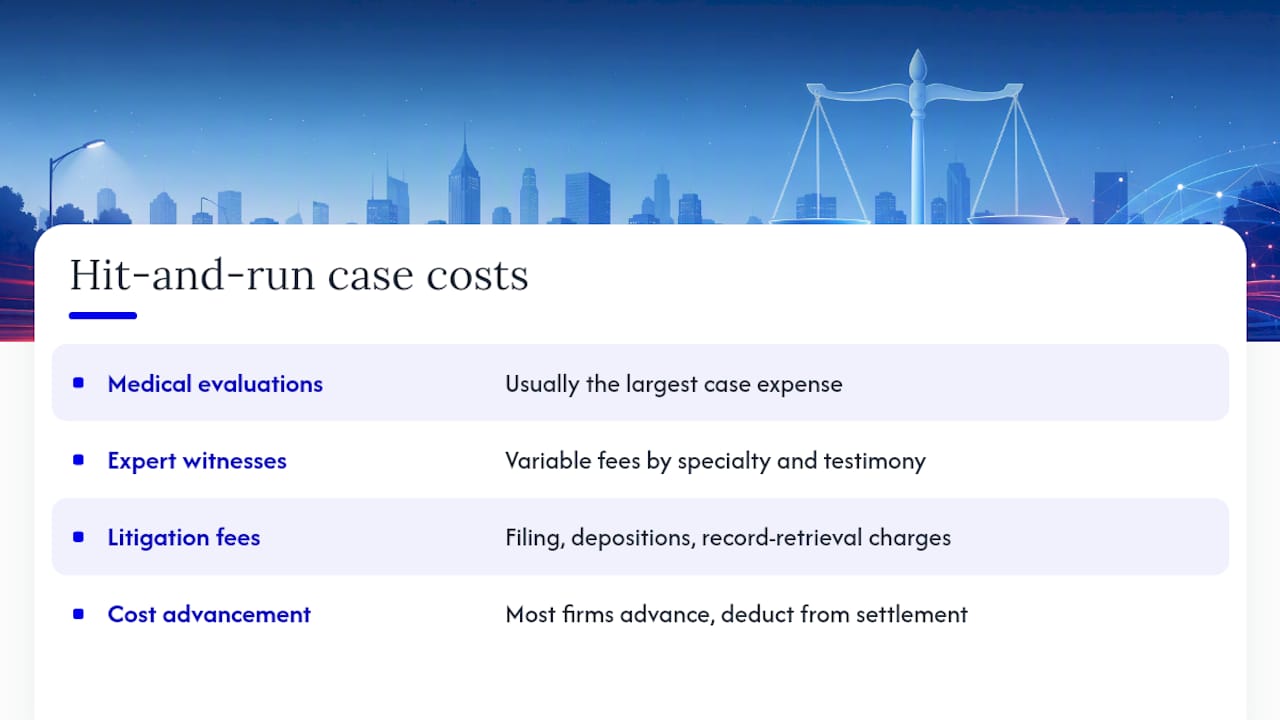
Medical evaluations are usually the largest of these. If your injuries are contested, your attorney may arrange an independent medical exam to document the extent of harm and connect it clearly to the crash. That exam, along with specialist consultations, gets billed as a case expense.
Expert witnesses come into play in more serious cases, accident reconstruction specialists who can testify about vehicle speed and impact, or vocational experts who project lost future earnings for someone who can no longer work the same job. These fees range widely depending on the expert's specialty and how much testimony the case requires.
Court filing fees, deposition costs, and record-retrieval charges add up in cases that proceed toward litigation rather than settling early. Your attorney should walk you through which of these apply to your specific case during the first consultation, not after the bill arrives.
Most firms advance these costs and deduct them from your settlement alongside the contingency fee, which is exactly why a contingency arrangement matters: it aligns your lawyer's incentive with getting you the largest possible recovery, since a bigger settlement covers those advanced costs and still leaves you with more.
How Do You Choose the Right Attorney for a Hit-and-Run Case?
Not every personal injury attorney has deep experience with hit-and-run specifics, and that gap shows up most in UM/UIM disputes, where insurers know exactly which arguments to make against an unprepared claimant.
Ask a prospective attorney these questions directly:
- How many hit-and-run or UM/UIM cases have you handled in this state?
- What's your approach when the at-fault driver is never identified?
- Do you have relationships with accident reconstruction experts if we need one?
- What's your fee structure if the case settles versus if it goes to trial?
Watch for red flags too. An attorney who guarantees a specific settlement amount before reviewing your evidence is overselling. So is one who can't clearly explain your state's physical-contact rule for UM/UIM claims, since that rule often decides whether you get paid at all. A lawyer who pushes you toward a fast, low settlement without discussing future medical costs is optimizing for a quick close, not your recovery.
Experience with insurer pushback matters more than most people realize going in. An attorney who knows adjuster tactics can often turn an initial lowball offer into a substantially larger settlement, particularly when the injuries are serious enough to justify it.
An Editorial Take on Acting Fast After a Hit-and-Run
The conventional advice on hit-and-run claims treats the police report as a formality. It isn't. In states with physical-contact rules for UM/UIM coverage, that report filed within hours, not days, is often the difference between a paid claim and a denied one. Most victims don't learn this until an adjuster already has grounds to say no.
Here's what the research actually supports: evidence quality beats legal maneuvering in the early going. An attorney can negotiate hard, but they can't manufacture a witness statement that was never taken or recover doorbell footage that got overwritten after a week. The highest-leverage move a victim can make happens in the first 72 hours, not in the negotiation room months later.
Prioritize the report, the photos, and the witness contacts before you worry about which attorney to hire. Get those secured, then get a free evaluation. The legal strategy can wait a day. The evidence can't.
— Gerard
Get a Free Case Evaluation From Carcollisionlawyer
Carcollisionlawyer connects hit-and-run victims directly to attorneys experienced in UM/UIM disputes and civil claims, without the guesswork of cold-calling law firms one by one.
The intake process asks about your injuries, the crash circumstances, and what evidence you already have, then matches you to attorneys who handle cases like yours in your state. Before you submit, gather your police report number, any photos or video, and medical records if you've already sought treatment; a more complete submission means a faster, more accurate match. Most users hear back from a matched attorney within a short window after submitting, and there's no upfront cost either way. Submissions are handled according to Carcollisionlawyer's privacy policy, and if an attorney takes your case, representation is typically on contingency, so you pay nothing unless you recover. Start your free case evaluation now while your evidence is still fresh.
Where to Learn More Before You File
For state-specific rules on hit-and-run penalties and how they intersect with civil claims, Grace Legal Group's overview of California law is a useful starting point if your crash happened there.
On the Carcollisionlawyer blog, you'll find deeper guides on uninsured motorist claims, state-by-state statute of limitations deadlines, and why hiring an attorney changes outcomes after any crash involving injury.
This article is general information, not a substitute for advice from a qualified lawyer. Consult a qualified legal professional about your own circumstances before acting on anything here.
Sources
- Do I Need a Lawyer After a Hit and Run Accident? - LegalClarity
- How will my personal injury lawyer get paid? - Nolo