
Report the crash through Lyft's accident portal or the app within hours, because your driver's status at the moment of impact decides which insurance policy pays. Call 911 if anyone is hurt, get a police report on record, and see a doctor within 24 hours even if the pain feels minor. Screenshot the trip details, driver name, route, and timestamps before the app data disappears from view.
TL;DR:
- Reporting an accident within hours is crucial to establish the driver’s app status and prevent insurance disputes over coverage tiers.
- Evidence collection at the scene, including screenshots of trip details and photos of damage, significantly reduces delays in claim processing.
- Lyft's insurance coverage varies dramatically based on app activity, with a minimum of $1 million liability when en route or in a ride, but only personal insurance applies if the app is off.
- The claim process can take several months to over a year, with settlement amounts heavily influenced by injury severity and insurance policy limits.
- Consulting a rideshare-experienced personal injury attorney is advised when fault is contested, injuries are serious, or multiple insurers are involved.
Table of Contents
- How Do You File a Lyft Accident Claim?
- How Does Lyft's Tiered Insurance Coverage Work?
- What Evidence Should You Collect After a Lyft Accident?
- How Long Does a Lyft Claim Take and What's the Average Settlement?
- When Should You Call a Personal Injury Attorney?
- What If the Other Driver Has No Insurance or Not Enough?
- CarCollisionLawyer's Perspective on Lyft Claims
- Get a Free Lyft Accident Case Evaluation
- Sources
How Do You File a Lyft Accident Claim?
Go to Lyft's accident reporting portal as soon as you're safe to do so. The form takes roughly 10 to 15 minutes and creates the official record Lyft's Claims Customer Care team uses to open a file and assign an adjuster. You can also report inside the app if you were the passenger or driver on the trip, and Lyft accepts reports from third parties too, including drivers of other vehicles involved in the crash.
Fill out the report with these details in hand:
- Your role in the accident (driver, passenger, or third-party motorist).
- Trip specifics, including the pickup and drop-off addresses and approximate time of the collision.
- Photos of vehicle damage, the scene, and any visible injuries.
- Police report number, once available.
- Contact information for witnesses and any other drivers involved.
Beyond the Lyft portal, notify your own auto insurer that you were in a rideshare-related accident. Some personal policies exclude rideshare activity entirely, which is why Lyft Help's insurance page matters here. If your insurer sends any letter denying coverage or citing a livery exclusion, save it. That letter often becomes the exact document an attorney needs to push the claim toward Lyft's policy instead of your own.
How Does Lyft's Tiered Insurance Coverage Work?
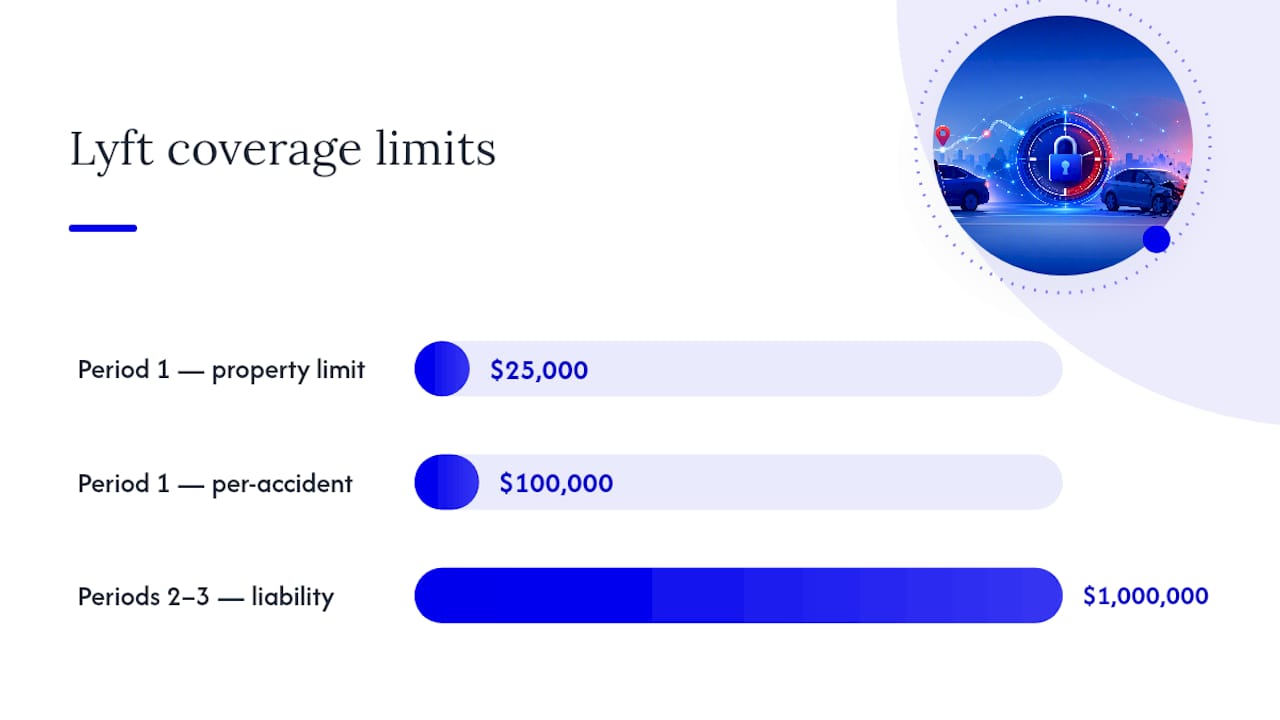
Lyft's insurance shifts based on exactly what the driver's app was doing at the moment of the crash, and that single detail can determine whether you're negotiating against a $25,000 property cap or a $1,000,000 liability policy.
- Period 0 (app off): Only the driver's personal auto policy applies. Lyft provides nothing here.
- Period 1 (app on, waiting for a ride request): Lyft's contingent coverage typically kicks in at $50,000 per person, $100,000 per accident, and $25,000 in property damage, but only after the driver's personal insurer denies the claim.
- Periods 2 and 3 (en route to pick up a rider, or a ride in progress): Coverage jumps to at least $1,000,000 in third-party liability, plus uninsured motorist, MedPay, or personal injury protection depending on your state.
Contingent collision coverage for the driver's own vehicle only applies if that driver already carries collision and comprehensive on their personal policy, and it comes with a $2,500 deductible. Some states and TLC-licensed markets like New York City run different rules entirely.
Why this matters for you: Period 1's $25,000 property limit gets exhausted fast in a multi-car pileup, and insurers frequently argue over exactly which second the app status changed. That's why the timestamp on your trip screenshot can be worth more than any single photo you take.
What Evidence Should You Collect After a Lyft Accident?
Adjusters move faster and offer fairer numbers when your documentation is organized before you even file. Build a single folder, digital or physical, and start filling it immediately.
At the scene:
- Photos of all vehicles from multiple angles, plus road signs, traffic signals, and weather conditions.
- Close-up shots of visible injuries.
- Names and phone numbers of every witness.
- License plate numbers for every vehicle involved.
Digital records:
- Screenshot the Lyft trip screen showing the driver's name, route, and timestamps before the app updates or the trip disappears from history.
- Never delete the Lyft app or clear its data, even temporarily.
Medical proof:
- See a doctor within 24 hours, even for soft-tissue pain that seems manageable.
- Keep every ER bill, physical therapy invoice, prescription receipt, and pay stub showing missed work.
Insurers frequently dispute the exact app timestamp when a crash happens right at a period boundary. A police report filed the same day, paired with your screenshots, closes most of that argument before it starts. A structured evidence checklist built the same week as the crash routinely speeds up how fast an adjuster moves on your file.
How Long Does a Lyft Claim Take and What's the Average Settlement?
Every Lyft claim moves through the same four stages: report and initial contact, investigation, demand and negotiation, and finally resolution or litigation. A minor fender-bender with clear fault can wrap up in a few months. A case involving disputed liability or serious injury can stretch past a year, especially once multiple insurance carriers get involved.
What drives the settlement number:
- Injury severity is the biggest factor. Minor injuries, sprains, whiplash, soft-tissue damage, typically settle in the low five-figure range (https://legalclarity.org/lyft-accident-settlement-amounts-what-to-expect/).
- Catastrophic injuries, think spinal damage, traumatic brain injury, or permanent disability, often push settlements into the high six-figure or more range (https://legalclarity.org/lyft-accident-settlement-amounts-what-to-expect/), depending on available policy limits.
- Comparative negligence rules in most states reduce your payout by your own percentage of fault. If you're found partially responsible, your settlement will be reduced proportionally.
- Policy limits cap everything. Even a catastrophic injury claim can't exceed what the applicable insurance tier actually covers.
Every state sets its own statute of limitations for personal injury lawsuits, commonly two years, though some states allow as little as one year or as many as six. Miss that window and you generally lose the right to sue entirely, regardless of how strong your case was. Reviewing the full claim process timeline early helps you avoid last-minute surprises.
When Should You Call a Personal Injury Attorney?
Bring in a lawyer when the insurance company's first offer feels low, when fault is contested, when your injuries require ongoing treatment, or when more than one insurer is fighting over who pays. Rideshare accidents often involve three or four policies at once, the driver's personal insurer, Lyft's contingent coverage, Lyft's excess policy, and possibly the other driver's insurer, and untangling that alone is where most claimants lose value.
An attorney typically handles:
- Subpoenaing Lyft's trip logs to lock in the exact timestamps that determine which coverage tier applies.
- Gathering complete medical records and calculating the full scope of damages, including future treatment costs.
- Negotiating directly with adjusters who are trained to minimize payouts.
- Filing suit before the statute of limitations closes, if negotiation stalls.
Most personal injury attorneys work on contingency, meaning you pay nothing upfront and they collect a percentage only if you win or settle. Free case evaluations are standard across the industry, so there's rarely a reason to skip that first conversation.
Pro Tip: Ask any attorney you're considering whether they've handled rideshare-specific claims before, not just standard car accidents. The insurance-tier disputes unique to Lyft and Uber cases trip up lawyers who mostly handle straightforward two-car crashes.
What If the Other Driver Has No Insurance or Not Enough?
Uninsured and underinsured motorist claims come up constantly in rideshare accidents, especially when a Lyft vehicle gets hit by someone carrying only the state minimum liability coverage, or none at all. Lyft's Period 2 and 3 policies commonly include uninsured/underinsured motorist (UM/UIM) coverage as part of that $1,000,000 liability package, which means passengers and drivers hurt by an underinsured third party may still have a real path to compensation.
The process starts the same way as any other Lyft claim: file through the accident reporting portal and specify that the at-fault party appears uninsured or underinsured. Lyft's claims team then verifies the other driver's coverage status, often through the police report, before determining whether its UM/UIM provision applies.
A few things complicate this process worth knowing upfront:
- Your own auto policy's UM/UIM coverage may also apply, and insurers sometimes argue over which policy, yours or Lyft's, pays first.
- Stacking rules vary by state, so whether you can combine multiple UM/UIM policies for a larger total payout depends entirely on where the accident happened.
- Documentation matters more here, not less. Without a police report confirming the other driver lacked adequate insurance, Lyft's insurer has grounds to delay or dispute the claim.
If you were a passenger and the Lyft driver themselves caused the crash while an uninsured third party also contributed, the claim can quickly involve three separate coverage disputes running in parallel. That's exactly the kind of tangle where a personal injury attorney earns the fee they charge.
CarCollisionLawyer's Perspective on Lyft Claims
Most guidance treats a Lyft accident like a generic fender-bender with an app attached. It isn't. The real fight in these cases almost never happens on the highway, it happens in the paperwork, arguing over what second the app status changed and which of three or four policies has to pay first. That's the piece most victims miss until an adjuster is already lowballing them.
CarCollisionLawyer's free evaluation exists for exactly that gap. You submit the accident date, an injury summary, and contact information, and the intake matches your specifics, driver versus passenger, minor injury versus catastrophic, to attorneys who actually handle rideshare coverage disputes rather than generic auto claims. There's no upfront fee to get matched, and the questions are built around the same tiered coverage confusion this article just walked through.
— Gerard
Get a Free Lyft Accident Case Evaluation
You've read the coverage tiers, the evidence checklist, and the timeline. If your case involves a disputed timestamp, a lowball offer, or an insurer that's gone quiet, the next move is getting a professional to look at the specifics instead of guessing at what your $50,000 Period 1 claim is actually worth against a $1,000,000 Period 2 policy.
CarCollisionLawyer's intake asks for the basics only: when the accident happened, a short summary of your injuries, and how to reach you. That information goes straight to vetted personal injury attorneys who handle rideshare cases specifically, not generalists learning the tiered-coverage system on your file. There's no upfront fee to start, and most matched attorneys work on contingency, meaning they only get paid if your claim recovers something. Start your free case evaluation and find out what your Lyft accident claim is actually worth before you accept anything an insurance adjuster offers.
This article is general information, not a substitute for advice from a qualified lawyer. Consult a qualified legal professional about your own circumstances before acting on anything here.