The official crash report for a fatal accident is held by the law enforcement agency that investigated the scene: the responding municipal police department, county sheriff, or state police. Your fastest path is to identify that agency using the case number or scene paperwork, then contact their records division directly with the minimum required identifiers and proof you are authorized to receive the record.
Before you make contact, pull together:
- Date, time, and exact location of the crash
- Agency name or police report/case number
- At least one vehicle identifier: license plate number or VIN
- Driver name and date of birth
- Proof of your authorization (government-issued ID plus documentation of your relationship to the case)
- Payment method for applicable fees
Pro Tip: Fatal-crash records are routinely blocked from online portals. Plan from the start to submit a written mail request to the agency's records division, and consult an attorney early if you need an unredacted copy.
Key Takeaways
Obtaining a fatal-crash police report requires identifying the correct investigating agency, supplying the right identifiers and proof of authorization, and choosing the request channel the agency actually accepts for fatality cases.
| Point | Details |
|---|---|
| Identify the right agency | Check scene paperwork or call dispatch; state police hold highway reports separately from local agencies. |
| Fees range from $4 to $20 | Maryland charges $4; Florida and South Carolina charge $10 per report; payment methods vary by agency. |
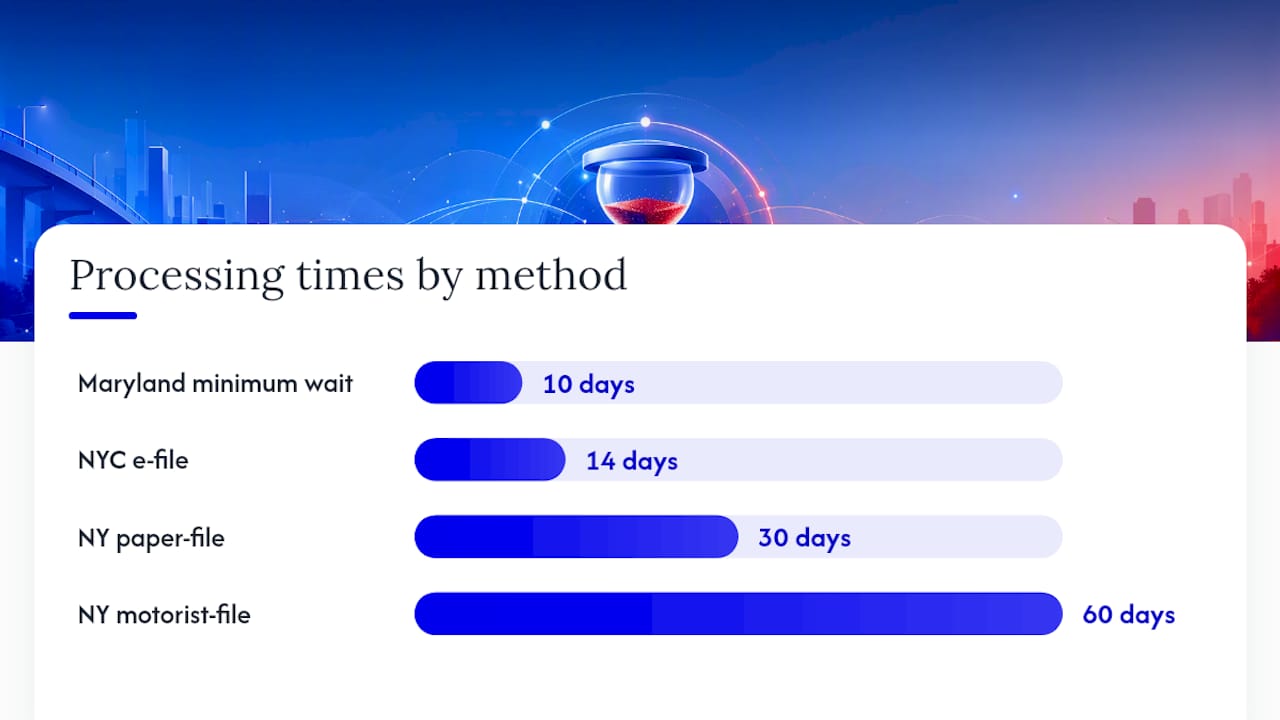
| Processing takes 10 days to 6+ weeks | Maryland requires 10 days minimum; New York paper reports take 30 days; mailed Florida requests take 4–6 weeks. |
| Fatality records often block online access | Large agencies like LAPD restrict portal access for fatal crashes; submit a signed written request to the records division. |
| Carcollisionlawyer offers free attorney matching | Connect with a local wrongful-death attorney who can issue subpoenas and preservation letters at no cost to request a match. |
Table of Contents
- What's the difference between the scene report and the official crash report?
- Who is authorized to receive a fatal-accident report?
- How do you find which agency actually holds the report?
- How to request the report: online, by mail, and in person
- What are typical fees and how long does it take?
- How do certified copies and investigative files work in legal proceedings?
- When should you contact an attorney or legal-representative service?
- What most people get wrong about this process
- Free attorney matching for fatal crash records and claims
- Sources
What's the difference between the scene report and the official crash report?
The paperwork exchanged at the scene is not the same document you need for insurance or litigation. The officer's field notes or incident card are preliminary. The finalized crash report is the version processed by the investigating agency and, in many states, forwarded to a central DMV repository. That version carries additional verification, standardized fields, and often supplemental attachments.
The NY DMV makes the distinction explicit: the quick record you see at the scene differs from the verified, legally usable version in the DMV system. For insurance claims or wrongful-death litigation, you need the finalized version.
A complete official crash report typically contains:
- Officer's narrative and diagram of the collision
- Witness statements and contact information
- Contributing factors (speed, impairment, road conditions)
- Vehicle and occupant damage summaries
- Supplemental reports filed after the initial investigation
Sensitive data, including witness contact details and medical information, is often redacted in the copy released to the public. Unredacted versions generally require a court order or subpoena.
Who is authorized to receive a fatal-accident report?
Most states permit the following parties to request a crash report:
- Drivers and vehicle owners directly involved in the crash
- Next of kin or immediate family members of a deceased victim
- Licensed attorneys representing any involved party
- Insurance companies with a legitimate claim interest
- Courts and government agencies with statutory authority (DPPA permitted users)
State rules vary considerably. For fatality cases specifically, many jurisdictions block online access entirely and require mailed or in-person requests accompanied by signed statements or certified documents. Massachusetts RMV notes that legal representatives often need extra documentation beyond standard ID, and recommends waiting roughly four weeks before submitting a request.
Pro Tip: If you are requesting as next of kin, bring a certified copy of the death certificate and your own government-issued ID. An attorney letter of representation is the fastest way to unlock access to restricted or redacted records.
Typical proof of authorization by requestor type:
- Involved driver or owner: government ID plus vehicle registration
- Next of kin: government ID plus death certificate or relationship documentation
- Attorney: letter of representation on firm letterhead, or a signed authorization from the client
- Third-party representative: notarized power of attorney plus government ID
How do you find which agency actually holds the report?
- Check scene paperwork first. The exchange form or receipt given at the scene usually names the investigating agency and includes a case number. That number is your fastest search key.
- Call 911 dispatch for the jurisdiction. If you have no paperwork, dispatch can confirm which agency responded and provide the records division contact.
- Search the state DMV crash portal. Many states centralize reports. Use the crash date, county, VIN, or plate number to search. New York State Police, for example, handle reports for crashes on major highways separately from local agencies, and those must be requested through the appropriate state authority or DMV.
- Work from most specific to broadest. When multiple jurisdictions are plausible, query in this order: municipal police → county sheriff → state police → state DMV repository.
Before contacting any agency, have these fields ready: crash date and approximate time, exact street address or highway milepost, county, vehicle plate number or VIN, and the full name and date of birth of at least one driver.
How to request the report: online, by mail, and in person
Online requests
Check the state or agency crash portal first. Large state portals like Florida's allow immediate download for available reports. The Florida Crash Portal charges $10 per report plus a portal convenience fee; mailed requests from the same agency take 4–6 weeks. Texas DOT similarly offers online purchase, but restricts access for fatality, arrest, and juvenile categories.
For fatal crashes, the LAPD and many large agencies block online access entirely for sensitive cases, requiring a records-division submission instead.
By mail
- Download and complete the agency's request form (example: SCDMV Form FR-50 for South Carolina, which charges $10 per report by mail).
- Write a signed request letter (see sample below).
- Include photocopies of your government-issued ID and any authorization documents.
- Enclose payment by check or money order as the agency requires.
- Mail to the records division address listed on the agency's website.
Sample mail/email request wording:
To the Records Division: I am requesting a certified copy of the official crash report for the following incident: Date: [MM/DD/YYYY], Location: [Street address or highway, City, County, State], Report/Case Number (if known): [XXXXXXX], Vehicle plate or VIN: [XXXXXXX], Driver name: [Full name], DOB: [MM/DD/YYYY]. I am the [relationship: next of kin / attorney of record / involved driver] and have enclosed [ID copy / death certificate / letter of representation] as proof of authorization. Please contact me at [phone/email] if additional documentation is required. I am requesting a certified copy for use in legal proceedings. [Your name, address, signature, date]
In person
Call the records division ahead of time to confirm hours and whether an appointment is needed. Bring original ID, proof of relationship or representation, the exact incident identifiers, and payment. Some agencies release the report on the spot; others mail it within their standard processing window.

Pro Tip: If a portal rejects your request for a fatality record, do not resubmit online repeatedly. Call the records division directly, confirm the correct submission method, and send a signed written request by certified mail with return receipt.
What are typical fees and how long does it take?
Fees range from roughly $4 to $20 per report depending on the state. Maryland State Police charge a $4 document search fee and ask requestors to wait at least 10 days before submitting. Florida charges $10 plus a convenience fee for online access. South Carolina's mail fee is $10 per report. New York's processing windows vary by filing method: electronically filed NYC reports are available after at least 14 days, paper-filed reports after 30 days, and motorist-submitted reports after 60 days.
Complex fatality investigations can extend these timelines significantly. If the case involves an ongoing criminal prosecution, the report may be partially or fully withheld until the investigation closes.
When the report is not yet available:
- Keep proof of every request (certified mail receipts, portal confirmation numbers).
- Set a calendar reminder to recheck after the agency's stated minimum window.
- Call the records division for a status update rather than resubmitting.
- Contact an attorney immediately if a claims deadline or evidence-preservation deadline is approaching.
How do certified copies and investigative files work in legal proceedings?
A standard copy is sufficient for many insurance purposes. A certified copy carries the agency's official seal or attestation and is required for court filings, wrongful-death claims, and any proceeding where chain of custody matters. Request certified copies from the start; retrofitting certification later adds time.
Beyond the crash report itself, litigation often requires supplemental investigative files: scene photographs, body-worn camera footage, toxicology results, and witness statements. These are typically held by the investigating agency's evidence or records unit, not the DMV. To access them:
- Submit a separate records request to the agency's evidence or detective division.
- Issue a preservation letter immediately to prevent routine destruction of footage or physical evidence.
- Serve a subpoena through your attorney when the agency declines a voluntary release.
Unredacted records containing witness contact information or medical details almost always require a court order. States vary on the threshold, but the practical rule is: if the report has black bars over anything material to your claim, your attorney needs to file for an order compelling disclosure. Preserving car accident evidence early is the single most effective way to avoid losing access to records that agencies routinely purge on schedule.
When should you contact an attorney or legal-representative service?
Some situations call for counsel before you even submit a request:
- The agency refuses access or says the report is sealed.
- The released copy is heavily redacted and the missing content is material to your claim.
- The crash crossed multiple jurisdictions (city, county, and state highway all involved).
- A statute of limitations or evidence-preservation deadline is within weeks.
- A criminal prosecution is running parallel to your civil claim.
An attorney can prepare and serve subpoenas, file motions for unredacted records, issue preservation demands to prevent evidence destruction, and coordinate requests across multiple agencies simultaneously. For families navigating a wrongful-death claim, that coordination is often the difference between a complete evidentiary record and a case built on gaps.
Pro Tip: Have the following ready before your first attorney call: the agency name, case number, crash date and location, names of all involved parties, and any denial letters or portal rejection notices you have received.
What most people get wrong about this process
The most common mistake is contacting the wrong agency entirely. Someone calls the county sheriff when the crash happened on a state highway, or searches a DMV portal that does not hold fatality records for that jurisdiction. The second most common mistake is submitting a request without the required identifiers and getting a "no record found" response that is actually a search failure, not a genuine absence of the report.
Three steps that prevent most of these problems: gather every identifier from scene paperwork before making any contact; call the agency's records division to confirm the exact submission procedure for a fatality case; and if access is restricted or the report is sealed, consult an attorney before your next move rather than after.
Early attorney involvement matters for a specific reason that most families do not anticipate: preservation letters must go out fast. Agencies and third parties (trucking companies, traffic camera operators) have retention schedules. Once footage or physical evidence is purged under routine policy, no subpoena can recover it. The benefits of a wrongful-death attorney are most concrete in that narrow window right after the crash, not months later when the case is already in litigation.
Free attorney matching for fatal crash records and claims
When the report is sealed, redacted, or held across multiple agencies, the fastest resolution is usually a local attorney who can issue subpoenas and preservation letters the same week. Carcollisionlawyer connects families and representatives in fatal-crash cases with vetted local attorneys at no cost to you. There is no fee to request a match.
The intake process takes a few minutes. You describe the crash, your relationship to the case, and what records you need. Carcollisionlawyer routes your case to an attorney experienced in wrongful-death and fatal-crash claims who can handle certified-copy requests, subpoenas, and multi-agency coordination from day one. If you are up against a claims deadline or a preservation window, that speed matters. Start your free case evaluation now and have your case number, crash date, and agency name ready.
Sources
Use these agency pages to find current forms, fees, and contact details for your jurisdiction:
- Order and Access Motor Vehicle Crash (Accident) Reports | NY DMV
- Mass
- Traffic Crash Reports - Florida Department of Highway Safety and Motor Vehicles
- Collision Reports | SCDMV
- Request police reports | Maryland Department of State Police
For non-traffic fatalities, different agencies govern the records:
For documentation guidance before your attorney intake call, the resource on how to document injury for attorney review covers what counsel typically needs from the outset.
This article is general information, not a substitute for advice from a qualified lawyer. Consult a qualified legal professional about your own circumstances before acting on anything here.