
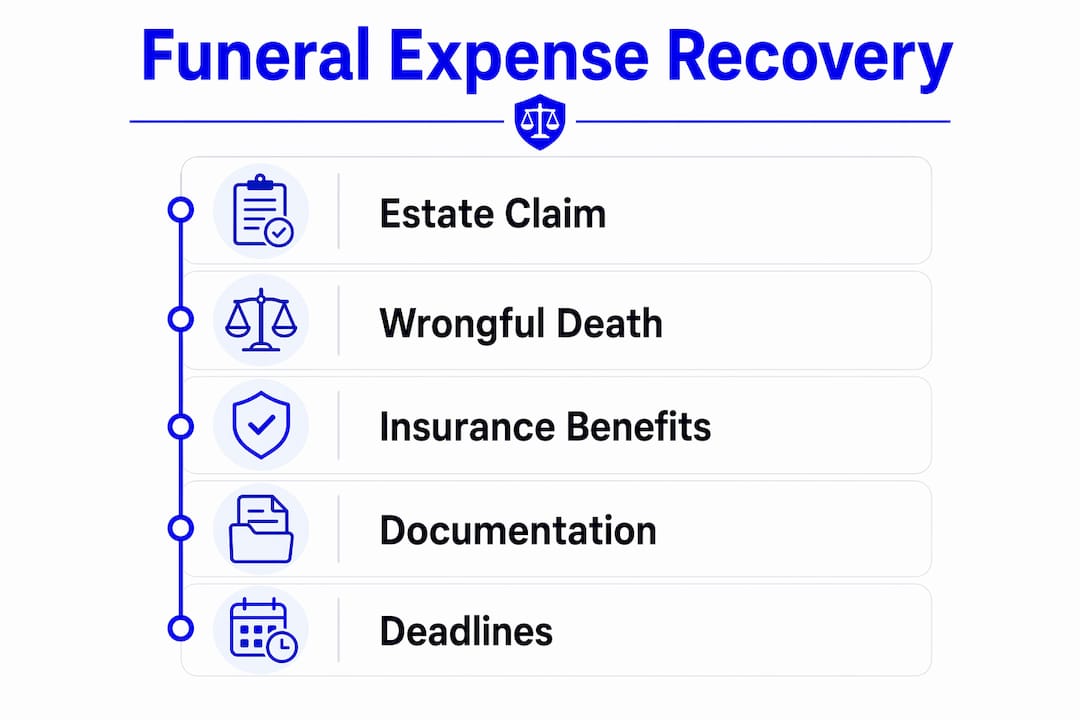
Funeral expenses can be recovered after a fatal accident through three main routes: reimbursement from the decedent's estate, wrongful-death damages paid by the at-fault party, or insurance benefits under an auto policy, life insurance, or victim compensation fund. Which path applies depends on who paid the costs, the relationship between the payer and the deceased, and the state where the death occurred.
Who can act right now:
- The person who paid funeral costs out of pocket (as a creditor of the estate)
- A surviving spouse, child, or other statutory beneficiary (through a wrongful-death claim)
- The estate's personal representative (through probate reimbursement)
Top three documents to preserve immediately:
- The itemized funeral bill and proof of payment (canceled check or credit card statement)
- A certified copy of the death certificate
- The police or accident report
Single recommended next step: Request a free case evaluation at CarCollisionLawyer.net before deadlines close your options.
Pro Tip: Do not wait for probate to open before gathering documents. Funeral homes sometimes purge records after 90 days, and insurer notice deadlines can run from the date of death, not the date probate begins.
Table of Contents
- What funeral and burial costs can you actually recover?
- Who may seek reimbursement or file a claim for funeral costs?
- How are funeral expenses actually recovered: three legal paths compared
- What deadlines can cut off your right to recover?
- Documentation checklist that strengthens a funeral expense claim
- What challenges and defenses should you expect?
- How an attorney can help you recover funeral costs
- Step-by-step checklist: what to do in the first 30 days
- Key Takeaways
- Why early legal advice changes the outcome in funeral expense cases
- Carcollisionlawyer connects you with a local attorney at no upfront cost
- Authoritative sources and statutes to check next
What funeral and burial costs can you actually recover?
Courts and insurers apply a "reasonable and necessary" standard to funeral expense compensation. That phrase does the most work in any dispute, so knowing which line items survive scrutiny matters.
Commonly allowed costs:
- Funeral director's professional services fee
- Embalming and body preparation
- Casket or cremation urn
- Burial or cremation fees
- Cemetery plot purchase or opening/closing fees
- Headstone or grave marker (often subject to a dollar cap in probate)
- Transportation of remains, including out-of-state transfer
- Death certificates (multiple certified copies)
- Obituary and funeral notice publication costs
- Limited memorial service costs (venue, printed programs)
Flowers, catering, and post-service receptions are the most frequently disputed items. Insurers and estate administrators routinely classify them as personal rather than necessary funeral costs, and courts often agree. Keep those receipts anyway; some wrongful-death statutes are broader than probate priority rules.
The wrongful-death recovery standard is generally more flexible than probate reimbursement, because wrongful-death damages compensate survivors for losses caused by the defendant's negligence, not just the estate's preferred creditor list.

Pro Tip: If the funeral home offered a family discount or you used prepaid funeral funds, your reimbursable amount is the actual out-of-pocket cost, not the original list price. Document the discount in writing so the estate administrator or insurer cannot later dispute what you actually paid.
Who may seek reimbursement or file a claim for funeral costs?
Three distinct claimant categories exist, and mixing them up is one of the most common mistakes families make.
The three primary claimants:
- Personal representative or estate. The PR files a creditor claim on behalf of the estate, or the estate itself is reimbursed when it paid the funeral home directly. This is the probate route.
- Statutory wrongful-death beneficiaries. Surviving spouses, children, and sometimes parents or siblings, depending on the state, can bring a wrongful-death action against the at-fault party. Funeral and burial expenses are a recognized damage element in most states, as explained in the wrongful-death vs. personal injury differences that govern who collects and how.
- Third-party payer. A friend, sibling, or employer who paid the funeral bill out of pocket becomes a creditor of the estate. Paying the bill does not automatically create a right to reimbursement; the payer must file a written creditor claim with the personal representative and meet the state's form and timing requirements.
State law controls which route is available and who has priority. Some states require the estate to pursue certain claims exclusively, while others let the payer file directly. A surviving spouse pursuing wrongful-death damages and a sibling who paid the funeral bill may both have valid claims simultaneously, but they cannot both collect the same dollars. Offset rules prevent double recovery.

How are funeral expenses actually recovered: three legal paths compared
Path A: Estate reimbursement through probate
The payer submits a written, itemized creditor claim to the personal representative. Most states give funeral expenses a preferred or priority status in the payment order, meaning they are paid before general unsecured creditors. North Carolina, for example, sets preferred priority at $3,500 for funeral expenses and $1,500 for gravestone or burial place costs. Amounts above those caps are not barred; they simply drop to a lower priority tier and are paid after higher-ranked claims if estate assets allow.
The risk here is estate insolvency. If the estate has more debts than assets, preferred funeral costs get paid first, but excess amounts may receive nothing.
Path B: Wrongful-death damages
When a third party's negligence caused the death, statutory beneficiaries can sue for wrongful-death damages that typically include funeral and burial costs. The defendant's liability insurer, not the estate, pays the judgment or settlement. This path is independent of whether the estate is solvent. The wrongful-death claim process for fatal accidents involves different deadlines and claimant rules than probate, so the two tracks need to be managed separately.
Path C: Insurance benefits
Three insurance sources commonly cover accident-related funeral claims:
- Auto no-fault or PIP (Personal Injury Protection). Michigan's no-fault statute, for instance, provides funeral and burial expense benefits under MCL 500-3107 and MCL 500-3108 as part of first-party benefits.
- Liability coverage. The at-fault driver's bodily injury liability policy typically covers funeral costs as part of the wrongful-death settlement.
- Life insurance or accidental death benefits. Check the deceased's employer-sponsored group life policy and any individual policies for accidental death riders.
When no liable party is identified (a hit-and-run, for example), state victim compensation funds or uninsured motorist coverage may provide financial support for funeral expenses.
| Recovery Path | Who Files | Proof Standard | Key Risk |
|---|---|---|---|
| Estate creditor claim | Payer or PR | Itemized bill + payment proof | Estate insolvency; priority caps |
| Wrongful-death action | Statutory beneficiaries | Negligence + causation | Statute of limitations; comparative fault |
| Insurance benefits | Policyholder or beneficiary | Policy terms + death certificate | Policy limits; exclusions |
Pro Tip: Present a written claim to the estate and preserve your wrongful-death demand simultaneously. Lawyers routinely run both tracks in parallel to avoid forfeiture, then apply offset rules at settlement to prevent double recovery.
What deadlines can cut off your right to recover?
Missing a deadline in a funeral expense recovery accident claim is not a technicality. It can permanently bar recovery.
Three deadline buckets to track:
- Wrongful-death statute of limitations. Most states set this at two years from the date of death, but some states are shorter. Missing this deadline ends the wrongful-death claim entirely, regardless of how strong the case is.
- Probate nonclaim deadline. Once the personal representative publishes notice to creditors, a window opens, often 90 days from personal notice or up to six months for claims arising at or near death. File a written creditor claim before that window closes.
- Insurer notice deadline. Auto insurers and no-fault carriers typically require prompt written notice of a claim. Some policies require notice within 30 days of the accident; others allow a reasonable time. Check the policy language immediately.
Action timeline:
- Days 0–30: Secure all receipts and the itemized funeral bill; obtain certified death certificates; notify every applicable insurer in writing; preserve the police report and any medical records.
- Days 30–90: Submit a written creditor claim to the personal representative if probate is open; consult an attorney about the wrongful-death statute of limitations in your state; request the estate's published creditor notice date.
- Six months and beyond: Track the wrongful-death filing deadline on a calendar; if a creditor claim is rejected, note the short litigation window (often three months in many states) to sue before the claim is barred.
Warning: If the personal representative rejects your creditor claim, state law typically gives you only a short period, often around three months, to file suit or the claim is permanently barred. Do not treat a rejection letter as the end of the road — treat it as a litigation deadline notice.
For context, the U.K.'s Funeral Expenses Payment program requires application within 6 months of the funeral. U.S. deadlines vary by state and claim type and are not bound by that rule, but the principle of early action applies everywhere.
Documentation checklist that strengthens a funeral expense claim
Documentation quality is often the single deciding factor when a personal representative or insurer evaluates a claim. An itemized final bill paired with clear payment proof is the foundation; everything else supports and corroborates it.
| Document | Purpose | Where to Use |
|---|---|---|
| Itemized funeral bill (final) | Establishes each charge and total cost | Estate claim, wrongful-death demand, insurer claim |
| Proof of payment (canceled check, CC statement) | Proves who paid and the actual amount | Estate creditor claim, insurer reimbursement |
| Funeral contract (signed) | Shows who authorized the services | Estate claim (establishes payer's standing) |
| Certified death certificate | Required by virtually every claim route | All three paths |
| Police or accident report | Links death to the accident | Wrongful-death demand, insurer claim |
| Medical examiner or coroner report | Confirms cause of death | Wrongful-death demand |
| Cemetery or cremation receipts | Documents burial/cremation costs | Estate claim, insurer claim |
| Transportation of remains receipt | Supports out-of-state transfer costs | Estate claim, insurer claim |
| Insurance policy documents | Identifies coverage and beneficiaries | Insurer claim |
The funeral contract matters beyond just the dollar amount. It shows who signed as the responsible party, which is the person with standing to file a creditor claim against the estate. If a family member signed but someone else paid, both documents are needed to establish the full picture.
Keep digital backups of every document. Scan receipts immediately; thermal paper fades. Organize everything into a single packet labeled with the decedent's name, date of death, and claim type before handing it to a personal representative or attorney.
Pro Tip: If you used evidence preservation steps after the accident, apply the same discipline to financial records. A well-organized document packet can shorten attorney review time and speed up insurer response.
What challenges and defenses should you expect?
Insurers and estate administrators push back on funeral expense claims more often than families expect. Knowing the common objections in advance lets you prepare the rebuttal before it is needed.
Common defenses:
- "The charges are unreasonable." The insurer or PR argues the funeral home's fees exceed the local market rate. Counter with two or three comparable quotes from other funeral homes in the same area.
- "You lacked authorization." The PR questions whether the payer had authority to contract for services. The signed funeral contract and any written authorization from next-of-kin resolve this.
- "Double recovery." The defendant argues that the estate already received life insurance proceeds covering the same costs. Offset rules handle this, but you need to document each payment source separately.
- "Estate insolvency." When the estate has more debts than assets, preferred funeral expense caps get paid first, but excess amounts may not be recoverable from the estate. The wrongful-death path against the at-fault party remains open regardless.
- "Comparative fault reduces the award." If the deceased was partially at fault for the accident, some states reduce wrongful-death damages proportionally. A few states bar recovery entirely if the decedent's fault exceeds a threshold.
- "Policy exclusions apply." Insurers sometimes argue the death falls outside covered events. Review the policy's accidental death definition carefully.
Red flags that predict disputes include large non-priority funeral costs (elaborate catering, extensive floral arrangements), missing receipts for any line item over a few hundred dollars, and funeral contracts signed by someone other than the person seeking reimbursement. Address each of these proactively rather than waiting for the objection.
How an attorney can help you recover funeral costs
An attorney does more than file paperwork. In a funeral expense recovery case, the specific tasks that move the needle are:
- Preparing and filing a properly formatted creditor claim in probate before the nonclaim deadline
- Drafting a wrongful-death demand letter that quantifies funeral costs alongside other damages
- Negotiating with the liability insurer or no-fault carrier on the reasonableness of charges
- Preserving evidence (accident reconstruction, medical records, insurer correspondence)
- Filing suit if the PR rejects the creditor claim within the litigation window
- Coordinating parallel claims to prevent forfeiture while avoiding double recovery
Most wrongful-death and accident claims are handled on a contingency fee basis, meaning the attorney collects a percentage of the recovery, typically in the range of one-third, plus reimbursement of case costs, and only if the claim succeeds. There is no hourly bill for the family during the case. The fee structure for wrongful-death attorneys varies by state and case complexity, so confirm the exact percentage and cost terms in the retainer agreement before signing.
Carcollisionlawyer's free case evaluation connects families with local attorneys who know their state's specific wrongful-death statutes, probate nonclaim rules, and insurer notice requirements. The evaluation takes minutes, requires no upfront payment, and puts you in contact with counsel who can assess whether the estate, wrongful-death, or insurance route, or all three, applies to your situation.
Pro Tip: When evaluating a wrongful-death attorney, ask specifically whether they handle probate creditor claims in addition to the civil wrongful-death action. Some personal injury firms refer probate work out, which can create coordination gaps. A wrongful-death attorney evaluation checklist helps you ask the right questions upfront.
Step-by-step checklist: what to do in the first 30 days
Time is the resource families most often underestimate after a fatal accident. The steps below are ordered by urgency, not convenience.
- Secure the itemized funeral bill and all receipts before leaving the funeral home. Request the final itemized statement, not just the contract estimate.
- Order multiple certified death certificates (at least five to ten copies). Every claim route requires one, and ordering extras now is faster and cheaper than reordering later.
- Notify all applicable insurers in writing. This includes the deceased's auto insurer, any no-fault carrier, life insurance carriers, and the at-fault driver's liability insurer if known. Send written notice, not just a phone call.
- Preserve the police report and any medical or coroner records. Request these in writing immediately; some agencies charge fees and have processing delays.
- Identify whether probate is open or needs to be opened. If no one has been appointed personal representative, a family member may need to petition the probate court. An attorney can do this quickly.
- Submit a written creditor claim to the personal representative if probate is already open. Do not rely on a verbal agreement or an informal email. The claim must be written, itemized, and timely.
- Request a free case evaluation at Carcollisionlawyer to connect with a local attorney who can assess your wrongful-death and estate claim options before deadlines run.
Avoid these common mistakes:
- Do not sign any insurer release or settlement agreement without attorney review. A release of "all claims" can extinguish your funeral expense recovery rights.
- Do not make informal verbal agreements with the personal representative about reimbursement. Get every commitment in writing.
- Do not pay disputed vendor charges without written PR approval if you are acting as the estate's representative.
Some of these steps run concurrently. Notifying insurers and ordering death certificates happen in the same week. Attorney consultation and creditor claim preparation can overlap. The wrongful-death demand is typically prepared after the attorney reviews the accident facts, but the statute of limitations clock runs from day one.
Key Takeaways
Recovering funeral expenses after a fatal accident requires acting on all three legal routes simultaneously, because missing any one deadline can permanently close that path.
| Point | Details |
|---|---|
| Three recovery routes exist | Estate creditor claim, wrongful-death damages, and insurance benefits can each apply and should be pursued in parallel. |
| Documentation is the deciding factor | An itemized final bill plus proof of actual payment is the foundation every claim route requires. |
| Deadlines are hard cutoffs | Probate nonclaim windows (often 90 days from personal notice) and wrongful-death statutes of limitations (commonly two years) bar recovery if missed. |
| Priority caps do not end recovery | North Carolina caps preferred funeral expenses at $3,500 and gravestone or burial place costs at $1,500 in probate, but excess amounts may still be paid as lower-priority claims if assets allow. |
| Carcollisionlawyer offers a free evaluation | Connecting with a local attorney through Carcollisionlawyer's free case evaluation is the fastest way to assess all three recovery routes before time runs out. |
Why early legal advice changes the outcome in funeral expense cases
The conventional wisdom is that funeral expense claims are simple creditor matters, a bill submitted to the estate, paid out, done. That framing misses most of the real complexity families face.
The probate creditor claim is only one piece. The wrongful-death action against the at-fault party often yields far more, because it draws from the defendant's liability coverage rather than a potentially insolvent estate. The insurance track, particularly no-fault benefits and accidental death riders, can pay quickly and independently of both. Families who pursue only one route routinely leave money on the table, not because the other routes were unavailable, but because no one told them the routes existed.
The urgency is real. Wrongful-death statutes of limitations do not pause while a family grieves. Probate nonclaim windows open and close on the estate's schedule, not the family's. An insurer's notice requirement runs from the date of the accident. Every week of delay narrows the options.
Early legal triage, even a single free consultation, maps the available routes, identifies the nearest deadline, and tells the family what to do first. That is the gap Carcollisionlawyer's free evaluation fills: not a sales pitch, but a structured first step that connects families with local counsel who know the state-specific rules that determine whether recovery happens at all.
Carcollisionlawyer connects you with a local attorney at no upfront cost
When a family member dies in an accident, the financial pressure of funeral costs lands immediately, often before anyone has thought about legal claims. Carcollisionlawyer's free case evaluation gives you a direct path to a local attorney who handles wrongful-death and accident claims in your state, without any upfront fee and without committing to representation before you are ready.
The evaluation takes minutes. You describe the accident, the relationship to the deceased, and the costs you have incurred. Carcollisionlawyer matches you with vetted local counsel who can assess your estate creditor claim, wrongful-death damages, and insurance benefit options in a single conversation. Attorneys in the network typically work on contingency for wrongful-death matters, meaning no fee unless there is a recovery. Your submission is handled according to Carcollisionlawyer's privacy policy, and your contact details are shared only with matched attorneys. Start your free case evaluation now while the evidence is fresh and the deadlines are still open.
Authoritative sources and statutes to check next
Use these to verify state-specific rules or pull model statute language for your jurisdiction.
- North Carolina probate reimbursement rules (priority caps, creditor claim timing, and documentation requirements): piercelaw.com
- Wrongful-death funeral and burial expense recovery (state-by-state overview of damage elements): mitchelldanoff.com
- Michigan no-fault funeral benefit statutes: MCL 500-3107 and MCL 500-3108 at legislature.mi.gov)/mileg.aspx?page=GetObject&objectname=mcl-500-3107)
- Oklahoma Attorney General (victim compensation fund information): oklahoma.gov
- GOV.UK Funeral Expenses Payment (non-U.S. comparative model only; U.K. deadlines and eligibility rules do not apply in the United States): gov.uk
- Your state's probate court or legislature website: Search "[your state] probate code funeral expenses" or "[your state] wrongful death statute" for the controlling text in your jurisdiction.
This article provides general legal information, not legal advice. Deadlines, priority rules, and claimant eligibility vary by state. Confirm the rules that apply to your specific situation with a licensed attorney or your state's probate court.