
Wrongful death attorneys charge families through contingency fees, a payment structure where the attorney collects nothing unless your case results in a financial recovery. Understanding how wrongful death attorneys charge families is the first step toward protecting your rights without risking your finances. Contingency fees typically range from 33% to 40% of the gross recovery, with the exact percentage depending on how far the case progresses. Beyond attorney fees, families also face separate case costs that can reach $100,000 or more in complex claims. Knowing both categories upfront prevents costly surprises after settlement.
How do wrongful death attorneys charge families through contingency fees?
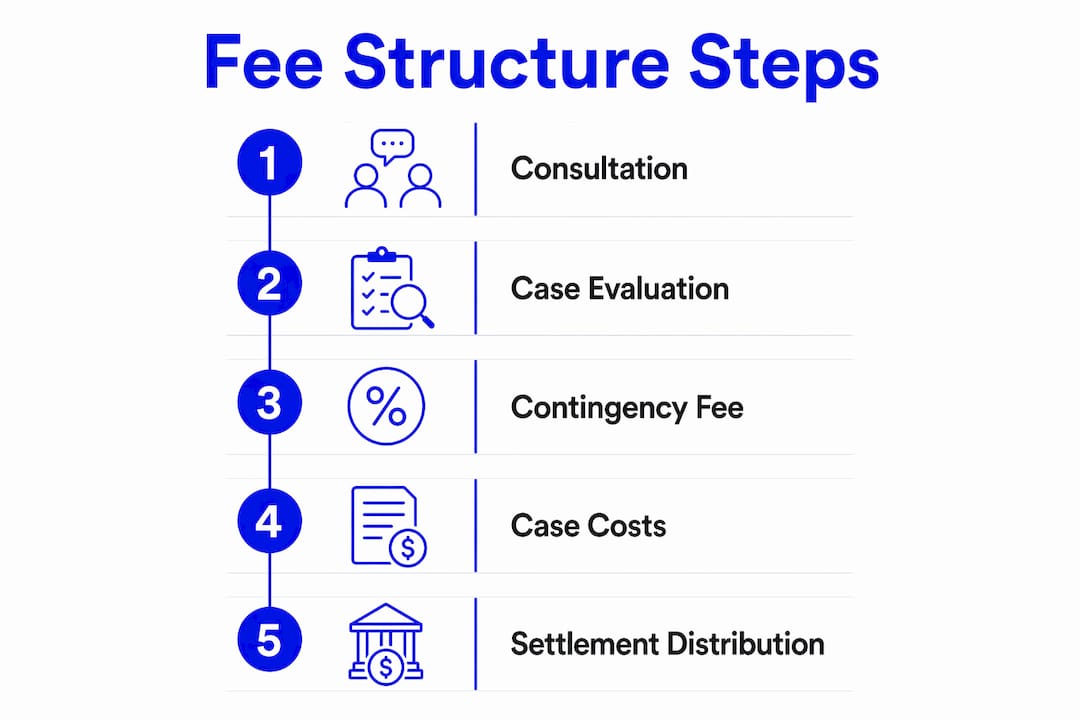
Contingency fees mean you pay no hourly rate and no retainer. The attorney's payment comes entirely from the money recovered on your behalf. If no recovery is made, you owe no attorney fees. This structure gives families access to experienced legal representation without any upfront financial commitment.
The percentage an attorney charges depends on the stage at which your case resolves:
- Pre-suit settlement (25%–33%): Cases resolved before a lawsuit is formally filed carry the lowest fee percentage.
- Post-filing litigation (33%–37%): Once a complaint is filed and discovery begins, the fee increases to reflect added legal work.
- Trial (35%–40%): If the case goes before a jury, the attorney's fee rises again to account for courtroom preparation and representation.
- Appeals (up to 45%): Cases that proceed to an appellate court carry the highest contingency percentage due to the complexity and time involved.
These stepped fee percentages reflect the reality that more legal work requires higher compensation. A case that settles in two months demands far less attorney time than one that goes to a three-week trial.
Pro Tip: Most reputable wrongful death attorneys offer a free initial consultation to review your case and explain their exact fee structure before you sign anything. Use this meeting to ask every fee question you have.

What kinds of case costs are involved, and how do they affect your settlement?
Attorney fees and case costs are two separate categories. Attorney fees cover legal services like negotiation, court representation, and document drafting. Case costs cover out-of-pocket expenses the attorney pays to build your case. Both are deducted from your settlement, but they are calculated differently.
Typical case costs in a wrongful death claim include:
- Expert witness fees: Medical experts, accident reconstructionists, and economists can charge $245–$500 per hour, and complex cases may require multiple experts testifying over several days.
- Court filing fees: Filing a wrongful death lawsuit typically costs $200–$500 depending on the jurisdiction.
- Deposition costs: Each deposition can run $1,000–$5,000 when you factor in court reporter fees, transcript preparation, and travel.
- Medical record retrieval: Gathering records from hospitals, specialists, and treating physicians adds up quickly across a multi-year case.
- Private investigators: Some cases require investigators to locate witnesses, document a scene, or gather surveillance footage.
Total case costs commonly range from $10,000 to $100,000 or more in complex wrongful death claims. That range reflects the difference between a straightforward car accident case and a multi-defendant medical malpractice claim.
Most law firms advance these costs on your behalf and deduct them from your settlement after the case resolves. The table below shows how cost deduction timing affects your actual payout.
| Scenario | Gross Recovery | Attorney Fee (33%) | Case Costs | Net to Family |
|---|---|---|---|---|
| Costs deducted before fee | $300,000 | $96,690 | $30,000 | $173,310 |
| Costs deducted after fee | $300,000 | $99,000 | $30,000 | $171,000 |
The difference in these two methods can reach thousands of dollars. Always ask your attorney which method their retainer agreement uses.
Pro Tip: Ask for a written breakdown of how case costs are deducted before you sign a retainer. The deduction method your attorney uses directly affects the check you receive at the end.
How do fee structures vary, and what should families watch out for?
Not every wrongful death fee agreement looks the same. Families need to read the fine print carefully before signing. Several important variations can significantly affect your financial outcome.
Key issues to watch for in any fee agreement:
- Sliding scale fees: Many agreements charge a lower percentage for early settlements and a higher percentage if the case proceeds to trial or appeal. This is standard practice, but the specific percentages should be clearly stated in writing.
- Cost responsibility if you lose: Some firms absorb case costs if no recovery is made. Others require you to repay advanced costs even when the case fails. Clarifying this policy in writing before signing is non-negotiable.
- State fee caps: Certain states impose statutory limits on contingency fees in wrongful death cases. Florida, for example, has specific rules governing maximum percentages. Ask your attorney whether your state has such limits.
- Vague fee language: Any agreement that does not specify the exact contingency percentage, the cost deduction method, and the cost responsibility policy if the case is lost is incomplete. Do not sign it until those terms are defined.
- Communication gaps: An attorney who cannot clearly explain their own fee structure during the consultation will likely be difficult to communicate with throughout your case.
The transparency of a fee agreement reflects the transparency of the attorney. A clear, written explanation of every deduction is a reasonable expectation, not a special request.
What is the difference between gross recovery and net recovery for families?
Gross recovery is the total amount paid by the defendant or their insurer before any deductions. Net recovery is the amount your family actually receives. The gap between these two numbers surprises many families who assume the settlement figure equals money in hand.
Three categories of deductions reduce gross recovery to net recovery. Attorney fees come first, calculated as a percentage of the gross amount. Case costs come next, deducted either before or after the fee calculation depending on your agreement. Medical liens and estate debts come last and are often overlooked entirely during early case discussions.
Medical liens arise when health insurers, Medicare, or Medicaid paid for treatment related to the death and seek reimbursement from your settlement. These lien amounts vary widely depending on the coverage involved and the length of treatment before death. Estate debts, such as outstanding medical bills, may also reduce the final distribution to family members.
Asking your attorney for an estimated net recovery figure early in the process sets realistic expectations. A skilled attorney can often negotiate lien reductions, which directly increases the amount your family keeps. Understanding how legal fees and liens interact helps you evaluate settlement offers with clear eyes.
How can families evaluate a wrongful death attorney on fees?
Choosing an attorney based solely on the lowest fee percentage is a mistake. Experienced attorneys typically secure higher gross recoveries, which means a higher net payout even after a larger percentage is deducted. A 33% fee on a $500,000 settlement leaves your family with more money than a 28% fee on a $200,000 settlement.
Questions to ask every wrongful death attorney before signing:
- What is your exact contingency fee percentage at each stage of the case?
- Do you use a sliding scale, and what triggers the higher percentage?
- How do you deduct case costs: before or after calculating your fee?
- Who is responsible for advanced case costs if we lose?
- Can you provide a written estimate of likely case costs for my type of claim?
- Have you handled cases similar to mine, and what were the outcomes?
A thorough wrongful death attorney evaluation goes beyond fee percentages. Track record, trial experience, and the firm's willingness to advance costs all affect your final outcome. Firms that handle wrongful death cases regularly have established relationships with expert witnesses and understand how to negotiate liens, both of which directly benefit your net recovery.
Pro Tip: Request a written copy of the fee agreement before your first consultation ends. Review every line, and do not hesitate to ask for clarification on any term you do not fully understand.
Key Takeaways
Wrongful death attorneys charge families through contingency fees ranging from 33% to 40%, with case costs deducted separately, making transparency in written fee agreements the single most important protection for families.
| Point | Details |
|---|---|
| Contingency fee basics | Families pay nothing upfront; fees of 33%–40% are owed only if a recovery is made. |
| Fee percentage by case stage | Pre-suit fees start at 25%–33% and rise to 45% for appeals. |
| Case costs are separate | Costs of $10,000–$100,000 are advanced by the firm and deducted from your settlement. |
| Deduction method matters | Whether costs are deducted before or after the fee calculation affects your net payout by thousands. |
| Net recovery vs. gross recovery | Medical liens and estate debts reduce your actual payout beyond attorney fees and case costs. |
What families often miss about wrongful death attorney fees
Families come to me after losing someone they love, and the last thing they want to think about is math. That is exactly why fee transparency matters so much. I have seen families sign retainer agreements without understanding that case costs could reach $50,000 or that their medical insurer held a lien on the settlement. The shock at the end of a long case adds pain to an already painful process.
The most important thing I have learned is this: the attorney who charges 33% and wins $600,000 serves your family far better than the attorney who charges 28% and settles for $180,000. Fee percentage is one variable in a much larger equation. Trial experience, expert witness relationships, and the willingness to absorb costs if the case fails all matter more than a few percentage points.
Ask hard questions before you sign anything. A good attorney welcomes those questions. If an attorney gets evasive when you ask how case costs are deducted, that tells you something important about how the rest of the relationship will go. Transparency at the start is the best predictor of a fair outcome at the end.
— Gerard
Carcollisionlawyer connects families with attorneys who explain every fee clearly
Losing a family member to someone else's negligence is devastating. The last thing you need is a legal fee structure that adds confusion to grief.
Carcollisionlawyer connects families with experienced wrongful death attorneys who work on a contingency fee basis, meaning no upfront costs and no fees unless you recover compensation. Every attorney in the network offers a free case evaluation to walk you through fee percentages, case cost policies, and estimated net recovery before you commit to anything. Start your free injury claim evaluation today and get clear answers about what your case is worth and what it will cost to pursue it.
FAQ
What percentage do wrongful death attorneys typically charge?
Wrongful death attorneys typically charge 33%–40% of the gross recovery, with lower percentages for pre-suit settlements and higher percentages if the case goes to trial or appeal.
Do families pay anything upfront for a wrongful death attorney?
No. Wrongful death attorneys work on contingency, meaning families pay no upfront fees and owe nothing unless the attorney recovers compensation on their behalf.
What are case costs, and are they separate from attorney fees?
Case costs cover expenses like expert witnesses, court filing fees, and depositions, and are separate from attorney fees. These costs are typically advanced by the firm and deducted from the settlement.
What happens to case costs if the wrongful death case is lost?
Policies vary by firm. Some attorneys absorb case costs if no recovery is made, while others require clients to repay advanced costs even after a loss. Families should confirm this policy in writing before signing any agreement.
How does gross recovery differ from what families actually receive?
Gross recovery is the total settlement amount before deductions. Attorney fees, case costs, and medical liens are all subtracted from that figure, leaving families with a lower net recovery.