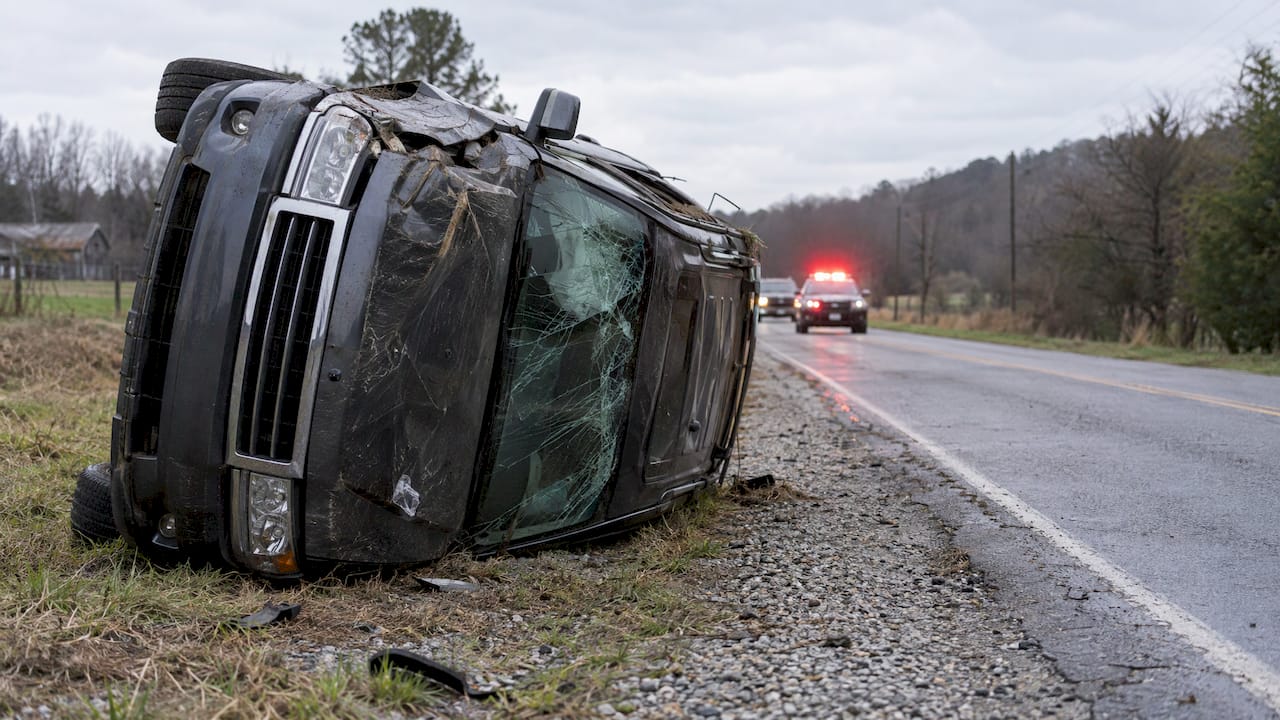
A rollover crash is rarely a simple claim. The vehicle may have failed, a driver may have caused the swerve, or a road defect may have played a part. Injuries tend to be severe, and several insurers and companies often point at one another. A rollover accident lawyer sorts out who is responsible, proves it, and pursues the full value of your losses. The fastest way to find one who fits your situation is a free evaluation: you describe the crash and your injuries, and we match you with a vetted local attorney, with no obligation.
TL;DR
- A rollover claim can involve a negligent driver, a vehicle maker, a parts supplier, a trucking company or a government body responsible for the road. A lawyer's first job is working out which.
- Evidence disappears fast: the vehicle, its data and the scene all change within days. Early legal help protects it.
- Filing deadlines differ by state and can be as short as a few months when a government body is involved. Waiting is the most common way to lose a valid claim.
- Your own share of fault, insurance limits and seat belt use can change what you recover, so a lawyer should review them before you talk numbers with an adjuster.
- Our free evaluation is tailored to your injury type and circumstances and connects you with a vetted local attorney.
Table of Contents
- Why rollover crashes are different from other collisions
- What a rollover accident lawyer actually does
- Who may be liable for a rollover crash
- The evidence that decides a rollover case
- What you can recover
- Deadlines: the rule that ends more claims than weak evidence
- What to do after a rollover crash
- What about T-bone crashes?
- How to choose the right attorney for a rollover claim
- Start with a free evaluation
- Perspective
- FAQ
- Sources
Why rollover crashes are different from other collisions
Rollovers are among the deadliest crash types. Federal crash data for 2007, cited by the National Highway Traffic Safety Administration (NHTSA) in its roof-crush rule, shows 10,196 occupants died in light-vehicle rollover crashes, 35 percent of all occupant deaths that year. About 57 percent of those people were partially or completely ejected from the vehicle. Those numbers are old, but they explain why rollover cases tend to involve catastrophic injuries: spinal cord and brain injuries, crushed limbs, and in the worst cases a death that leaves a family with funeral costs and lost income.
That severity changes how a claim works. The medical bills are larger, the recovery is longer, and the other side has far more reason to fight over fault. A rollover is also often a single-vehicle event, which means the question "who caused this?" has no obvious answer. A lawyer's work starts there.

What a rollover accident lawyer actually does
You do not need to know the law to understand the job. A personal injury attorney handling a rollover case typically:
- Investigates the cause. That means the crash scene, police report, witness accounts, photographs, the vehicle itself and any recorded vehicle data.
- Identifies every party who may be responsible. More on this below.
- Documents your injuries and losses. Medical records, bills, proof of missed work and the long-term effect on your life.
- Deals with the insurance companies. Adjusters often ask for recorded statements and offer quick settlements before the full extent of an injury is known.
- Tracks deadlines. Missing a filing date can end a claim no matter how strong the facts are.
- Negotiates or files suit. Most claims settle, but a lawyer prepares as though the case may be heard by a jury, which is what gives a settlement demand weight.
For families who have lost someone, a lawyer also handles a wrongful death claim, which has its own rules about who may file and what damages are recoverable. Those rules vary by state, so the attorney you are matched with should be licensed where the crash happened.
Who may be liable for a rollover crash
The driver who caused the crash is the first suspect, but not the only one. Rollovers often come from a chain of causes, and each link can point to a different defendant.
Another driver
A driver who cut you off, forced you off the road or clipped your vehicle can be liable even if there was no impact in the final tumble. Rollovers frequently follow an evasive swerve. Witnesses and dashcam footage matter here because the other driver may have left the scene. For a plain-language look at how fault and responsibility are assigned between drivers, see our guide to car accident liability.
The vehicle or parts maker
If the roof collapsed, a tire failed, a steering or stability system malfunctioned or the vehicle was unusually prone to tipping, a product liability claim may be possible. Federal rules set a minimum for how strong a roof must be. Under NHTSA's 2009 rule, the test force for covered light vehicles rose from 1.5 to 3.0 times the vehicle's unloaded weight, and the rule was phased in between 2012 and 2017 depending on vehicle class. The same rule requires the test to be run on both sides of the roof while preserving headroom for occupants. Which standard your vehicle was built to depends on its model year and class, which is one reason a lawyer looks at the specific vehicle rather than rollovers in general.

A trucking company or commercial driver
A rollover involving a tractor-trailer or delivery truck can bring in the driver, the carrier, the company that loaded the cargo and the one that maintained the brakes. Overloaded or poorly secured cargo is a classic cause of a tipping truck. If you were hurt when a smaller vehicle slid under a trailer, our overview of truck underride claims covers liability, damages and deadlines.
A government body responsible for the road
A washed-out shoulder, a sudden drop-off at the pavement edge, missing guardrails or poor signage can all send a vehicle into a roll. Claims against a city, county or state agency usually follow special rules, including short notice windows. We explain how this works in our pieces on government liability for road defects and who pays for road defect injuries.
Criminal and administrative proceedings alongside your claim
When impairment or reckless driving is suspected, police and motor vehicle authorities may open their own reviews, and a criminal case can run in parallel with your civil claim. Reading about how DMV investigations work helps you understand why those outcomes and your injury claim move on separate tracks. The civil claim is about money for your losses, not punishment, and it does not wait for a verdict in a criminal case.
The evidence that decides a rollover case
Fault in a rollover is proved with physical evidence more often than testimony. The strongest items are time-sensitive:
- The vehicle. Towing yards crush or sell wrecks. Once the vehicle is gone, a defect claim is much harder to prove.
- Event data. Many modern vehicles record speed, braking and steering in the seconds before a crash. That data can be overwritten or lost if the vehicle is repaired or scrapped.
- Scene evidence. Skid marks, gouges, debris fields and road conditions fade with weather and traffic.
- Police and emergency reports. They record the first account of what happened, who was cited and what the responders saw.
- Medical records from day one. The first emergency records connect your injuries to the crash itself.
- Photos and video. Of the scene, the vehicles, your injuries and any dashcam or nearby camera footage.
When you speak with an attorney early, they can send preservation letters asking other parties to keep evidence. That is hard to do on your own while you are in the hospital.
What you can recover
Compensation in a rollover claim is meant to cover what the crash cost you. Typical categories include:
- Emergency care, surgery, hospital stays, rehabilitation and future medical needs
- Lost wages and reduced ability to earn in the future
- Pain and suffering, including the lasting emotional trauma that follows a violent crash
- Vehicle repair or replacement and other property damage
- In a wrongful death claim, funeral and burial costs and the loss of the person's income and companionship to the family
The amounts depend on your injuries, the evidence, the insurance coverage available and your state's rules. No honest source can give you a number before your case has been reviewed, and you should be wary of anyone who does.
How shared fault and seat belts can affect the total
Most states reduce a claimant's recovery by their own percentage of fault, and some bar recovery above a threshold. In a rollover, insurers commonly argue speed, distraction or an unbuckled belt. Seat belt arguments usually affect the amount of damages rather than the question of who caused the crash, which we explain in how the seat belt defense works. A lawyer can respond to these arguments with evidence, which is far better than agreeing to them in a recorded call.
Deadlines: the rule that ends more claims than weak evidence
Every state sets a statute of limitations, the deadline for filing a lawsuit. It varies by state and by who you are suing, and recent court decisions can shift how it is applied.
Two examples show how different the rules are:
- Colorado: In October 2025 the state's Court of Appeals ruled in Nesjan v. J & A Distributing that injury actions arising from the use or operation of a motor vehicle fall under a three-year deadline rather than the general two-year negligence period, in a first-of-its-kind ruling that includes maintenance activities.
- Rhode Island: The state's general laws provide a three-year period for injuries to the person.
Neither figure is a national rule. Other states are shorter or longer, and claims against a government body can require a written notice within a much tighter window. Our state-by-state guide to car accident filing deadlines shows how wide the range is. If a rollover involves a defective road, read the notice requirements in our road defect liability guide the same day you learn of them.
What to do after a rollover crash
- Get medical care right away. Rollover injuries, especially to the head, neck and spine, can show up hours or days later. Tell the clinicians everything that hurts and that you were in a rollover.
- Call 911 and make sure a police report is filed. Ask the officer for the report number.
- Photograph everything you safely can. The vehicle's position, the road, tire marks, your injuries and any visible hazards.
- Collect names and contact details of witnesses and other drivers.
- Do not move the wrecked vehicle for repair or scrapping. Ask that it be kept where it is stored until a lawyer has advised you.
- Be careful with insurers. Give your own insurer the basic facts. Do not give a recorded statement to the other side or accept a settlement before you know the full extent of your injuries.
- Start your free evaluation. The sooner an attorney is looking at the case, the more evidence can be saved.
What about T-bone crashes?
A T-bone, or side-impact, collision happens when the front of one vehicle strikes the side of another, often at an intersection. The same logic applies: the claim turns on who had the right of way, whether a signal was run, and what the physical evidence shows. Intersection cameras, traffic signal timing, witness statements and vehicle damage patterns all help establish liability, and the injury record shows how the impact affected you. T-bone crashes can also lead to rollovers when a vehicle is struck at speed, in which case both sets of questions apply to the same claim. The attorney you are matched with will look at each.
How to choose the right attorney for a rollover claim
A good fit matters more than a famous name. Look for:
- Experience with serious injury and vehicle cases, not just minor fender-benders.
- A license in your state, because deadlines and fault rules are state law.
- A local presence, since local courts, insurers and road conditions affect strategy.
- A willingness to investigate, including the vehicle, data and road, before talking settlement.
- Clear communication about what will happen and when.
The point of our evaluation is to do that matching for you based on the nature of your injury and the facts of your crash, so you do not have to start from a search page full of identical promises.
Start with a free evaluation
Our free evaluation is designed to show you whether you may be entitled to financial compensation, with no immediate commitment. You describe what happened and how you were hurt, whether it was a car, truck, motorcycle or bicycle crash, a physical injury, emotional trauma or the loss of a family member. We then connect you with a vetted local attorney suited to your circumstances.
You can start your free evaluation now. If you want to read more first, our blog covers deadlines, liability and claim basics.
Perspective
Rollover victims usually come to us at the worst possible moment: hurt, worried about bills and unsure whether the crash was anyone's fault but their own. The most common mistake we want to prevent is waiting. Evidence is lost and deadlines pass while people hope they will feel better.
Our approach is built around specifics. A rollover with a possible vehicle defect is a different case from a rollover after a driver ran you off the road, and a family dealing with a wrongful death has different needs from someone recovering from a broken back. That is why our free evaluation is tailored to your injury type and circumstances, and why it comes with no obligation. You learn where you stand and who can help before you decide anything.
If you were hurt in a rollover, or you lost someone in one, start the evaluation and let a vetted local attorney look at what happened.
Gerard
FAQ
How much does a rollover accident lawyer cost?
Our evaluation is free and carries no obligation. Fee terms after that are set by the attorney you are matched with, so ask them to explain how they are paid before you sign anything.
Can I file a claim if I caused the rollover myself?
Possibly. A single-vehicle rollover can still involve a defective vehicle part, a road hazard or a driver who forced you off the road. Fault rules vary by state, so it is worth having the facts reviewed rather than assuming you have no claim.
How long do I have to file a rollover accident claim?
It depends on your state and on who is responsible. Some states allow two years and others three or more, and claims against government bodies can require notice much sooner. Our state-by-state deadline guide is a good starting point, and the evaluation can put you in touch with an attorney who knows your state's rule.
Does the same process apply to a T-bone accident claim?
Yes. The claim still comes down to proving who was at fault and documenting your injuries. Side-impact cases often rely on signal timing, camera footage and witness statements, and the attorney you are matched with will build the case around the specifics of your crash.
What if a family member died in the rollover?
A wrongful death claim may be available to certain family members, and the rules on who can file differ by state. Start the free evaluation and describe what happened, and we will connect you with an attorney who handles these cases.
Sources
- Federal Register: Federal Motor Vehicle Safety Standards; Roof Crush Resistance, Phase-in Reporting Requirements (NHTSA, 2009)
- Colorado Court of Appeals, Nesjan v. J & A Distributing, 2025COA81 (October 2, 2025)
- Rhode Island General Laws Section 9-1-36 (2025)