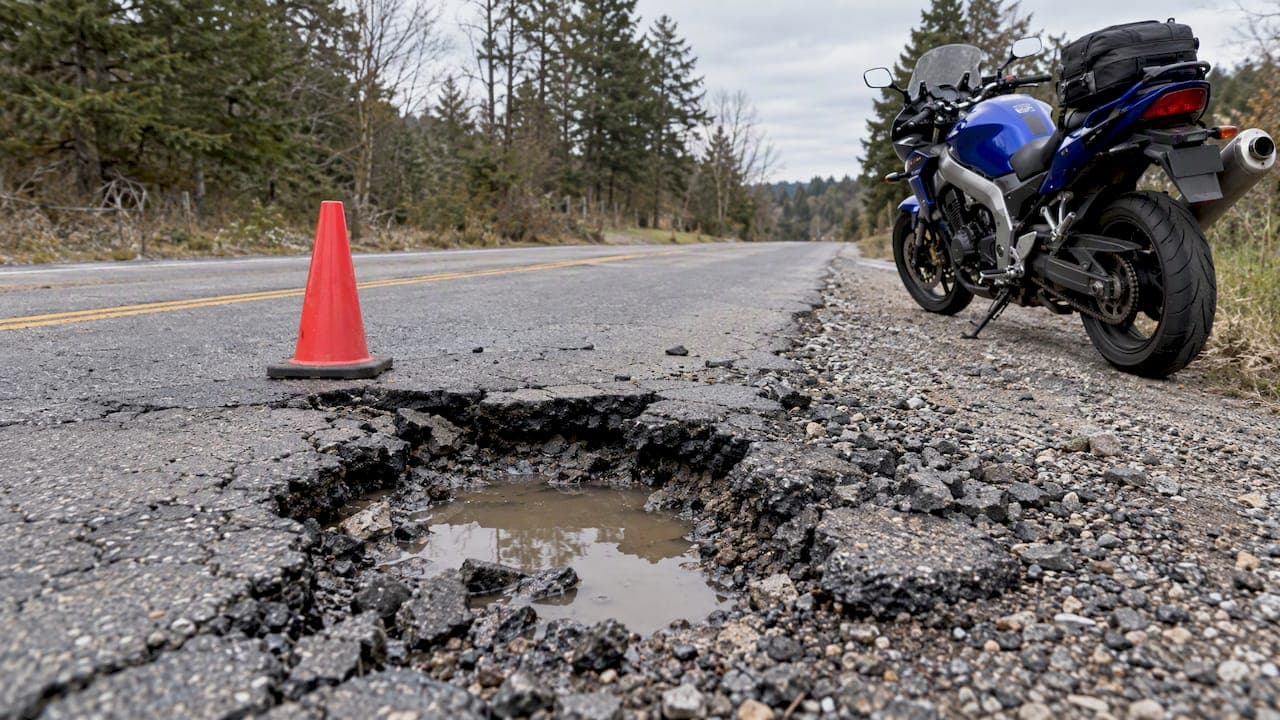
If a pothole, a crumbling shoulder or a badly built roadway caused your crash, you may have a claim. It is harder than an ordinary car accident claim, though, and the first obstacle is usually time. Claims against a city, county or state often require a written notice within weeks or months of the injury. That is far shorter than the general lawsuit deadline.
This guide covers who can be responsible, why these cases are difficult, what evidence matters and what to do in the first days. The rules differ by state and even by city, so treat the examples below as illustrations, not as your deadline.
TL;DR
- Road defect claims usually run against a government agency, and government immunity rules limit or condition recovery.
- A notice of claim is often required first. Deadlines range from 90 days in Houston to six months in Atlanta, and missing one can end the claim.
- Hitting a pothole does not prove negligence. You generally have to show the agency knew, or should have known, about the defect and failed to fix it in a reasonable time.
- Photos, an exact location, witnesses and medical records, gathered early, decide many of these cases.
- Our free evaluation can help you understand your options and get matched with an attorney who handles this kind of claim.
Table of Contents
- What counts as a road defect
- Who can be held responsible
- Why claims against the government are different
- What you have to prove
- Evidence that makes or breaks the claim
- What compensation can cover
- Steps to take in the first weeks
- Our perspective
- Get a free evaluation
- Common mistakes that sink road defect claims
- FAQ
- Sources
What counts as a road defect
A road defect is a condition of the roadway that makes it unreasonably dangerous to drive, ride or walk on. Common examples:
- Potholes and broken or sunken pavement
- Missing, faded or wrongly placed signs and lane markings
- Malfunctioning traffic signals
- Drop-offs between the lane and the shoulder
- Standing water from poor drainage
- Loose gravel or debris left after repairs
- Poorly marked or poorly designed construction zones
- Dangerous design, such as a curve with inadequate banking or guardrails
Some defects are about maintenance (the road was fine once and was allowed to deteriorate). Others are about design or construction (the road was built or reworked in a hazardous way). The distinction matters because it changes who is responsible and what you must prove.
Motorcyclists and cyclists feel these defects most. A pothole that costs a car driver a tire can throw a rider onto the pavement. If that is your situation, our article on why a specialized bicycle injury attorney can matter explains how those claims differ.
Who can be held responsible
The answer depends on who owns and maintains the road, and sometimes on who worked on it last.
Federal, state, county or city
Interstates and state highways are normally the state's responsibility. County and city streets belong to local governments. Utah's transportation department, for example, invites damage claims for vehicles or property damaged by a pothole, road condition or construction problem it could have been aware of, while stating that submitting a claim does not mean it accepts fault. Which agency owns the stretch of road where you were hurt is the first thing to pin down, because a notice sent to the wrong body can be worthless.
California shows how jurisdiction can complicate things. Caltrans explains that the Government Claims process must be followed to preserve the right to sue it for many types of claims, and that claims of $12,500 or less go directly to Caltrans, while larger ones are handled through the state's Government Claims Program. Filing in the wrong place can get a claim rejected.

Contractors and private parties
If a road crew left a trench uncovered, a utility company failed to restore pavement, or a private property owner let a driveway apron crumble into the street, a private company may share the blame. Courts have long recognized that a city held liable may have a "remedy over" against the party that actually created the hazard. In practice, that means the city and a contractor may point at each other, and a victim may need to name both.
Other drivers
A road defect is rarely the only factor. Another driver may have been speeding, following too closely or distracted. A claim against that driver's insurer can be simpler than one against a government agency, and sometimes both run in parallel. Our piece on why rear-end accidents complicate claims shows how shared fault gets argued.
Why claims against the government are different
In an ordinary crash you file with an insurer and, if needed, sue within the statute of limitations. Government defendants add two layers.
Immunity and its limits
Governments have traditionally been shielded from lawsuits. Most states have passed statutes that waive that immunity for certain situations, including dangerous road conditions, but only on conditions and often with limits. Michigan's statute is a good example: as a condition to any recovery for injuries from a defective highway, the injured person must give notice within 120 days of the injury, with the statute spelling out what that notice must contain. Other states use different periods and different rules, and some cap damages.
The point is not to memorize one state's law. It is that a road defect claim can be lost on procedure before anyone looks at the facts.
The notice of claim
A notice of claim is a formal written statement to the responsible agency that you were injured and intend to seek compensation. It generally states the date, the location, what happened and the injuries or damage. Examples of how much deadlines vary:
| Place | Notice rule (as published by the agency or statute) |
|---|---|
| Michigan (defective highway statute) | 120 days from the injury |
| Houston, Texas | City charter requires notice before the city can be liable for injuries |
| Atlanta, Georgia | Written claim within six months of the event |
| California (state highways) | Government Claims process to preserve the right to sue Caltrans |
Because the periods are short and unforgiving, do not assume you have the two or three years that apply to ordinary injury lawsuits. Our state by state look at car accident deadlines shows how widely time limits vary, and government claims are often shorter still. Confirm your own deadline with the agency's published instructions or with an attorney licensed in your state as soon as possible.
What you have to prove
Governments are not insurers of every road. Courts generally require more than "there was a hole and I hit it."
Notice of the defect
The central threshold in many states is that the agency had actual notice of the defect, or constructive notice, meaning it should have known about it. Constructive notice usually turns on how long the defect existed and how visible it was. Agencies commonly note that potholes are routine hazards, and the UDOT claims page itself frames claims around conditions the agency could have been aware of. A pothole that appeared yesterday after a storm is a very different case from one that sat in the same spot for months while residents reported it.
Some places go further and require prior written notice of the specific defect. New York's courts have dealt with this kind of rule, and the state's top court has examined how proximate cause is proven in a road case. Check whether your jurisdiction has a similar requirement. If it does, your case may depend on whether anyone ever reported the defect in writing.

Reasonable time to repair
Even when an agency knew, it generally gets a reasonable time to fix the problem. What is reasonable depends on weather, equipment, crew availability, how severe the hazard was and how often similar defects appear. A pothole that opened during a freeze and thaw cycle gives the agency more latitude than a sinkhole that was fenced off by nothing for six weeks.
Causation and fault
You must also show the defect, not something else, caused your injury. Speed, weather, inattention, worn tires and other drivers all get raised by the defense. Many states reduce compensation by your share of fault, and some bar recovery if you are mostly at fault. Complex crashes can need an accident reconstructionist or engineer. Federal Highway Administration material identifies roadway departure crashes as a major safety focus, which is one reason road condition evidence gets analyzed so carefully.
Evidence that makes or breaks the claim
Agency claims departments reject vague submissions. The more precise your record, the harder you are to dismiss.
- Photograph the defect first. Take wide shots and close-ups with something for scale, such as a tape measure or a coin, and capture the road around it, signs and lighting.
- Record the exact location. Use GPS coordinates from your phone, the nearest cross street, mile marker or utility pole number. "Somewhere on Main Street" is not enough.
- Photograph the vehicle and the scene. Include tire damage, bent rims, skid marks and debris.
- Get names and numbers of witnesses. Neighbors and other drivers often know the defect has been there for a long time, which supports constructive notice.
- Call the police and request a report. The report fixes the date and time and records conditions.
- Get medical care right away. Records tie your injuries to the crash. Gaps make it easier to argue they came from something else.
- Look for prior reports. Many cities run 311 apps and online report systems. Complaints about the same spot show the agency knew. A public records request can retrieve them, but do it promptly, since repairs can erase the evidence.
- Save repair estimates, receipts and pay stubs. These document your losses.
- Keep a short written log of pain, missed work and limits on daily life.
Our guide to car accident evidence best practices goes deeper on preservation, and the same habits apply here. One caution: do not move into traffic or stay near the defect if it is not safe. Your safety comes before the photos, and you can return when conditions allow.
What compensation can cover
If liability is established and the claim survives the procedural hurdles, damages in injury cases generally include:
- Medical bills, past and future
- Lost wages and reduced earning capacity
- Pain and suffering and emotional distress
- Vehicle repair or replacement and other property damage
- In a fatal crash, wrongful death damages for surviving family members
Government claims can face statutory caps or limits on certain damages in some states, so an attorney in your state should tell you what applies. For a broader view of what moves a payout, see our car accident settlement factors list.
Steps to take in the first weeks
- Get medical help and follow the treatment plan.
- Document everything using the checklist above.
- Identify who owns the road. Check state, county and city maps or ask the local public works office. Do not guess.
- Find the notice deadline for that agency and calendar it with a safety margin.
- Notify your own insurer as your policy requires. Collision or medical payments coverage may help you while the government claim is pending.
- Be careful with statements. Do not guess at fault or minimize injuries when speaking to adjusters. Agencies and their insurers investigate to limit liability.
- Talk to a personal injury attorney licensed in your state before the notice window closes.
Our perspective
We built this site around a simple observation: people hurt in crashes rarely know which questions to ask, and road defect cases punish that. Most readers who reach us after a pothole or a broken road are not wondering about legal theory. They want to know whether they still have time and whether anyone will take the case.
We do not decide your case and we are not a law firm. Our role is to help you understand whether your situation merits a conversation with a lawyer, and to connect you with an attorney who handles claims like yours. Our view is that the deadline is the thing to protect first. A strong case with a missed notice date can be worth nothing, while a modest case filed correctly keeps every option open.
We also think readers should hear the hard part plainly. Road defect claims against governments are harder than typical car accident claims, and not every pothole injury is worth pursuing. An honest early evaluation, based on the injury and the circumstances, saves you time whichever way it comes out.
— Gerard
Get a free evaluation
If you were hurt because of a road defect, our free case evaluation asks about your injury and what happened, then helps match you with an attorney. There is no cost to use it and no obligation to hire anyone. You can also read about accident injury compensation on our site. Because notice deadlines can be short, it is worth starting sooner rather than later.
Common mistakes that sink road defect claims
- Waiting for the injury to "settle down." Notice deadlines keep running while you recover.
- Sending the claim to the wrong agency. State, county and city roads can sit side by side. Caltrans, for example, warns that its process applies to its own claims, not to every road.
- Giving a vague location or description. The notice should be specific enough for the agency to find and inspect the defect.
- Skipping the repair. If the defect is fixed before you photograph it, you lose your best evidence.
- Blaming only the road. If another driver also contributed, ignoring that claim can leave money on the table.
- Assuming a small town is different. Towns often run claims through their insurance pools, and compensation is paid only if the town is found liable, as one Massachusetts town's claim form states.
FAQ
Can I sue a city for a pothole injury?
Often yes, but only if your state has waived immunity for road conditions and you follow its procedures. That usually starts with a timely notice of claim, and you generally must show the city knew or should have known about the pothole. Whether you can sue depends on your state's law and on the specific facts.
How long do I have to file a road defect claim?
It depends on the agency and state, and the window can be much shorter than the normal injury deadline. Examples include 120 days under Michigan's highway statute and six months in Atlanta. Find your deadline right away and confirm it with a local attorney.
Does hitting a pothole automatically make the government liable?
No. Courts generally require proof that the agency had notice of the defect and failed to repair it within a reasonable time, and that the defect caused your injury. Liability can also be shared with drivers or contractors, so evidence about all of these matters.
What if the road is a state highway?
Then your claim usually goes to the state transportation agency under its own process. Some agencies publish online claim forms, such as UDOT's damage claims page. Using the correct office and form is essential.
Do I need a lawyer for a road defect claim?
You are not required to hire one, but government claims involve strict notice rules, immunity defenses and often expert evidence. Speaking with a personal injury attorney early, especially for serious injuries or a death, helps protect your rights. Our free evaluation can help you find one.
Sources
- Michigan Legislature: MCL 691.1404, notice of injury and defect in highway
- City of Houston Legal Department: Filing a Claim
- City of Atlanta: claim notice guidance
- Caltrans: Submit Damage Claim
- UDOT: Damage Claims
- Denio v. State of New York, New York Court of Appeals
- Chicago v. Robbins, U.S. Supreme Court
- FHWA: roadway departure and safety focus areas
- Town of Longmeadow, MA: Filing a Claim