
A personal injury case evaluation is a review of three things: who was at fault, what your injuries and losses are, and what evidence proves both. Done well, it tells you whether you likely have a claim, what kind of compensation is in play, and what to gather next. You do not need a finished file to start. Our free evaluation asks about your injury type and what happened, so the review fits your situation, and it carries no obligation.
TL;DR
- An evaluation weighs liability (fault), damages (your losses) and proof. A weakness in any one changes the outcome.
- Early dollar figures are estimates. Courts expect losses to rest on evidence, and future costs on more than guesswork.
- Medical records, bills, photos, wage proof and a written timeline do most of the work.
- Rules differ by state, including deadlines and how medical bills are proven, so a local attorney's view matters.
- Our free evaluation is built around your injury type and circumstances, with no commitment.
Table of Contents
- What a case evaluation actually decides
- The four parts of the review
- Why an early estimate can move
- Pain, suffering and emotional distress
- What to bring to an evaluation
- Questions worth asking during the review
- What to say, and what to hold back
- Special situations
- Start a free evaluation
- FAQ
- Sources
What a case evaluation actually decides
People often expect a number. The first job of an evaluation is different: it decides whether the facts support a claim at all, and how strong that claim is.
Courts follow the same order. The U.S. District Court for the District of Hawaii's civil jury instructions say a plaintiff must establish liability before damages are awarded, and that damages should fairly compensate injuries the defendant legally caused. Liability means legal responsibility, usually that someone failed to act with reasonable care. Damages means the losses you can be compensated for.
An attorney reviewing your case therefore asks two questions, in this order:
- Can fault be shown, and against whom?
- If so, what are the losses, and can they be proven?
A car crash with a clear rear-end impact and a documented injury answers both quickly. A crash with disputed fault, a delayed diagnosis or a gap in treatment takes more work, and the evaluation is where that shows up.
The four parts of the review
Fault and who is responsible
The reviewer looks at the police report, witness names, photos of the scene and vehicles, and anything that shows how the crash happened. In a motorcycle or bicycle accident, the question is often whether a driver saw the rider and what they did next. In a truck crash, more than one party may be involved, such as a driver and a carrier. Your own account matters, so write down what you remember while it is fresh.
Injuries and medical treatment
Your medical records connect the crash to your injury. Emergency notes, imaging, specialist visits and therapy records show what was wrong, when it was found and how you were treated. A gap between the accident and your first appointment, or between appointments, invites questions, so tell the reviewer about it plainly. If you have not yet been seen, see a doctor first. Your health comes before any claim.
Damages: the losses that count
The Hawaii instructions list the categories a jury may consider once liability is found: medical expenses, past and future lost income, disability, permanence, disfigurement, pain and emotional suffering. In practice these split into two groups.
- Economic losses: bills, prescriptions, lost wages, reduced earning ability. The same instructions describe these as losses that can be calculated precisely or determined with reasonable certainty from the evidence.
- Non-economic losses: pain, emotional distress, lost enjoyment of life, scarring. These are harder to put a figure on, which is why documentation of daily impact matters.
For a closer look at how factors stack up, see our car accident settlement factors list.
Insurance and other sources of recovery
The reviewer also checks which policies may respond: the at-fault driver's coverage, your own coverage, and in some states no-fault or personal injury protection benefits that pay first. These rules are state-specific. In Massachusetts, for example, personal injury protection claims carry their own filing window, separate from a lawsuit against the at-fault driver. Knowing which coverage applies early keeps you from missing a benefit.
Why an early estimate can move
If an evaluation gives you a range, treat it as a starting point. Three things make early figures shift.
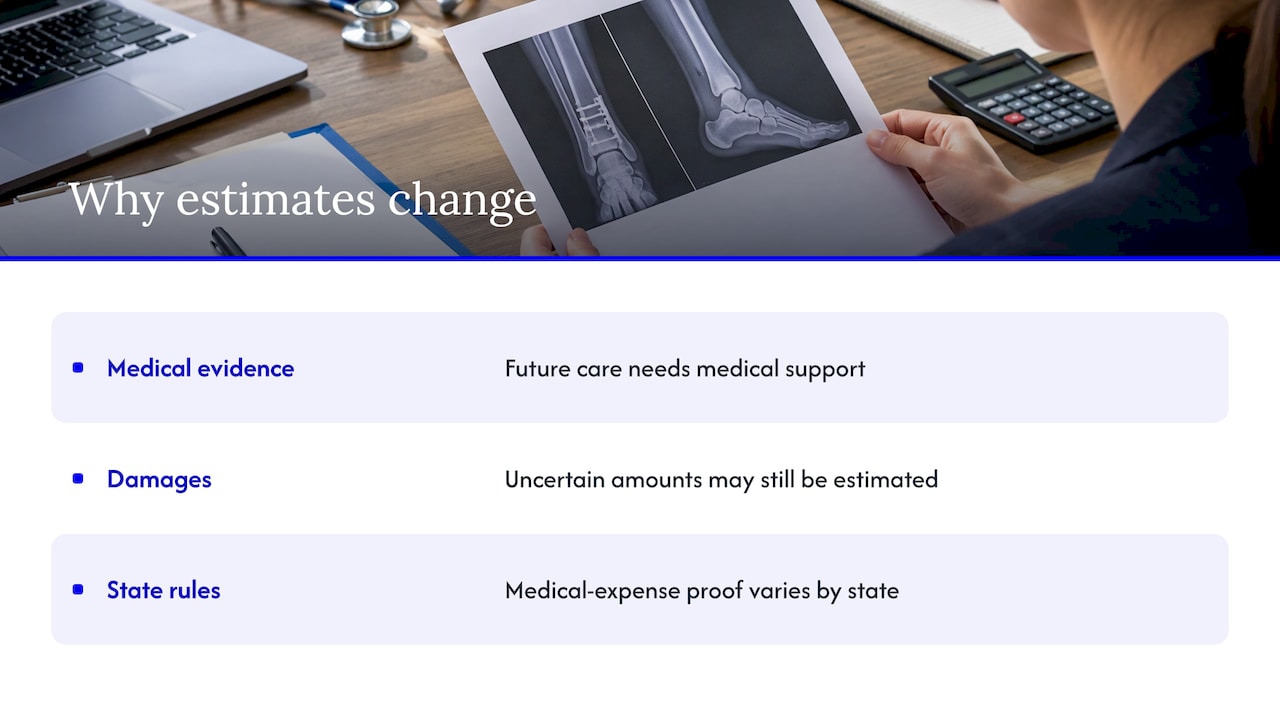
Your medical picture is still developing. Courts want evidence behind medical costs. The American Bar Association's survey of Nebraska law says past and future medical expenses must be supported by evidence, and future expenses must be reasonably certain rather than conjectural. Its Pennsylvania survey similarly describes future expenses as those reasonably likely to be incurred, with a reasonable evidentiary basis rather than speculation. Until a treating doctor can say what future care you need, that part of the estimate stays soft. Our guide on how future medical expenses are proven and valued walks through what that proof looks like.
Uncertainty does not erase a loss. The same Nebraska survey says uncertainty about the amount of damages does not by itself defeat recovery when the evidence gives a reasonably certain factual basis for estimating the loss. So a range now is normal, and it tightens as records come in.
State rules change what counts as proof. Florida is a good example. A 2023 American Bar Association analysis of Florida's tort-law changes says the state changed its evidence rules for proving medical expenses, generally focusing on amounts actually paid or on amounts tied to coverage status. It also says claims for medical expenses under a letter of protection require disclosure of the letter and an itemized billing ledger. Virginia works differently: the ABA's Virginia survey describes a statutory presumption that a medical bill is authentic and reasonable if the plaintiff identifies it and testifies about the provider, services and link to the injury, with records furnished at least 21 days before trial. The survey is from 2011, so a local attorney should confirm what applies today.
The lesson: the same injury and the same bills can be valued differently depending on where the case is filed. That is the main reason to have a lawyer in your state look at it.
Pain, suffering and emotional distress
The question we hear most is how pain is valued. The Hawaii instructions describe general damages as compensation for past, present and reasonably probable future disability, pain and emotional distress caused by the injury. Pain is subjective, and the instructions say a plaintiff need not assign it a dollar value. What you must prove is the nature, extent and effect of the injury. The fact-finder then decides fair compensation.
That shifts what you should collect. Instead of arguing a number, show the effect:
- A short daily journal: sleep, pain levels, tasks you cannot do, activities you gave up.
- Treatment notes from a therapist or counselor if you are dealing with anxiety, flashbacks or fear of driving or riding.
- Statements from family, coworkers or friends who saw the change.
- Photos of visible injuries and scars over time.
Emotional injury claims also run into state rules about when they are allowed, such as the impact rule. Our emotional injury evaluation guide explains how that review works, and our pain and suffering calculation example shows a documented case with a checklist.
What to bring to an evaluation
You can begin with very little. The more of this you have, the more specific the review can be.
| Item | Why it matters |
|---|---|
| Police or crash report number | Records the basic facts and the parties |
| Photos and video of the scene, vehicles, injuries | Shows impact and visible harm |
| Names and contact details of witnesses | Supports your version of events |
| Medical records, discharge papers, imaging | Connects the crash to the injury |
| Bills, receipts, explanation-of-benefits statements | Proves economic loss |
| Pay stubs and a note from your employer | Documents lost income |
| Insurance cards and any letters from insurers | Identifies coverage and early positions |
| Your written timeline and symptom journal | Preserves details and shows daily impact |
If you are a family member after a fatal crash, add the death certificate and details about the person's income and household role. Our wrongful death evaluation guide covers what is reviewed in those cases.
Questions worth asking during the review
- Based on what I have shown you, what are the strongest and weakest points of my claim?
- Which records are missing, and who can get them?
- Which deadlines apply in my state, and what is the first one?
- How do the rules where I live affect proof of my medical bills?
- What will you need from me in the next 30 days?
Deadlines deserve special attention. Every state sets a time limit for filing an injury lawsuit, and the length varies by state and by type of claim. Ask the attorney which one applies to you and write it down.
What to say, and what to hold back
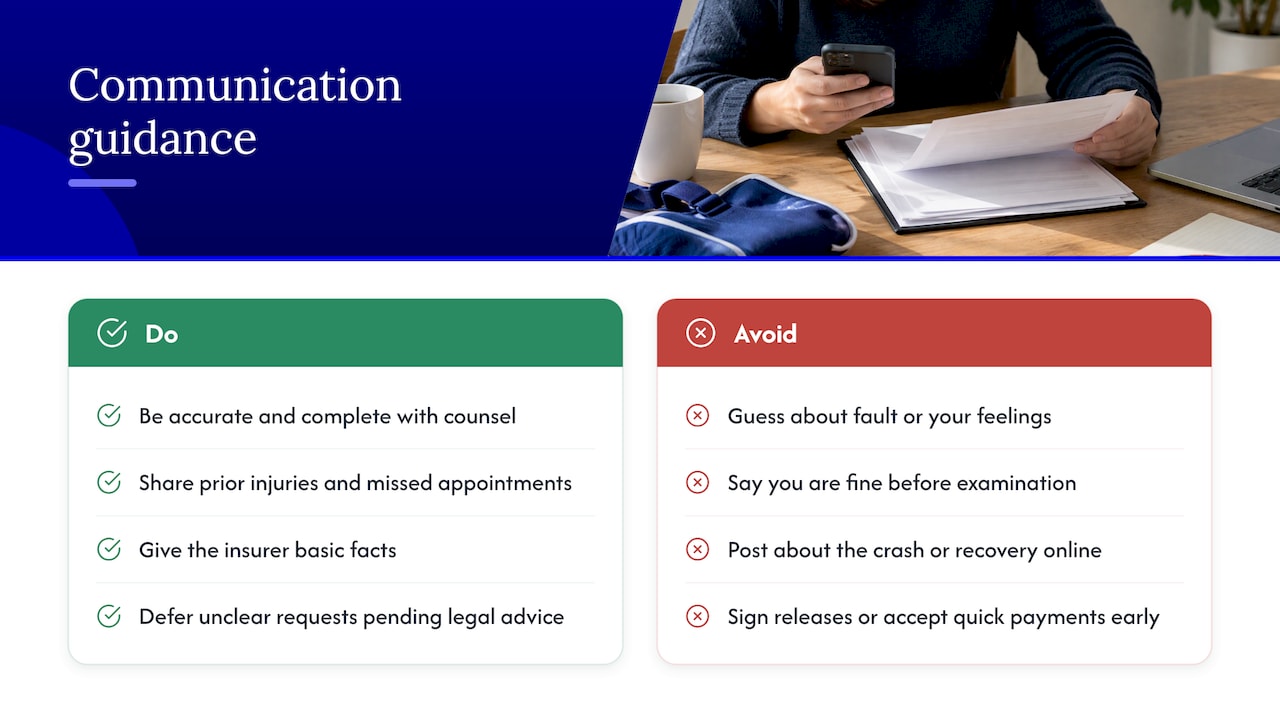
Be accurate and complete with your lawyer. Everything you share helps them judge the case, including facts that seem unhelpful, such as a prior injury to the same body part or a missed appointment. Surprises later cost more than candor now.
With an at-fault driver's insurer, the safer habit is to give basic facts and avoid guessing about fault or speculating about how you feel. Do not say you are fine if you have not yet been examined. Do not post about the crash or your recovery on social media. Do not sign a release or accept a quick payment before you know the full extent of your injuries. If you are unsure what a request means, tell the adjuster you will respond after speaking with an attorney.
Special situations
Motorcycle and bicycle riders. Injuries are often severe, and fault is sometimes questioned unfairly. Evidence such as helmet-cam footage, bike damage and lighting matters. See our pieces on why a specialized bicycle injury attorney helps and bicycle accident settlement value.
Specific injuries. Orthopedic injuries and scarring each depend on particular proof. Our guides on knee injury settlements and scar injury settlements explain what documentation drives value.
Families after a death. The review looks at the cause of death, the person's earnings and role, and the family's losses, under your state's wrongful death law.
Start a free evaluation
Our free evaluation is for people hurt in car, truck, motorcycle and bicycle accidents, and for families who lost someone. You describe your injury and what happened, including physical injuries, emotional trauma or a wrongful death, and the assessment is tailored to that. It is free and does not commit you to anything. Where you want legal help, we connect you with vetted local attorneys.
When you are ready, begin at our free evaluation page. Have your date of accident, your injury and any records handy, but do not wait to assemble everything.
Our view
A case evaluation should not feel like a sales call. It should feel like someone reading your facts carefully and telling you where you stand. Most people reach us in the weeks after an accident, when treatment is ongoing, bills are arriving and the insurer is already calling. That is when a clear read of the situation helps most.
We built our evaluation around the injury and the circumstances, because a bicycle crash with a concussion and a truck collision with a wrongful death raise different questions, and each deserves its own intake. A free, no-obligation start lets you learn whether you may be entitled to compensation before you decide anything, and matching you with a local attorney means the person reviewing your claim knows your state's rules.
Evidence and timing decide most outcomes. Start early, keep your records and ask direct questions.
Gerard
FAQ
Is a free injury case evaluation really free?
Our evaluation is free and carries no obligation. You share details about your accident and injury, and you decide what to do with the result. Nothing in the evaluation requires you to hire anyone.
How long does an evaluation take?
Submitting your details takes a few minutes. A thorough legal review can take longer when your treatment is still ongoing, because records and prognosis shape the picture. Expect the estimate to firm up as documents arrive.
Can I get an evaluation if my injury is mostly emotional?
Yes. Anxiety, post-traumatic stress and similar harm after a crash can be part of a claim. Treatment records and a symptom journal are the core proof, and state rules differ on when such claims are allowed, so a local attorney should review yours.
What if I was partly at fault?
Tell the reviewer. Many states reduce or limit recovery based on shared fault, and the rule differs by state. It does not automatically end a claim, so share the facts and let an attorney apply your state's law.
What does a case evaluation not tell me?
It gives an informed range and a plan, not a guaranteed result. The final value depends on medical proof, the insurance involved and the law of your state.
Sources
- U.S. District Court for the District of Hawaii, civil jury instructions
- American Bar Association, 50-state survey: Nebraska (2011)
- American Bar Association, 50-state survey: Pennsylvania (2011)
- American Bar Association, 50-state survey: Virginia (2011)
- American Bar Association, Big Changes in Florida Tort Law (2023)