
An accident emotional injury attorney evaluation is the process by which a licensed attorney determines whether your emotional trauma claim meets the legal elements required for compensation. Courts recognize emotional harm as a legitimate category of damages, often called "emotional distress" or "psychological injury" in personal injury law. Getting this evaluation right from the start shapes every decision that follows, from evidence gathering to settlement negotiations. Carcollisionlawyer connects accident victims with attorneys who specialize in exactly this assessment, at no upfront cost.
What legal elements must be present for emotional injury claims?
Every emotional injury claim rests on four legal elements. Free case reviews typically last 15–30 minutes and assess whether all four are present: duty of care, breach, causation, and measurable damages. If any element is missing, the claim cannot move forward.
Here is what each element means in practice:
- Duty of care: The at-fault party had a legal obligation to act safely. A driver on a public road owes every other road user a duty of care.
- Breach: The at-fault party violated that duty. Running a red light or driving while distracted are clear examples of breach.
- Causation: The breach directly caused your emotional injury. An attorney must connect the accident event to your diagnosed psychological condition, not a pre-existing issue.
- Measurable damages: Your emotional harm must be quantifiable. Courts accept diagnoses like PTSD, generalized anxiety disorder, and major depressive disorder as measurable damages.
Emotional distress claims accompanying significant physical injuries are more likely to be compensated. Standalone emotional claims face a higher burden of proof and state-specific legal hurdles. This distinction matters enormously during the evaluation stage because it shapes how an attorney builds your case theory.
Statute of limitations rules also apply to emotional injury claims. Most states allow two years from the accident date to file, though some states set shorter windows. Missing this deadline eliminates your right to compensation entirely, regardless of how strong your evidence is.

What medical documentation supports a strong emotional injury evaluation?
Strong documentation is the backbone of any psychological damage attorney evaluation. Attorneys look for clinical records that meet both medical and legal standards before advising you to pursue a claim.
The most credible documentation includes:
- DSM-5 diagnoses: A formal diagnosis under the Diagnostic and Statistical Manual of Mental Disorders, Fifth Edition, gives your claim clinical authority. PTSD, acute stress disorder, and adjustment disorder are the most common diagnoses in accident cases.
- PCL-5 and CAPS-5 assessments: The PTSD Checklist for DSM-5 (PCL-5) and the Clinician-Administered PTSD Scale (CAPS-5) are standardized tools that measure symptom severity. PTSD documentation beyond one month, supported by these assessments, is critical for serious injury claims.
- Psychiatric and psychological treatment records: Ongoing therapy notes, medication records, and psychiatrist evaluations show that your condition required professional intervention.
- Pre-accident mental health history: Establishing what your psychological baseline looked like before the accident helps attorneys argue that the accident caused new harm, not a continuation of prior issues.
- Lay witness statements: Family members, coworkers, and friends who observed changes in your behavior after the accident provide non-medical evidence that courts find credible.
Expert forensic psychologists charge $200–$500 per hour to provide litigation support, including prognosis reports and courtroom testimony. That cost is a real factor in evaluating whether your claim justifies full litigation or is better resolved through settlement.
Pro Tip: Start a daily symptom journal the day after your accident. Write down sleep disruptions, anxiety episodes, flashbacks, and any activities you can no longer do. This journal becomes contemporaneous evidence that is very difficult for insurance companies to dispute.
Maintaining a symptom journal immediately after the accident helps establish the pre-accident baseline and distinguishes new trauma from pre-existing conditions. Attorneys treat this journal as one of the most persuasive pieces of non-clinical evidence available.
How do attorneys conduct an emotional injury evaluation step-by-step?
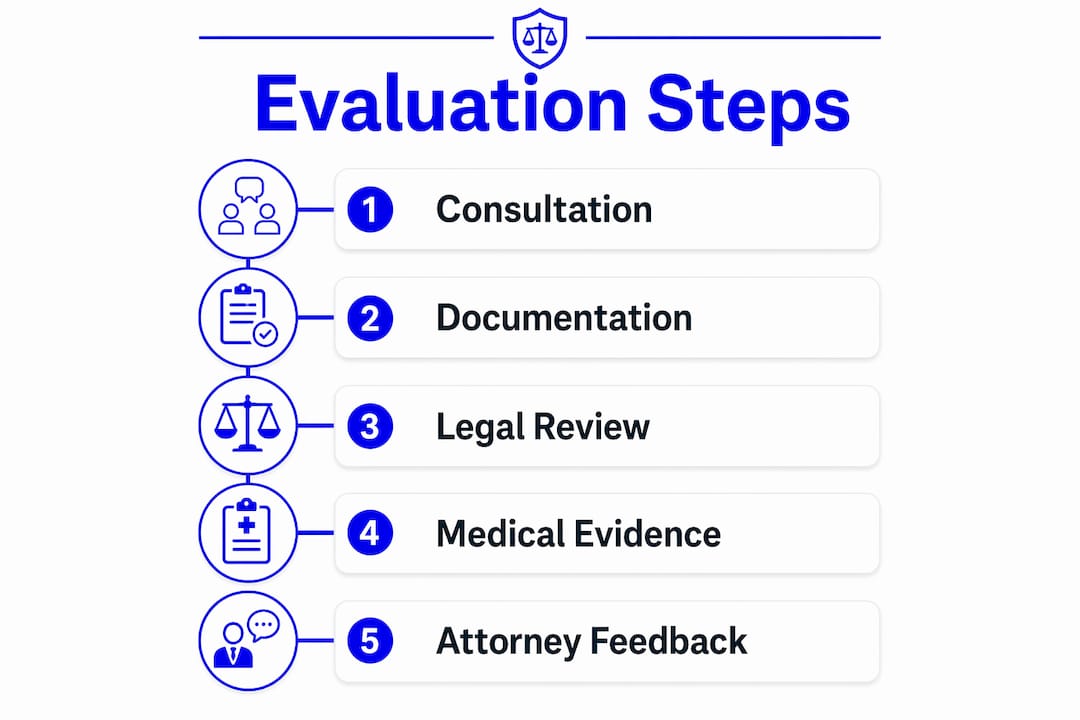
Understanding the attorney's process removes the uncertainty from your first meeting. A free case review with a licensed attorney in your state provides a no-obligation assessment of your emotional injury claim and advises whether the case is worth pursuing.
-
Initial intake and fact gathering. The attorney asks you to describe the accident, the at-fault party's actions, and the timeline of your emotional symptoms. This conversation typically lasts 15–30 minutes and covers the basic facts needed to assess duty of care and breach.
-
Medical record review. The attorney examines your psychiatric diagnoses, therapy records, and any standardized assessments like the PCL-5. Records that show a clear timeline from accident to diagnosis strengthen the causation argument significantly.
-
Evidence strength assessment. The attorney evaluates whether your current documentation is sufficient or whether gaps exist. Gaps in treatment records, for example, give insurance companies room to argue your symptoms were not serious. Learn more about how attorneys build cases using this evidence.
-
Witness statement review. Statements from people who knew you before and after the accident help build a narrative about how your daily life changed. An attorney's ability to connect medical documentation, daily impacts, and witness accounts strongly influences the evaluation outcome and settlement potential.
-
Legal element verification. The attorney maps your facts against the four legal elements. If causation is weak, the attorney may recommend additional psychiatric evaluation before proceeding.
-
Settlement potential assessment. The attorney estimates a realistic compensation range based on your diagnosis, documented losses, and the strength of your evidence. This includes lost wages, therapy costs, and non-economic damages for pain and suffering.
-
Recommendation and next steps. The attorney tells you whether to pursue the claim, what additional evidence to gather, and what the litigation timeline looks like. Your PTSD claim rights include the right to understand this recommendation fully before committing to representation.
Common challenges in emotional injury evaluations and how to handle them
Emotional injury claims face obstacles that physical injury claims do not. Knowing these challenges in advance lets you prepare rather than react.
Insurance companies are skeptical of emotional trauma claims because the injuries lack visible proof. Adjusters are trained to question whether symptoms are real, exaggerated, or caused by something other than the accident. Lay witness testimony from family members and coworkers becomes vital in this environment because it provides behavioral evidence that supplements medical records.
"Independent medical exams (IMEs) are typically conducted by doctors hired by the insurance company aiming to minimize the injury and dispute causation. Clients should always be supported by their own medical and legal experts ready to challenge deficient or minimized findings."
IMEs are adversarial by design. The doctor conducting your IME works for the insurer, not for you. Bring your own treatment records to any IME appointment, and brief your attorney beforehand so they can prepare a rebuttal if the IME report contradicts your treating physician's findings.
Social media is another underestimated risk. Photos or posts showing you at social events can be used to argue your emotional distress is not as severe as claimed. Attorneys consistently advise clients to limit social media activity during the claims process.
Delayed psychiatric treatment weakens claims significantly. Courts scrutinize the timeline between the accident date and your first mental health appointment. A gap of several months invites the argument that your symptoms were not serious or were caused by something else entirely.
Pro Tip: If you have not yet seen a mental health professional, book an appointment before your attorney evaluation. Even one documented visit establishes that you sought treatment promptly and takes the timeline argument away from the insurer.
Key Takeaways
A successful accident emotional injury attorney evaluation requires four legal elements, clinical documentation meeting DSM-5 standards, and a clear timeline connecting the accident to your diagnosed psychological condition.
| Point | Details |
|---|---|
| Four legal elements required | Duty of care, breach, causation, and measurable damages must all be present for a claim to qualify. |
| DSM-5 diagnosis is foundational | A formal psychiatric diagnosis, supported by PCL-5 or CAPS-5 assessments, gives your claim clinical and legal credibility. |
| Document immediately | A daily symptom journal started right after the accident establishes your pre-accident baseline and counters insurer arguments. |
| IMEs are adversarial | Insurance-hired doctors aim to minimize your injury; prepare with your own medical team and attorney before any IME. |
| Physical injury strengthens claims | Emotional distress tied to physical injury has a clearer legal path than standalone psychological harm claims. |
What I've learned from watching emotional injury cases succeed and fail
Most people who contact an attorney after an accident focus entirely on their physical injuries. The emotional damage, the nightmares, the inability to drive again, the anxiety that follows them into every ordinary moment, gets mentioned almost as an afterthought. That is a serious mistake, and I have seen it cost people real money.
The cases that succeed share one pattern: the client started documenting their emotional symptoms early, saw a mental health professional quickly, and gave their attorney a clear, consistent story. The cases that struggle share a different pattern: the client waited months to seek psychiatric care, posted on social media without thinking, and gave inconsistent accounts of their symptoms because they had not written anything down.
The evaluation itself is not something to fear. Think of it as a diagnostic appointment for your legal situation. A good attorney will tell you honestly whether your claim has legs and what it will take to prove it. That honesty is worth more than false encouragement.
One thing most articles skip: the tax question. Emotional distress damages without physical injury are often taxable, while physical injury damages generally are not. This affects your actual net recovery. Ask your attorney to loop in a tax advisor before you finalize any settlement. Most people never think about this until after the check clears.
The evaluation is your first step toward understanding what you are actually owed. Take it seriously, prepare your documentation, and go in with realistic expectations. The process works when you work it.
— Gerard
How Carcollisionlawyer can help with your emotional injury claim
Emotional trauma after an accident is real, and you deserve a legal team that treats it that way.
Carcollisionlawyer connects accident victims with licensed attorneys who handle emotional distress and PTSD claims every day. The process starts with a free injury evaluation that costs you nothing and commits you to nothing. Attorneys in the network work on a contingency fee basis, meaning you pay no legal fees unless you recover compensation. If you are ready to understand what your emotional injury claim is worth, start your assessment and get matched with an attorney who can give you a straight answer.
FAQ
What is an accident emotional injury attorney evaluation?
An accident emotional injury attorney evaluation is a free legal consultation where a licensed attorney reviews your accident facts, medical records, and emotional symptoms to determine whether your claim meets the four legal elements required for compensation.
How long does a free emotional injury case review take?
Free case reviews typically last 15–30 minutes and cover the essential legal criteria needed to assess whether your emotional injury claim is viable.
What diagnoses qualify for emotional distress compensation?
PTSD, generalized anxiety disorder, acute stress disorder, and major depressive disorder are the most commonly compensated diagnoses, provided they are supported by DSM-5 criteria and documented through clinical assessment tools like the PCL-5.
Can I claim emotional distress without a physical injury?
Yes, but standalone emotional distress claims face a higher burden of proof and stricter state-specific legal standards than claims tied to a physical injury. An attorney evaluation will clarify which standard applies in your state.
How do I prepare for my first attorney evaluation?
Gather your accident report, any medical or psychiatric records, and a written timeline of your emotional symptoms. A symptom journal started immediately after the accident is one of the most useful documents you can bring to your first meeting.