
Emotional distress claims, known formally as negligent or intentional infliction of emotional distress, require attorneys to prove that psychological harm is serious, documented, and directly caused by the defendant's conduct. How emotional injury attorneys build cases depends on assembling medical records, expert testimony, and witness statements into a coherent picture of real, lasting harm. Courts do not accept vague claims of upset or anxiety. The injury must rise to a level that substantially impairs daily life, relationships, or the ability to work. That standard shapes every decision an attorney makes from the first client meeting forward.
How emotional injury attorneys build cases: the core framework
The foundation of every emotional injury case is evidence that connects the defendant's actions to a specific, serious psychological injury. Attorneys do not build these cases on a client's word alone. They gather clinical records, pharmacy histories, and statements from people who witnessed the harm firsthand.
Courts require both actual cause and proximate cause to be established, meaning the attorney must show a clear and direct line between the wrongful conduct and the psychological harm. This is harder than proving a broken bone because emotional injuries are invisible. The attorney's job is to make the invisible visible through objective, corroborating evidence.
Legal experts emphasize framing emotional distress as a serious impairment, not ordinary stress, to meet the high recovery thresholds courts apply. That framing starts in the first pleading and runs through every piece of evidence collected.
What types of evidence do attorneys use to prove emotional injury?
Attorneys rely on several categories of evidence to prove emotional harm. Each type serves a different purpose, and the strongest cases use multiple types together.
Clinical records are the backbone of any emotional distress claim. Diagnoses, therapy notes, and treatment plans from licensed mental health professionals establish that a recognized condition exists. These records show when symptoms began, how severe they became, and what treatment was required.
Pharmacy records add objective weight. Sustained use of antidepressants or anti-anxiety medications demonstrates that a doctor recognized and treated a serious condition over time. A single prescription carries less weight than months of refills.
Lay witness testimony fills gaps that medical records cannot. Descriptions of withdrawal, relationship breakdown, and loss of interest from family members or close friends show how the injury changed the claimant's daily behavior. Juries respond to these accounts because they translate clinical language into recognizable human experience.
Physical manifestations also matter. Invisible emotional injuries are often substantiated through objective physical symptoms like elevated blood pressure and insomnia, which are easier for juries to understand than subjective feelings. A doctor's note documenting sleep disruption or weight loss gives the jury something concrete to hold onto.
Expert evaluations from psychiatrists or psychologists provide the clinical framework that ties all other evidence together. These professionals explain how the documented symptoms meet diagnostic criteria and why they constitute a legitimate medical injury.
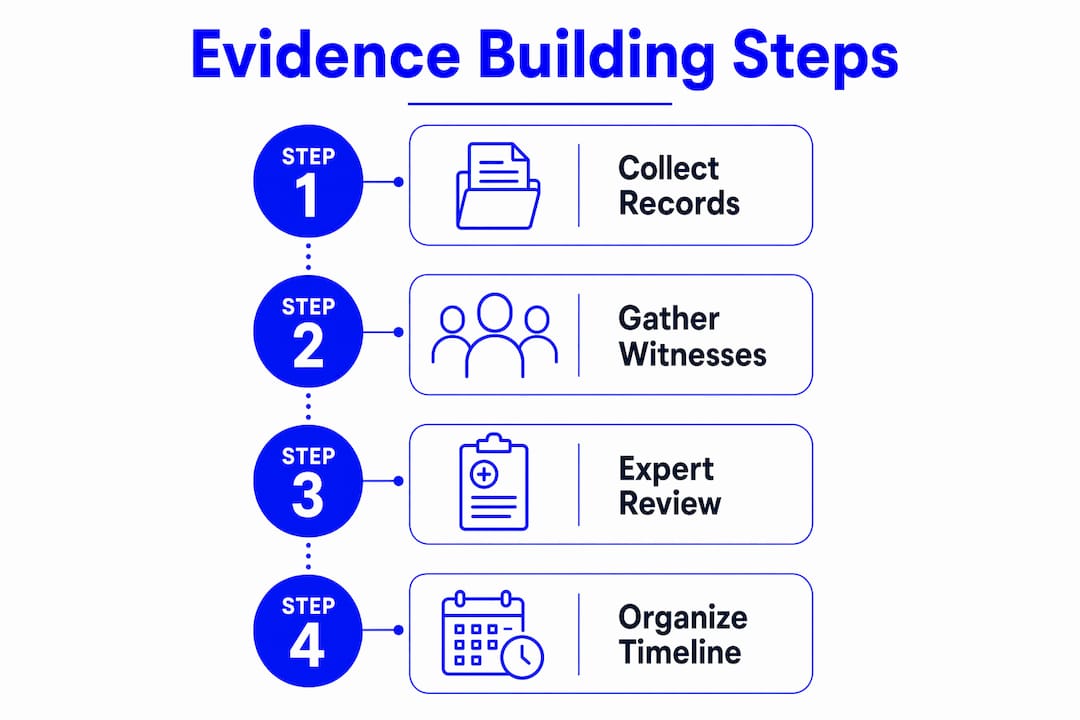
The evidence types work best in combination. Clinical records establish the diagnosis. Pharmacy records confirm sustained treatment. Lay witnesses show real-world impact. Physical symptoms give juries tangible proof. Expert testimony explains what it all means.
Pro Tip: Start collecting evidence immediately after the incident. Gaps in treatment records give defense attorneys grounds to argue the injury was not serious or was caused by something else entirely.
How do attorneys establish causation and rule out other causes?
Causation is where most emotional injury cases are won or lost. Proving that the defendant's conduct caused the harm is not enough. The attorney must also show that nothing else caused it.
Experienced attorneys follow a structured process to establish and protect causation:
-
Document the timeline precisely. Attorneys map the exact sequence of events, from the incident date to the first medical visit to the ongoing treatment record. A clear timeline shows that symptoms appeared after the defendant's conduct, not before.
-
Conduct a thorough client history audit. Defense attorneys scrutinize client history for unrelated stressors such as divorce or job loss to argue against causation. An experienced attorney reviews this history first and builds a proactive explanation for any pre-existing conditions.
-
Address pre-existing conditions directly. A prior mental health diagnosis does not automatically defeat a claim. Attorneys use the "eggshell plaintiff" doctrine, which holds that defendants take victims as they find them. The argument is that the defendant's conduct worsened a pre-existing condition significantly.
-
Anticipate "causation break" arguments. A common defense tactic is to argue that external stressors or pre-existing conditions, not the defendant's conduct, caused the distress. Attorneys prepare expert witnesses to explain why the incident, not background stress, triggered the clinical-level injury.
-
Maintain consistent documentation throughout. Gaps or delays in treatment weaken claims by giving the defense grounds to dispute causation or severity. Attorneys advise clients to attend every appointment and document every symptom change.
Pro Tip: Keep a daily journal from the day of the incident. Brief notes about sleep, mood, and daily function create a contemporaneous record that is very difficult for the defense to challenge.
What role do expert witnesses play in building emotional injury cases?
Expert witnesses serve as translators between clinical medicine and the courtroom. Psychiatrists and psychologists bridge DSM-5 clinical jargon and lay comprehension to demonstrate severe emotional injuries in court. Without this translation, juries often struggle to treat psychological harm as seriously as physical injury.
An expert witness in an emotional injury case typically does the following:
- Reviews all clinical records and treatment notes to form an independent opinion on diagnosis and severity.
- Explains how the claimant's symptoms meet the criteria in the DSM-5, the standard diagnostic manual used in American psychiatry.
- Describes the functional impairment in plain terms, such as the inability to return to work, maintain relationships, or perform daily tasks.
- Offers a prognosis, explaining whether the injury is likely to be permanent or require ongoing treatment.
- Addresses causation directly, explaining why the defendant's conduct, rather than other life stressors, produced the clinical-level injury.
The expert's role is powerful but not always legally required. Not every case requires expert psychiatric evidence. Some cases succeed based on credible lay testimony combined with strong functional impairment documentation. Attorneys weigh the cost of expert testimony against the complexity of the case and the strength of the lay evidence before deciding.
When the defense has its own expert, the plaintiff's expert becomes critical. Two competing clinical opinions force the jury to evaluate credibility, and a well-prepared expert who speaks clearly and avoids jargon almost always has the advantage.
How do attorneys organize and present evidence to maximize case strength?
Organizing evidence is as important as collecting it. A disorganized case file, even one full of strong evidence, fails to communicate the harm clearly to a judge or jury.
Attorneys build a coherent narrative by creating a master timeline that runs from the incident through every medical visit, prescription, and symptom change. This timeline becomes the spine of the case. Every piece of evidence attaches to a point on that timeline, showing progression and continuity.

Corroborative testimony from family members and close friends is collected early and structured carefully. Attorneys prepare these witnesses to describe specific behavioral changes rather than general impressions. "She stopped attending her daughter's school events after the accident" is far more persuasive than "she seemed sad."
| Evidence type | Courtroom impact |
|---|---|
| Clinical diagnosis records | Establishes recognized medical condition and onset date |
| Pharmacy and prescription records | Proves sustained, medically supervised treatment |
| Lay witness statements | Shows real-world behavioral and relational impact |
| Physical symptom documentation | Provides objective, tangible proof juries can evaluate |
| Expert psychiatric evaluation | Translates clinical findings into legal standards |
Structured pleadings and narrative framing matter at every stage. Attorneys write complaints and briefs that tell a story, not just list facts. The goal is for the judge or jury to understand the harm before they hear a single witness.
Pro Tip: Request copies of all medical records yourself and review them for accuracy. Errors in clinical notes, such as a wrong date or a misquoted symptom, can create openings for the defense to challenge the entire record.
Key takeaways
Emotional injury attorneys build strong cases by combining clinical evidence, expert testimony, and witness accounts into a clear, documented narrative of serious psychological harm.
| Point | Details |
|---|---|
| Causation is the central challenge | Attorneys must link the defendant's conduct directly to the injury, ruling out all other causes. |
| Multiple evidence types work together | Clinical records, pharmacy records, lay testimony, and expert evaluations each fill a different gap. |
| Early documentation is critical | Gaps in treatment records give the defense grounds to dispute both causation and severity. |
| Expert witnesses translate harm | Psychiatrists and psychologists explain DSM-5 diagnoses in terms juries can evaluate and accept. |
| Lay testimony can stand alone | Credible witness accounts of behavioral change can support a claim even without formal expert testimony. |
What I've learned about proving invisible injuries
Emotional injury cases are among the hardest personal injury claims to litigate well. Physical injuries have X-rays and surgical reports. Emotional injuries have treatment notes and a client's account of how their life changed. That gap in tangibility is where most cases fail.
The attorneys who win these cases consistently do one thing differently: they start building the record on day one. They do not wait for the client to "see how things go." Every week without documentation is a week the defense can use to argue the injury was not serious enough to seek help.
The other mistake I see repeatedly is underestimating the defense's causation attack. Defense teams are skilled at finding life stressors, a job change, a family conflict, a prior therapy session, and presenting them as the real cause of the distress. The only counter is a thorough client history review done before discovery begins, not after.
Claimants also need realistic expectations. These cases take time. The documentation process is ongoing, not a one-time event. Clients who stay consistent with treatment and keep detailed records give their attorneys the strongest possible foundation to work from. The cases that settle well are almost always the ones where the paper trail is airtight.
— Gerard
Connecting with the right legal support for your claim
Emotional injury claims after accidents require attorneys who know how to gather the right evidence, manage expert evaluations, and counter defense tactics before they gain traction. Carcollisionlawyer connects accident victims with trusted attorneys who specialize in exactly this kind of case preparation.
The free evaluation process at Carcollisionlawyer lets you understand what your claim may be worth before making any commitment. Attorneys in the network handle the documentation, the expert coordination, and the negotiation so you can focus on recovery. If you were injured in a car, motorcycle, or truck accident and are experiencing lasting emotional harm, start your claim evaluation today to connect with a specialist who can assess your specific situation.
FAQ
What qualifies as emotional injury in a legal claim?
Emotional injury, legally called negligent or intentional infliction of emotional distress, must rise above ordinary upset or anxiety. Courts require proof that the disturbance substantially impaired daily life, relationships, or work capacity.
How long does building an emotional injury case take?
The timeline varies based on case complexity, the volume of medical records, and whether expert witnesses are needed. Most emotional distress cases take months to years to fully document and resolve.
Can I win an emotional injury claim without a psychiatrist?
Yes. Credible lay testimony combined with functional impairment documentation can support a successful claim without formal expert testimony, though complex cases benefit significantly from expert analysis.
What is the biggest mistake claimants make in emotional injury cases?
Delaying or stopping treatment is the most damaging mistake. Gaps in treatment records give defense attorneys grounds to argue the injury was not serious or was caused by something unrelated to the defendant's conduct.
How do attorneys handle pre-existing mental health conditions?
Attorneys use the eggshell plaintiff doctrine to argue that the defendant's conduct worsened a pre-existing condition significantly. A thorough client history audit allows the attorney to frame pre-existing conditions proactively before the defense raises them.