
Post-traumatic stress disorder (PTSD) is a diagnosable psychiatric condition triggered by traumatic vehicle accidents and is fully eligible for compensation as part of an accident claim when liability is established. Understanding the ptsd after accident claim explained process matters because psychological injuries are just as real as broken bones, yet far easier for insurers to dismiss. Approximately 22% of road accident survivors develop PTSD after a crash. That means more than 1 in 5 accident victims carry serious psychological scars that qualify as compensable non-economic damages under personal injury law. This guide covers symptoms, proof requirements, compensation ranges, and the exact steps to file a successful claim.
PTSD after an accident claim: what you need to know
PTSD is classified legally as non-economic damage, covering pain and suffering and emotional distress separately from medical bills or lost wages. This distinction is critical. It means your psychological injury stands on its own legal footing and does not need to be attached to a physical injury to qualify for compensation. The causal link between the accident and your PTSD symptoms is what the claim turns on.
Accident victim PTSD is not a vague complaint. It is a formal diagnosis defined by the Diagnostic and Statistical Manual of Mental Disorders, Fifth Edition (DSM-5), and recognized by courts across the United States. Symptoms must meet specific clinical criteria, persist beyond one month, and cause measurable disruption to daily life. When those conditions are met, the law treats PTSD the same way it treats a fractured spine: as an injury caused by someone else's negligence.

The most important early step is connecting the accident to your symptoms through medical documentation. Without that documented causal link, insurers will argue your condition existed before the crash or has no verifiable origin. Establishing that link early protects your claim and your recovery.
What are the common types and symptoms of PTSD after vehicle accidents?
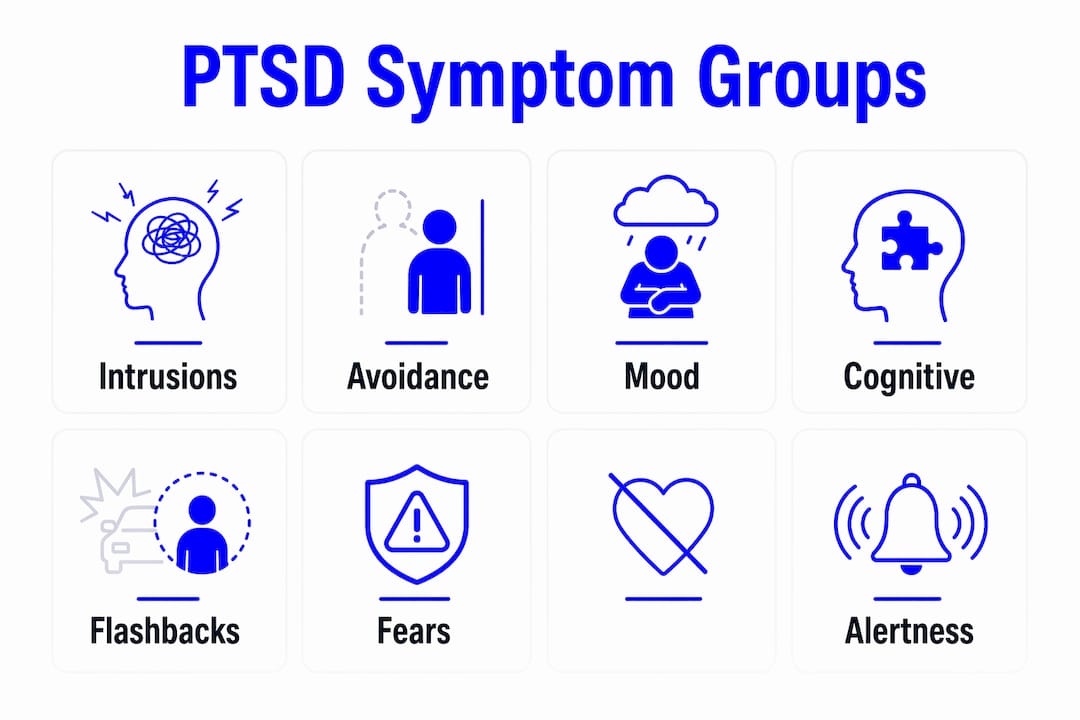
PTSD after a car accident clusters into four distinct symptom groups, and recognizing them early gives you a significant advantage in both treatment and legal documentation.
Intrusive memories are the most recognized symptom. These include vivid flashbacks of the crash, recurring nightmares, and intense psychological distress when exposed to accident-related cues like the sound of screeching tires or driving past the crash site. The brain replays the trauma involuntarily, which is what separates PTSD from ordinary stress.
Avoidance behaviors show up as a refusal to drive, reluctance to discuss the accident, or actively steering clear of roads, vehicles, or conversations that might trigger memories. Many accident victims quietly reorganize their entire lives around avoiding reminders, without realizing this pattern is a clinical symptom.
Negative mood and cognitive shifts include persistent guilt, self-blame, emotional numbness, and a loss of interest in activities you previously enjoyed. Depression co-occurs in 17.4% of accident survivors with PTSD, which compounds both the suffering and the legal damages.
Hyperarousal presents as constant alertness, exaggerated startle responses, irritability, and chronic sleep problems. You may feel permanently on edge even in safe environments.
One fact many accident victims miss: PTSD symptoms can have delayed onset from weeks up to a year after the accident. A delayed presentation does not disqualify you from filing a claim, provided the causal connection to the accident is clear.
Pro Tip: Start a daily symptom journal the week after your accident. Log nightmares, avoidance behaviors, and mood changes with dates. This record becomes powerful evidence in both your clinical assessment and your legal claim.
How do you prove PTSD for an accident claim?
Proving PTSD in a legal context requires a specific chain of documentation. Courts and insurers do not accept self-reported distress alone. Here is the evidence framework that holds up:
-
Formal DSM-5 diagnosis. A licensed mental health professional using DSM-5 criteria must diagnose you. This can be a psychiatrist, psychologist, or licensed clinical social worker. The diagnosis report must name PTSD specifically, not just "anxiety" or "stress."
-
Consistent therapy records. Attend therapy regularly and keep every appointment. Gaps in treatment give insurers ammunition to argue your condition is not serious. Records showing ongoing treatment over months document both the severity and the persistence of your symptoms.
-
Nexus letter from your provider. A nexus letter is a formal written statement from your treating clinician connecting your PTSD diagnosis directly to the accident. This document is the legal spine of your claim. Without it, the causal link remains arguable.
-
Accident evidence. Police reports, photographs, witness statements, and emergency room records establish the traumatic event itself. Your PTSD claim needs the accident to be documented as a genuinely traumatic incident.
-
Expert testimony. In contested claims or litigation, an independent mental health expert may testify about the nature of your diagnosis, its connection to the accident, and its expected duration and impact on your life.
Victims should not delay mental health treatment while waiting for a formal PTSD label. Early symptom documentation strengthens both your recovery and your legal position. Seeing a therapist within days of the accident creates a contemporaneous record that is far more credible than records started months later.
Pro Tip: Ask your therapist explicitly to document how your symptoms relate to the accident in every session note. Vague records that do not mention the crash are far less useful in a claim than notes that consistently reference the traumatic event.
What compensation can you expect for PTSD after an accident?
PTSD compensation covers more categories than most accident victims realize. Understanding what is on the table helps you avoid accepting a settlement that leaves real damages unpaid.
What PTSD damages can include:
- Pain and suffering tied to psychological trauma
- Emotional distress and loss of enjoyment of life
- Therapy costs, psychiatric medication, and future treatment expenses
- Lost wages if PTSD prevents you from working
- Loss of earning capacity for long-term or permanent impairment
Average PTSD settlements range between $50,000 and $500,000, with a median value around $100,000. That range reflects how much severity, documentation quality, and jurisdiction affect the final number.
| Compensation Factor | Impact on Settlement Value |
|---|---|
| Severity of PTSD symptoms | More severe and disabling symptoms push settlements toward the higher end |
| Quality of documentation | Strong nexus letters and consistent therapy records increase credibility |
| Duration of symptoms | Chronic PTSD lasting years commands higher damages than short-term cases |
| Lost income evidence | Documented wage loss adds quantifiable economic damages on top of non-economic claims |
| Jurisdiction | State laws and local jury verdicts influence what insurers are willing to offer |
Insurance companies routinely undervalue mental health injuries like PTSD because they are invisible. Insurers may offer a quick, low settlement before you understand the full scope of your condition. Victims without legal representation are most vulnerable to this tactic. An attorney experienced in psychological injury claims knows how to counter lowball offers with documented evidence and expert support.
What are the practical steps for filing a PTSD claim after an accident?
Filing a PTSD claim follows a clear sequence. Skipping steps or moving out of order weakens your position significantly.
-
Seek mental health evaluation immediately. If PTSD symptoms last longer than two weeks and interfere with daily life, see a mental health professional right away. Do not wait for symptoms to become severe before seeking help.
-
Notify your insurance company. Report the accident and your injuries, including psychological symptoms, promptly. Delays in notification can be used against you. Keep all communications in writing.
-
Gather and preserve all evidence. Collect the police report, medical records, photos of the scene, and contact information for witnesses. Preserve any physical evidence from the accident.
-
Build your medical documentation chain. Attend every therapy appointment, request copies of all session notes, and ask your provider to write a nexus letter connecting your diagnosis to the accident.
-
Consult a personal injury attorney before accepting any settlement. Insurers move fast with settlement offers. An attorney can evaluate whether an offer reflects the true value of your PTSD claim, including future treatment costs and long-term income impact. You can start a personal injury claim evaluation to understand your options before committing to anything.
-
Watch the statute of limitations. Every state sets a deadline for filing personal injury claims, typically two to three years from the accident date. Missing that deadline eliminates your right to compensation entirely.
How is PTSD different from general anxiety after an accident?
PTSD and general anxiety disorder are not the same condition, and the distinction matters enormously for both treatment and legal claims.
General anxiety after an accident is common and understandable. It may involve worry, tension, and nervousness about driving again. These feelings often resolve within weeks as the shock of the accident fades. PTSD, by contrast, is defined by a specific set of symptom clusters that persist and are directly tied to re-experiencing the traumatic event itself.
The DSM-5 requires four distinct symptom categories for a PTSD diagnosis: intrusion symptoms, avoidance, negative alterations in mood and cognition, and alterations in arousal and reactivity. General anxiety does not require all four. This clinical specificity is what makes PTSD a stronger and more clearly defined basis for a legal claim.
Key distinctions that matter for your claim:
- PTSD involves involuntary re-experiencing of the trauma (flashbacks, nightmares). General anxiety does not.
- PTSD requires active avoidance of trauma-related stimuli as a defining feature.
- PTSD symptoms must persist for more than one month and cause significant functional impairment.
- A misdiagnosis of general anxiety instead of PTSD can reduce your compensation significantly.
If your provider has diagnosed you with anxiety after your accident, ask directly whether your symptoms meet the DSM-5 criteria for PTSD. The correct diagnosis is not just a clinical matter. It is a financial one.
Key takeaways
PTSD after an accident is a legally compensable injury, but only when it is formally diagnosed, causally linked to the crash, and thoroughly documented from the earliest possible date.
| Point | Details |
|---|---|
| PTSD is a legal injury | PTSD qualifies as non-economic damage in accident claims, covering pain, suffering, and emotional distress. |
| Documentation is everything | A DSM-5 diagnosis, consistent therapy records, and a nexus letter form the core of a provable claim. |
| Compensation ranges widely | Settlements typically fall between $50,000 and $500,000 depending on severity and documentation quality. |
| Delayed onset is still valid | Symptoms appearing weeks or months after the accident do not disqualify your claim if causation is clear. |
| Legal help changes outcomes | Insurers undervalue invisible injuries; an experienced attorney significantly improves settlement results. |
What i've learned from watching PTSD claims go wrong
After years of covering personal injury cases and accident victim stories, the pattern I see most often is this: people wait. They wait to see a therapist because they think they should "just get over it." They wait to call an attorney because they assume the insurance company will be fair. By the time they realize neither is true, months of undocumented symptoms have passed and their claim is weaker for it.
The other mistake I see constantly is accepting the first settlement offer. Insurers know that accident victims are often financially stressed and emotionally exhausted. A fast offer feels like relief. What it actually is, in most PTSD cases, is a fraction of what the claim is worth. More than 50% of individuals with PTSD after car accidents retain symptoms for over three years without treatment. A settlement that covers six months of therapy does not account for that reality.
The most important thing I can tell you is this: your psychological injury is as real and as legally valid as any physical injury from the same crash. The law recognizes it. Courts award damages for it. The only variable is whether you build the evidence to support it. Start documenting now, see a mental health professional now, and talk to a lawyer before you sign anything. Those three steps, taken early, make the difference between a claim that gets dismissed and one that gets paid.
— Gerard
Get legal support for your PTSD accident claim
If you are dealing with PTSD or other psychological injuries after a car, motorcycle, or truck accident, you do not have to figure out the claims process alone. Carcollisionlawyer connects accident victims with experienced attorneys who understand how to document, value, and fight for non-economic damages like PTSD compensation.
The free evaluation process at Carcollisionlawyer lets you understand your legal options without any upfront commitment. Attorneys in the network know how to work with mental health professionals, build nexus documentation, and counter insurer tactics that undervalue psychological injuries. If you are ready to understand what your claim is worth, start your injury claim evaluation today and get matched with legal support tailored to your specific situation.
FAQ
Can you claim compensation for PTSD after a car accident?
Yes. PTSD qualifies as a non-economic damage in personal injury claims and is compensable when causally linked to the accident through a formal DSM-5 diagnosis and supporting documentation.
How much is a PTSD settlement worth after an accident?
Settlements typically range between $50,000 and $500,000, with a median around $100,000. Severity, documentation quality, and jurisdiction are the primary factors that determine the final amount.
What evidence do you need to prove PTSD in an accident claim?
You need a formal PTSD diagnosis from a licensed mental health professional, consistent therapy records, a nexus letter connecting your diagnosis to the accident, and supporting accident documentation such as police reports and medical records.
Can you file a PTSD claim if symptoms appeared months after the accident?
Yes. PTSD symptoms can have a delayed onset of weeks to a year after the accident. Delayed presentation does not disqualify your claim as long as the causal link to the accident is clearly established.
How is PTSD different from anxiety for legal claim purposes?
PTSD requires four specific DSM-5 symptom clusters including trauma re-experiencing and active avoidance, which general anxiety does not. The correct diagnosis directly affects the strength and value of your compensation claim.