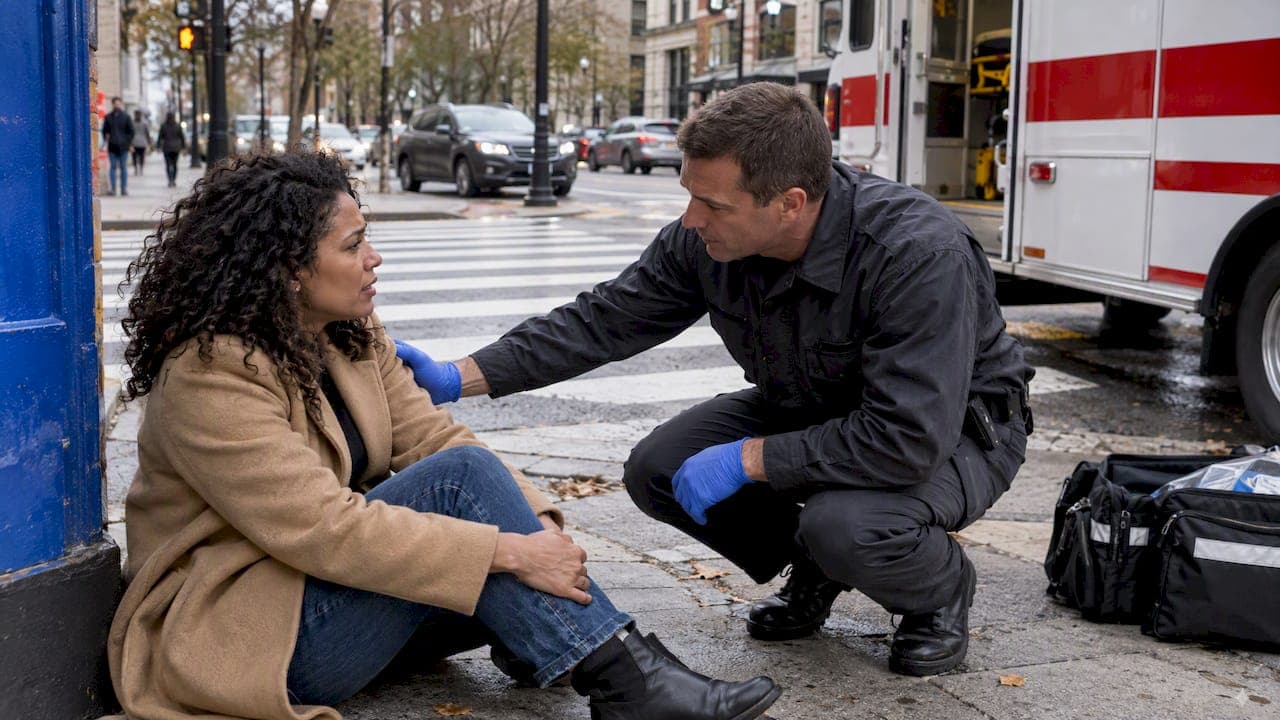
If a driver hit you while you were on foot and left, you can still file a claim. Report the crash to police, get medical care, collect whatever evidence you can, and tell your insurer quickly. If the driver is found, you can pursue their liability coverage. If not, your own uninsured motorist coverage, or a state fund in some states, may pay. Deadlines are short and differ by state, so the first days matter most.
This guide walks through each step in order, explains which insurance can respond when the driver is a stranger, and shows what affects the value of a claim.
TL;DR
- Call 911 if anyone is hurt, do not chase the car, and make sure a police report exists. Some policies and state programs require a report within 24 hours.
- Write down everything about the vehicle, driver, witnesses and scene while memory is fresh, and photograph your injuries and the location.
- If the driver is never identified, uninsured motorist coverage on your own policy (or a household relative's) may pay for injuries. Pedestrians often have it without realizing.
- Notice deadlines can be as short as 30 days in some states, and lawsuit deadlines vary widely. Check your state early.
- A free attorney match can help you understand your options before you commit to anything.
Table of Contents
- What to do in the first hours
- Evidence that can identify the driver and support your claim
- Who pays when the driver is gone
- Deadlines that can end a claim
- What you can claim, and what moves the number
- Talking to insurance companies
- A simple plan for the first 72 hours
- Our perspective
- Get a free evaluation
- FAQ
- Sources
What to do in the first hours
Your health comes first. Move out of traffic if you can, and do not chase the fleeing car. Progressive's hit-and-run guidance advises putting health and safety first and calling 911 if anyone is seriously injured. Even if you feel fine, get checked. Pain from a fall or impact can show up hours later, and a medical record made right away ties your injuries to the crash.
Then make sure police know. USAGov says to dial 911 in an emergency and to contact local law enforcement where the crime happened to file a report, and that some agencies take reports online or by phone. If officers decline to come for a minor incident, Nolo explains that you can go to the nearest police station and file the report there.
Speed matters for a practical reason. Progressive notes that victims should file a report within 24 hours of the incident or of discovering the damage, which can help both the claim and the investigation. Many uninsured motorist policies carry a similar requirement, so treat 24 hours as the working deadline.

Will police actually investigate?
Sometimes, and not always with full effort. Practice varies by department. The Kansas City Police Department explains in its victim resource guide that hit-and-run cases are assigned by priority based on injuries, with the strongest emphasis on fatal crashes. Crashes with no injury, or only a parked car damaged, are typically not assigned to an investigator. A pedestrian with real injuries sits much higher on that priority list than a fender-bender, which is another reason to report injuries clearly and get them documented.
The same guide points out that criminal charges generally need a victim or witness who can positively identify the driver and will testify in court. Vehicle registration alone is not enough. That makes witnesses valuable, and it is why your own notes matter.
Evidence that can identify the driver and support your claim
You may only have seconds of information. Gather what you can, or ask a bystander to help, and write it down immediately.
The National Association of Insurance Commissioners (NAIC) recommends recording the other car's make, model, year and plate, witness contact information, the responding officer's name, badge number and contact details, and the time, date, exact location, skid marks, weather and road conditions. It also suggests photographing or sketching the scene.
A Farm Bureau Financial Services checklist adds details that people forget in the moment: even a partial plate counts, along with the vehicle description, the driver's description and the direction the car was traveling.
A quick evidence list
| Item | Why it helps |
|---|---|
| Partial or full plate, make, model, color, damage | Lets police search for the vehicle |
| Direction of travel and time | Points investigators to cameras and routes |
| Witness names and phone numbers | Witnesses can identify the driver and support your account |
| Photos of injuries, clothing, and the crash location | Shows severity and where it happened |
| Officer name, badge number, report number | Lets you get the report later |
| Medical records and bills from day one | Connects injuries to the crash |
Two more habits help. First, keep a short daily note on pain, missed work and limits on your activities. Second, go back to the spot, if it is safe, and look for businesses or homes with cameras. Footage is often overwritten, so ask quickly and give the report number to the owner. Our guide on car accident evidence best practices covers more ways to preserve proof.
Who pays when the driver is gone
This is the question most pedestrians ask, and the answer depends on whether the driver is found.
If the driver is identified
You may be able to claim against the driver's liability insurance for medical bills, lost income and other losses. If the driver has no insurance, or too little, the same fallback coverage described below may apply. A criminal case against the driver is separate from your civil claim for compensation, and you do not need to wait for one to finish to start the other.
If the driver is never found
Your own policy may be the source of payment. The NAIC's consumer auto guide says uninsured motorist coverage reimburses you if an uninsured or hit-and-run driver hits you. Progressive describes the split: UMPD may cover car damage, while UMBI covers injuries caused by an uninsured driver, depending on your state and coverage.
The Insurance Information Institute (Triple-I) reports that about one in eight U.S. drivers does not carry auto coverage, which is why this protection exists.
Two points surprise pedestrians. You do not need to have been in your own car for this coverage to matter. Nolo advises that pedestrians who have car insurance should call their insurance company after being hit. And coverage can extend to household relatives in some situations: New York's Department of Financial Services says that if you or a household relative has no auto policy and you are hurt by a hit-and-run driver, you file with MVAIC and report the accident to the proper authority within 24 hours.
The NAIC also cautions that which coverage pays depends on fault, your policy and your state, and it advises asking your insurer whose coverage will pay. Ask in writing when you can.
Deadlines that can end a claim
There are two kinds of clocks. One is the notice your insurer requires. The other is the court deadline, called the statute of limitations.
Notice rules can be tight. In New York, the Department of Financial Services says written no-fault notice generally must be filed within 30 calendar days, unless you give clear and reasonable written justification for being late. In a Michigan case, the Court of Appeals described a policy requiring police notice within 24 hours and insurer notice within 30 days. The court still held that the insurer had to show actual prejudice before avoiding liability for late notice. That outcome depends on Michigan precedent, so do not count on it elsewhere. Report fast and do not test it.
For lawsuit deadlines, every state sets its own period, and some shorten it for claims against government bodies. Our state-by-state guide to the statute of limitations for car accident claims is a good place to check yours, and a local attorney can confirm which deadline applies to your situation.
What you can claim, and what moves the number
In a pedestrian claim, the losses usually considered include:
- Emergency care, hospital stays, surgery, therapy and ongoing treatment
- Lost wages and reduced ability to earn
- Pain, suffering and lasting limits on daily life
- Damage to personal property, such as a phone, glasses or a bike
- For families after a death, funeral costs and wrongful death claims
What shapes the value is not a formula. It comes down to the seriousness and permanence of the injury, the medical and wage documentation, how clearly the crash is proven, and what insurance is available. When the claim goes through your own uninsured motorist coverage, your policy limits cap what that coverage can pay.
State rules also change what you can recover. In New York, for example, the Court of Appeals explained in Raffellini v. State Farm that under the No-Fault Law, recovering for non-economic loss such as pain and suffering through supplementary uninsured motorist coverage requires showing a serious injury as defined in Insurance Law § 5102(d). Other states have different thresholds, which is a reason to get state-specific advice. For a broader look at payouts, see our guide to pedestrian accident settlements.
Talking to insurance companies
Call your own insurer if you have a policy, as noted above, and keep notes. The NAIC suggests keeping notes of conversations with your agent or adjuster. Record the date, the person's name and what was said.
The NAIC's consumer guidance also says to avoid admitting fault, get witness contact details and start the claim while memories are fresh. For a hit-and-run, that translates into some simple habits:
- Stick to facts: where you were, what you saw, what hurts.
- Do not guess about speed, distance or what you "should have" done.
- Do not speculate about your recovery. If you do not know yet, say so.
- Be careful with recorded statements to any insurer that is not your own until you have had advice.
- Keep copies of everything you send and receive.
If a claim is denied or delayed, it is not always the end. Our article on common claim denials and what to do next explains typical reasons and responses.
A simple plan for the first 72 hours
- Get medical care and keep every record and bill.
- Confirm the police report and write down the report number.
- Write out what you remember about the car and driver, then add witness details.
- Photograph injuries, torn clothing, the road and any visible vehicle debris.
- Notify your insurer and ask about uninsured motorist coverage, with attention to written notice deadlines.
- Ask about cameras at nearby businesses before footage is erased.
- Speak with an attorney about your state's rules before accepting any offer.
We go deeper on this window in our guides on protecting a pedestrian accident claim and saving a hit-and-run claim. If you were on a bike, see bicycle hit-and-run claims.
Our perspective
Most people who contact us after a hit-and-run believe they have no claim because nobody can name the driver. That belief costs people money. A claim can still run through your own coverage, and the work that makes it strong, such as the report, the records and the evidence, has to start in the first days, not after the shock wears off.
We built our free evaluation around that urgency. Instead of a generic contact form, we ask about your injury type and what happened, so the request reaches an attorney who handles cases like yours. It costs you nothing to ask and carries no obligation.
What we hope you take from this page: report it, document it, get treated, and get a professional opinion on your state's rules before you sign anything. A conversation early can clarify which coverage applies and which deadline is closest.
Gerard
Get a free evaluation
If you are not sure whether you have a claim, or which coverage applies, you can start a free case evaluation. Tell us about your injuries and what happened. We designed the process to match you with a vetted local attorney based on your situation, with no commitment and no fee to you for the evaluation.
If you prefer to read more first, our blog covers related situations, including road defect injury claims when a hazard contributed to the crash.
FAQ
Can I file a claim if the driver was never found?
Yes, in many cases. Uninsured motorist coverage on your own policy, or a household relative's, is designed to respond when a hit-and-run driver cannot be identified. Coverage and rules vary by state, so confirm the details with your insurer and an attorney.
Will the police do anything about a hit-and-run?
Often they take a report, and injury cases get higher priority than property-only ones. Charges usually need someone who can positively identify the driver. Give officers every detail you have, plus the location of any cameras.
How long do I have to report a pedestrian hit-and-run?
Report to police immediately, and aim for within 24 hours, since some policies and state programs require it. Insurer notice deadlines can be as short as 30 days in some places. Lawsuit deadlines are separate and vary by state.
How much is a pedestrian hit-and-run claim worth?
There is no standard figure. Value depends on injury severity, medical costs, lost income, available insurance and your state's rules. An attorney can review your records and explain a realistic range for your case.
Sources
- Hit-and-Run Insurance: Claims & Coverage, Progressive
- Information for Victims of Hit-and-Run Accidents, Kansas City Police Department
- Report a crime, USAGov
- Report a Car Accident to the Police?, Nolo
- What You Should Know About Filing an Auto Claim, NAIC
- Don't Be a Crash Dummy, NAIC
- Hit-and-Run Accident Checklist for Victims and Witnesses, Farm Bureau Financial Services
- Consumer auto guide, NAIC
- Protect yourself against uninsured motorists, Triple-I
- Hit By a Car as a Pedestrian, Nolo
- Filing Claims Under Your Own Policy, New York DFS
- DeFrain v State Farm, Michigan Court of Appeals
- Raffellini v State Farm, New York Court of Appeals