
Most pedestrian accident settlements in the United States vary widely from amounts typical for minor injuries to much higher figures in cases involving fractures, surgery, or permanent disability. Catastrophic injuries and wrongful death claims can reach highly significant sums. The number that actually applies to you depends on three things: how severe your injuries are, what percentage of fault gets assigned to you versus the driver, and how much insurance coverage exists to pay the claim. Get medical care immediately, preserve every piece of evidence you can, and consider a free case evaluation before accepting anything an insurer offers.
TL;DR:
- Settlement amounts are heavily influenced by injury severity, fault percentage, and insurance coverage, with catastrophic injuries often receiving the largest awards.
- The injury type and whether it causes permanent limitations determine if the settlement will be in the lower, moderate, or high range, with wrongful death claims reaching very high sums.
- State fault laws, such as comparative or contributory negligence, can significantly reduce damages if the pedestrian is found partially at fault, especially in jurisdictions with strict liability rules.
- Most pedestrian claims take six months to two years to settle, with the timing affected by reaching maximum medical improvement and the insurer's negotiation tactics.
- Proper documentation, waiting until MMI, and expert input are crucial, while early settlement can drastically undervalue long-term needs and potential future damages.
Table of Contents
- Pedestrian Accident Settlement Ranges by Injury Type
- What Determines How Much a Pedestrian Injury Claim Is Worth
- How Fault and State Law Change Your Payout
- How Long a Pedestrian Settlement Takes and Why MMI Matters
- Settling vs. Going to Trial: Trade-Offs and Negotiation Tactics
- Real Numbers: How Two Pedestrian Claims Add Up
- Do Pre-Existing Conditions Lower Your Settlement?
- What Happens After You Settle: Structure and Taxes
- An Editorial Take on Timing and Realistic Expectations
- Get a Free Case Evaluation Before You Settle for Less
- Sources
- FAQ
Pedestrian Accident Settlement Ranges by Injury Type
Insurance adjusters don't pull numbers out of thin air. They sort injuries into rough tiers, then apply multipliers and formulas that vary by carrier. Knowing where your injury falls on the spectrum tells you almost everything about what a fair number looks like.
Minor injuries typically include bruising, minor sprains, road rash, and soft-tissue strains that resolve within a few weeks of physical therapy. These claims usually settle in a lower monetary range, largely because medical bills stay low and there's no lasting impairment to compensate.
Moderate injuries cover broken bones, torn ligaments requiring surgery, or concussions with lingering symptoms. Think a fractured tibia from being struck at a crosswalk, or a shoulder that needs arthroscopic repair after a driver clips a pedestrian in a parking lot. These cases commonly settle at moderate to significant amounts, depending on the number of surgeries involved and whether the person missed substantial work.
Severe and catastrophic injuries are where the numbers change dramatically. Traumatic brain injury, spinal cord damage, amputation, or multiple fractures requiring long-term rehabilitation often lead to settlements at the higher end of the scale. Wrongful death claims can reach very substantial amounts when the deceased had significant lost future earnings or dependents.
- Minor injuries (bruising, sprains, road rash): typically lower settlement amounts
- Moderate injuries (fractures, surgery, concussion): moderate to high settlements
- Severe injuries (TBI, spinal damage, amputation): substantial settlements
- Wrongful death: often very significant settlements depending on lost earnings and dependents
What pushes a case into a higher tier isn't just the diagnosis. It's whether the injury creates permanent limitations. A broken arm that heals fully settles very differently than one that leaves nerve damage.
Pedestrian crashes tend to produce worse outcomes than typical vehicle collisions because there's no metal cage absorbing the impact. National NHTSA crash data confirms pedestrians face a disproportionately high fatality and severe-injury rate compared to occupants in other crash types, which is exactly why catastrophic and wrongful-death settlements show up so often in this category.
Statistic Callout: Fatal and severe pedestrian crashes aren't evenly distributed across the country. GHSA's state-by-state fatality data shows significant variation by state, which matters because state law also controls how much of your settlement you actually keep.
One catch that trips up a lot of injured pedestrians: even a case with $800,000 in documented damages might settle for far less if the at-fault driver only carries a $100,000 policy and has no meaningful personal assets. Coverage limits, not just injury severity, often set the real ceiling on recovery.
What Determines How Much a Pedestrian Injury Claim Is Worth
Settlement value breaks into two buckets: economic damages you can put a receipt on, and non-economic damages that require more judgment to calculate.
Economic damages include everything with a paper trail: emergency room bills, surgery costs, physical therapy invoices, prescription costs, and lost wages from missed work. Future economic damages matter just as much, projected costs for ongoing care, additional surgeries, or reduced earning capacity if the injury limits what kind of work you can do going forward.
Non-economic damages cover pain and suffering, emotional distress, and loss of enjoyment of life. Insurers often use a multiplier method, taking your economic damages and multiplying them by a factor (commonly 1.5 to 5) based on injury severity, to estimate this figure. The multiplier climbs when injuries are permanent, disfiguring, or require ongoing medical management.
For serious or lasting injuries, adjusters and attorneys frequently bring in life-care planners or treating physicians to project the cost of decades of future treatment. This is where claims involving disability or chronic pain often get undervalued by the insurance company's first offer because that offer rarely accounts for treatment 10 or 20 years down the line.
Documentation checklist for a stronger claim:
- All medical records and itemized billing statements
- Pay stubs or tax records showing lost income
- Photos of injuries at multiple stages of healing
- A written journal of pain levels and daily limitations
- Written opinions from treating doctors on long-term prognosis
Pro Tip: Keep a simple daily log noting pain levels, missed activities, and medication use. Insurers dismiss vague pain claims, but a dated, specific record carries real weight in negotiations and shows a pattern rather than a one-time complaint.
Reviewing how settlement factors typically get calculated can help you understand which documents matter most for your specific injury type before you start negotiating.
How Fault and State Law Change Your Payout
Here's something a lot of injured pedestrians don't expect: even when a driver is clearly at fault, you can still lose part of your settlement if you were doing anything the insurer can spin as contributing to the crash, like crossing outside a marked crosswalk or against a signal.
States handle this through one of three legal frameworks, and which one applies to you depends entirely on where the crash happened:
- Pure comparative negligence lets you recover damages even if you were 99% at fault, just reduced by your percentage of fault.
- Modified comparative negligence cuts off recovery entirely once your fault reaches 50% or 51%, depending on the state.
- Contributory negligence, used in a small number of states, bars recovery completely if you're found even 1% at fault. It's harsh, and it's exactly why early legal advice for pedestrian accidents matters so much in those jurisdictions.
The math matters more than people expect. Say your damages total $200,000 and you're found 20% at fault for jaywalking. Under a comparative negligence state, your recovery drops to $160,000. Under contributory negligence, that same 20% fault finding could zero out your claim entirely. Cornell Law School's overview of comparative negligence breaks down exactly how these frameworks apply state by state.
If the vehicle that struck you belonged to a city, county, or other government entity, special notice rules often apply, sometimes requiring formal notice within 90 to 180 days, far shorter than typical filing deadlines. Missing that window can end your claim before it starts, so checking your state's statute of limitations rules early is worth the ten minutes it takes.
How Long a Pedestrian Settlement Takes and Why MMI Matters
Most pedestrian accident settlements take several months to a couple of years to resolve, though minor cases can close relatively quickly and catastrophic cases may take longer, especially if litigation occurs.
The process generally moves through these stages:
- Emergency and follow-up medical treatment
- Reaching maximum medical improvement (MMI), the point where a doctor determines your condition has stabilized and won't meaningfully improve further
- Sending a demand letter with full documentation to the insurer
- Negotiation, sometimes followed by mediation
- Trial, if negotiation fails to produce a fair number
MMI matters because settling before you reach it risks locking in a number that doesn't account for future surgeries, ongoing therapy, or permanent limitations that only become clear over time. Practice guides consistently recommend waiting for MMI before finalizing any settlement, precisely because early offers tend to undervalue long-term needs.
Insurers know delay works in their favor. A slow-walked claim pressures injured people into accepting less simply because they need money now. Countering that starts in the first three days: a 72-hour protection checklist for preserving evidence and documenting the scene keeps your leverage intact from day one.
Settling vs. Going to Trial: Trade-Offs and Negotiation Tactics
Roughly 95% of personal injury claims settle before trial, largely because trial is expensive, slow, and unpredictable for both sides. But the mere willingness to litigate is often what pushes an insurer off a lowball number.
A few tactics consistently improve outcomes:
- Send a comprehensive demand letter backed by complete medical records, not a rushed summary
- Bring in medical experts for serious injuries rather than relying on adjuster assumptions
- Reject the first offer as a matter of course; it's rarely the insurer's real ceiling
- Document everything in writing, since verbal promises from adjusters carry no weight later
If evidence shows the driver was drunk, distracted, or acted with extreme recklessness, punitive damages can enter the conversation, and that possibility alone often raises settlement offers to avoid the risk of a jury verdict.
Pro Tip: Never accept a first offer on a claim involving any lasting injury. Adjusters expect a counter and usually build room into that opening number for exactly that negotiation.
An attorney adds the most value at the negotiation and demand-letter stage, where insurers frequently test how a claimant responds to a denial or lowball tactic before deciding what to actually pay.
Real Numbers: How Two Pedestrian Claims Add Up
Example 1: A pedestrian struck in a marked crosswalk suffers a fractured wrist requiring a cast, no surgery. Medical bills total $18,000, lost wages add $4,000, and a 2x pain-and-suffering multiplier brings the estimate to roughly $44,000. Liability was undisputed, so no reduction applied.
Example 2: A pedestrian crossing mid-block suffers a spinal injury requiring surgery and ongoing care projected at $400,000. The pedestrian is found 25% at fault for not using the nearby crosswalk. Total damages of $600,000 get reduced to $450,000, but the driver's policy caps out at $250,000, leaving underinsured motorist coverage to potentially fill the gap.
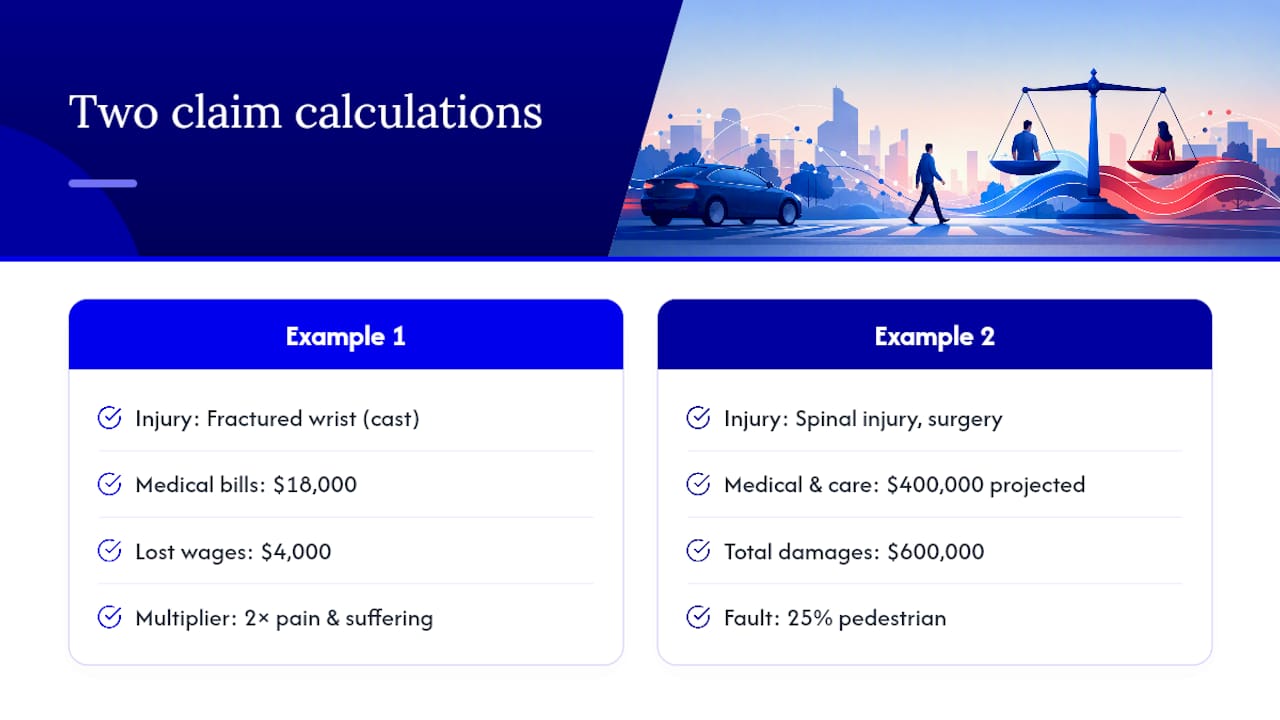
That second scenario is exactly why policy limits matter as much as injury severity, and why comparing real settlement examples against your own facts helps set realistic expectations. A free evaluation can map your specific numbers against these kinds of scenarios before you commit to any offer.
Do Pre-Existing Conditions Lower Your Settlement?
Yes, but not as dramatically as most people fear. Insurers routinely dig through medical history looking for any prior injury to a body part involved in the current crash, then argue the pedestrian's condition wasn't caused by the collision.
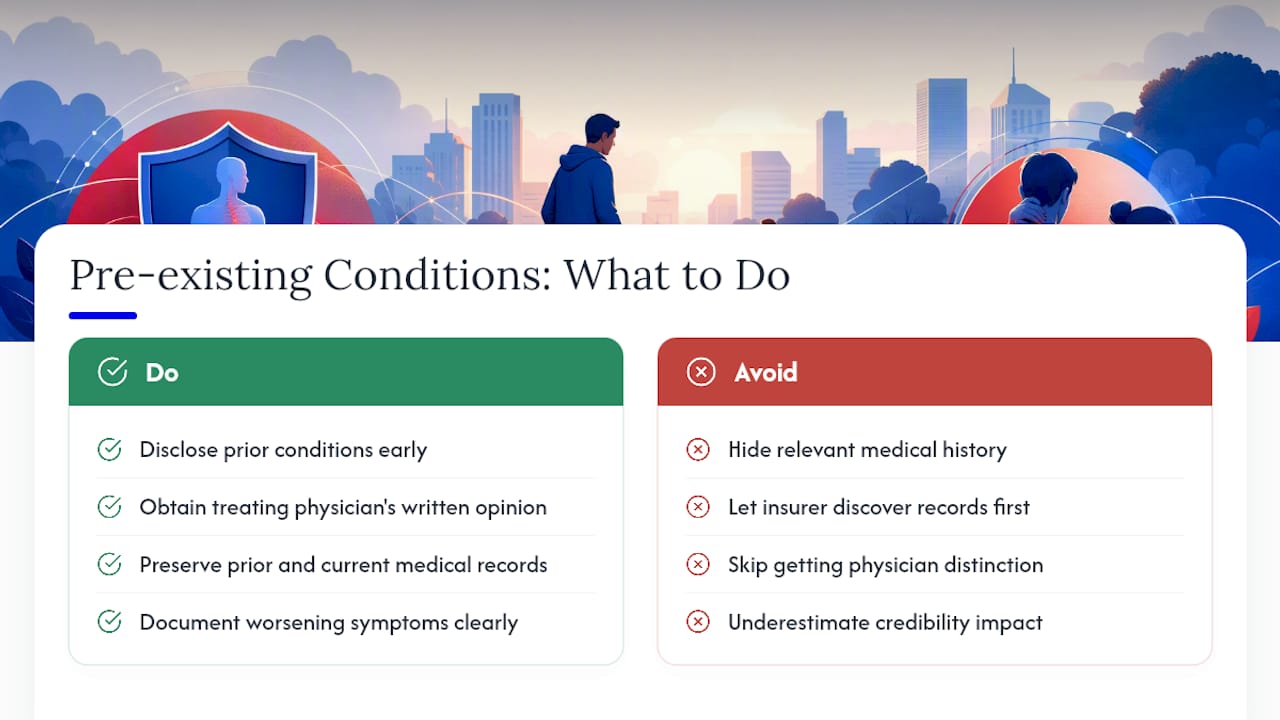
The legal standard that protects you here is called the "aggravation rule." If a crash worsens a pre-existing condition, you're entitled to compensation for that worsening, even if you can't recover for the original condition itself. Someone with an old back injury who suffers a new disc herniation in a crosswalk collision can still claim compensation for the new damage and any increase in pain or limitation the crash caused.
The practical problem is proof. Insurers will request years of prior medical records and argue that current symptoms stem from the old injury rather than the new one. This is where a treating physician's written opinion distinguishing "before" and "after" becomes critical. Without that documentation, adjusters default to minimizing the payout, sometimes attributing the entire injury to the pre-existing condition to avoid paying anything at all.
Being upfront about prior conditions from the start, rather than letting the insurer discover them independently, generally produces better outcomes. Claims where a pedestrian hid a relevant medical history and got caught tend to lose credibility fast, and that credibility hit affects the entire negotiation, not just the disputed body part.
What Happens After You Settle: Structure and Taxes
Once you sign a settlement release, the money typically arrives as either a lump sum or a structured settlement paid out over time. Structured settlements make sense for catastrophic injury cases where ongoing medical costs need a predictable income stream rather than one large payment that has to last decades. Before signing anything, it's worth understanding exactly what a settlement release actually commits you to, since it typically waives your right to pursue any future claims tied to the same crash, even if new symptoms appear later.
On taxes: compensation for physical injuries and physical sickness is generally not taxable at the federal level under IRS rules. That covers the bulk of a typical pedestrian settlement, medical expenses, pain and suffering tied to physical injury, and lost wages connected to that injury.
Punitive damages are the exception. If your settlement includes a punitive component, that portion is typically taxable regardless of the underlying injury. Interest that accrues on a settlement while it's pending is also usually taxable. Anyone receiving a settlement above $100,000, or one that includes a punitive damages component, should talk to a tax professional before spending the money, since the taxable and non-taxable portions need to be tracked separately from day one.
An Editorial Take on Timing and Realistic Expectations
The biggest mistake injured pedestrians make isn't picking the wrong lawyer or missing a document. It's settling too early because the first check that arrives feels like relief after weeks of medical chaos and unpaid bills.
Early action and patience aren't contradictory. Preserve evidence and get medical care within the first 72 hours, but don't finalize numbers until you understand your actual prognosis. A quick, honest case evaluation early on costs nothing and often reveals whether your instinct to settle fast is protecting you or costing you.
— Gerard
Get a Free Case Evaluation Before You Settle for Less
A free case evaluation service can connect injured pedestrians with local attorneys to help assess what a claim might be worth before negotiating with insurance adjusters.
Such evaluations typically consider the crash details, injuries and treatments, insurance coverage, and relevant state fault rules, and may help connect you with an attorney experienced in similar cases, often working on a contingency basis where fees are paid only from recovered amounts.
Before you start, gather what you have: medical records, photos of the scene or injuries, any police report number, and contact information for witnesses. Then start your free evaluation and find out where your case actually stands, no cost, no obligation, and no pressure to sign anything until you're ready.
Sources
A few sources back the figures and legal concepts in this guide, and they're worth checking directly if your case touches specific state rules:
- NHTSA crash report
- Cornell Law School — Comparative negligence
- GHSA pedestrian fatalities by state (2024 data)
This article is general information, not a substitute for advice from a qualified lawyer. Consult a qualified legal professional about your own circumstances before acting on anything here.
FAQ
How Much Is Likely in a Pedestrian Injury Lawsuit?
Most pedestrian injury settlements range from lower tens of thousands for minor injuries to amounts reaching hundreds of thousands or millions for catastrophic cases, with the exact figure depending on injury severity, fault percentage, and available insurance coverage.
How Much of a $25,000 Settlement Will I Get?
After attorney fees and any outstanding medical liens are subtracted, the amount an injured person nets from a settlement varies widely depending on fee agreements and lien amounts.
How Long Does a Pedestrian Accident Settlement Take?
Most settlements take six months to two years, with minor injury claims often resolving in three to four months and severe or contested cases sometimes extending beyond two years.
How Much Should I Settle for a Foot Injury?
A foot fracture without surgery typically settles in a lower monetary range, while a foot injury requiring surgery or leaving permanent mobility limitations can lead to significantly higher settlements, depending on lost wages and long-term impact.