
Injured pedestrians in the United States can usually file a claim against the at-fault driver's insurance and, if that stalls, a civil lawsuit. Both routes can recover medical bills, lost wages, future care costs, and pain and suffering. The three moves that protect that claim start now: get medical care, preserve every piece of evidence, and get a free case evaluation before talking to any insurer.
TL;DR:
- Pedestrians should immediately seek emergency medical care and document the scene with photos and witness contacts within the first 72 hours.
- Evidence such as police reports, traffic camera footage, and skid mark analysis are crucial to establishing driver fault in a claim.
- Multiple insurance sources like underinsured motorist, MedPay, and commercial policies may provide additional coverage beyond the driver’s liability limits.
- Compensation includes both economic damages, such as medical bills and lost wages, and non-economic damages like pain and suffering, but policy limits often cap payouts.
- A free case evaluation can help identify all potential coverage sources and determine the best legal approach without upfront costs.
Table of Contents
- How Do You File a Pedestrian Accident Claim?
- How Is Fault Proven in a Pedestrian Accident Lawsuit?
- Who Pays: Finding Every Insurance Source Available
- What Compensation Can You Recover After Being Hit?
- How Long Does a Pedestrian Accident Claim Take?
- When Should You Hire a Pedestrian Accident Lawyer?
- What Goes Into a Demand Letter and Negotiation?
- Hit-and-Run, Government, Rideshare, and Wrongful Death Claims
- How Carcollisionlawyer Helps Injured Pedestrians Move Forward
- Ready to Start Your Free Case Evaluation
- Authoritative Resources for Pedestrian Accident Claimants
- Why Most Pedestrians Undervalue Their Own Claims
- Sources
How Do You File a Pedestrian Accident Claim?
Filing a pedestrian accident claim starts with documentation, not paperwork. Insurance adjusters decide value based on what you can prove, and the first 72 hours generate most of that proof.
Handle these in order:
- Get emergency care immediately, even if injuries seem minor. Adrenaline masks pain, and a same day diagnosis ties your injuries directly to the crash.
- Call 911 and get a police report filed. Ask for the report number and the responding officer's name before they leave the scene.
- Collect the driver's insurance and contact information, plus names and phone numbers for any witnesses who saw the crash happen.
- Photograph everything: the vehicle's position, skid marks, your injuries, the crosswalk or signal, and lighting conditions if it happened at dusk or night.
- Ask nearby businesses about surveillance footage before it gets overwritten, which often happens within days.
Pro Tip: Do not give a recorded statement to the driver's insurance company. You are not required to, and Nolo's legal overview notes that insurers commonly use those statements to minimize claims later.
How Is Fault Proven in a Pedestrian Accident Lawsuit?
Every pedestrian injury compensation claim rests on four legal elements, and Cornell Law School's negligence overview lays them out clearly: duty, breach, causation, and damages. The driver owed you a duty to drive safely. They breached it, say, by running a red light or failing to yield at a marked crosswalk. That breach caused your injuries, and those injuries produced measurable damages.
Most states apply comparative negligence, meaning your compensation shrinks by whatever percentage of fault gets assigned to you. Step off the curb against a "don't walk" signal, and a jury might assign you 20% fault, cutting a $100,000 verdict to $80,000. A handful of states still use contributory negligence, where any fault on your part can bar recovery entirely, so knowing your state's rule matters before you accept blame for anything.
Evidence that typically proves driver fault includes:
- Police citations issued at the scene
- Traffic camera or dash cam footage
- Cell phone records suggesting distracted driving
- Skid mark analysis and accident reconstruction reports
- Witness statements corroborating the pedestrian's account
Who Pays: Finding Every Insurance Source Available
The driver's liability policy is the primary source of pedestrian injury compensation, but it is rarely the only one. Policy limits vary widely. A driver carrying the state minimum might only have $25,000 in coverage, which disappears fast against a broken leg requiring surgery.
Check these additional sources before assuming the driver's policy is your ceiling:
- Your own auto policy's uninsured/underinsured motorist (UM/UIM) coverage, even though you were on foot
- Personal Injury Protection (PIP) or MedPay, which often pay medical bills regardless of fault
- Your health insurance, which may cover treatment upfront but could place a lien on your eventual settlement
- Commercial auto policies if the driver was working, which typically carry much higher limits than personal policies
- Rideshare insurance tiers, which shift dramatically depending on whether the driver had the app on, was en route to a passenger, or had one in the car
Roughly a quarter of the coverage identification work in serious pedestrian cases involves tracking down secondary policies most victims never knew existed. Waiting until the demand letter to figure out who is paying is a common and costly delay.
What Compensation Can You Recover After Being Hit?
Pedestrian accident compensation splits into two main categories, and understanding both changes how you negotiate.
Economic damages cover the bills you can point to:
- Past and future medical treatment, including surgery, physical therapy, and prescriptions
- Lost wages from missed work, plus diminished future earning capacity if injuries limit your job options
- Assistive devices like wheelchairs, home modifications, or in home care
Non-economic damages cover harder-to-price losses:
- Pain and suffering
- Loss of enjoyment of life
- Emotional distress and anxiety around walking near traffic again
Punitive damages appear rarely, usually reserved for drunk driving or extreme recklessness. And here is the part insurers hope you skip: policy limits cap what a driver's carrier will pay no matter how severe your injuries are, which is exactly why checking settlement factors and every available coverage source matters before you settle for whatever the first offer includes.
How Long Does a Pedestrian Accident Claim Take?
A pedestrian accident claim typically moves through five stages, and knowing them helps you avoid panicking over a slow month or accepting a lowball offer out of impatience.
- Days 1 to 30: Emergency treatment and initial evidence gathering.
- Days 30 to 90: Ongoing care and assessment of whether injuries have stabilized or will require long-term treatment.
- Months 2 to 4: Demand package preparation, once your treatment timeline is documented.
- Months 4 to 9: Negotiation with the insurer.
- Month 6 to 12 (if needed): Lawsuit filing, per the Personal Injury Law Center's breakdown of typical claim stages.
Statutes of limitations for personal injury claims generally run 2 to 3 years depending on the state, but deadlines vary significantly and some are much shorter. If a government vehicle, like a city bus or municipal truck, was involved, notice requirements can shrink that window to 90 days or less.
When Should You Hire a Pedestrian Accident Lawyer?
Certain situations call for a lawyer immediately, not after weeks of frustration with an adjuster.
- Injuries requiring surgery, hospitalization, or long-term rehabilitation
- The driver or insurer disputes fault, especially if a citation was not issued
- Multiple insurance policies might apply and coverage is unclear
- Policy limits look too low to cover your actual medical costs
Attorneys handle the work most claimants cannot do alone: investigating the scene, retaining accident reconstruction or medical experts, building the demand packet, and negotiating or litigating when the insurer refuses to budge.
Pro Tip: Most personal injury attorneys work on contingency, meaning they take a percentage of your settlement, typically 33% to 40%, and charge nothing upfront. Case costs and medical liens get deducted from the final recovery before you see a check.
What Goes Into a Demand Letter and Negotiation?
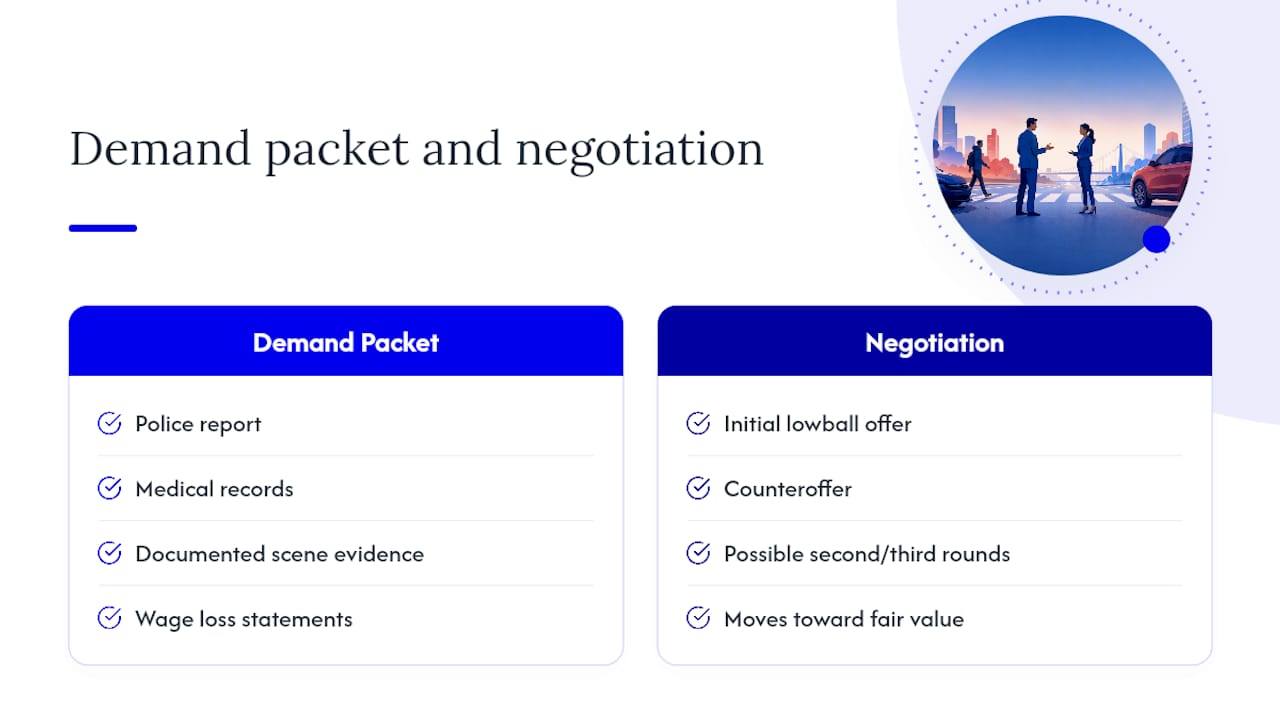
A strong demand packet includes the police report, medical records, documented evidence from the scene, wage loss statements, and a written narrative connecting the crash to your ongoing treatment. You can request your own treatment records directly, and Hhs to obtain copies from any provider.
Negotiation rarely resolves in one round. Expect an initial lowball offer, a counteroffer, and possibly a second or third round before the insurer moves close to fair value. Filing suit becomes necessary when the statute of limitations is approaching, when the insurer stops responding in good faith, or when settlement talks stall entirely despite solid documentation.
Hit-and-Run, Government, Rideshare, and Wrongful Death Claims
Some pedestrian accident lawsuit tips only apply to specific situations:
- Hit-and-run: File a police report immediately, then pursue your own UM coverage since the driver cannot be identified for a liability claim.
- Government vehicles: Special notice deadlines, often 90 days, apply before you can sue a city or state entity.
- Rideshare crashes: Coverage depends entirely on the driver's app status at the moment of impact, from personal insurance to million dollar commercial policies.
- Wrongful death: Surviving family members or an estate representative can sue, and damages expand to include lost financial support and loss of companionship.
How Carcollisionlawyer Helps Injured Pedestrians Move Forward
A free online case evaluation service exists that matches injured pedestrians with local attorneys based on injury type, such as broken bones, traumatic brain injuries, or wrongful death claims. There is no upfront cost and no obligation to hire anyone after the evaluation. The intake process is built to be quick, reducing redundant paperwork during recovery. You can review how your information is handled in the site's privacy policy.
Ready to Start Your Free Case Evaluation
Before you request an evaluation, gather what you already have: the police report number, photos from the scene, medical records or at least the names of providers who treated you, and contact information for any witnesses.
Carcollisionlawyer is the alternative to guessing your way through insurance calls alone. Instead of spending hours figuring out which policy applies or whether your state's deadline is 2 years or 90 days, you submit your case details once and get matched with an attorney who already knows how to handle pedestrian claims in your state. The evaluation reviews your accident details, flags likely coverage sources like UM/UIM or PIP, and outlines recommended next steps, all before you pay anything or commit to representation. If you were hit as a pedestrian and are not sure where to start, request your free case evaluation and find out what your claim might actually be worth.
Authoritative Resources for Pedestrian Accident Claimants
For deadline rules and legal definitions, Cornell Law School's negligence page explains the elements courts require. NHTSA's pedestrian safety data covers roadway and lighting factors tied to liability. The CDC's traumatic brain injury statistics support long-term care documentation, and HHS.gov explains how to request your own medical records.
Why Most Pedestrians Undervalue Their Own Claims
The biggest mistake I see in how pedestrian accident claims get handled isn't legal, it's psychological. Injured pedestrians tend to accept the first number an adjuster offers because they assume insurance companies are neutral referees. They are not. Adjusters are trained to close files fast and cheap, and a pedestrian without a lawyer settling within the first month almost always leaves money on the table, particularly for injuries that have not fully revealed their long-term cost yet.
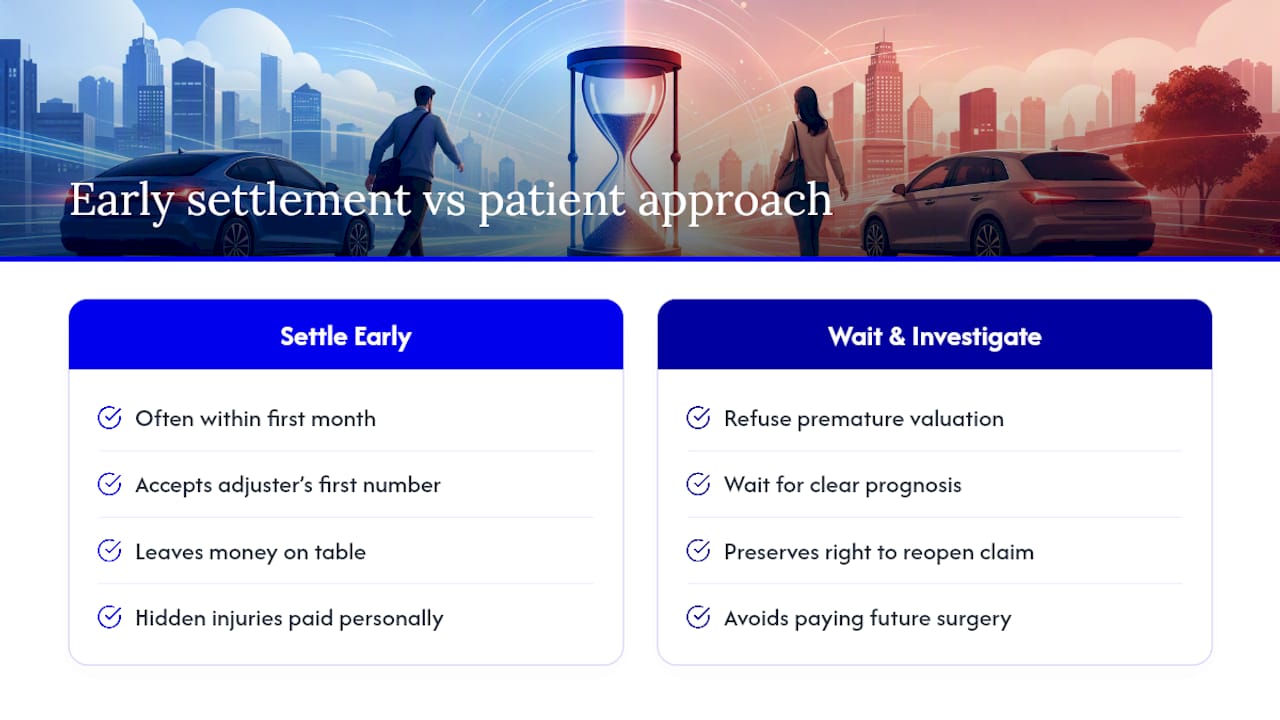
The conventional advice to "get multiple estimates" or "document everything" is fine but incomplete. What actually moves the needle is refusing to value a serious injury before your prognosis is clear. A knee injury that looks minor in week two can require surgery in month four. Settle early, and that surgery comes out of your own pocket because you signed away your right to reopen the claim. Patience costs nothing. Premature settlement costs everything.
The other blind spot is coverage. Most people assume the driver's policy is the only pot of money available, then feel stuck when that policy turns out to be $25,000 against $80,000 in hospital bills. It rarely is the only pot. Between UM/UIM, PIP, MedPay, and sometimes a commercial or rideshare policy layered on top, serious cases usually have more than one payer if someone actually looks for them. That search is tedious, unglamorous work, and it is exactly why free case evaluations exist: to catch the coverage a distracted, injured person understandably misses.
— Gerard
This article is general information, not a substitute for advice from a qualified lawyer. Consult a qualified legal professional about your own circumstances before acting on anything here.