
In a wrongful death case, the parties who can be held legally responsible include negligent drivers, trucking companies, property owners, medical providers, product manufacturers, employers, and government entities. Multiple defendants can be named in the same lawsuit under doctrines like vicarious liability, joint-and-several liability, market-share liability, and alternative liability. State law governs how fault is divided and what deadlines apply, so the specific rules vary significantly depending on where the death occurred.
The core principle: A single fatal incident often involves a chain of failures, not a single mistake. Identifying every link in that chain is what separates a partial recovery from a full one.
Common categories of wrongful death liable parties include:
- Drivers and vehicle operators (including rideshare and commercial drivers)
- Trucking companies, cargo loaders, and fleet maintenance contractors
- Medical providers (physicians, surgeons, nurses, hospitals, diagnostic labs)
- Product manufacturers, distributors, and retailers
- Property owners, landlords, and contractors
- Employers (under vicarious liability for employee conduct within the scope of employment)
- Government entities and private contractors (road design, signage, maintenance)
- Third-party vendors (security firms, replacement-parts makers, freight brokers)
State apportionment rules and notice deadlines differ. Consulting a wrongful death attorney early is the most reliable way to identify every viable defendant before time bars close the door. For a broader overview of how these claims work, see what a wrongful death lawsuit involves.
Key Takeaways
Wrongful death cases almost always involve more than one liable party, and identifying every viable defendant early is the single most important step toward a full recovery.
| Point | Details |
|---|---|
| Multiple defendants are common | Drivers, employers, manufacturers, property owners, and government entities can all be named in a single wrongful death suit. |
| Key doctrines expand recovery | Joint-and-several, vicarious, market-share, and alternative liability let families pursue entities with real financial resources. |
| Evidence must be preserved fast | Surveillance footage, electronic logs, and maintenance records can disappear within days; a spoliation letter from counsel stops that. |
| Deadlines are strict and short | Government notice rules often require filing within 60–180 days; missing them can permanently bar a claim. |
| Carcollisionlawyer offers a free evaluation | Submit an intake to get matched with a wrongful death attorney who can identify liable parties and advise on next steps. |
Table of Contents
- Who are the most common wrongful death liable parties?
- How do courts divide fault among multiple defendants?
- What does a plaintiff need to prove in a wrongful death claim?
- Who can file a wrongful death lawsuit, and who should be named as a defendant?
- What damages can families recover, and who actually pays?
- What deadlines and notice rules apply to wrongful death claims?
- When should you contact a wrongful death attorney?
- A free case evaluation can help you identify who to pursue
- Sources
Who are the most common wrongful death liable parties?
Fatal incidents rarely trace back to one person's mistake. Multiple parties can be responsible for a wrongful death when a fatality results from a chain of failures, and naming every plausible defendant often determines how much a family can actually recover. Here is how each category typically looks in practice.
Drivers and multi-vehicle crashes
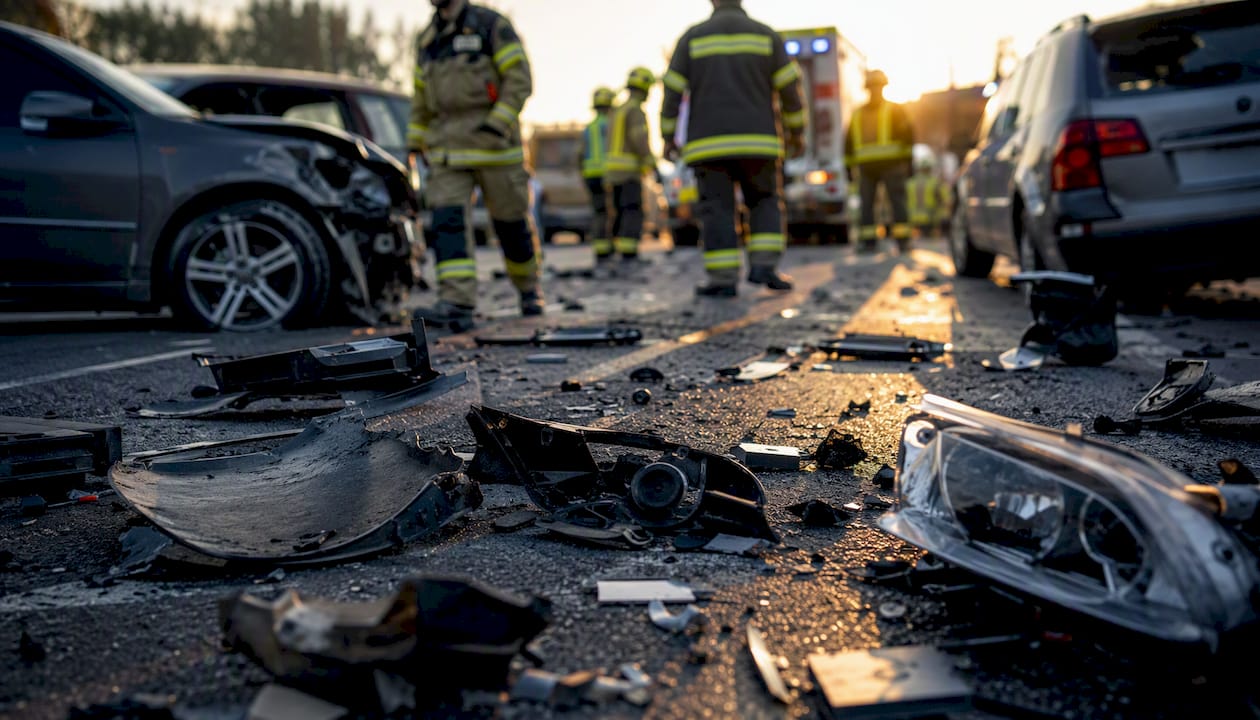
Road traffic injuries are a leading cause of death worldwide, and vehicle crashes generate some of the most common wrongful death suits. When two drivers share fault for a collision, both can be named as defendants. A rideshare driver who ran a red light while a distracted delivery driver failed to yield, for example, could leave both drivers and their respective employers exposed to liability. The platform or employer relationship matters because it can trigger vicarious liability for the company, not just the individual behind the wheel.
Trucking-related defendants
A single fatal truck crash can implicate five or more separate parties. Consider a scenario where a commercial truck's brakes fail on a highway: the driver may have ignored warning signs, the carrier may have skipped required maintenance, the cargo loader may have created an unstable load that shifted and contributed to the loss of control, and the brake manufacturer may have sold a defective component. Each party played a distinct role. For a detailed breakdown of how these cases unfold, see why trucking companies face wrongful death suits. The liable parties in truck accident cases commonly include the driver, the carrier, the owner-operator (when different from the carrier), the freight broker, and the maintenance contractor.

Medical providers and facilities
Medical malpractice wrongful death cases can name attending physicians, surgeons, nurses, the hospital itself, diagnostic labs, and medical device manufacturers. A vignette: a patient presents with chest pain, the emergency department physician orders the wrong test, the lab processes it incorrectly, and the patient dies of a heart attack that a proper workup would have caught. The physician, the hospital (as the physician's employer), and the lab may all face liability. Device makers enter the picture when a defective implant or monitoring tool contributed to the outcome.
Manufacturers, distributors, and retailers
Consumer product injuries cause a significant share of home and community fatalities, and every link in the supply chain can be named as a defendant. Design defects, manufacturing defects, and failures to warn are the three main theories. If a space heater's wiring was defectively designed, the manufacturer bears primary exposure. If a retailer knew of a recall and kept selling the product anyway, the retailer is also exposed. Distributors who stored or transported the product negligently can be added as well.
Property owners and contractors
Premises liability wrongful death cases arise when a hazard on someone's property causes a fatal injury. A warehouse owner who knew a mezzanine railing was failing but delayed repairs, and a contractor who had inspected the railing and signed off on it anyway, could both be named. Landlords face liability when they control common areas. Property managers who handle maintenance on behalf of an owner can be named separately when their negligence is distinct from the owner's.
Employers and vicarious liability
An employer is responsible for an employee's wrongful acts committed within the scope of employment. A delivery driver who causes a fatal crash while making a scheduled delivery implicates the employer directly, even if the driver was the one behind the wheel. The analysis shifts when the worker is classified as an independent contractor, but courts look past labels: if the employer controlled how the work was done, the contractor classification may not shield the company. Vicarious liability is the doctrine that lets families pursue entities with real financial resources rather than only the individual who acted negligently.
Public entities and private contractors
Dangerous road design, missing signage, and deferred maintenance can make a government entity or its private contractor a defendant. State-level crash reports, such as PennDOT's 2024 crash and safety data, document contributing factors that investigators use to trace responsibility to a public agency or the contractor it hired. Suing a government entity requires following specific notice rules and shorter deadlines, covered in the timeline section below.
Other third parties
Security firms that failed to prevent a foreseeable assault, maintenance vendors who left equipment in a dangerous state, freight loaders who improperly secured cargo, and manufacturers of replacement parts that failed prematurely are all examples of third-party defendants who appear in wrongful death suits. Each role is fact-specific: the question is always whether that party owed a duty of care and whether its failure contributed to the death.
Pro Tip: Prioritize defendants by two factors: (1) the strength of evidence linking them to the death, and (2) financial viability, meaning whether they carry insurance or have assets to satisfy a judgment. A defendant who is clearly at fault but uninsured and insolvent may not be worth pursuing as the primary target.
How do courts divide fault among multiple defendants?
When more than one party is responsible, the legal system has several tools for deciding who pays what and how much a family can actually collect.
Comparative fault vs. contributory negligence
Most states use some form of comparative fault, which means each defendant's share of responsibility is assigned as a percentage. A small number of states still apply contributory negligence, which can bar recovery entirely if the decedent bore any fault at all. Knowing which system applies in your state is not optional — it shapes the entire litigation strategy.
Joint-and-several liability
Under joint-and-several liability, a plaintiff can collect the full value of a judgment from any one liable defendant, regardless of that defendant's percentage of fault. This matters enormously when one defendant is insolvent. In a toxic tort case where three companies each contributed to a fatal chemical exposure, the family can pursue the one solvent company for the entire judgment, leaving that company to seek contribution from the others. Many states have modified or abolished joint-and-several liability, so the rule varies.
Vicarious liability in practice
Vicarious liability does not require the employer to have done anything wrong directly. The employee's negligent act, committed while doing the job, is enough. A hospital is vicariously liable for a nurse's medication error during a shift. A trucking carrier is vicariously liable for a driver's reckless lane change on a scheduled route. The scope-of-employment test is the key question: was the employee doing something the job required or authorized, even if done badly?
Market-share and alternative liability
These doctrines apply when causation is genuinely impossible to trace to a single defendant. In Summers v. Tice, two hunters fired simultaneously and one pellet blinded the plaintiff — since no one could prove which gun fired the injuring pellet, both defendants were held liable and had to disprove their own causation. Sindell v. Abbott Laboratories extended this logic to pharmaceutical cases: when a plaintiff could not identify which manufacturer produced the DES she was exposed to, courts assigned liability proportional to each manufacturer's market share. These doctrines are not universal, but they are powerful tools in drug, asbestos, and multi-source product cases.
Doctrine comparison
| Doctrine | When it applies | Who bears the burden | Collection consequence |
|---|---|---|---|
| Comparative fault | Most multi-defendant cases | Plaintiff proves each defendant's share | Each defendant pays its percentage only (in pure several-liability states) |
| Joint-and-several liability | Multiple defendants, one judgment | Plaintiff collects from any defendant | One solvent defendant can be pursued for the full amount |
| Vicarious liability | Employee acts within scope of employment | Plaintiff shows employment + scope | Employer's assets and insurance are reachable |
| Market-share liability | Product ID impossible (drugs, asbestos) | Burden shifts to each manufacturer | Each pays proportional to market share |
| Alternative liability | Two defendants, one caused harm, unknown which | Burden shifts to defendants to exculpate themselves | Both liable unless one proves innocence |
What does a plaintiff need to prove in a wrongful death claim?
Every wrongful death claim built on negligence requires proof of four elements. Miss one and the claim fails, regardless of how sympathetic the facts are.
- Duty: The defendant owed the decedent a legal duty of care. A driver owes a duty to other road users. A doctor owes a duty to patients. A property owner owes a duty to lawful visitors.
- Breach: The defendant failed to meet that standard of care. Running a red light, prescribing the wrong medication, or ignoring a known structural hazard are all breaches.
- Causation: The breach actually caused the death. This has two parts: actual cause (the breach was a but-for cause of the death) and proximate cause (the death was a foreseeable result of the breach).
- Damages: The death produced measurable losses — financial, relational, and sometimes punitive.
Evidence that supports each element
Gathering the right evidence early is what makes or breaks a wrongful death case. The types of evidence that typically matter most:
- Police and accident reports (establish the basic facts and often assign preliminary fault)
- Medical records and autopsy reports (link the cause of death to the defendant's conduct)
- Expert testimony from engineers, medical professionals, or accident reconstructionists
- Maintenance logs and inspection records (critical in trucking, premises, and product cases)
- Employment and dispatch records (establish scope of employment for vicarious liability claims)
- Surveillance footage and cellphone data (place people at the scene and document behavior)
- Product testing results and recall history (for manufacturer defendants)
- Witness statements and contact information gathered at the scene
Pro Tip: Evidence disappears fast. Surveillance footage is often overwritten within 30–72 hours. Trucking companies are required to preserve electronic logging device data after a crash, but that obligation has limits. Counsel can send a spoliation letter within days of retaining, which puts defendants on formal notice to preserve everything.
Photographs of the scene, the decedent's financial records (for lost-income calculations), and any prior complaints or notices about a hazard are also worth gathering immediately. An attorney can subpoena records that families cannot access on their own, including employment files, maintenance contracts, and internal communications.
Who can file a wrongful death lawsuit, and who should be named as a defendant?
Statutory plaintiffs
Wrongful death statutes define who may bring the claim. The typical categories are surviving spouses, minor children, dependent parents, and in some states, siblings or other dependents. A personal representative of the estate often files on behalf of all beneficiaries. State law controls this list, and it varies more than most people expect. For a clear breakdown of how these rights differ from personal injury claims, see why wrongful death differs from personal injury claims.
A survival action is distinct from a wrongful death action. The survival action is brought on behalf of the decedent's estate and recovers damages the decedent suffered before death, including pre-death pain and suffering and medical expenses. A wrongful death action compensates the survivors for their own losses. Both can often be filed together.
Who to name as defendants
- Every individual whose negligent act or omission contributed to the death
- The employer of any negligent employee, under vicarious liability
- Every entity in the product supply chain when a defective product is involved
- Property owners, managers, and contractors when a premises hazard caused the death
- Government entities and their contractors when road or public-space conditions contributed
- Any third-party vendor whose failure was a contributing cause
To identify defendants in a complex incident, trace the sequence of events backward: who was present, what role did each party play, who had a duty to maintain or inspect, who had a contractual obligation, and who had knowledge of a hazard. Employment contracts, maintenance agreements, and inspection records often reveal defendants that are not obvious from the police report alone.
What damages can families recover, and who actually pays?
Categories of recoverable damages
- Lost income and financial support: The present value of what the decedent would have earned and contributed to the household over a working lifetime
- Loss of companionship and consortium: The relational loss suffered by a spouse, children, or dependent parents
- Funeral and burial costs: Typically recoverable as economic damages
- Pre-death pain and suffering: Recoverable in a survival action for the period between injury and death
- Punitive damages: Available in cases of gross negligence or intentional misconduct, though standards vary by state
How payment typically works
Auto liability insurance is the first source in vehicle-related deaths. Employer liability policies cover vicarious liability claims. Product liability insurance covers manufacturer defendants. When a defendant is uninsured or underinsured, the family may need to pursue assets directly or look to the decedent's own uninsured motorist coverage.
Settlements resolve the majority of wrongful death cases before trial. A settlement offers certainty and speed; a judgment offers potentially higher recovery but requires enforcement, which can be difficult if the defendant lacks assets. When multiple defendants settle for different amounts, contribution claims among defendants can arise, where one defendant who paid more than its share seeks reimbursement from the others.
Identifying insured defendants first is a practical priority. Insurance companies have a financial incentive to settle within policy limits, which often produces faster resolution than pursuing an uninsured party through judgment and collection. For alternatives to full litigation, see wrongful death resolution options beyond court.
What deadlines and notice rules apply to wrongful death claims?
Time limits in wrongful death cases are strict, and missing them typically ends the claim permanently.
- Statutes of limitations for wrongful death vary by state, commonly ranging from one to three years from the date of death. Some states start the clock from the date the cause of death was discovered, which matters in latent-disease cases.
- Government notice requirements are shorter and more demanding. Claims against municipalities, counties, or state agencies often require a formal notice of claim filed within 60–180 days of the death, well before any lawsuit is filed. Missing this notice deadline can bar the claim entirely, even if the statute of limitations has not run.
- Tolling rules may extend deadlines for minor children or when the defendant fraudulently concealed its role, but these exceptions are narrow and fact-specific.
- Preservation letters should go out immediately after retaining counsel to prevent defendants from destroying records, footage, or data.
Pro Tip: Government defendants are among the most time-sensitive. A family that waits six months to consult an attorney may have already missed the notice window for a claim against a city or state agency. Consult counsel within weeks of the death, not months.
State traffic-safety data, such as PennDOT's crash documentation, can help identify government or contractor responsibility in road-related deaths, but that evidence is only useful if the claim is filed in time.
When should you contact a wrongful death attorney?
Contact an attorney as soon as you suspect negligence or multiple liable parties. The earlier counsel is involved, the better the chance of preserving critical evidence and meeting notice deadlines before they expire.
Here is what an attorney or attorney-matching service typically does in a wrongful death case:
- Case screening: Evaluates the facts to identify viable legal theories and likely defendants
- Defendant identification: Traces employment relationships, contracts, and maintenance records to find every party with potential liability
- Expert coordination: Retains accident reconstructionists, medical experts, and engineers whose testimony can establish causation
- Claims filing: Drafts and files the complaint, serves defendants, and manages procedural deadlines
- Insurer negotiation: Engages each defendant's insurer and works toward settlement or prepares for trial
When you meet with an attorney or submit an intake form, bring whatever you have: the death certificate, any police or incident reports, medical records, photos, and contact information for witnesses. Most wrongful death attorneys work on a contingency fee, meaning no upfront cost and payment only from a recovery. For a clear explanation of how attorney fees work, see how wrongful death attorneys charge families.
A free case evaluation through an attorney-matching service can help you understand which defendants are worth pursuing and connect you with counsel who handles cases in your state. See the benefits of working with a wrongful death attorney for what that relationship typically looks like from intake through resolution.
The mistake most families make when identifying defendants
The most common error in wrongful death cases is stopping at the obvious defendant. A family whose loved one died in a truck crash names the driver and moves on. The carrier, the maintenance contractor, the cargo loader, and the brake manufacturer never get investigated. The driver may be uninsured or have minimal assets. The carrier has a $5 million commercial policy.
Naming too few defendants is not just a financial mistake. It is a strategic one. Each defendant you add creates pressure on the others to settle, because no one wants to be left holding the entire judgment while co-defendants walk away. The dynamic of a multi-defendant case often produces better outcomes than a single-defendant case, even when the evidence against each individual party is thinner.
The other mistake is accepting the first insurer offer without understanding the full scope of liability. An insurer's opening offer is calibrated to close the case before the family retains counsel and discovers additional defendants. Documented evidence, not social media posts or secondhand accounts, is what moves insurers. A screenshot of a witness's Facebook post is not evidence. A signed statement, a surveillance clip, or a maintenance log is.
A free case evaluation can help you identify who to pursue
When a loved one's death may involve multiple liable parties, the hardest part is often knowing where to start. Carcollisionlawyer connects families with vetted wrongful death attorneys through a free, no-commitment case evaluation. You describe what happened, and the service matches you with counsel who handles cases in your state and has experience with the defendant types your situation involves.
The intake takes minutes. There is no fee to submit, no obligation to retain, and attorneys in the network work on contingency, meaning you pay nothing unless there is a recovery. The evaluation helps you understand which defendants are worth investigating, what evidence to preserve, and what deadlines apply to your case.
Submit a free wrongful death case evaluation and get matched with an attorney who can assess your specific situation. Results depend on case facts and attorney availability; no outcome is guaranteed.
Sources
The following authoritative sources can help you verify legal doctrines, review safety statistics, and understand state-specific rules:
- Joint and several liability — Cornell Legal Information Institute (WEX)
- What Is Vicarious Liability? Definition & Examples — Forbes Advisor
- Road traffic injuries — World Health Organization
- Consumer product injuries — National Safety Council / Injury Facts
- Pa
State law varies on every procedural point covered in this article. Consult a licensed attorney in your state to confirm the deadlines, notice rules, and apportionment standards that apply to your specific case.
This article is general information, not a substitute for advice from a qualified lawyer. Consult a qualified legal professional about your own circumstances before acting on anything here.