
Mediation, arbitration, private settlement negotiation, and hybrid ADR processes like med-arb are the four main alternatives to a court trial for resolving a wrongful death claim. For most families, the right first move is mediation or direct settlement talks, since both preserve confidentiality and give you control over the outcome. Arbitration makes more sense when the parties want a binding private decision without a public jury. Hybrid options like med-arb combine both. Before you pursue any of these routes, preserve your evidence, check your state's statute of limitations, and get a legal evaluation from an attorney experienced in ADR. Carcollisionlawyer offers a free case evaluation that connects families with wrongful death attorneys who handle exactly this kind of non-court resolution.
- Mediation: Voluntary, non-binding, confidential. Best when you value control, emotional closure, or creative remedies.
- Arbitration: Formal, often binding, private. Best when you want a final decision without a public trial.
- Private settlement negotiation: Fastest route. Best when liability is clear and the insurer is willing to talk.
- Hybrid ADR (med-arb, mini-trial): Combines features of the above. Best for complex cases where one method alone won't work.
Table of Contents
- What does mediation actually look like in a wrongful death case?
- How does arbitration work, and when is it better than mediation?
- How do informal settlement negotiations and pre-suit offers work?
- What other ADR options exist beyond mediation and arbitration?
- Can non-monetary remedies actually be part of a wrongful death settlement?
- What do ADR options actually cost, and how long do they take?
- What makes a mediated settlement or arbitration award actually enforceable?
- When is litigation actually the better choice?
- How do you actually start ADR for a wrongful death claim?
- Which ADR option should you try first?
- Key Takeaways
- Why ADR is often the better choice for grieving families
- Carcollisionlawyer connects you with ADR-experienced wrongful death attorneys
- Useful sources
What does mediation actually look like in a wrongful death case?
Mediation is a voluntary, facilitated negotiation guided by a neutral third party called a mediator. The mediator does not decide the case. Instead, they help both sides move toward an agreement, and nothing is binding unless the parties sign a written settlement. That distinction matters enormously for families who are not ready to hand over control to a stranger in a black robe.
A typical wrongful death mediation session opens with a joint session where both sides briefly state their positions. After that, the mediator usually separates the parties into private rooms for "caucuses." This is where most of the real work happens. Experienced mediators often spend intentional time building rapport with the plaintiff's family before any numbers come up, because moving to damages too quickly tends to cause an impasse. Families often need to tell the story of the person they lost before they can engage productively on value.
Wrongful death mediation is particularly well-suited to cases where confidentiality matters, where the family wants to avoid a public trial, or where non-monetary remedies are on the table. A jury can only award money. A mediator can help parties reach agreements that include apologies, memorial funds, safety policy changes, or scholarships, outcomes a verdict simply cannot produce. These creative non-monetary resolutions are one of the strongest practical arguments for choosing mediation.
Practically speaking, expect the process to take anywhere from a few weeks to a few months from mediator selection to signed settlement. Families should bring documentation of economic losses (lost income, medical bills, funeral costs), a summary of the decedent's life and contributions, and any expert reports. Attorneys typically prepare a mediation brief in advance that frames damages and liability without the full formality of trial exhibits.
Pro Tip: Ask your attorney to prepare a short "day in the life" summary or video of the decedent before mediation. Mediators and defense counsel who see a real person, not just a damages spreadsheet, tend to engage more seriously on value.
How does arbitration work, and when is it better than mediation?
Arbitration is a private adjudication where a neutral arbitrator (or a panel of three) hears evidence and issues a decision called an award. Unlike mediation, the arbitrator decides the outcome. Unlike a court trial, the proceeding is private, the rules of evidence are more flexible, and the timeline is usually shorter.

The binding versus non-binding distinction is the most important thing to understand. In binding arbitration, the award is final and enforceable in court, and appeal rights are extremely narrow. In non-binding arbitration, either party can reject the award and proceed to trial. Most wrongful death arbitrations that produce a real resolution are binding.
One complication families sometimes face: the decedent may have signed an arbitration clause in a contract before death, such as an assisted living agreement or a medical services contract. In those situations, arbitration may be required by the terms of that agreement, not chosen voluntarily. That changes the strategic calculus entirely, and it is one reason reviewing any contracts the decedent signed is an early priority for counsel.
The table below compares the key dimensions across mediation, arbitration, and trial.
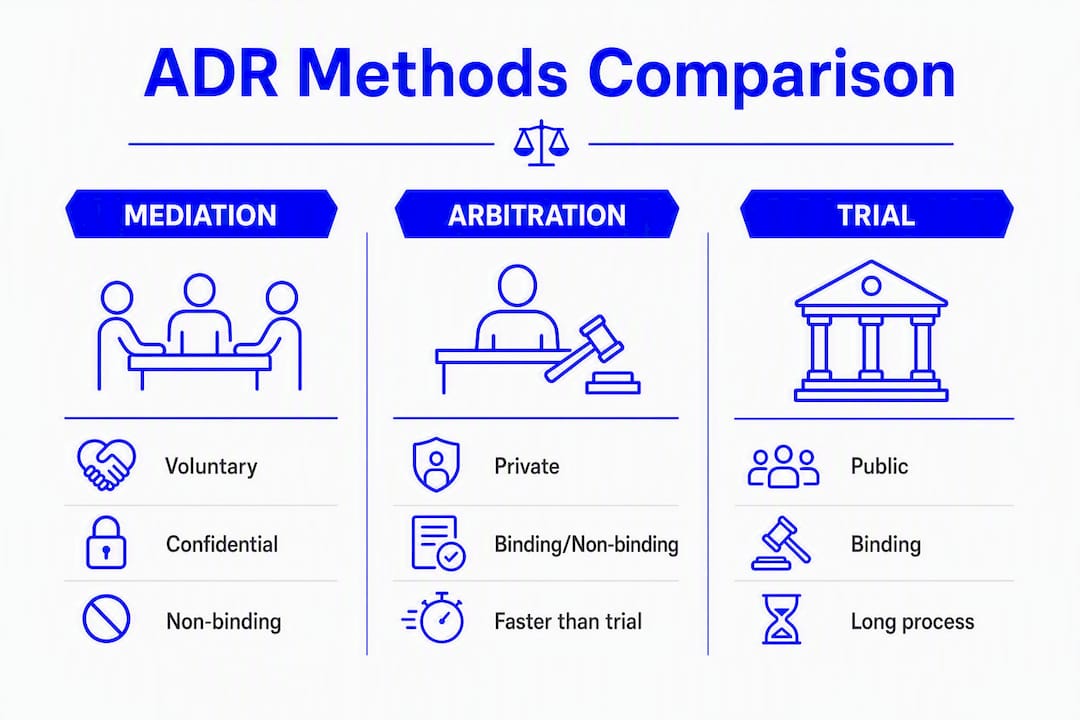
| Dimension | Mediation | Binding Arbitration | Court Trial |
|---|---|---|---|
| Binding outcome | No (unless settled) | Yes | Yes |
| Confidentiality | Yes | Generally yes | No (public record) |
| Cost | Lowest | Moderate | Highest |
| Timeline | Weeks to months | Months | 1–3+ years |
| Control over outcome | High (parties decide) | Low (arbitrator decides) | Low (jury decides) |
| Appealability | N/A (contract law) | Very limited (FAA grounds) | Full appellate rights |
| Punitive damages | Possible in settlement | Possible | Possible |
| Best for | Privacy, creative remedies, emotional closure | Binding private decision, mandatory clauses | Precedent, public record, high punitive damages |
How do informal settlement negotiations and pre-suit offers work?
Before any formal ADR process begins, many wrongful death claims resolve through direct negotiation between attorneys and the defendant's insurer or legal team. This is the fastest route to resolution, and it happens entirely outside any formal proceeding.
Pre-suit settlement negotiation typically starts with a demand letter. Your attorney sends a written demand to the at-fault party or their insurer that outlines liability, damages, and the amount the family is seeking. The insurer responds with a counteroffer, and the back-and-forth continues until both sides agree or talks break down.
This approach works best when liability is reasonably clear, the insurer has sufficient coverage, and both sides want to avoid the cost and publicity of a formal proceeding. It is also the most private option available, since there is no mediator, no arbitrator, and no court record.
A few practical points on how these negotiations are structured:
- Lump sum vs. structured settlement: Families can accept a single payment or negotiate a structured settlement annuity that pays out over time. Each has different tax and financial planning implications, and the right choice depends on the family's circumstances.
- Documentation matters: A signed release agreement is the key document. It must clearly identify who is released, what claims are covered, and any conditions attached to payment. Vague releases can create enforcement problems later.
- No neutral means no buffer: Without a mediator in the room, the negotiation can feel more adversarial. Insurers have professional negotiators; families usually do not. Skilled legal counsel is not optional here.
Pro Tip: Never sign a release without having your attorney review it first. Insurers sometimes present broad releases that extinguish claims you did not intend to waive, including claims by other family members or claims against additional defendants.
What other ADR options exist beyond mediation and arbitration?
Alternative dispute resolution covers a wider range of processes than most people realize. For complex wrongful death cases, a few specialized options are worth knowing.
Early neutral evaluation
Early neutral evaluation (ENE) brings in a neutral expert, often a retired judge or senior attorney, to give both sides a frank assessment of the case's strengths and weaknesses. It is not a settlement process itself. The goal is to calibrate expectations so that subsequent settlement talks start from a more realistic baseline. ENE works well when the parties are far apart on liability or damages and need an outside perspective to move the needle.
Private judging
Some states allow parties to hire a retired judge to conduct a trial-like hearing under private contract. The proceeding follows formal rules of evidence more closely than arbitration, and the decision can be binding. Private judging is faster than a public trial and keeps the proceedings out of the public record. It tends to cost more than mediation or standard arbitration, but less than full litigation.
Med-arb
Med-arb is a hybrid process where the same neutral first attempts mediation and, if no settlement is reached, shifts into binding arbitration. The efficiency is real: one neutral, one process, one resolution. The tradeoff is that parties may be less candid in mediation if they know the mediator can become the arbitrator. Some practitioners address this by using different neutrals for each phase.
Mini-trial
A mini-trial is a structured settlement negotiation where senior decision-makers from both sides hear abbreviated presentations of each party's best case. The goal is to give executives or claims managers a realistic picture of trial risk so they can authorize a settlement. It is most useful in cases involving corporate defendants where the people with settlement authority are not the same people managing the litigation.
Can non-monetary remedies actually be part of a wrongful death settlement?
Yes, and families often find them more meaningful than a check. Mediation opens the door to outcomes that no jury can order. Documented examples include formal apologies, the creation of memorial funds or scholarships in the decedent's name, commitments to change safety policies or procedures, and the surrender of professional licenses by the responsible party.
Insurers and corporate defendants often prefer mediation precisely because it offers certainty and confidentiality compared to the unpredictability of a public jury award. Plaintiffs can use that institutional preference as leverage. A defendant who is genuinely worried about a large public verdict has a strong incentive to offer something meaningful in a private settlement, including non-monetary terms that cost them relatively little but matter deeply to the family.
The enforceability of non-monetary terms depends entirely on how the settlement agreement is drafted. Vague commitments ("defendant will improve safety practices") are nearly impossible to enforce. Specific, measurable obligations ("defendant will install guardrails on all loading docks by a specific date, subject to a $50,000 penalty per month of delay") can be enforced as contract terms. Your attorney should draft these provisions with the same rigor as the monetary terms.
What do ADR options actually cost, and how long do they take?
Cost and timeline are where ADR's advantages over litigation are most concrete. The table below gives realistic ranges; actual figures vary by jurisdiction, case complexity, and attorney rates.
| Method | Typical Timeline | Neutral Fees | Total Cost Range |
|---|---|---|---|
| Direct settlement negotiation | Weeks to 3 months | None | Attorney fees only |
| Mediation | 1–6 months | — | Lower than arbitration or trial |
| Arbitration | 3–12 months | Higher than mediation; panel of 3 costs more | Moderate |
| Court trial | 1–3+ years | None (judge is public) | Highest (discovery, experts, trial prep) |
The biggest cost driver in litigation is discovery: depositions, document production, expert witnesses, and the attorney hours that go with all of it. Arbitration typically involves more flexible and less expensive discovery than a full trial, which is one reason it can resolve faster and cheaper. Mediation skips formal discovery almost entirely, though parties usually exchange key documents informally before the session.
Who pays the neutral's fees? In mediation, the parties typically split the mediator's hourly rate. In arbitration, the same general rule applies, though the arbitration agreement may specify a different allocation. Neutral fees for a single-day mediation with an experienced mediator can run several thousand dollars total, split between the parties. That is still a fraction of what a trial costs.
A few cost considerations families often overlook:
- Expert witnesses (economists, life-care planners, accident reconstructionists) are necessary in most wrongful death cases regardless of the resolution method. Budget for them early.
- Structured settlement annuities have their own transaction costs, but they can provide long-term financial security that a lump sum does not.
- Attorney contingency fees apply to ADR settlements the same way they apply to verdicts. Confirm the fee percentage and what expenses are deducted before the contingency is calculated.
What makes a mediated settlement or arbitration award actually enforceable?
A mediated settlement is not automatically enforceable just because both parties agreed to it in the room. It becomes an enforceable contract when both parties sign a written settlement agreement. That agreement should specify the payment amount and structure, who is released and from what claims, any non-monetary obligations, confidentiality terms, and what happens if a party defaults. Some states have specific statutes that give mediated agreements additional enforcement mechanisms, so local counsel matters here.
Arbitration awards operate differently. Under the Federal Arbitration Act, a binding arbitration award is generally enforceable in federal and state courts, and the grounds for challenging it are narrow: fraud, evident partiality, arbitrator misconduct, or an arbitrator exceeding their authority. This is a much harder standard to meet than a standard appeal, which is why binding arbitration is genuinely final in most cases. Counsel should draft the arbitration agreement carefully to define the arbitrator's scope of authority, because awards that exceed that scope are one of the few viable vacatur arguments.
Statute of limitations is the timing issue that can kill a wrongful death claim before ADR even begins. Most states impose a two-year deadline from the date of death to file a wrongful death lawsuit, though the specific period varies by state. Pursuing mediation or settlement negotiations does not automatically pause that clock. If talks drag on and the deadline passes without a filed suit or a signed tolling agreement, the claim may be barred entirely. The practical rule: file suit or get a signed tolling agreement before the deadline, even if you are actively negotiating.
Confidentiality in ADR is real but not absolute. Mediation communications are protected by confidentiality rules in most states, and arbitration proceedings are private by default. But if you need to enforce a settlement in court, some details may become part of the public record. Mandatory disclosure rules (for example, in cases involving public entities or certain insurance regulations) can also limit confidentiality. Know the limits before you rely on them.
When is litigation actually the better choice?
ADR is not always the right answer. Some wrongful death cases belong in court, and pushing them toward mediation or arbitration can actually hurt the family's position.
The strongest case for going to trial is when the family needs a public record. If a corporation has been concealing a dangerous product defect, or a government agency has been covering up negligence, a public trial creates accountability that a confidential settlement cannot. The precedent set by a verdict can also protect future victims in ways that a private resolution never will.
Punitive damages are another factor. Juries can award punitive damages in cases involving egregious misconduct, and those awards can be substantial. Defendants rarely agree to punitive damages in settlement, and arbitrators are sometimes reluctant to award them. If punitive damages are a realistic and important goal, trial may be the only path to them.
Power imbalances in ADR deserve serious attention. An unrepresented family member sitting across from an insurer's professional negotiator and in-house counsel is at a structural disadvantage. ADR without skilled legal representation on the plaintiff's side can produce settlements that are far below what a case is actually worth. The benefits of a wrongful death attorney in this context go beyond legal knowledge; an experienced attorney levels the playing field in a way that no ADR process can do on its own.
Watch for bad faith. If a defendant is using mediation or arbitration to delay proceedings, avoid discovery, or run out the statute of limitations clock, that is a signal to stop negotiating and file. Coercive arbitration clauses buried in contracts the decedent signed deserve scrutiny too. Some of those clauses are unenforceable, and an attorney can challenge them.
How do you actually start ADR for a wrongful death claim?
Here is a concrete sequence to follow, from the day after the loss through the first ADR session.
- Preserve evidence immediately. Photographs, surveillance footage, medical records, accident reports, and witness contact information all have a shelf life. Secure them before they disappear.
- Identify the statute of limitations. Your state's wrongful death statute sets the deadline for filing a lawsuit. Most states allow two years from the date of death, but some are shorter. Check the specific rule for your state, and do not assume you have more time than you do.
- Get legal counsel before you talk to anyone. Insurance adjusters will contact you quickly. Do not give recorded statements or sign anything without an attorney. The wrongful death claim process is different from a personal injury claim in ways that matter for ADR strategy.
- Send a demand letter (when advised by counsel). A formal demand letter opens the negotiation, establishes your position, and signals that you are serious. Your attorney drafts this; do not send one yourself.
- Select a mediator or arbitrator. Ask for candidates with specific wrongful death experience. Vet them on their approach to emotional issues, their familiarity with damages in death cases, and their track record of reaching resolution. Organizations like JAMS and the American Arbitration Association maintain rosters of qualified neutrals.
- Prepare your case materials. Counsel will assemble a mediation brief, damages summary, and expert reports. Families contribute by providing personal evidence: photographs, letters, videos, and testimony about the decedent's role in the family.
- File suit or execute a tolling agreement before the deadline. Even if you are deep in mediation, protect the claim by filing or getting a signed agreement that pauses the limitations clock.
- Start your free evaluation at Carcollisionlawyer. The intake process at Carcollisionlawyer.net matches families with attorneys who have ADR experience in wrongful death cases, at no cost to the family.
Which ADR option should you try first?
The practical decision rule is straightforward. Start with direct negotiation or mediation when liability is reasonably clear, the insurer is engaged, and the family values privacy and control. Move to arbitration when the parties want a binding private decision and are willing to give up appellate rights for finality. Go to trial when public accountability, punitive damages, or a contested legal precedent is the priority.
On timing: early mediation (before full discovery) costs less and resolves faster, but you may have less information about the case's full value. Post-discovery mediation is more expensive but produces better-informed settlements. The right timing depends on how much is known about liability and damages at the outset.
Signals that mean you should stop ADR and head to court:
- The defendant is using ADR to delay and run out the statute of limitations.
- The other side is negotiating in bad faith or withholding key information.
- The case involves a pattern of corporate misconduct that deserves a public record.
- Punitive damages are a realistic and significant part of the family's goals.
- A mandatory arbitration clause in the decedent's contract appears unconscionable or was signed under duress.
- The family is unrepresented and the power imbalance is too severe to produce a fair result.
The evaluation guide for wrongful death attorneys at Carcollisionlawyer walks through exactly what questions to ask a prospective attorney about their ADR experience before you commit to a path.
Key Takeaways
Mediation is usually the best first step for wrongful death families who want control, confidentiality, and the possibility of non-monetary remedies, but the right ADR method depends on the specific facts of the case.
| Point | Details |
|---|---|
| Try mediation or negotiation first | Both preserve confidentiality and give families control; mediation also allows creative non-monetary remedies no jury can order. |
| Arbitration is binding and final | Under the Federal Arbitration Act, grounds to challenge an award are narrow; choose binding arbitration only when finality outweighs appellate rights. |
| Protect the statute of limitations | File suit or sign a tolling agreement before the deadline, even if ADR talks are active; most states allow roughly two years from the date of death. |
| Draft settlement terms precisely | Vague non-monetary commitments are unenforceable; specific, measurable obligations with penalty clauses hold up in court. |
| Carcollisionlawyer's free evaluation | Carcollisionlawyer matches families with ADR-experienced wrongful death attorneys at no upfront cost through its free case evaluation. |
Why ADR is often the better choice for grieving families
Most articles about wrongful death ADR treat the process as a purely tactical question: which method is faster, cheaper, or more likely to produce a large number. That framing misses something families already know. A trial is not just expensive and slow. It forces a family to relive the worst experience of their lives in a public forum, under cross-examination, for months or years. The adversarial structure of litigation is designed to produce a winner and a loser, not to help anyone heal.
Mediation, done well, can do something a verdict cannot. It can give a family the chance to be heard by the people responsible, to ask why, and sometimes to receive an acknowledgment that the loss mattered. Those outcomes are not guaranteed, and they are not always possible when the defendant is a large institution with lawyers whose job is to minimize exposure. But when they happen, families consistently report that the process felt more humane than anything a courtroom could have offered.
The practical argument for ADR is strong on its own: lower cost, faster resolution, confidentiality, and control. But the human argument is just as real. Families who choose ADR are not settling for less. They are choosing a process that puts their needs, not the court's docket, at the center.
Carcollisionlawyer connects you with ADR-experienced wrongful death attorneys
Losing someone to another party's negligence is hard enough without spending years in court. Carcollisionlawyer's free case evaluation gives families a faster path: answer a few questions about the accident and the loss, and the platform matches you with a vetted wrongful death attorney who has real experience handling ADR, including mediation and arbitration, not just trial work.
The evaluation collects basic details about the incident, the family's relationship to the decedent, and the type of resolution the family is considering. There are no upfront fees for families. Attorneys in the network work on contingency, meaning they only get paid if the case resolves successfully. Carcollisionlawyer prioritizes matching wrongful death families with counsel who understand the emotional and procedural demands of ADR, not just the legal ones.
Start your free evaluation now and get connected with an attorney who can tell you, based on your specific facts, whether mediation, arbitration, or direct settlement is the right first move.
This article is general information, not legal advice. Wrongful death laws and ADR procedures vary by state. Confirm the rules that apply to your situation with a qualified attorney.
Useful sources
- Alternative Dispute Resolution — Cornell Law School Wex: Authoritative definitional overview of ADR forms including negotiation, mediation, arbitration, and early neutral evaluation.
- The Case for Mediating Wrongful-Death Actions — Advocate Magazine: Practitioner analysis of why mediation suits wrongful death cases, including creative remedies and insurer dynamics.
- The Saddest Mediation: Mediating Wrongful Death Cases — Miles Mediation: Mediator perspective on emotional preparation, rapport-building, and impasse prevention in wrongful death mediations.
- Wrongful Death Disputes: Mediation and Arbitration — Morgenstern ADR: Explains binding vs. non-binding arbitration, mandatory arbitration clauses, and the Federal Arbitration Act enforcement framework.
- Wrongful Death Mediation — ADR Systems: Practical overview of mediation's cost, confidentiality, and timeline advantages over litigation.
- Wrongful Death Settlement: Fees, Process, and Damages — LegalClarity: Covers settlement structures, attorney fees, and how families choose between lump sum and structured payments.
- Benefits of a Wrongful Death Attorney — Carcollisionlawyer Blog: Explains the role of legal counsel in ADR and how attorneys prepare families for mediation and settlement.
- What Is a Wrongful Death Lawsuit — Carcollisionlawyer Blog: Overview of the wrongful death legal process, statute of limitations, and who can bring a claim.