
If your insurance adjuster has gone quiet after a crash, start a written record today, ask for a specific response date, and check the claim deadlines in your state. Silence is often a paperwork problem, but it can also be a sign that the claim is stalling. If you were injured, a free evaluation from Carcollisionlawyer can match you with an attorney who can take over the calls and the deadline tracking.
TL;DR
- Confirm in writing that the insurer received your claim, then ask for a reply by a specific date.
- Most states set response deadlines, often 10 to 15 days to acknowledge a claim and about 30 days to decide or explain a delay.
- Log every call, email and name. That record is your proof if you need to complain.
- If the insurer still does not answer, escalate to a supervisor, then file a complaint with your state insurance department.
- If you have injuries, a lawyer can handle the insurer for you. We offer a free evaluation.
Table of Contents
- Why adjusters stop answering
- Step 1: Confirm the claim was received
- Step 2: Put a follow-up in writing
- Step 3: Keep a record of everything
- What the deadlines say in your state
- Step 4: Escalate to a supervisor
- Step 5: File a complaint with your state insurance department
- When silence may be bad faith
- Mistakes to avoid while you wait
- Get an attorney to take over the chasing
- Our perspective
- FAQ
- Sources
Why adjusters stop answering
Delay is common. The South Dakota Division of Insurance says a delay in the claims process is the number one complaint of insurance consumers across the country. It also notes that incorrect or incomplete information can slow a claim down.
The usual causes are ordinary ones:
- A missing police report, medical record or repair estimate.
- A contact detail that is wrong, so the adjuster's messages never reach you.
- A dispute over who was at fault, which can freeze the file.
- A reassigned file, after which no one has told you who your new adjuster is.
- A claim sitting in the investigation stage while the insurer waits for information from others.
Before you assume the worst, check your own side. Confirm that the insurer has your correct phone number and email, and that everything it asked for has been sent.
Step 1: Confirm the claim was received
Call or email and ask one simple question: has my claim been received, and who is handling it? Get a name, a title, a direct number and a claim number.
The South Dakota Division of Insurance says insurers must respond to claim communications within 30 days. That does not mean payment within 30 days. It also advises that if you have not heard back, you contact the company to verify it received your claim. Other states set shorter windows, covered below.
If you are dealing with the other driver's insurer rather than your own, the rules and leverage differ. Our guide to third-party car claims explains how.
Step 2: Put a follow-up in writing
Phone calls leave no proof. A short email or letter does. Include:
- Your name, claim number, date of the accident and the adjuster's name.
- A list of what you have already sent and when.
- A direct request: a status update and a substantive reply by a specific date, such as seven days out.
- Any new information, such as updated medical records or repair bills.
Keep the tone factual. If you have sent a formal demand, our guide to the car accident demand letter covers the usual response window. For what to say on the phone, see how to talk to an insurance adjuster after a crash.
Step 3: Keep a record of everything
The South Dakota Division of Insurance advises keeping copies of correspondence, writing down the date, name and title of each person you speak to and what was said, and tracking your time and expenses. A simple log works:
| Date | Method | Person and title | What was said or sent | Next step |
|---|---|---|---|---|
| Example: Day 1 | Phone | Adjuster, name | Confirmed claim received | Email by Day 3 |
The same habit helps if the claim becomes a dispute. For the evidence side of a crash, see our car accident evidence checklist.
What the deadlines say in your state
Claim handling is regulated state by state, so the clock depends on where your policy was issued. Examples from official sources:
| State | What insurers must do |
|---|---|
| Texas | Acknowledge a claim within 15 days, approve or deny in writing within 15 business days after receiving all needed information, and pay within 5 business days of approval. The decision deadline can extend up to 45 days if the company explains why. |
| Washington | Approve, deny or explain a delay within 30 days, then keep explaining every 30 days during a delay. |
| Minnesota | Acknowledge within 10 business days and reply to reasonable communications within 10 business days. |
| Alabama | Acknowledge a first-party claim and reply to pertinent written communications within 15 days. |
| Louisiana | Begin work on a claim within 30 days and respond to claimant questions within 14 days unless extended. |
The NAIC's model regulation, which many states draw on, calls for acknowledgment within 15 calendar days and a reply to other pertinent communications within 15 days. Washington has also updated its claims rules, with written updates every 30 days and replies to supplemental auto estimates within five business days, taking effect in October 2026.
Two cautions. These rules are mostly written for claims on your own policy, and they can be extended for catastrophes. Check your own state insurance department's website for the exact rule.
A missed response deadline is not the only clock. The time you have to sue can be much shorter than people expect. See our state-by-state statute of limitations guide.
Step 4: Escalate to a supervisor
If your written follow-up goes unanswered past the date you set, ask for the adjuster's supervisor. Send the same summary, attach your log and say which deadline you believe has passed. Ask for a named person and a date for the next update.
Do not agree to drop or shrink a claim just to end the silence. Our article on common car accident claim denials explains what to do if a delay turns into a denial or a low offer.
Step 5: File a complaint with your state insurance department
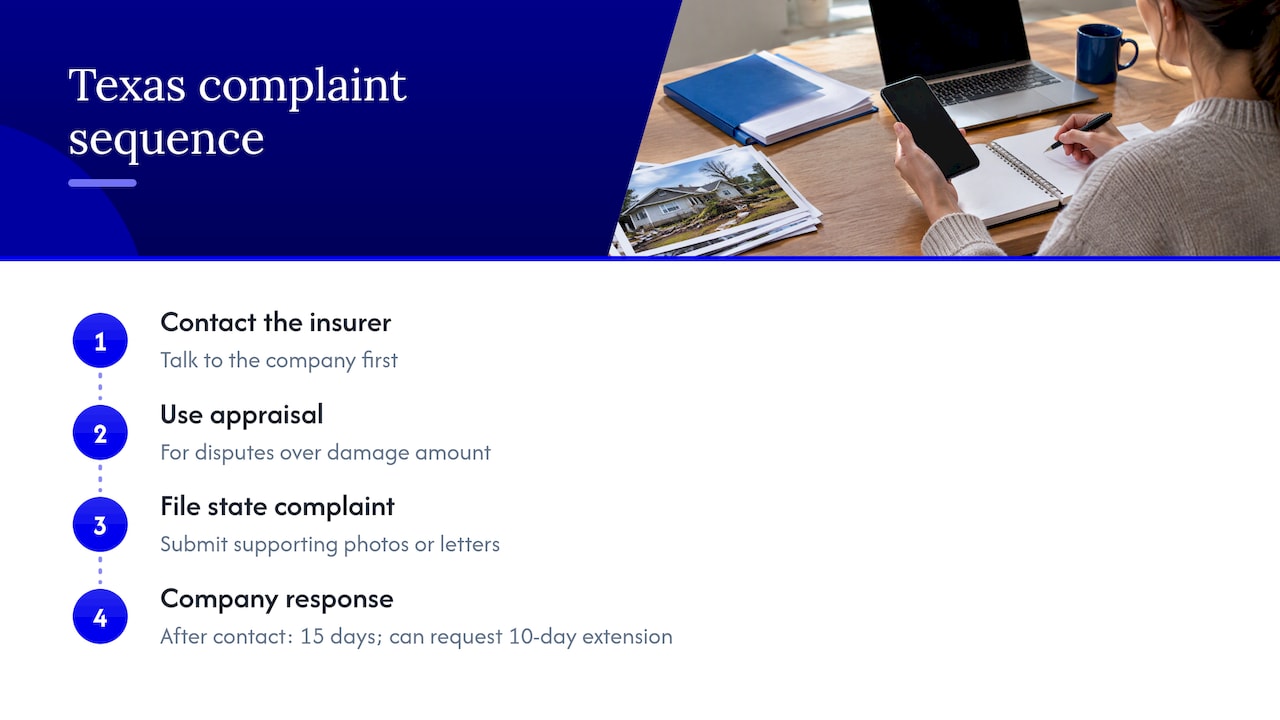
Every state has an insurance regulator. The Texas Department of Insurance says to talk to the company first, use the policy's appraisal process if the dispute is about the amount of damage, then file a complaint through its online system, with supporting documents such as pictures or letters. Once the department contacts the company, the company has 15 days to respond and can request a 10-day extension.
In Washington, the insurer's response to a complaint is due in 15 business days. The Office of the Insurance Commissioner reviews it against state law and fair claims practices, shares the results with you, and keeps the complaint on the company's record.
Your log from Step 3 is what makes a complaint effective. Include claim number, dates, names and copies of your follow-ups.
When silence may be bad faith
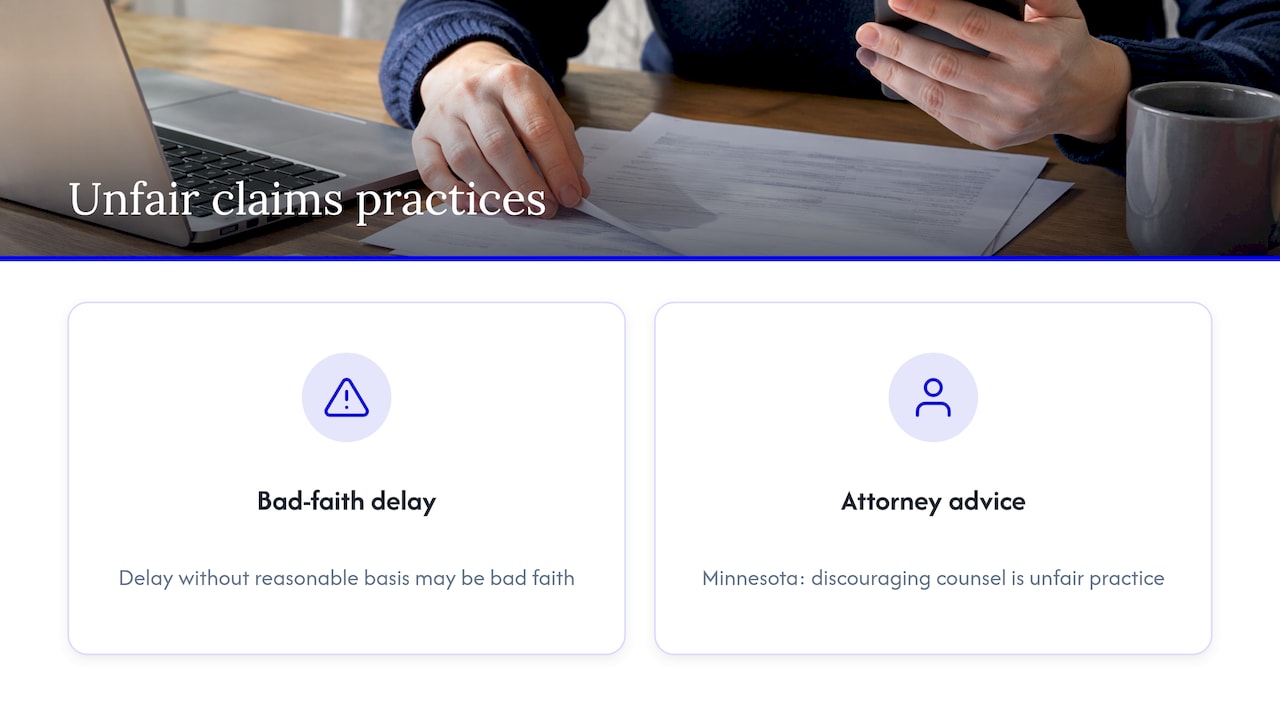
Insurers that delay without a reasonable basis can be acting in bad faith. Some states also forbid insurers from discouraging you from hiring a lawyer. Minnesota, for example, treats advising an insured not to obtain an attorney as an unfair practice. Our guide to insurance bad faith claims explains what policyholders should know. For background on how states police unfair claim handling, this legal overview of workers' compensation denials and unfair practices is a helpful read.
Mistakes to avoid while you wait
The Louisiana Department of Insurance advises claimants not to throw away damaged items before inspection or insurer approval, not to make permanent repairs without discussing them with the insurer, and to give accurate, complete information.
For injury claims, also keep treating with your doctor and keep every medical record. For a sense of how long a typical claim takes, see our car accident injury claim timeline and the overview of the car accident claim process.
Get an attorney to take over the chasing
If you were hurt, or you lost a family member in a crash, chasing an adjuster while recovering is a heavy load. Our free evaluation asks about your injury and the circumstances of the accident, so the match reflects your situation. It carries no obligation, and it shows whether you may be entitled to compensation. It covers car, truck, motorcycle and bicycle accidents, including physical injuries, emotional trauma and wrongful death, and connects you with vetted local attorneys.
Start your free evaluation when you are ready.
Our perspective
Most people who write to us are not worried about a number yet. They are worried because the phone has stopped ringing and they do not know what that means.
Our view is simple: you should not have to learn insurance regulation while you heal. A free evaluation tailored to your injury and your circumstances lets you find out where you stand, with no commitment, and lets an attorney who handles cases like yours take the next call from the insurer.
Silence is a signal to act in writing, early, and with someone in your corner.
Gerard
FAQ
Why won't my insurance adjuster call me back?
Often it is a missing document, a wrong contact detail, a fault dispute or a file that has been reassigned. Email the adjuster, ask for confirmation that your claim was received, and request a reply by a set date. If nothing comes, go to a supervisor.
How long does an insurance company have to respond to a claim?
It depends on your state. Many require acknowledgment within 10 to 15 days and a decision or an explanation of the delay within about 30 days. The examples in the table above come from state regulators, and your state insurance department can confirm the exact rule.
Does the 30-day response period mean I get paid in 30 days?
No. The South Dakota Division of Insurance states that the response requirement does not obligate payment within that period. It means the insurer must communicate with you.
When should I contact my state insurance department?
After you have followed up in writing and tried a supervisor without a real answer. Bring your log, claim number and copies of your messages. Many departments take complaints online.
Should I hire a lawyer if I was injured?
If your injuries are significant, the insurer is stalling or the claim has been denied, a lawyer can deal with the insurer and track deadlines for you. Our free evaluation can match you with one.
Sources
- South Dakota Division of Insurance: Make the Claims Process Easier
- Texas Department of Insurance: Get help with an auto insurance complaint
- Texas Department of Insurance: Consumer Bill of Rights
- Washington OIC: Filing an auto insurance claim
- Washington OIC: Improving the claims process
- Washington OIC: Understanding the complaint process
- Minnesota Statutes 72A.201
- Alabama Admin. Code 482-1-125
- Louisiana Department of Insurance Disclosure Guide
- NAIC Model Regulation 902