
Insurance bad faith claims give policyholders a legal tool to hold insurers accountable when an insurer unreasonably denies, delays, or underpays a covered claim. When that happens, you may be entitled to recover damages that go well beyond the original policy limits. The legal foundation is the implied covenant of good faith and fair dealing, a principle embedded in every insurance contract under U.S. law. To succeed, you generally need to show three things: a valid policy, conduct by the insurer that was unreasonable or dishonest, and actual harm caused by that conduct.
The role of insurance bad faith claims is not just about money. These claims serve a broader consumer-protection function, deterring insurers from systematically shortchanging policyholders who are already in a vulnerable position after an accident or loss. State insurance departments and the National Association of Insurance Commissioners (NAIC) provide administrative oversight, but a private bad faith lawsuit often delivers faster and more meaningful relief.
Key things to know right away:
- Bad faith can arise from denial, delay, underpayment, or failure to investigate a claim.
- Remedies can include policy benefits, consequential losses, emotional distress damages, attorney's fees, and punitive damages.
- State law controls the standard of proof and available remedies — rules vary significantly.
- Filing a complaint with your state insurance department is a useful parallel step, not a substitute for legal action.
- Carcollisionlawyer offers a free case evaluation to connect you with a vetted local attorney who handles bad faith and personal injury claims.
Pro Tip: Start a dated log the moment you suspect a problem. Note every phone call, every letter, every email, and every deadline the insurer misses. That paper trail is often the difference between a provable bad faith claim and a frustrating dead end.
Table of Contents
- What does "bad faith" mean in U.S. insurance law?
- First-party vs. third-party bad faith: who you sue and why it matters
- What insurer actions signal bad faith?
- What damages can you recover in a bad faith claim?
- How do legal standards vary by state?
- How do you document and pursue a bad faith claim?
- What looks like bad faith but legally is not?
- When should you hire an attorney for a bad faith claim?
- Key Takeaways
- Why bad faith claims matter more than most policyholders realize
- Get a free case evaluation if you suspect bad faith
- Useful sources and further reading
What does "bad faith" mean in U.S. insurance law?
Every insurance contract in the United States carries an implied covenant of good faith and fair dealing. That means your insurer must handle your claim honestly and reasonably, even when the policy language does not spell out every obligation. When an insurer violates that covenant, it may face liability that goes far beyond simply paying the original claim.
Courts have developed three main legal theories for bad faith claims:
Contract breach. A few states treat bad faith purely as a contract violation. Remedies are limited to what the policy would have paid, plus foreseeable consequential damages in some jurisdictions.
Independent tort. Most states recognize bad faith as a standalone tort, separate from the contract. This matters enormously because tort treatment opens the door to consequential damages, emotional distress damages, and punitive damages that a contract claim cannot reach.
Statutory unfair claims practices. Many states have enacted unfair claims settlement practices acts, often modeled on NAIC guidelines. These statutes can provide additional penalties and, in some states, a private right of action on top of the common-law tort.
The shift from contract-only remedies to tort and statutory remedies happened for a specific reason: contract damages alone failed to deter insurers from improperly denying claims. Courts and scholars recognized that an insurer facing only the obligation to pay what it already owed had little financial incentive to act fairly. Tort remedies corrected that imbalance.
The landmark California case Gruenberg v. Aetna Insurance Co. (1973) was among the first to recognize bad faith as an independent tort, establishing that an insurer owes a duty of good faith directly to the insured, not merely a contractual obligation. Many states followed California's lead, though the specific standards differ.
"A private cause of action became necessary because administrative remedies and regulatory complaints alone often failed to provide timely relief or adequate compensation to injured insureds." — University of Michigan Journal of Law Reform
First-party vs. third-party bad faith: who you sue and why it matters
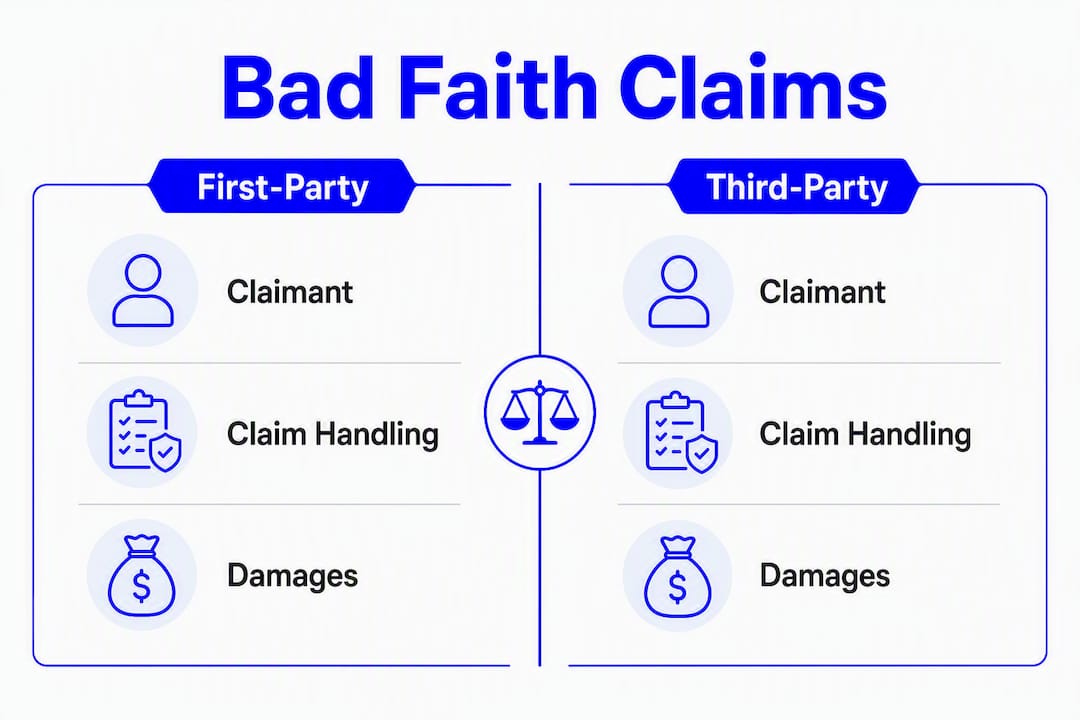
The distinction between first-party and third-party bad faith determines who you can sue, what you must prove, and what remedies are available. State law governs both categories, but the practical differences are significant.

| Feature | First-party bad faith | Third-party bad faith |
|---|---|---|
| Who brings the claim | Policyholder vs. their own insurer | Injured claimant vs. at-fault party's insurer, or insured who assigns rights |
| Common examples | Denial of UM/UIM benefits, underpaid property claim | Failure to settle within policy limits, failure to defend |
| Typical remedy | Policy benefits + consequential damages + punitive | Excess judgment over policy limits |
| Standing to sue | Policyholder directly | Claimant (via assignment) or insured |
First-party bad faith arises when your own insurer mishandles your claim. The most common examples in auto accident cases involve uninsured/underinsured motorist (UM/UIM) benefits. If you are hit by an uninsured driver and your insurer refuses to pay a reasonable UM settlement without a legitimate basis, that is a first-party bad faith situation. Underpayment of medical payments coverage or property damage benefits follows the same logic.
Third-party bad faith is more complex. It typically involves the at-fault driver's liability insurer failing to settle a claim within the policy limits when it had a reasonable opportunity to do so. If the insurer gambles on litigation and loses, the insured may be exposed to a judgment that exceeds their coverage. In that scenario, the insured can often assign their bad faith claim against their own insurer to the injured party, who then pursues the excess judgment.
Common red flags in each category:
- First-party: insurer ignores your treating physician's records, delays payment past statutory deadlines, or offers a settlement far below documented losses.
- Third-party: insurer refuses a reasonable settlement demand within limits, fails to communicate settlement offers to the insured, or drags out negotiations until a verdict comes in over the policy cap.
What insurer actions signal bad faith?
Spotting bad faith early gives you time to preserve the evidence you need. Some insurer behaviors are clear warning signs; others require context and legal analysis to evaluate. Here are the most common red flags:
- Unexplained or unjustified denial. The insurer denies your claim without citing a specific policy exclusion or providing a written explanation.
- Unreasonable delays. The insurer acknowledges your claim but takes months to investigate without a legitimate reason.
- Lowball settlement offers. The insurer offers a fraction of your documented losses with no credible basis for the reduction.
- Failure to investigate. File-review denials without contacting treating physicians, or ignoring contradictory evidence, are recurring red flags in successful bad faith cases.
- Misrepresentation of policy terms. The insurer tells you a covered loss is excluded, or misquotes your policy language.
- Failure to communicate. The insurer stops responding to calls and letters, or fails to acknowledge receipt of your claim within the timeframe required by state law.
- Reliance on undisclosed reports. The insurer bases a denial on an internal medical or engineering review it refuses to share with you.
When you spot these patterns, preserve evidence immediately: save every letter, email, and voicemail. Request a copy of your claim file in writing. Note the date and content of every phone call. Ask for every denial in writing and demand the specific policy language the insurer is relying on.
Pro Tip: Send all communications by certified mail or email so you have timestamped proof of delivery. An insurer that ignores a written demand has a much harder time claiming it acted reasonably.
What damages can you recover in a bad faith claim?
When a bad faith claim succeeds, the recoverable damages typically go well beyond the original policy benefit. The exact scope depends on your state's legal framework and whether you are pursuing a first-party or third-party claim.
Recoverable damages generally include:
- Policy benefits owed. The amount the insurer should have paid in the first place.
- Consequential/economic losses. Financial harm caused by the delay or denial, such as lost wages, additional medical costs, or foreclosure resulting from unpaid insurance proceeds.
- Emotional distress. Compensation for anxiety, depression, and suffering caused by the insurer's conduct. Courts have awarded emotional distress damages in bad faith cases where the insurer's behavior was particularly callous.
- Attorney's fees. Available under fee-shifting statutes in many states and sometimes as consequential damages in others.
- Punitive damages. Awarded in egregious cases to punish and deter. Most states require proof of malice, fraud, oppression, or conscious disregard of the policyholder's rights.
| Damage type | Availability | Notes |
|---|---|---|
| Policy benefits | All states | Always recoverable if coverage existed |
| Consequential losses | Most states | Must be foreseeable and causally linked |
| Emotional distress | Majority of states | Stronger in tort-based jurisdictions |
| Attorney's fees | Varies by state | Statutory fee-shifting or as consequential damage |
| Punitive damages | Many states | Requires heightened proof (malice, fraud, or recklessness) |
In third-party cases, the most powerful remedy is recovery of the excess judgment: if the insurer's refusal to settle within limits results in a verdict above the policy cap, the insurer may owe the entire judgment, not just the policy limit. For a real sense of how damages are calculated in accident-related claims, the car accident damages examples on Carcollisionlawyer's blog illustrate the range of outcomes.
How do legal standards vary by state?
Bad faith law is almost entirely state-specific. There is no federal bad faith statute for most private insurance lines, so the rules you face depend entirely on where you live and where the policy was issued.
The major axes of variation:
- Tort vs. contract treatment. States like California, Washington, and Florida recognize bad faith as an independent tort. A handful of states limit recovery to contract damages only.
- Culpability standard. Some states require proof that the insurer acted with knowledge that its denial lacked a reasonable basis (a subjective standard). Others require only that the insurer's conduct was objectively unreasonable.
- Punitive damages threshold. Most states require clear and convincing evidence of malice or fraud. A few states allow punitive damages on a preponderance standard; others cap them by statute.
- Statutory unfair claims practices. Many states have enacted statutes that list specific prohibited conduct. Whether those statutes create a private right of action varies widely.
Scholars note that states with tort-based bad faith remedies tend to show different claims characteristics and investigative practices compared to states with contract-only regimes, and that the choice of legal framework involves real trade-offs between deterrence and the risk of over-deterrence.
Action checklist for jurisdictional research:
- Search your state's insurance code for "unfair claims settlement practices" or "bad faith."
- Check your state's NAIC model law adoption status at naic.org.
- Review your state insurance department's complaint process (most departments publish this online).
- Ask any attorney you consult to identify the controlling standard in your jurisdiction before you decide how to proceed.
Some states have not recognized a private tort of bad faith at all, limiting you to contract remedies or regulatory complaints. Knowing which regime applies before you file is not optional — it shapes your entire litigation strategy.
How do you document and pursue a bad faith claim?
Pursuing a bad faith claim requires methodical documentation from the very first day. Here is a practical roadmap:
- Preserve your policy and claim file. Request a complete copy of your claim file in writing. Insurers are generally required by state law to provide it.
- Build a communications log. Record every contact with the insurer: date, name of representative, what was said, and any commitments made.
- Collect medical and economic proof. Gather bills, records, wage statements, and repair estimates that document your actual losses.
- Send a written demand. Before filing suit, send a formal demand letter identifying the bad faith conduct, the damages you are claiming, and a reasonable deadline for response.
- File a state insurance department complaint. Regulators and unfair-claims-practice statutes can impose penalties and trigger investigations. A complaint also creates an official record that can support your lawsuit.
- Consult an attorney. Bad faith litigation is complex. An attorney can subpoena the insurer's internal notes, demand timetables, and build a coherent narrative from fragmented evidence.
- File suit if necessary. If pre-suit demands fail, your attorney files a complaint, conducts discovery (including deposing claims adjusters), and pursues settlement or trial.
| Phase | Typical duration |
|---|---|
| Initial documentation and demand | 1–3 months |
| Insurance department investigation | 2–6 months |
| Pre-suit negotiation | 1–4 months |
Statute of limitations: Bad faith claims are subject to statutes of limitations that vary by state, typically ranging from 2–4 years from the date of the denial or the date you discovered the bad faith conduct. Some states apply the contract limitations period; others apply the tort period. Check your state's rules immediately — missing the deadline bars your claim entirely.
Most bad faith attorneys work on a contingency fee, meaning you pay nothing unless you recover. Fee-shifting statutes in many states also allow you to recover attorney's fees as part of your damages, which further reduces your out-of-pocket risk. For a broader look at common claim denials and how to respond, Carcollisionlawyer's blog covers the most frequent scenarios in detail.
Pro Tip: Ask your attorney to request the insurer's claim diary and internal reserve notes during discovery. Those documents often reveal exactly when the insurer knew your claim was valid and why it delayed anyway.
What looks like bad faith but legally is not?
Not every frustrating insurer behavior rises to the level of bad faith. Courts in most states apply a "fairly debatable" or "genuine dispute" doctrine: if a reasonable coverage question existed at the time of the denial, the insurer may escape bad faith liability even if it ultimately turns out to be wrong.
Situations that typically do not constitute bad faith:
- Honest coverage disputes. If the policy language is genuinely ambiguous and the insurer's interpretation is reasonable, a court may find the dispute was fairly debatable.
- Clerical errors promptly corrected. An isolated administrative mistake fixed by paying the claim is not bad faith. Courts require proof of unreasonable or systemic conduct, not a one-time processing error.
- Reasonable investigation delays. If the insurer is waiting for medical records you have not yet authorized, or for an independent appraisal, a delay may be justified.
- Legitimate subrogation or coverage questions. Disputes about which insurer is primary, or whether an exclusion applies, can be genuine legal questions rather than pretextual denials.
The key distinction is pattern versus isolated incident. A single delayed payment with a prompt apology and correction looks very different from a six-month pattern of ignored correspondence, shifting explanations, and lowball offers. If you are unsure which category your situation falls into, a regulator complaint and a free attorney consultation are low-cost ways to find out. Avoiding common lawsuit mistakes at this stage can protect your ability to escalate later.
When should you hire an attorney for a bad faith claim?
The short answer: earlier than you think. Evidence that supports an insurer's unreasonable denial is central to proving bad faith, and early counsel helps create a documented timeline and collect the insurer's file before records are lost or altered.
An attorney brings specific advantages to a bad faith case:
- Subpoenaing the insurer's claim file, internal notes, and reserve history.
- Identifying which state statutes and case law apply to your specific situation.
- Drafting a pre-suit demand that satisfies any statutory notice requirements.
- Evaluating whether the insurer's conduct crosses the line from genuine dispute to actionable bad faith.
- Negotiating a settlement that accounts for consequential damages and attorney's fees, not just the policy benefit.
For accident victims, consulting a lawyer in an insurance dispute early also prevents common procedural missteps that can limit your recovery later.
Carcollisionlawyer's free case evaluation connects you with a vetted local attorney who handles personal injury and bad faith claims. The intake process is straightforward: describe your accident, your injuries, and the insurer's conduct, and the service matches you with counsel in your area. There is no fee for the injured party.
Pro Tip: When you consult an attorney, ask specifically whether they have handled bad faith claims against your insurer before. Insurers have litigation patterns, and an attorney who knows those patterns has a real advantage.
What to expect from an initial consultation:
- Review of your policy and claim file.
- Assessment of whether the insurer's conduct meets your state's bad faith standard.
- Explanation of likely remedies and realistic timeline.
- Discussion of contingency-fee terms (typically 33%–40% of recovery, varying by case complexity and state rules).
Key Takeaways
Insurance bad faith claims give policyholders the legal means to recover damages beyond policy limits when an insurer acts unreasonably, and early documentation combined with prompt legal counsel are the two factors most likely to determine whether a claim succeeds.
| Point | Details |
|---|---|
| Document everything immediately | Log every call, letter, and deadline the insurer misses from day one. |
| Know your state's standard | Bad faith rules vary widely; tort states allow punitive damages, contract states do not. |
| File a regulator complaint | A state insurance department complaint creates an official record and can trigger penalties. |
| Hire counsel early | Attorneys can subpoena claim files and internal notes that are otherwise inaccessible. |
| Carcollisionlawyer | Offers a free case evaluation to match you with a vetted local attorney at no cost to you. |
Why bad faith claims matter more than most policyholders realize
The conventional wisdom treats bad faith claims as a last resort, something you pursue only after every other option has failed. That framing gets it backwards. The threat of a bad faith claim is often what motivates an insurer to settle a legitimate claim fairly in the first place. Without it, the insurer's rational move is to delay, lowball, and wait for a financially stressed policyholder to accept less than they are owed.
What most people underestimate is the systemic nature of insurer misconduct. A single adjuster making a mistake is not bad faith. But when an insurer's internal protocols consistently produce denials without physician contact, or when reserve notes show the insurer knew a claim was valid and delayed anyway, that is a pattern. Patterns are what bad faith law was designed to address.
There is a legitimate counterargument: strong bad faith remedies can alter insurer behavior in ways that are not always beneficial, potentially making insurers more cautious about paying borderline claims to avoid litigation exposure. That tension is real, and courts have grappled with it for decades. But for a policyholder who paid premiums in good faith and is now facing a denied or underpaid claim after a serious accident, the deterrence function of bad faith law is not an abstraction. It is the mechanism that gives your claim leverage.
The consumer-protection role of these claims is why Carcollisionlawyer focuses on connecting accident victims with attorneys who understand both the personal injury and the insurance side of these disputes. The two are rarely separable.
Get a free case evaluation if you suspect bad faith
If your insurer has denied, delayed, or underpaid your accident claim without a credible explanation, the next step is a free case evaluation through Carcollisionlawyer.
The process is straightforward. Submit your claim details online, and Carcollisionlawyer matches you with a vetted local attorney who handles personal injury and bad faith cases in your state. There is no fee for the injured party. The intake preserves your earliest-contact timestamp, which matters if a statute of limitations question arises later.
Before you submit, gather the following:
- Your insurance policy (declarations page and full policy document).
- Your claim number and all correspondence with the insurer.
- Medical bills, treatment records, and wage-loss documentation.
- Photos, police reports, and any other accident evidence.
- A written timeline of every contact with the insurer.
The service connects you to attorneys, not a law firm directly. Review the terms of use for details on how the matching process works and how your information is handled. Start your free evaluation now and find out whether your insurer's conduct crosses the line.
Useful sources and further reading
For jurisdiction-specific research, start with these primary sources:
- Insurance Bad Faith Law, Justia Personal Injury Law Center — Plain-language overview of bad faith definitions, remedies, and state variation.
- Breaching Bad: Bad Faith Insurance Claims and Standards Across the United States — Law review article tracing the historical development of bad faith tort remedies.
- The Tort of Bad Faith in First-Party Insurance Transactions — University of Michigan Journal of Law Reform analysis of why courts recognized private bad faith causes of action.
- The law and economics of first-party insurance bad faith liability — Economic analysis of deterrence trade-offs across state legal regimes.
- Insurance Bad Faith in California, United Policyholders — Practical guide to California policyholder rights; useful as a model for understanding what strong state protections look like.
This article provides general legal information, not legal advice. Bad faith law varies significantly by state, and statutes of limitations are strict. Consult a licensed attorney in your jurisdiction to evaluate your specific situation.