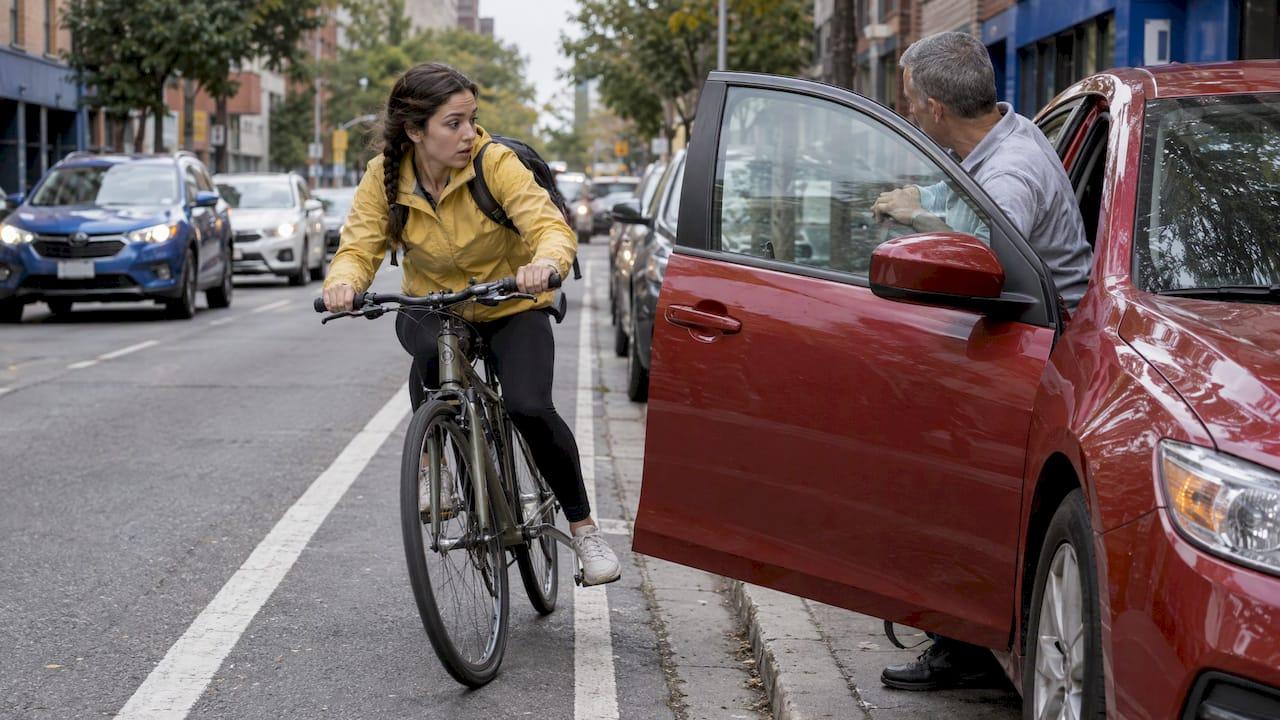
In most dooring crashes, the person who opened the vehicle door is the one the law expects to answer for it, whether that was the driver or a passenger. Many states put the duty on whoever opens a door to check that it is safe first. That duty, plus the evidence you collect in the first hours, usually decides who pays your medical bills, lost income and pain. If you were hurt, a free evaluation can show you whether you have a claim and connect you with an attorney who handles bicycle injuries.
TL;DR
- "Dooring" means a vehicle door is opened into the path of a cyclist or other road user. The injury can come from hitting the door or from the fall that follows.
- Many states have a statute that makes the door-opener responsible for checking first. Connecticut's is one example, and it treats a violation as an infraction.
- Fault is rarely all or nothing. Insurers often argue the cyclist was riding too fast, too close or without lights, so how you document the crash matters.
- Photos, witness names, the police report and prompt medical care are the core of a dooring claim.
- Filing deadlines differ by state. Check yours early and get a free case evaluation before you talk at length with an insurer.
Table of Contents
- What dooring is, and why the injury is often worse than the impact
- Who can be held liable
- What the law says: Connecticut as a worked example
- How a cyclist's own actions can change the outcome
- Evidence that proves who opened the door
- What to do after a dooring crash
- What compensation can cover
- Why a bicycle-focused attorney helps in a dooring case
- Get your dooring case evaluated
- Our view on dooring claims
- FAQ
- Sources
What dooring is, and why the injury is often worse than the impact
The League of American Bicyclists defines dooring as opening a motor vehicle door into the path of another road user. Cyclists are the usual victims, though motorcyclists and scooter riders get doored too.
The collision itself is only part of the story. A 2023 peer-reviewed study of U.S. emergency-room data describes a dooring event as a moving rider striking an open vehicle door, and notes that injuries can also happen when the rider falls or hits the surrounding environment. That matters for your claim. A rider who swerves left to miss a door and is hit by a passing car, or who is thrown to the pavement, was still hurt because of the door. The door-opener's responsibility does not end at the door itself.
The same study used national injury surveillance data for 2012 to 2021 and estimated that 17,156 people went to U.S. emergency departments with dooring injuries over that period. Superficial injuries such as cuts and bruises made up about 48% of the estimate and fractures about 13%. Those numbers describe the study's emergency-room sample, not every dooring incident, but they show that these crashes send real people to the hospital every year.

Who can be held liable
The driver who opens the door
The driver is the most common defendant. A driver who swings a door open without checking mirrors and the road behind has failed to use reasonable care, and in states with a door statute, that failure is also a rule violation. Most dooring claims start with the driver's auto liability policy.
A passenger
Passengers open doors too, often into a bike lane when they step out at a curb. A passenger can be personally responsible for the harm, and the driver can face questions about whether they let someone exit into traffic. Both are reasons to write down who was in the vehicle.
An employer or a company behind the vehicle
If the person who opened the door was working at the time, for example making a delivery, driving a taxi or running a work errand, the employer or the company behind the trip may share responsibility. A claim like this can involve more than one insurance policy, which is one reason an early look at the facts helps.
Property owners and others, in rare cases
A parked vehicle owner who was not present, or a business whose loading zone created the hazard, is not the typical defendant. Most dooring cases are about the person at the door.
What the law says: Connecticut as a worked example
Liability rules vary by state, so it helps to see one statute in full. Connecticut General Statutes § 14-300j covers it. The statute defines moving traffic to include bicycles, e-bikes and e-scooters on a highway, along with cyclists and pedestrians on sidewalks, shoulders or bikeways. It applies when that traffic is traveling at a reasonable rate and with due regard for safety. It also bars leaving a vehicle door open longer than necessary if that causes contact. Under the General Assembly's 2026 supplement, door contact under those conditions is an infraction.
The Connecticut Department of Transportation's highway safety office says the same thing in plain terms: the rule prohibits opening a door, or leaving it open too long, where it contacts a pedestrian or bicyclist on a sidewalk, shoulder or bikeway, and it describes violations as infractions.
Two lessons carry over to other states:
- The duty sits with the person opening the door. You do not have to prove the driver was reckless, only that the door was opened when it was not safe.
- The statute has conditions. In Connecticut, the traffic must be moving reasonably and with due regard for safety. That is exactly the wording an insurer will use to argue you were partly to blame.
A traffic ticket is separate from your injury claim. Even if no one is cited, you can still pursue compensation for your injuries, and a citation does not by itself decide how much you receive. Check your own state's vehicle code, or ask the attorney you are matched with, which door rule applies where you were hurt.
How a cyclist's own actions can change the outcome
Insurers rarely accept fault on the first call. Expect questions that try to shift some of the blame to you. The usual arguments are these:
- Speed. Was the rider going faster than conditions allowed? Connecticut's wording about reasonable speed and due regard for safety shows how this argument is built.
- Lane position. Riding in a marked bike lane next to parked cars is generally what the lane is for. Riding well into the traffic lane to avoid parked cars is a different question, and the answer depends on state law.
- Visibility. Missing lights at night, dark clothing or a distracted rider are common talking points.
- Reaction. Did the rider have time to brake or swerve? A door opened a split second ahead of a rider leaves almost no time, which supports the cyclist.
Most states use some form of comparative fault, where your share of the blame reduces what you collect, and a small number apply stricter rules. A few states bar recovery if you are found even slightly at fault. Because the rule is set by state, learn which one applies to you before you accept any statement of blame. Our guide to bicycle accident liability walks through how fault is divided in bicycle cases.
Evidence that proves who opened the door
Dooring cases often come down to one person's word against another's, because the door closes again within seconds and the driver may drive off. The evidence you gather early fills that gap.
At the scene, if you are able
- Photos and video of the vehicle, the open or closed door, your bike, your injuries and the lane markings, from several angles.
- The vehicle's details: plate number, make, color and the driver's name and insurance information.
- Witness names and phone numbers. A bystander who saw the door open is among the strongest pieces of evidence you can have.
- Your position: note where you were relative to the parked cars and the lane lines, and the direction of travel.
- Surveillance and dash cameras. Shops, buses and other drivers may have footage. Ask nearby businesses quickly, since recordings are often overwritten within days.
After you leave
- The police report. Call the police from the scene so there is an official record. Ask for the report number and read the report for errors about where the door and your bike were.
- Medical records. See a doctor right away, even if you feel fine. Adrenaline hides injuries, and a gap between the crash and your first treatment gives an insurer room to argue the injury came from something else.
- Your bike and gear. Keep your damaged bike, helmet and clothing as they are. Do not repair or throw them away before they are photographed.
- A written account. Write down what happened while you remember it, including the time, weather and what the driver said.
A bike that is scraped on the side facing the door, and a helmet with a fresh mark, can corroborate your account. The same is true of dooring that sends you into traffic. If a second vehicle hit you, that driver may share responsibility too. For another example of an evidence checklist built around a common bicycle crash, see our right hook evidence checklist. If the driver left the scene, read about the first 72 hours after a bicycle hit and run.
What to do after a dooring crash
Move step by step. Your health comes first, and your claim second.
- Get to safety and call 911 if you are hurt, and have someone call if you cannot. Do not ride away.
- Get medical care the same day. Tell the provider that a car door struck you, and mention every sore spot, including your head, wrists, shoulders and hips.
- Report the crash to the police and get the report number.
- Collect evidence as listed above before the driver leaves, if you safely can.
- Be careful with insurers. You can give the other driver's insurer basic facts, but do not guess about speed, do not say you are fine and do not accept a quick payment before you know the full extent of your injuries. A first offer is often low.
- Track your losses. Keep bills, receipts, pay stubs, mileage to appointments and a short daily note on pain and what you cannot do.
- Mind the filing deadline. Each state sets a time limit for injury lawsuits, and claims against a government body often have shorter notice periods. See our guide to bicycle accident statutes of limitation by state.
- Get a case evaluation before you give a recorded statement.
If the crash killed a loved one, the family may have a wrongful death claim, with its own deadline and its own rules about who can file. Share the facts as soon as you can, even while you are grieving, so the evidence is preserved.
What compensation can cover
A dooring claim can include several kinds of loss:
- Emergency care, surgery, hospital stays, physical therapy and future treatment
- Lost wages and reduced earning ability if you cannot return to work as before
- Bike, helmet and gear repair or replacement
- Pain and suffering, and the emotional toll of the crash, including anxiety about riding again
- In a fatal crash, funeral costs and the family's losses
The amount depends on the severity of the injury, your treatment, how fault is divided and the available insurance. No honest source can promise a figure before the facts are known. If you want to see how value is worked out, read our piece on bicycle accident settlement value and how bicycle cases are settled.
Why a bicycle-focused attorney helps in a dooring case
A dooring case looks simple: the door opened, you got hurt. In practice, the insurer's defense is built on details such as lane position, speed and whether the door was open long enough to be seen. A lawyer who handles cyclist injuries knows how those arguments are made and which evidence answers them. We explain what to look for in the benefits of a specialized bicycle injury attorney and why bicycle claims need specialists.
What makes that practical is a quick match. Many injured riders do not have a lawyer on hand, and they are in pain, off work and fielding calls from adjusters. That is the gap a free evaluation fills.
Get your dooring case evaluated
Our free evaluation is a no-obligation way to learn whether you may be entitled to compensation. You describe your injury and what happened, and the assessment is tailored to the type of injury and the circumstances, whether that is a physical injury, emotional trauma or the loss of a family member. We then connect you with vetted local attorneys, so the person who reviews your dooring case is nearby and focused on injury claims.
Start your free evaluation once you have the basics: the date and place of the crash, your injuries and any report number. If you want to know what to expect from the first conversation, our free consultation guide covers it.
Our view on dooring claims
Dooring is the crash where riders blame themselves most. They were in the bike lane, doing nothing wrong, and a door appeared. Then an adjuster asks how fast they were going and whether they were watching the cars, and the rider starts to wonder.
We built our free evaluation for that moment. We believe an injured cyclist should find out where they stand without paying anything or committing to anything, and that the assessment should fit the injury and the circumstances rather than force every crash into the same form.
The matching matters as much as the evaluation. Our service connects you with vetted local attorneys, because a dooring claim depends on local rules and local facts. Our advice is simple: document the scene, get checked by a doctor, and get your case reviewed before you settle the question of fault with an insurer.
Gerard
FAQ
Is the driver always at fault in a dooring accident?
Not always, but the person who opened the door is usually the main target of the claim, because many states require that person to make sure opening the door is safe. Insurers may still argue you rode too fast, too close or without lights, which can reduce what you recover in many states. Evidence of your lane position and speed helps answer that.
Can I be ticketed after a dooring crash?
The door-opener can be. In Connecticut, for example, door contact under the statute's conditions is an infraction. A ticket is separate from your injury claim, and the claim does not depend on one being issued.
What if the driver left the scene?
Report it to the police at once, and give them every detail you remember: the plate, vehicle description and direction of travel. Ask nearby businesses about camera footage right away. Your own insurance may also have coverage that applies, so a case evaluation is worthwhile.
How long do I have to file a dooring claim?
The deadline is set by your state and is often a few years for injury lawsuits, but it can be much shorter when a government vehicle or agency is involved. Do not wait until the end of the period, because evidence disappears. Our state-by-state deadline guide is a place to start.
Does a family have a claim if a dooring crash was fatal?
In most states, certain family members can bring a wrongful death claim when a death was caused by someone else's negligence. Who may file, and by when, depends on the state, so a family should seek a case evaluation soon after the loss.
Sources
- Dooring and the Dutch Reach, League of American Bicyclists
- Descriptive Analysis of Cyclist Dooring Events Using Data, IRCOBI 2023
- Chapter 249, Traffic Control and Highway Safety, Connecticut General Assembly (2026 supplement)
- Pedestrian Safety, Connecticut Highway Safety Office