
How bicycle accident cases are settled: the short version
Most bicycle accident cases settle without ever reaching a courtroom. The process starts when your attorney sends a demand letter to the at-fault driver's insurer, triggering a back-and-forth negotiation that ends with a signed release of liability and payment. What you actually receive depends on a handful of factors that interact in ways most injured cyclists don't anticipate.
Here's what shapes every bicycle accident settlement:
- Injury severity is the single biggest driver. California settlements range from roughly $25,000 for soft-tissue injuries to $5 million or more for catastrophic cases, with a median between $75,000 and $250,000.
- Comparative negligence can reduce your payout proportionally if you share any fault for the crash.
- Insurance coverage sets a practical ceiling. If the at-fault driver carries minimal liability limits, recovering your full damages gets complicated fast.
- Documentation quality directly affects how insurers value non-economic damages like pain and suffering.
- Helmet use matters more than most cyclists realize. Riding without one won't eliminate your claim, but it can reduce the head-injury portion of your damages.
- Signing a release permanently waives your right to pursue further claims related to the accident. Read it carefully before you sign anything.
- Timelines vary widely. Straightforward cases with clear liability can settle in six months; disputed or catastrophic injury cases routinely take over a year.
The sections below break down each of these elements in detail so you know exactly what you're working with before you negotiate a single dollar.
What actually determines your settlement amount
Settlement value isn't a formula. It's a negotiation, and the outcome depends on how well you can document and argue each of the following factors.
Injury severity and economic damages
The more serious and lasting your injuries, the higher your economic damages: medical bills, future treatment costs, lost wages, and reduced earning capacity. These are the foundation of every settlement because they're verifiable with records and receipts. Soft-tissue injuries with a full recovery produce modest settlements. Surgical cases, permanent impairment, and traumatic brain injuries produce the highest values because the lifetime cost of care is enormous.
Comparative negligence and fault allocation
Your settlement shrinks in proportion to your share of fault. If you were riding against traffic at night without lights and a driver hit you, expect the insurer to argue you bear significant responsibility. Strong police reports and witness statements are your best tools for minimizing that reduction.
Insurance policy limits
The at-fault driver's liability policy sets a practical ceiling on what you can recover from that source. If their coverage is thin, your own uninsured/underinsured motorist (UM/UIM) coverage on your auto policy may step in. Stacking multiple coverage sources, including umbrella policies and, in commercial-vehicle cases, employer liability coverage, can substantially increase total recovery.
Medical documentation quality
Insurers use a pain and suffering multiplier of 1.5 to 5 times your economic damages to calculate non-economic losses. Where your multiplier lands depends almost entirely on how well your medical records link ongoing symptoms to the accident. A treating physician's narrative report that traces your chronic neck pain directly to the crash is worth far more than a stack of billing statements alone.
Helmet use and the "empty helmet" defense
Adult cyclists face no legal helmet requirement in most states, but insurers routinely use the absence of a helmet to argue comparative fault on the severity of head injuries. This empty helmet defense doesn't touch your other injuries, but it can meaningfully reduce the head-injury component of your damages. Documenting that you wore a helmet at the time of the crash strengthens your position considerably.
Driver conduct and punitive damages
If the driver was impaired, distracted by a phone, or fled the scene, punitive damages may apply on top of compensatory damages. These cases can push settlements well beyond standard policy limits because the exposure to a jury verdict becomes genuinely unpredictable for the insurer.
Bicycle equipment defects
A defective brake, frame failure, or faulty tire creates a separate products-liability claim against the manufacturer or retailer. California and most other states apply strict products liability, meaning you don't need to prove negligence, only that the product was defective and caused your harm. These claims often produce higher recoveries than vehicle-liability claims alone.
Pro Tip: Document your bicycle's condition immediately after the crash. Photograph every component, and don't let anyone repair or dispose of the bike before your attorney can inspect it for potential product defects.
Typical settlement amounts by injury type
Settlement ranges vary by injury category, but the figures below reflect real-world outcomes across US cases. Your specific result will depend on documentation quality, available insurance coverage, and comparative-fault evidence.
| Injury type | Typical settlement range | Key value drivers |
|---|---|---|
| Soft tissue (sprains, contusions, abrasions) | roughly $25,000 | ER visit and brief physical therapy with full recovery |
| Moderate (non-surgical fractures, road rash with scarring) | $75,000 to $250,000 | Imaging, sustained physical therapy, lost wages, scarring evidence |
| Severe (surgical fractures, concussion, internal injury) | — | Surgery records, neuropsychological testing, extended recovery |
| Traumatic brain injury (documented) | $5 million or more | Cognitive, physical, and emotional impairment documentation |
| Spinal cord injury | — | Permanent impairment, life care planning |
| Wrongful death | — | Survivors' economic and non-economic loss |
Real-world examples from Illinois illustrate how wide the range gets: a $9 million award for a man injured after a utility company damaged a bike path, a $5.25 million wrongful death settlement for a bike-share rider, and a $2.25 million uninsured motorist settlement for a cycling head injury. These figures come from cases where liability was clear and documentation was thorough.
Key drivers that push any injury category toward the higher end of its range:
- Same-day emergency room evaluation creating an immediate injury record
- Treating-physician narrative reports linking ongoing symptoms directly to the crash
- Documented lost wages and reduced earning capacity
- Photographic evidence of injuries, property damage, and the accident scene
- Absence of comparative fault, or strong evidence minimizing the cyclist's share
How the settlement process works from start to finish
Settling a bicycle accident claim follows a predictable sequence, though the pace varies significantly by case complexity.
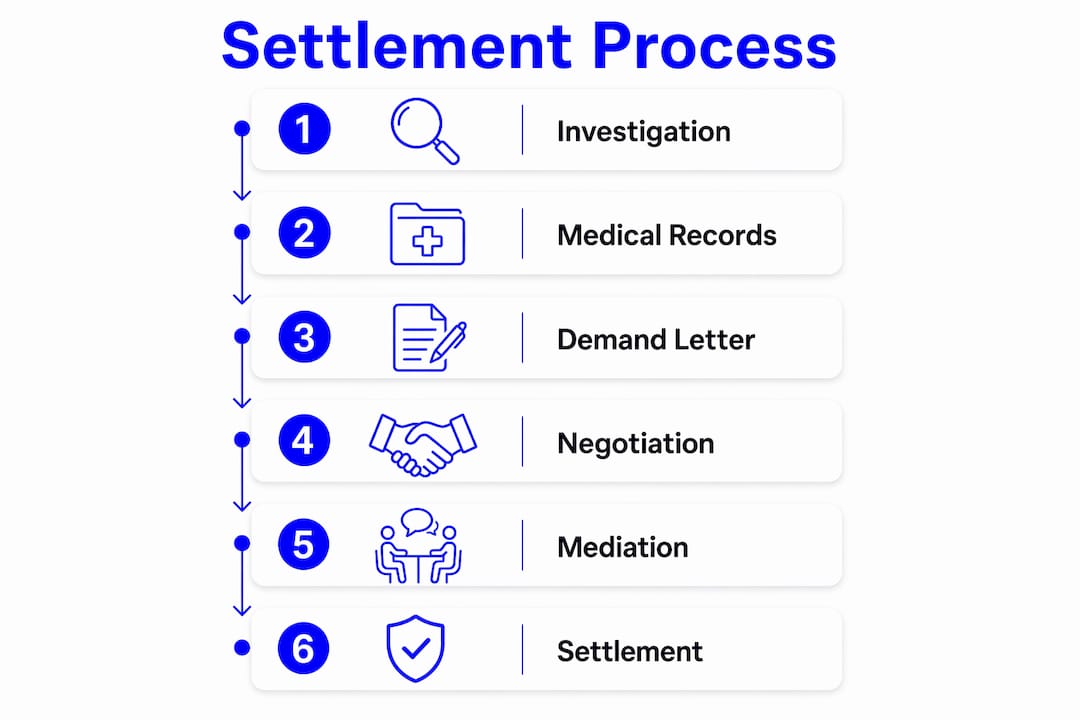
1. Investigation and evidence gathering
The process begins immediately after the crash. Police reports, witness statements, traffic camera footage, and photographs of the scene form the evidentiary foundation. Gaps in this evidence give insurers room to dispute liability, so collecting it quickly matters. Your attorney can issue preservation letters to businesses with surveillance cameras before footage is overwritten.
2. Medical treatment and records compilation
You need to complete, or at least substantially advance, your medical treatment before sending a demand letter. Settling too early locks in a number before you know the full cost of your recovery. Your attorney compiles all medical records, billing statements, and physician narratives into a package that documents both economic and non-economic damages.
3. Demand letter

Your attorney sends a demand letter to the at-fault party's insurer outlining liability, your injuries, and the compensation you're seeking. This letter initiates formal negotiation and sets the anchor for the entire process.
4. Counteroffers and negotiation

The insurer responds with a counteroffer, typically lower than your demand. Multiple rounds of back-and-forth follow. Insurance companies often want to settle quickly to limit their costs, but their early offers frequently undervalue claims, particularly for injuries with long recovery arcs. Your attorney's job is to hold the line and counter with documented justification.
5. Mediation or arbitration
When negotiations stall, mediation brings in a neutral third party to facilitate agreement. Both sides present their positions, and the mediator works toward a number both can accept. Arbitration is more formal: an arbitrator hears evidence and issues a binding or non-binding decision depending on the agreement. Either option avoids the cost and uncertainty of a trial.
6. Settlement agreement and release
Once both parties agree on a number, you sign a release of liability. That signature permanently ends your right to pursue further legal claims related to the accident. Review every term carefully with your attorney before signing, because the release is final.
7. Timeline
Straightforward cases with clear liability and moderate injuries can resolve in six months. Disputed liability, catastrophic injuries requiring ongoing treatment, or government-entity involvement can push the timeline past a year. The statute of limitations in most states gives you two years from the date of injury to file a lawsuit, so you have time to negotiate properly rather than accepting an early lowball offer.
How comparative negligence affects what you actually recover
Comparative negligence is the legal rule that reduces your settlement by the percentage of fault assigned to you. If you're found 30% at fault for a crash, you recover 70% of your total damages.
States apply this rule in two main ways. Pure comparative negligence states, including California, let you recover even if you were 99% at fault, with damages reduced proportionally. Modified comparative negligence states, like Illinois under §735 ILCS 5/2-1116, bar recovery entirely if your fault exceeds 50%. Knowing which system your state uses changes how aggressively you should negotiate.
Comparative negligence doesn't just affect whether you recover. It determines how much you recover. In a $300,000 case where the cyclist is found 25% at fault, the net recovery drops to $225,000. That $75,000 difference is why fault allocation is worth fighting over, and why police reports and witness statements are the most valuable documents in your file.
Common scenarios that raise a cyclist's fault percentage include riding against traffic, riding without lights at night, failing to signal turns, and riding in pedestrian crosswalks where prohibited. Strong evidence from police reports and independent witnesses directly counters these arguments. The bicycle accident liability guide from Carcollisionlawyer covers how each of these factors gets weighed in practice.
Helmet use adds a specific wrinkle. If you sustained a head injury and weren't wearing a helmet, the insurer may argue that your non-helmet use contributed to the severity of that injury, even if it had nothing to do with causing the crash itself. This is a targeted reduction, not a blanket one. Your fractures, road rash, and other injuries remain unaffected.
Why legal representation changes your settlement outcome
Attorneys who specialize in bicycle accident cases consistently produce higher settlements than injured cyclists negotiating on their own. The gap isn't marginal.
Here's why representation matters at each stage:
- Evidence preservation. An attorney can issue spoliation letters immediately, compelling businesses to preserve surveillance footage and preventing evidence from disappearing before you've even finished treatment.
- Negotiation leverage. Insurers know that represented claimants are more likely to litigate if negotiations fail. That threat alone raises settlement offers. As one California firm notes, the trial threat is what produces strong settlements: when defendants know plaintiff counsel will actually try the case, settlement values rise.
- Identifying all compensation sources. An attorney checks for stacked coverage across the at-fault driver's policy, your own UM/UIM coverage, umbrella policies, and employer liability towers in commercial-vehicle cases. Unrepresented cyclists often leave significant money on the table by settling against a single policy.
- Countering comparative negligence arguments. Insurers are skilled at inflating a cyclist's fault percentage. An attorney who understands comparative fault arguments can push back with evidence and legal precedent.
- Managing liens and subrogation. If your health insurer paid your medical bills, they may have a right to reimbursement from your settlement. An attorney negotiates those liens down, increasing your net recovery.
- Municipal liability cases. When a dangerous bike lane, defective road surface, or government-owned vehicle caused your crash, the legal process is more complex. Government Claims Act deadlines can be as short as six months, and missing them forfeits your right to sue entirely.
Pro Tip: Look for an attorney who specifically handles bicycle accident cases, not just general personal injury. A lawyer who understands cycling infrastructure, traffic laws applicable to cyclists, and the empty helmet defense will negotiate from a stronger position than a generalist.
The benefits of specialized bicycle injury attorneys go beyond negotiation skill. They know which expert witnesses, such as accident reconstruction specialists and forensic human factors analysts, carry the most weight with insurers and juries. In a $1.84 million settlement case, accident reconstruction experts were central to establishing liability. That kind of expertise doesn't come from a general practice.
Key Takeaways
Bicycle accident settlements in the US are driven primarily by injury severity, fault allocation, and documentation quality, with legal representation consistently improving outcomes for injured cyclists.
| Point | Details |
|---|---|
| Settlement ranges vary widely | California cases range from $25,000 for soft tissue to $5M+ for catastrophic injuries. |
| Comparative negligence reduces recovery | Your payout drops by your fault percentage; modified states bar recovery above 50% fault. |
| Documentation drives multiplier value | Insurers apply a 1.5–5x multiplier to economic damages for pain and suffering based on evidence quality. |
| Timelines run six months to over a year | Clear liability cases settle faster; disputed or catastrophic cases take significantly longer. |
| Legal representation increases net recovery | Attorneys identify stacked coverage, counter fault arguments, and negotiate medical liens down. |