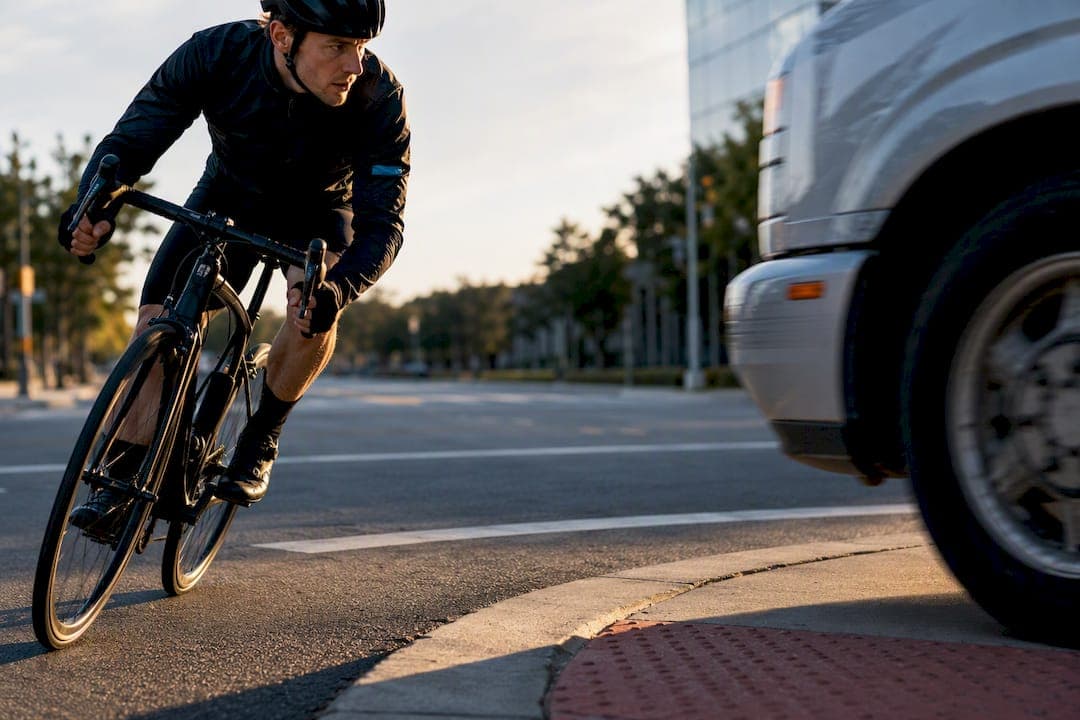
A right hook happens when a driver turning right crosses the path of a cyclist traveling straight through an intersection, usually because the driver failed to check for or yield to the rider. Under U.S. traffic law, the turning driver typically bears fault, though comparative negligence rules can shift some responsibility depending on the state and the cyclist's positioning. If you have been hit, get medical care, document the scene, and consider a free legal evaluation before talking to an insurer.
TL;DR:
- Most right-hook crashes occur at intersections with bike lanes on the right of travel lanes and no dedicated right-turn pockets, increasing hit risk.
- Driver blind spots, poor sightlines, and cyclist positioning close to vehicles significantly raise the likelihood of a collision happening.
- Vehicles like trucks and vans are involved in more severe impacts, and their larger size makes injuries more serious when a cyclist is hit.
- Fault predominantly falls on the turning driver who fails to yield, but shared liability can complicate claims depending on cyclist behavior and local laws.
- Immediate actions such as medical evaluation, scene documentation, and capturing footage are crucial to support future legal claims.
Table of Contents
- What a right-hook collision looks like on the road
- Primary causes and human factors
- Where right-hook crashes concentrate and what U.S. data show
- Liability and legal options in the U.S.
- Evidence checklist and immediate post-crash actions
- Infrastructure and design treatments that reduce right-hook risk
- Why specialized legal guidance changes outcomes for cyclists
- Get a free case evaluation for your right-hook claim
- Sources
- FAQ
What a right-hook collision looks like on the road
A right-hook crash is a collision between a cyclist moving straight through an intersection and a motor vehicle turning right across the cyclist's lane. The geometry matters because it separates this crash type from a left hook, where a driver turning left into oncoming traffic strikes a cyclist heading the opposite direction, or a simple rear-end collision. Right hooks concentrate at specific points in the road network rather than occurring randomly.
Common scenarios include:
- Curbside bike lanes at intersections where a bike lane runs to the right of a travel lane with no dedicated right-turn pocket.
- Right-on-red maneuvers, where a driver stopped at a red light turns without a full check for approaching cyclists.
- Driveway and parking lot pullouts, where a vehicle crosses a bike lane to exit onto the street.
- Lane-squeeze situations, where a driver merges right just before an intersection, cutting off a cyclist already in the lane.
Federal crash data reflect a classification change starting in 2022 that folds some motorized bicycles into the pedalcyclist category, which affects year-over-year comparisons of crash statistics.
Primary causes and human factors
Most right-hook crashes trace back to a driver who never fully registered the cyclist's presence or badly misjudged the rider's speed. Research from Oregon's Department of Transportation found that the worst-case scenario occurs when a cyclist approaches at a higher speed, while riding in a driver's blind zone; failures to search for cyclists or to correctly project their path were identified as primary causes in the simulator study.
Several factors compound the problem:
- Blind spots, especially in trucks and delivery vans, where mirrors cannot cover the full space beside the cab.
- Cyclist positioning, such as riding immediately alongside curbside vehicles instead of holding back or moving slightly left.
- Parked cars and poor sightlines that block a driver's view of an approaching rider until the last moment.
- Glare and signal complexity at busy intersections, which add to the number of things a driver must process at once.
NHTSA's bicycle safety guidance stresses that drivers have a duty to check behind and beside them before turning right, including at red lights, and to give cyclists real space when passing, a behavior it identifies as central to preventing these crashes according to its bicycle safety guidance.
Pro Tip: Avoid riding directly beside a vehicle that could turn right ahead of you; dropping back a few feet or shifting slightly left gives you time to react and puts you in the driver's field of view.
Where right-hook crashes concentrate and what U.S. data show
Right-hook crashes are not evenly distributed. They cluster at intersections with specific design flaws, and federal data show they carry serious injury risk when they involve larger vehicles.
Right-hook crashes accounted for a notable share of all bicycle crashes in a dataset of Oregon collisions reviewed between 2007 and 2011, according to ODOT's crash analysis, which identified 504 right-hook crashes in that period. The same review found these crashes were most common at intersections where a bike lane sits to the right of a motor vehicle lane with no separate right-turn lane, forcing cyclists and turning drivers into the same space with little warning.
At the national level, NHTSA crash data show that:
- Pedalcyclist fatalities remain a persistent share of total traffic deaths, tracked annually in NHTSA's crash statistics.
- Heavier vehicles show a higher share of right-side impacts and are associated with more severe outcomes in pedalcyclist crashes.
- The 2022 classification change for motorized bicycles affects how some crashes are counted in year-over-year comparisons.
The takeaway for cyclists is straightforward: the intersections most likely to produce a right hook are the ones where a bike lane runs alongside a lane also used by turning traffic, particularly where trucks and vans are common.
Liability and legal options in the U.S.
Fault in a right-hook crash usually comes down to right-of-way rules and whether the driver met a basic duty to look before turning. Insurers and courts weigh evidence like witness statements, video footage, and the physical positions of the vehicle and bicycle after impact. In most states, a driver who turns across a cyclist's path without yielding is presumed at fault, but that presumption can be challenged if the cyclist was passing on the right in an unsafe way or violated a local traffic law.

Comparative negligence rules complicate this. This is one reason a specialized bicycle injury attorney can matter: fault allocation in these cases often hinges on details a general practice attorney might not think to pursue, like signal timing or lane markings.
Damages in a right-hook claim can include:
- Medical expenses, both immediate treatment and projected future care.
- Lost earnings from missed work during recovery.
- Pain and suffering, covering the physical and emotional toll of the crash.
- Property damage, including the bicycle itself and any gear destroyed in the collision.
| Fault factor | What it affects |
|---|---|
| Right-of-way at the intersection | Whether the driver had a duty to yield before turning |
| State comparative negligence rule | How much a cyclist's own fault percentage reduces recovery |
| Available evidence (video, witnesses, police report) | Strength of the claim and speed of settlement |
| Vehicle type involved | Severity of injury and scope of damages claimed |
A free case evaluation typically reviews the crash report, medical documentation, and any available footage to flag liability indicators and filing deadlines before a claim moves forward. More detail on how these claims resolve is available in a guide to bicycle accident settlements.
Evidence checklist and immediate post-crash actions
What you do in the minutes and days after a right-hook crash can determine whether a claim holds up later. Medical care comes first, but preserving evidence runs a close second.
- Get to safety and call 911 if you or anyone else is injured, even if the injury seems minor at first.
- Seek medical evaluation promptly, since some injuries, especially head and soft-tissue trauma, do not show symptoms immediately.
- Photograph the scene, including vehicle position, road markings, skid marks, debris, and damage to the bicycle.
- Document your injuries with photos taken over the following days and weeks as bruising and swelling develop.
- Collect driver information, including license plate, insurance details, and contact information for any witnesses.
- Get the police report number and request a copy once it is filed.
- Preserve digital evidence, such as helmet-cam or dashcam footage, and request nearby traffic-camera footage before it is overwritten.
- Keep timestamped notes describing what happened while the details are still fresh.
Pro Tip: Traffic-camera footage is often deleted or overwritten within days, so request it in writing as soon as possible after the crash.
Prompt medical treatment does more than protect your health. It creates a documented link between the crash and your injuries, which insurers scrutinize closely. Readers dealing with a driver who fled the scene should move even faster: a 72-hour action guide for hit-and-run claims outlines the specific steps that preserve a claim when the at-fault driver cannot be immediately identified.
Infrastructure and design treatments that reduce right-hook risk
Road design plays as large a role in right-hook crashes as driver behavior, and federal guidance points to several fixes. The FHWA's separated bike lane design guide recommends treatments including protected corners, lateral shifts, mixing zones, and dedicated bicycle signal phases, each suited to different intersection volumes and vehicle mixes.
- Protected corners use physical islands to slow turning vehicles and improve sightlines between drivers and cyclists.
- Lateral shifts move the bike lane slightly left before an intersection, pulling cyclists out of a driver's blind zone.
- Mixing zones blend bicycle and turning-vehicle traffic in a marked shared space, which works best at lower turn volumes.
- Separate signal phases give cyclists a dedicated green interval so they clear the intersection before turning traffic moves.
None of these treatments eliminates risk on its own. A separated bike lane without a protected corner or signal phase can still leave a blind zone at the intersection itself, which is why National Academies research emphasizes matching the treatment to actual turn volumes and vehicle types rather than defaulting to one design everywhere.
Why specialized legal guidance changes outcomes for cyclists
Bicyclist claims get undervalued more often than they should, mainly because insurers still treat cyclists as an afterthought in a system built around cars. A right-hook case often turns on details, like signal timing or lane markings, that a general injury intake will not think to ask about. That is exactly what a focused case review is built to catch: whether the intersection design, the driver's actions, and the available evidence line up to support a strong claim, and what deadlines apply in your state.
— Gerard
Get a free case evaluation for your right-hook claim
You already know what happened at that intersection. What you may not know is whether the evidence you gathered is enough to hold up, or whether your state's comparative negligence rule will reduce what you can recover. A free case evaluation reviews your crash details, medical records, and any photos or footage you collected, then matches you with an attorney suited to your specific injury and circumstances at no upfront cost.
Before you request an evaluation, gather your police report number, medical treatment records, and any photos or video from the scene. The review checks liability indicators, the severity of your injuries, and filing deadlines that apply in your state, so nothing important gets missed while you focus on recovery. Start your free evaluation today and find out where your claim stands.
This article is general information, not a substitute for advice from a qualified lawyer. Consult a qualified legal professional about your own circumstances before acting on anything here.
Sources
- TOWARDS EFFECTIVE DESIGN TREATMENT FOR RIGHT TURNS AT INTERSECTIONS WITH BICYCLE TRAFFIC Final Report
- Separated Bike Lane Planning and Design Guide - FHWA
- 2024 Data - Bicyclists and Other Cyclists
- NHTSA bicycle safety guidance
FAQ
Which state has the most bicycle accidents?
Bicycle crash totals vary by state and year, and figures depend on population, ridership levels, and how each state reports data to federal databases. Rather than citing a single ranking, cyclists in any state benefit most from understanding local intersection risks and their own state's fault rules.
Was there a bike rider killed today?
Daily fatality counts are not tracked in a single public source, and figures change constantly as new crash reports are filed. NHTSA publishes annual pedalcyclist fatality data through its crash statistics reports, which offer the most reliable yearly context.
Who is at fault if you hit a cyclist?
In most right-hook cases, the turning driver is at fault because U.S. traffic law generally requires drivers to yield to cyclists traveling straight through an intersection. Fault can shift under comparative negligence rules if the cyclist's own actions, like passing unsafely on the right, contributed to the crash.
How often is a bicyclist killed in the United States?
NHTSA tracks pedalcyclist fatalities annually as part of its national crash data, though the exact count changes each year and reporting methods shifted in 2022 to reclassify some motorized bicycles. Current figures are published directly in NHTSA's crash statistics.
What should I do immediately after a right-hook crash?
Get medical attention first, even if injuries seem minor, then document the scene with photos of vehicle positions, road markings, and damage. Collect the driver's information, witness contacts, and the police report number, and consider a free case evaluation to understand your legal options early.