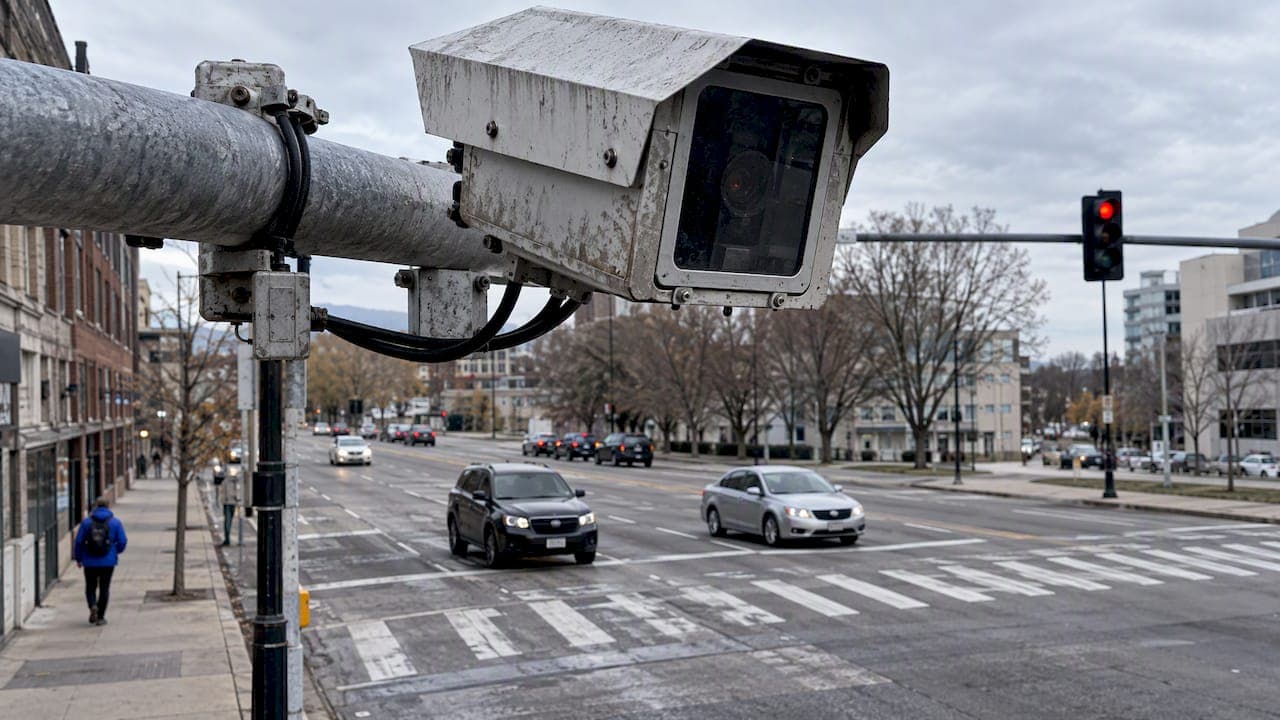
Traffic camera footage is often obtainable, but most agencies only keep it for a matter of days, so the first move matters more than the paperwork. Contact the agency that operates the camera immediately and ask them to preserve the recording before it is overwritten. Once preservation is confirmed, you can follow up with a formal public-records request to the right custodian: local police, a city or county records office, or a state department of transportation.
TL;DR:
- Retention varies by operator: Ohio DOT often keeps feeds for 72 hours, while Iowa and New Jersey typically retain them for about seven days.
- Identify the camera’s owner through the police report, DOT camera map, municipal traffic page, or nonemergency police line; nearby cameras may belong to different agencies.
- Specify a 15 to 30 minute window, exact location or camera ID, incident number, a written preservation request, and MP4 delivery to reduce delays.
- A records request does not stop deletion; when an investigation exemption blocks access or injuries leave fault contested, an attorney can seek footage through discovery.
Table of Contents
- Who Operates the Camera and How to Find the Right Custodian Fast
- Time Limits and Preservation: Why You Need to Act Within Days
- How to File a Public-Records Request for Traffic Camera Footage
- What to Expect: Fees, Formats, and Processing Times
- When Agencies Deny Requests: Exemptions and the Discovery Alternative
- Templates and a Checklist to Send a Correct Request the First Time
- When Footage Alone Isn't Enough
- Get Matched With a Local Attorney to Preserve or Obtain Footage
- FAQ
- Sources
Who Operates the Camera and How to Find the Right Custodian Fast
Not every camera near an intersection belongs to the same agency, and sending your request to the wrong office wastes the hours you don't have. Traffic cameras are typically run by one of four types of custodians, each with its own rules, forms, and contact point.
City traffic divisions usually control signal cameras and red-light enforcement units within city limits. County public works departments sometimes manage cameras on county roads. State departments of transportation operate highway and freeway cameras through Traffic Management Centers, often the same cameras you see feeding a state's public traffic map. Transit agencies run cameras on buses, light rail platforms, and transit-adjacent intersections. Private businesses or HOAs occasionally have cameras pointed at nearby roadways, though these fall outside public-records rules entirely.
A few fast ways to identify the right owner:
- Check your police report: officers often note which camera or system captured the scene, or which agency they contacted for footage.
- Search the state DOT's public camera map, since most states publish a live list of monitored highway cameras tied to specific mile markers or interchanges.
- Look up the city or county traffic operations page, which usually lists signal camera locations and a records contact.
- Search "[city or county] traffic camera request" plus the road name, since most agencies publish a dedicated form once you find the right department.
- Call the non-emergency police line for the jurisdiction where the crash happened and ask which agency owns the camera at that location.
The custodian you identify determines everything downstream: how long the footage is kept, what fees apply, what format you'll receive, and whether any exemption could block release. A state DOT camera and a city intersection camera can have completely different retention windows even if they sit a block apart, so confirming ownership before you request anything saves time you can't get back.
Time Limits and Preservation: Why You Need to Act Within Days
Retention windows for traffic camera footage are short, and there is no federal rule forcing agencies to keep recordings longer. The Federal Highway Administration's guidance on Transportation Management Centers explains that raw traffic camera feeds are often treated as operational data rather than a guaranteed public record, which is part of why states handle retention so differently.
Many traffic camera systems record on a loop of a few days to about a week before older footage is automatically overwritten. The Ohio Department of Transportation keeps a 72-hour buffer on many of its camera feeds, meaning footage older than three days is typically gone. The Iowa Department of Transportation and New Jersey DOT, by contrast, typically retain footage for about seven days. Neither window gives you much room to wait.
Because there's no federal standard, you cannot assume your state follows either example. The only reliable move is to treat every request as urgent until you know otherwise.
Three steps protect you regardless of jurisdiction:
- Contact the camera's custodian the same day as the incident and ask them to place an immediate preservation hold on the footage.
- Reference your police report number or incident number so the agency can tie your request to a specific time and location.
- Ask for written confirmation, by e-mail if possible, that the preservation request was received and logged.
That confirmation matters later. If the agency says the footage was overwritten despite your request, a documented preservation notice becomes evidence in itself, useful if an attorney later needs to show the agency failed to act.
How to File a Public-Records Request for Traffic Camera Footage
Once you've asked for a preservation hold, the formal request is where you lock in your right to the footage. States handle this under their own public-records or FOIA-style statutes, so the labels differ, but the core components are the same everywhere.
1. Pin down the exact window. Agencies need a narrow time range to search, not a general description of "the afternoon." Request footage from a 15 to 30 minute window around the incident, using the precise time from your police report or your phone's timestamped photos.
2. Identify the specific camera. Give the intersection name, mile marker, camera ID number if listed on a DOT map, or direction of travel. Vague location descriptions are a leading cause of delayed or denied requests.
3. Include your police report number. This ties your request to an official incident and often speeds up processing, since staff can cross-reference the report rather than search blind.
4. State that you are requesting preservation in addition to release. Even if you already called, repeat the preservation request in writing so it's part of the record.
5. Specify your preferred format. Ask for a standard MP4 file or a downloadable link rather than a proprietary export your software can't open.
6. Send it to the correct office. For police-operated cameras, this is usually the department's evidence or records unit. For city or county traffic cameras, it's the public-records office listed on the municipal website. For state highway cameras, most DOTs have a dedicated form, such as the Iowa DOT's Camera Video Request Form, which routes requests directly to the Traffic Management Center instead of a general mailbox.
Pro Tip: Send your request by e-mail rather than mail or fax whenever the agency allows it. E-mail creates an automatic timestamp that helps prove when you asked, which matters if footage disappears before the agency responds.
After submitting, most agencies send an acknowledgment within a few business days, though this varies widely by office. If you receive no response or an outright denial, ask in writing for the specific statutory exemption being cited. That answer determines whether you appeal administratively or, if the window is closing, escalate to an attorney who can pursue discovery.

What to Expect: Fees, Formats, and Processing Times
Getting a "yes" on your request is only half the picture. Knowing what you'll actually receive, and when, helps you plan your next move.
- Fees vary by agency and typically cover staff search time or copying costs, often ranging from no charge for a simple digital copy to a modest fee for staff time pulling archived footage; some agencies waive fees for requests tied to an active police investigation.
- Formats are usually digital, delivered as an MP4 file, a secure download link, or occasionally a proprietary player format tied to the agency's camera system, which is why specifying MP4 upfront avoids compatibility headaches.
- Processing times range from same-day to several weeks, depending on staffing and whether the footage has already been preserved or still needs to be pulled from a live feed before it loops over.
- A pending request does not pause the retention clock unless you've separately secured a preservation hold, which is why the written preservation request matters more than the formal records request itself.
The gap between a short retention window and a slower administrative response is the single biggest risk to losing footage. Preservation first, formal request second, is the order that protects you.
When Agencies Deny Requests: Exemptions and the Discovery Alternative
Agencies don't deny footage requests arbitrarily, but several legitimate exemptions come up often enough that you should expect at least one of them if your case involves anything beyond a routine fender-bender.
- Active investigation exemption: footage tied to an open criminal or law-enforcement investigation is frequently withheld until the case closes.
- Privacy exemptions: footage showing identifiable bystanders, minors, or sensitive locations may be redacted or withheld in part.
- Raw data classification: some agencies argue the footage was never formally "selected" as a retained record, placing it outside public-records law entirely, a distinction the FHWA's TMC guidance specifically flags as a source of inconsistent state practice.
When a legitimate exemption blocks your public-records request, litigation discovery is the remaining path. Once a lawsuit is filed, an attorney can issue a subpoena or discovery request that compels an agency to produce footage, including footage tied to an active investigation that would otherwise stay sealed from a public request. Discovery can also force an agency to explain, under oath, whether footage was actually overwritten or simply never searched for. If your request is denied and the stakes involve a serious injury or disputed fault, this is the point where retaining counsel stops being optional.
Templates and a Checklist to Send a Correct Request the First Time
A request that's missing one detail, like the wrong time window or no incident number, often comes back asking for clarification, and clarification takes days you don't have.
Preservation notice (send immediately, by e-mail or phone followed by e-mail):
"I am requesting that your agency immediately preserve all video and camera recordings from [camera location/intersection/mile marker] between [start time] and [end time] on [date], related to an incident referenced in police report number [number, if available]. Please confirm in writing that this footage has been placed on preservation hold."
Formal records request (send once preservation is confirmed):
"Under [state]'s public records law, I am requesting a copy of traffic camera footage from [exact camera location or ID] covering [start time] to [end time] on [date]. This relates to police report number [number]. Please provide the footage in MP4 format, delivered by [e-mail/download link], and let me know of any applicable fees in advance."
- Confirm the exact date, time window, and location before sending anything.
- Identify the camera owner using the police report, a DOT camera map, or a direct call.
- Send a preservation notice the same day as the incident whenever possible.
- Follow with the formal request and keep a copy of every e-mail and confirmation.
Collecting a police report number and precise timestamps before you submit either template, as outlined in car accident evidence best practices, reduces the back-and-forth that burns retention days.
When Footage Alone Isn't Enough
Most footage requests resolve without a lawyer, but a few situations call for one well before you've exhausted the records process. If the crash caused a serious injury, if fault is contested, if the retention window has nearly closed with no response from the agency, or if you've received an outright denial citing an investigation exemption, waiting rarely helps your position.
An attorney can send a formal preservation letter that carries more legal weight than an individual request, file discovery once litigation starts, and subpoena footage an agency has refused to release voluntarily. Pairing a preserved recording with supporting documentation, including photos that support an accident claim, strengthens a case well beyond what footage alone can show.
— Gerard
Get Matched With a Local Attorney to Preserve or Obtain Footage
When a records office stalls or denies your request, a free evaluation connects you with a local attorney who can issue a formal preservation letter and pursue discovery if the footage is tied to litigation.
Submitting a request through our free evaluation carries no obligation. We ask about your injury and the circumstances of your crash, then match you with an attorney in your area who handles cases like yours, including the kind of evidence disputes that come up when an agency sits on a footage request. If a denial has you worried about a closing window, requesting your free case evaluation now gives an attorney the time they need to act before the footage is gone for good.
This article is general information, not a substitute for advice from a qualified lawyer. Consult a qualified legal professional about your own circumstances before acting on anything here.
FAQ
What states use cameras for speeding tickets?
Automated speed enforcement is authorized in 22 states plus Washington, D.C., though specific rules and program availability vary by state and even by city within those states. These systems typically capture still images when a vehicle exceeds a set speed threshold rather than recording continuous video.
How do I obtain dash cam footage?
Dash cam footage usually belongs to the driver or the police department, not a public agency, so your request goes to whichever party owns the camera. For a police vehicle's dash cam, request it through the department's records or evidence unit using your police report number, and ask for it alongside any related body camera footage.
How long do police keep dash cam footage?
Retention periods for police dash cam and body camera footage vary by department and state, with no single national rule. A 2024 Illinois opinion addressed access disputes over this type of footage, underscoring that you should confirm your specific department's policy rather than assume a standard timeline.
How long do cities keep traffic camera footage?
Many traffic camera systems retain footage for only a short loop, commonly cited examples range from a 72-hour buffer to a seven-day archive, before older recordings are automatically overwritten. Because there's no federal retention standard, the only way to know your city's actual window is to check with the specific agency that operates the camera.
Sources
- Automated enforcement overview — National Conference of State Legislatures (NCSL)
- Traffic Cameras & Footage Requests — Ohio Department of Transportation
- Transportation Management Center recording and archiving best practices — FHWA
- Request a Traffic Camera Video Recording — Iowa DOT