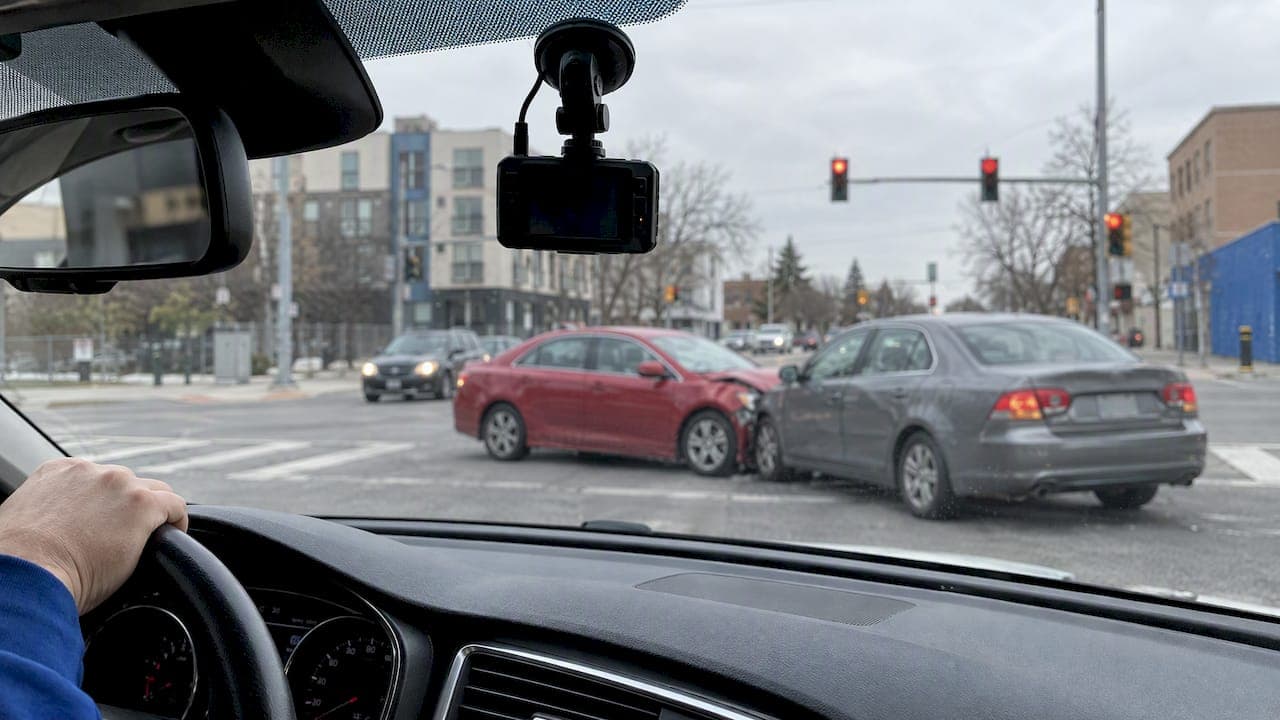
Dash cam footage is usually admissible in a U.S. car accident case, as long as it is relevant, can be shown to be authentic, and was not recorded or altered in a way that breaks a rule. The video itself rarely causes trouble. The fights come over the audio, over gaps and edits, over who can vouch for the file, and over whether the footage helps the other side more than it helps you. This guide explains how courts treat dash cam evidence, where state law changes the answer, and what to do in the first days after a crash.
TL;DR
- Dash cam video is generally admitted when it is relevant and a witness can testify that it fairly shows what happened. Judges can still exclude parts that are unrelated or unfairly prejudicial.
- Audio is the weak spot. In-car conversation can raise state recording-consent questions, and commentary from the driver can be excluded even when the video comes in.
- Your footage can be used against you. Insurers and courts do not care whose camera it was.
- Stop the camera from overwriting, keep the original file, make copies, and write down who handled each one.
- Rules on mounting and recording differ by state, so check your own state before you rely on a particular setup.
Table of Contents
- Is dash cam footage admissible in court?
- The three tests footage has to pass
- Audio and commentary: where good footage goes wrong
- Dash cam laws vary by state
- Can your own dash cam footage be used against you?
- What we think about dash cam evidence
- How to preserve dash cam footage after a crash
- Getting footage you did not record
- Mistakes that hurt dash cam evidence
- Footage is evidence, not a verdict
- Talk to an attorney before you decide how to use your footage
- FAQ
- Sources
Is dash cam footage admissible in court?
In most cases, yes. Admissibility does not turn on the word "dash cam." It turns on the ordinary rules every piece of evidence faces: is it relevant, is it authentic, and does its value outweigh the risk of unfair prejudice or confusion?
Two recent examples show how this plays out. In 2023, Florida's Fifth District Court of Appeal admitted the first 48 seconds of silent dash cam video showing traffic conditions and the collision, because that part bore on liability. The court excluded the later footage as irrelevant, and it excluded the soundtrack. So the video was not thrown out wholesale, and it was not accepted wholesale either. The judge sorted it into pieces.
Texas goes further in a statute for collision cases. Section 72.055 of the Civil Practice and Remedies Code presumes that properly authenticated photographs or videos of the vehicles or objects involved are admissible in civil actions under that subchapter. That holds even when the footage supports or disputes a claim about how severe the injury or damage was. Expert testimony is not required except to authenticate the material.
New York's judicial guidance describes the same balance from the judge's side: a trial judge may admit a relevant, authenticated video in the court's discretion and may exclude one that is sensational, unnecessary, or unfairly exaggerates the features it is meant to prove.
The practical takeaway: assume your footage can get in, and prepare as if every second and every spoken word will be challenged.

The three tests footage has to pass

Relevance
Footage must make a fact in the case more or less likely: who had the right of way, who was speeding, whether a light was red, what the road looked like, how the vehicles moved on impact. The ten minutes of driving before the crash and the drive home afterward are usually not relevant, and a judge may trim them. That is why the Florida court cut the video off where liability stopped being shown.
Authentication
Authentication means showing the video is what you say it is. Under Federal Rule of Evidence 901, the party offering an item must produce enough evidence to support a finding that it is what that party claims. Testimony from a witness with knowledge is one accepted method. State rules follow the same logic.
In practice, one of these people usually does the job:
- A person who saw the events. The driver or a passenger testifies that the video matches what they remember.
- The person who installed or operates the camera. They explain how it records, how the clock is set and how the file was saved.
- A combination. A witness plus other evidence showing the video accurately represents the scene, such as photos of the intersection or a police report.
Disputes tend to arise when the footage came from someone who is not available to testify, when the timestamp is wrong, or when the file was copied, trimmed or converted before anyone preserved the original.
Unfair prejudice
Even relevant, authentic video can be limited. A judge can exclude material whose likely effect is to inflame or mislead more than it informs. Graphic images of injuries or heavily edited compilations are the usual targets. This is also where audio gets into trouble.
Audio and commentary: where good footage goes wrong
The Florida decision is the clearest illustration. The court held that audio and commentary must be assessed separately from the picture. Repeated statements by the recorder that the other driver was fleeing were unfairly prejudicial and irrelevant, and the recorder's lay opinions about speed and fault were inadmissible. The video stood on its own; the narration did not.
Two separate problems can attach to sound:
- Evidentiary problems. Angry remarks, guesses about fault, and admissions such as "I didn't see him" can be excluded or, worse, used against you.
- Recording-consent problems. Video of a public road is usually treated differently from a recorded conversation. Recording-law resources note that dash cam video is generally evaluated under ordinary relevance and authentication rules, while in-car audio may face a separate challenge under state wiretap or consent laws, and that the applicable rule varies by state. Some states require every party to a conversation to consent. Turning the microphone off removes that question entirely.
If you drive for a ride-share service, carry passengers often, or live in a state with an all-party consent rule, think hard about whether audio is worth the risk. If you keep it on, tell passengers. California goes a step further: when a vehicle has a video event recorder for monitoring driver performance, the law requires a visible notice that passenger conversations may be recorded.
Dash cam laws vary by state
Most state differences are about how the camera is mounted and what it records, not whether footage can be used in a civil claim. The recurring issues are windshield placement or obstruction rules and consent requirements for audio, and the legality and evidentiary treatment of audio can differ even when the video itself stays usable.
| Issue | What to check in your state | Example from the sources |
|---|---|---|
| Windshield placement | Rules on objects that obstruct the driver's view and where a device may sit | California permits a video event recorder in a 7-inch square in the lower corner farthest from the driver, a 5-inch square in the lower corner nearest the driver outside an airbag zone, or a 5-inch square at the top center (AB 1942) |
| Audio recording | One-party or all-party consent for recorded conversations | Varies by state; disabling the microphone avoids the question |
| Civil admissibility | Whether the state has a collision-specific evidence statute | Texas presumes authenticated collision photos and videos admissible in covered civil actions |
| Notice to passengers | Whether you must tell people they may be recorded | California requires a visible notice for driver-monitoring recorders |
If the placement rules in your state are unclear, ask your state's motor vehicle agency or a local attorney before you permanently mount a camera. A placement violation is a traffic matter. It does not by itself make accurate footage of a crash inadmissible in a civil case, but it hands the other side something to argue about.
If an officer stops you with the camera running, it also helps to know what rights you hold at a stop. For California drivers, this explainer on DUI checkpoint rights in California covers what you can and cannot be required to do.
Can your own dash cam footage be used against you?
Yes. A dash cam is neutral. Courts and insurers can use a driver's own footage, including video showing the recording driver at fault. If you were speeding, looking at a phone or rolling through a stop sign, the video can prove it.
That does not mean you should avoid a camera or delete anything. Deleting footage once you reasonably expect a claim or lawsuit is far riskier than the footage itself. Under the spoliation doctrine, a party who fails to preserve evidence can face sanctions or an instruction that lets the jury assume the lost material was unfavorable. Texas courts apply this in cases such as Brookshire Brothers v. Aldridge, as one Texas firm explains. The safe rule is simple: save everything, talk to a lawyer before sharing it, and let your lawyer decide how it gets used.
What we think about dash cam evidence
At Carcollisionlawyer, we see accident victims at the moment they are least prepared: hurt, stressed and unsure what a claim requires. Our view on dash cam footage is practical.
First, a camera is valuable mainly because it removes the argument. When two drivers tell opposite stories, a clean clip often settles the question of who did what before anyone spends months disputing it. But we would never tell someone that a clip alone wins a case. Injuries, medical records, lost income and the way the other side's insurer values the claim still decide the outcome.
Second, most of the damage we see is self-inflicted after the crash: footage that was overwritten because the card kept looping, clips posted online, a trimmed version sent to an adjuster, or a driver who narrated their own guesses on the audio track. None of that is about the law being unfair. It is about preservation and discipline.
Third, do not send raw footage to any insurance company, including your own, before you understand the claim. Give a lawyer the original and let them handle the sharing. Our job is to connect you with a vetted local attorney who knows your state's rules and can decide what to do with it.
— Gerard
How to preserve dash cam footage after a crash
Preservation is where most real-world cases are won or lost, because dash cams record in a loop and overwrite older files. Forensic guidance for lawyers says to act promptly and preserve the original source in native format, document how it was collected and handled, and store multiple secure copies. Here is how that translates into steps a driver can take.
- Stop recording and protect the file. Press the lock or emergency button if your camera has one, then power it down. Take out the memory card if you can do so safely, so nothing records over the crash.
- Do not edit, trim, convert or rename the original. Work only from copies. Changes to the original are the quickest way to invite an authenticity fight.
- Make several copies. Put them on separate devices or accounts, and keep the original untouched. Practitioner guides also advise keeping metadata, stopping loop recording, and documenting each copy and who handled it.
- Write a short log. Note the date and time you pulled the card, where it was kept, who had it and which copies exist. If a dispute arises, this record is what lets someone testify the file was not changed.
- Capture the context. Photograph the scene, damage, road signs and any visible camera angles. These support the footage, and our guide on car accident evidence best practices walks through the full list.
- Keep the camera's settings. Note whether the clock is set correctly and whether GPS data was on. A wrong timestamp is easy to explain if you caught it early, and hard to explain months later.
For complex or disputed cases, forensic examiners follow documented methods. Academic guidelines presented at the 2023 DFRWS USA conference describe how dash cam files can hold road, route, cabin and audio evidence and set out procedures for preserving, acquiring, examining and presenting it. Specialists also use write-blocking and integrity hashes to show a copy matches the original. You do not need to do that yourself, but you should not do anything that would make it impossible.
Getting footage you did not record
Your camera may not have caught the crash. Footage from other sources often matters just as much, and it disappears fast.
Other drivers and witnesses
If another driver, a rideshare driver or a bystander stopped, ask for their contact information at the scene and ask them to keep any video. Do not count on a stranger to hold files for months. A lawyer can send a written preservation request.
Businesses, fleets and transit
Stores, parking lots, delivery fleets and buses often keep video on short retention cycles, and many overwrite within days or weeks. Send a written request right away to the manager or the company's risk or legal department, identify the date, time and location, and ask them to preserve the footage. Companies are far more likely to comply when a lawyer asks. For public cameras at intersections, see our guide on requesting traffic camera footage.
Police and public agencies
If an officer's body or vehicle camera recorded the scene, you can usually ask the agency for it through a public records request. Expect delays, redactions and, in some places, an answer that no video exists. Many local agencies do not equip every cruiser with a camera, and some states limit release while an investigation is open. Call the agency's records unit first, then submit a written request citing your state's public records law. Ask your attorney to do it if there is any chance of litigation, because a subpoena can reach what a records request cannot.
The common thread is speed. A request sent in the first week often succeeds. One sent in month three often meets the answer that the file was overwritten.
Mistakes that hurt dash cam evidence
- Posting the clip on social media. It can be copied, misdescribed and used by the insurer. Our guide to car accident lawsuit mistakes covers other ways well-meaning claimants undercut themselves.
- Giving the adjuster the only copy. Share a copy only, and only after talking with your attorney.
- Letting the card overwrite. This is the most common failure, and it cannot be undone.
- Narrating fault out loud. Statements and opinions on the soundtrack may be excluded, but they may also be used to challenge your account.
- Cutting the "boring" parts. Trimmed video invites claims of manipulation. Keep the full file and let the lawyer choose which segment to present.
- Ignoring a wrong clock. If the timestamp is off, record the difference at once and mention it when you hand the footage over.
Some accident types add complications. Rear-end crashes, for example, often turn on braking distance and following distance, which a forward-facing camera can capture. Our article on why rear-end accidents complicate claims explains why. Motorcyclists who wear helmet cameras face similar questions, and the photos they take at the scene matter too, as we cover in how motorcycle accident photos help your case.
Footage is evidence, not a verdict
The value of a clip depends on what surrounds it. Practitioners sometimes say video can carry more weight than an accident reconstruction expert because the jury sees the event directly. That can be true. But a judge may still limit what is shown, the other side may offer its own recording, and the video says nothing about your medical bills or how the injury changes your life. Fault rules also differ by state, so even clear footage showing shared blame can reduce what you recover. In a drunk-driving crash, video can sit alongside police and toxicology evidence, as in our guide to preserving evidence to sue a drunk driver.
Talk to an attorney before you decide how to use your footage
If you were hurt in a car, truck, motorcycle or bicycle crash and you have video, do not guess how it will be used. Our free case evaluation asks about your injury and what happened, then connects you with a vetted local attorney who can review your footage and explain what it means under your state's rules. There is no charge for the evaluation and no obligation to go further. If you want to start with a specific injury type, you can also use our injury-specific intake.
FAQ
Can a judge refuse to admit my dash cam video?
Yes. A judge can exclude footage that is not relevant, cannot be authenticated, or is more likely to mislead than help. Courts also admit part of a video and exclude the rest, as the Florida appeals court did when it kept 48 seconds and excluded later footage and the audio.
Do I need an expert to get dash cam footage into evidence?
Usually not. A witness who saw the events or who installed and operates the camera can often authenticate the file. Texas's collision statute says expert testimony is not required except to authenticate the material. A forensic expert becomes more likely when someone claims the video was altered.
Is it legal to record audio with my dash cam?
It depends on your state. Some states require all parties to a conversation to consent, and in-car audio can raise that issue even when the road video does not. If you carry passengers, disable the microphone or tell everyone before they get in, and check your state's recording law.
How long do I have to keep dash cam footage?
Keep it at least until your claim and any related lawsuit are fully resolved, and do not delete it once you reasonably expect a dispute. Courts can sanction a party who fails to preserve relevant evidence. Ask your attorney how long to hold the file.
Can the other driver's insurer demand my footage?
An insurer can ask, and you may be required to produce it in a lawsuit, but you should not hand over the original on request. Speak with an attorney first, who can provide a copy at the right time and protect your position.
Sources
- Florida Fifth District Court of Appeal opinion, 2023
- Texas Civil Practice and Remedies Code section 72.055
- New York Guide to Evidence 9.14, Video Recording
- Federal Rule of Evidence 901
- California AB 1942, chaptered 2010
- Dashcam Laws by State, Recording Law
- Dashboard Camera Legality and Privacy Laws, Recording Law
- Dashcam Evidence in Texas Car Accidents
- From DVR to Discovery, USLAW Magazine, Fall 2025
- Dashcam forensic investigation guidelines, DFRWS USA 2023
- Can Dash Cam Footage Be Used in Court?
- Dashcam Video and Vehicle Data as Evidence
- DUI Checkpoint Rights in California