
Yes, you can request corrections to a US police report, and factual errors like a misspelled name, wrong plate number, or incorrect date often get fixed. Subjective disagreements over fault or officer interpretation usually don't change the original report. Instead they get a supplemental statement attached to the file. Get a copy of the report immediately, mark the exact lines that are wrong, and gather your evidence before you contact the records division.
TL;DR:
- Factual errors like incorrect names, license plates, or dates are usually corrected quickly, but subjective interpretations or fault assessments generally see only supplemental comments added.
- Obtain your police report promptly via online portals or formal requests, and mark specific lines with supporting evidence before submitting a formal amendment request.
- Strong evidence such as timestamped media, official documentation, or witness statements can significantly influence whether a correction is approved or if a supplemental report is created.
- If the agency refuses to amend the report, you can appeal in writing, submit a statement of disagreement, or use external legal help to address impacts on your claim.
- Timing is critical; delays in requesting corrections reduce chances of successful amendments, especially since archived reports are harder to access and modify.
Table of Contents
- How to Amend a Police Report: Steps to Take Right Now
- Where Do You Obtain the Original Police Report?
- Which Errors Can You Actually Get Fixed?
- What Evidence Actually Moves a Correction Request Forward
- What Happens After You Submit: Supplements vs. Full Rewrites
- What If the Agency Refuses to Amend the Report?
- Why Timing Matters More Than People Realize
- How Carcollisionlawyer Helps When a Report Error Affects Your Claim
- The Part of This Process Most Guides Get Wrong
- Get a Free Case Evaluation Before the Report Works Against You
- Sources
- FAQ
How to Amend a Police Report: Steps to Take Right Now
Correcting a police report starts with speed and precision, not a phone call demanding a rewrite. Records clerks and reporting officers respond better to specific, documented requests than vague complaints about "getting it wrong."
Here's the sequence that actually moves a correction forward:
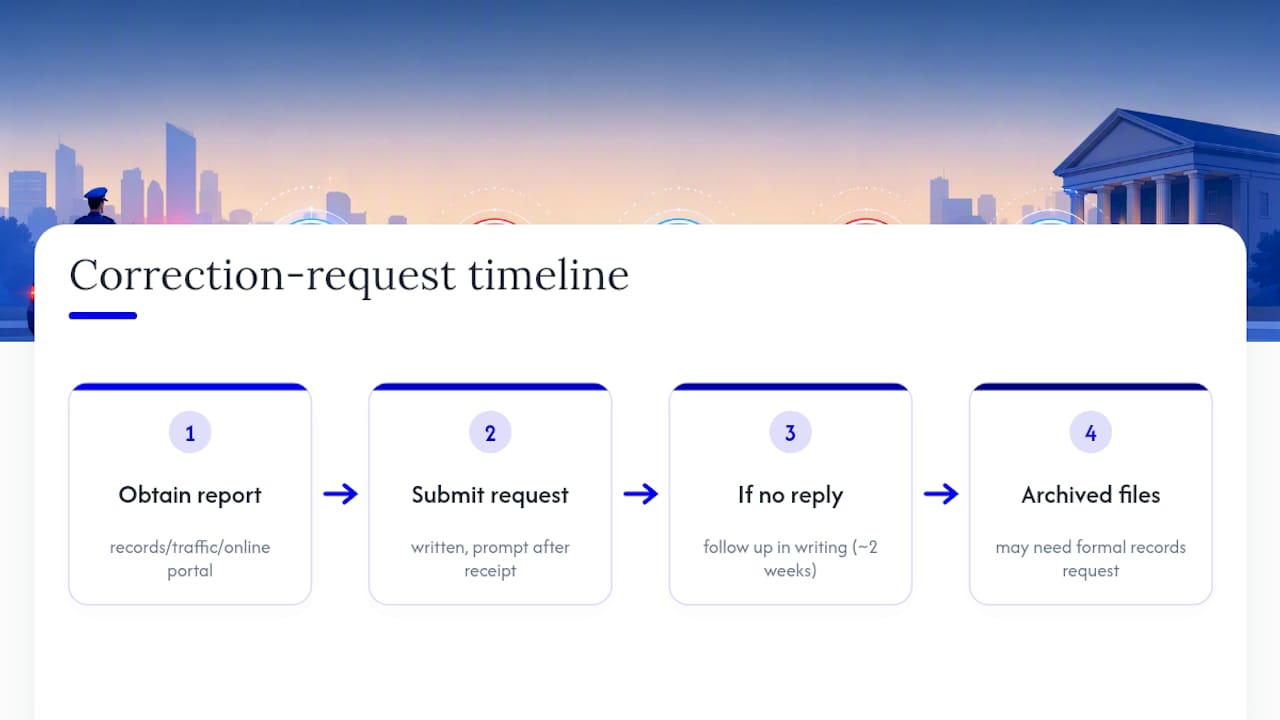
- Get your case or CAD number. Call the records division, check the department's online portal, or use the number on your citation or exchange-of-information slip.
- Pull the full report immediately. Don't wait for your insurance adjuster to request it. Order your own copy the same week, if not the same day.
- Mark exact line references. Note the page, paragraph, or field (name, plate, narrative sentence) that's wrong, and write one clear sentence describing what it should say instead.
- Attach supporting files. Original photos or video with metadata intact, your registration, insurance card, or a witness statement all strengthen the request, as LegalClarity's guidance on amendment evidence points out.
- Submit through the official channel. Most departments accept email, an online form, or certified mail. Use whichever the records division specifies, and ask for a receipt confirming your request was logged.
Pro Tip: Keep your correction request to one page. A tight, line-by-line request with attached evidence moves through a records queue far faster than a long narrative explaining your side of the accident.
Where Do You Obtain the Original Police Report?
Before you can fix anything, you need the actual document in hand. Most agencies route requests through a records or traffic division, and many now offer an online portal where you enter your case number, name, or incident date to pull a copy directly.
If the portal doesn't have it yet, or the agency doesn't offer digital access, a formal public records request works as a backup. Some state DMV sites, like Colorado's report-request page, walk drivers through exactly how to order a crash report and who to contact if something's wrong.
Once you have the report, check these fields line by line:
- Case or CAD number and filing date
- Names, addresses, and driver's license numbers for every party
- Vehicle plates, makes, models, and insurance information
- Time and location details in the narrative
- Any quoted statements attributed to you or a witness
Request your copy as soon as you can. Departments follow retention and archiving schedules that vary by record type, and a report that's already been filed into long-term storage is harder to touch. Our step-by-step guide to obtaining a police report breaks down the records request process in more detail if your department is slow to respond.
Which Errors Can You Actually Get Fixed?
Not every mistake in a police report gets the same treatment. Verifiable factual errors are the easiest wins. Subjective conclusions are a much harder sell, and most agencies won't touch them directly.
Here's the realistic breakdown:
- Usually corrected: misspelled names, wrong addresses, incorrect license plate numbers, wrong dates or times, transposed vehicle details.
- Rarely rewritten: the officer's sequence of events, fault determination, speed estimates, or characterizations of who said what.
- Common middle ground: a supplemental report or addendum gets attached, preserving the original narrative while adding your documented objection.
Agencies keep the original report intact almost as a rule. Officer report-writing training emphasizes factual accuracy and the 5W1H framework (who, what, when, where, why or how), according to the LERC Report Writing Student Manual, but once a narrative is filed, most departments treat the interpretive parts as the officer's professional judgment call, not a clerical error to be reopened.
What Evidence Actually Moves a Correction Request Forward
A correction request without evidence is just an opinion on file next to the officer's opinion. Records reviewers respond to documentation, not frustration.
The strongest supporting materials tend to fall into three categories:
- Timestamped media. Dashcam footage, phone photos, or surveillance video with original metadata intact carry more weight than a screenshot or a copy that's been cropped or edited.
- Official paperwork. Vehicle registration, insurance declarations, medical records, and tow or repair receipts confirm details like ownership, damage extent, and timing.
- Signed witness statements. A written statement with the witness's contact information, and notarized if you can manage it, holds up better if the case ends up disputed later.
Keep your originals untouched and build a labeled exhibit packet instead. A one-page cover letter that maps each piece of evidence to the specific report line it corrects makes the reviewer's job simple, which is exactly the approach outlined in our guide to car accident evidence best practices.
Pro Tip: Number your exhibits (Exhibit 1, Exhibit 2) and reference those numbers directly in your written request. It turns a confusing pile of attachments into something a clerk can process in minutes instead of days.
What Happens After You Submit: Supplements vs. Full Rewrites
Most local police departments won't erase and rewrite a filed report. Instead they attach a supplemental report, an addendum, or a formal annotation that sits alongside the original. The original text stays intact, and your correction becomes part of the permanent file, as FindLaw's overview of report amendments explains.
Federal agencies work under a different, more formal set of rules. The Privacy Act (5 U.S.C. § 552a) gives individuals an explicit right to request amendments to records held by federal agencies, and it requires those agencies to acknowledge the request and provide an appeals process if the amendment is denied, according to federal Privacy Act regulations.
State and local police departments almost never operate under a comparable statutory deadline. Response times depend entirely on internal department policy, which is why a documented, well-organized request matters more at the local level than anywhere else in the process.
Whatever level of agency you're dealing with, ask for two things in writing: confirmation that your request was received, and a copy of whatever supplement or annotation gets added. Note who approved the change and the date it was made. That paper trail becomes critical if the correction later matters to an insurer or a court.
What If the Agency Refuses to Amend the Report?
A refusal isn't the end of the road. It just means your next steps need to be more formal.
- Get the refusal in writing. A verbal "no" from a records clerk doesn't count for anything later. Ask for a written denial that states the reason.
- File an internal appeal if one exists. Many departments have a supervisor or internal review process specifically for disputed report content.
- Submit a Statement of Disagreement. Even if the agency won't change the narrative, most will accept a written addendum stating your version of events, which stays permanently attached to the file.
- Use your evidence outside the report. Police reports carry weight, but they aren't the final word. Insurers and courts both accept photos, witness statements, and other documentation independent of what the officer wrote, per FindLaw's analysis of report disputes. Preserve your chain of custody for every piece of evidence you plan to use.
- Loop in an attorney if the stakes are real. If the disputed section affects fault, liability, or the value of your claim, a lawyer can push the correction further than you can alone, and a free evaluation is a low-risk way to find out where you stand. Report errors that go unaddressed are a common thread in claims that lose value over avoidable mistakes. Understanding your rights when dealing with police can also help you spot inaccuracies before they harden into the official record.
Why Timing Matters More Than People Realize
Most states don't set a hard statutory deadline for requesting a report amendment, but that doesn't mean time is on your side. The longer you wait, the harder correction gets, both practically and procedurally.
Records archiving schedules vary by jurisdiction and by record type. A minor traffic collision report might follow a different retention timeline than a report tied to a criminal investigation, and once a file moves into long-term archive status, pulling it back out for correction gets slower and sometimes requires a formal records request instead of a simple call to the front desk, as FindLaw notes on report retention.
If you submit a request and hear nothing back within a couple of weeks, follow up in writing and reference your original submission date. Silence isn't approval, and it isn't denial either. It's usually just a backlog, but you need a paper trail showing you followed up promptly.
How Carcollisionlawyer Helps When a Report Error Affects Your Claim
A wrong detail in a police report can shift how an insurer values your claim or how a court weighs liability. That's exactly the kind of situation where a free evaluation earns its place: it helps you figure out whether the error actually changes your compensation strategy, or whether it's a clerical fix that won't move the needle.
An intake process can match you with an attorney suited to your injury type and circumstances, whether that's a straightforward fender-bender dispute or something more serious involving long-term medical documentation. Our guides on obtaining a fatal accident report and preserving evidence that holds up reflect the same practical, document-first approach we bring to every case assessment.
The Part of This Process Most Guides Get Wrong
Most articles on this topic treat amendment requests like a formality, as if attaching a photo automatically flips a switch and the report changes. It doesn't work that way, and readers who go in expecting an easy rewrite usually walk away frustrated when they're offered a supplement instead.
Here's the judgment call worth making early: decide whether the error you found is clerical or interpretive before you spend hours building a case. A wrong middle initial or transposed digit in a plate number is worth five minutes of your time. A dispute over who had the right of way is a different fight entirely, and it belongs with an attorney, not a records clerk.
The conventional advice tells you to "request a correction" as if every error gets the same response. It doesn't. Factual errors get fixed quietly and quickly. Everything else becomes a documentation exercise, and the strength of your file, not the strength of your argument, decides whether it holds up later with an insurer or in court. Prioritize the paper trail first. Everything downstream depends on it.
— Gerard
Get a Free Case Evaluation Before the Report Works Against You
You can be connected with a vetted local attorney who can look at what's wrong in your report and advise whether it's worth pursuing, all before you commit to anything or pay a cent. If a records division has already refused to touch the substantive parts of your report, that's precisely the situation where an outside legal read matters most: an attorney can weigh in on how the disputed content affects fault, valuation, or your negotiating position with the insurer.
The free evaluation takes a few minutes. You share what happened, what's wrong in the report, and what evidence you've preserved so far. From there, you can be matched with an attorney suited to your injury type and circumstances. Keep your original photos, videos, and documents untouched in the meantime. If you're ready to see where you stand, start your free case evaluation today.
This article is general information, not a substitute for advice from a qualified lawyer. Consult a qualified legal professional about your own circumstances before acting on anything here.
Sources
- Can You Get a Police Report Changed? - FindLaw
- How to Amend a Police Report: Steps and Evidence - LegalClarity
- eCFR: Privacy Act amendment rules (example cite)
- LERC Report Writing Student Manual
FAQ
How Do I Amend a Police Report After the Fact?
Contact the records or traffic division that filed the report, request a copy, and identify the exact line or field that's wrong. Submit a written request with supporting evidence like photos, registration, or witness statements, and ask for confirmation once it's processed.
Can I Undo a Police Report?
You generally can't erase or undo an entire report once it's filed. What you can do is request a factual correction or, for disputed interpretations, submit a supplemental statement that stays attached to the original file.
What Should I Do When a Police Report Is Incorrect?
Get a copy of the report immediately, mark every incorrect detail, and gather evidence like timestamped photos or official documents before contacting the records division. If the error affects your insurance claim or potential compensation, a free case evaluation can help you decide whether legal help is worth pursuing.
What's the Difference Between a Correction and a Supplement?
A correction changes a verifiable factual error, like a misspelled name or wrong date, directly in the record. A supplement is a separate document added to the file when the disagreement involves the officer's interpretation, such as fault or sequence of events, and the original narrative stays unchanged.
Do Federal Agencies Handle Amendment Requests Differently?
Yes. Federal agencies operate under the Privacy Act, which gives individuals a formal right to request amendments and requires the agency to respond and offer an appeal if denied. State and local police departments don't follow that same statutory framework, so their response times and procedures depend on internal policy.