
Subrogation means your insurance company steps into your legal shoes after paying your claim and goes after the at-fault party to get its money back. Three things every policyholder should know right away:
- Your settlement can shrink. If your insurer recovers money from the at-fault party, it takes back what it paid before you see a dime of that recovery.
- You may get your deductible back. When the insurer fully recovers its costs, it typically refunds your out-of-pocket deductible.
- You usually have to cooperate. Your policy almost certainly contains a subrogation clause requiring you not to interfere with the insurer's recovery efforts.
Got a subrogation letter in the mail? Jump to Section 8. Want to challenge a demand or understand the made-whole doctrine? Section 7 covers your defenses.
Table of Contents
- What does subrogation mean in plain English?
- How the subrogation process typically unfolds
- What a waiver of subrogation means and when you need one
- How subrogation differs from liens, and what Medicare's role is
- What to do when you receive a subrogation letter
- How AI is changing subrogation practice and what it means for you
- Key Takeaways
- Why subrogation deserves more attention than most claimants give it
- Facing a subrogation dispute? Get a free case evaluation
- Useful sources and further reading
What does subrogation mean in plain English?
Merriam-Webster defines subrogation as the assumption by a third party of another's legal right to collect a debt or damages. In insurance, that third party is your insurer, and the right it assumes is yours.
The Legal Information Institute at Cornell Law puts it this way: the insurer steps into the insured's shoes and pursues the responsible party to recover what it paid out. That "stepping into the shoes" phrase is not just a metaphor. The insurer literally inherits your legal standing to sue or demand payment from whoever caused the loss.
Three quick examples show how this plays out:
Auto collision. A driver runs a red light and totals your car. Your collision insurer pays $18,000 for repairs and your $1,000 deductible. It then pursues the at-fault driver's liability insurer for that $18,000. If it recovers the full amount, you get your $1,000 back.

Health insurance. You're rushed to the ER after a slip-and-fall at a store. Your health insurer pays $9,000 in medical bills. When you later settle with the store's liability carrier, your health insurer asserts a subrogation claim against those settlement proceeds.
Property damage. A contractor's negligence causes a burst pipe that floods your kitchen. Your homeowner's insurer pays $25,000 for repairs, then files a subrogation claim against the contractor's general liability policy.
The right almost always comes from two places: the subrogation clause written into your policy (which you agreed to when you bought coverage) and state law, which reinforces and sometimes limits that right.
How the subrogation process typically unfolds
The sequence is predictable once you know it. Here's how it usually goes, from claim payment to final resolution:
- Demand letter goes out. The insurer sends a subrogation letter to the at-fault party or their insurer. The letter identifies the policy, describes the incident, states the legal basis for recovery, and names the amount demanded.
Timeline: Straightforward cases between two insurers often resolve in weeks to a few months. Disputed liability, uninsured defendants, or litigation can stretch the process to a year or more. Understanding how liability is assigned in your state affects how quickly the insurer can close a demand.
Pro Tip: Keep every document related to your claim in one folder: the police report, all medical bills, repair estimates, payment receipts, and any communications from your insurer. The insurer's investigation depends on this paper trail, and gaps can delay your deductible refund.
What a waiver of subrogation means and when you need one
A waiver of subrogation is a contractual agreement in which one party's insurer gives up the right to pursue the other party after paying a claim. The insurer is not waiving your rights; it is waiving its own recovery rights against a named third party.
You see these most often in three contexts:
Commercial leases. A landlord may require a tenant's insurer to waive subrogation so the landlord cannot be sued by the tenant's carrier after a covered loss. The tenant's insurer adds an endorsement to the policy confirming the waiver.
Construction contracts. General contractors routinely require subcontractors to carry policies with mutual waivers of subrogation. This prevents a cascade of insurer-vs-insurer litigation after a job-site accident.
Service agreements. Vendors and facilities management contracts often include waiver language to limit post-loss disputes between parties with ongoing business relationships.
If a contract you're signing requires a waiver of subrogation, ask your insurer to add the endorsement before you sign. Signing the contract first and asking later can create a coverage gap. The practical cost is usually modest, but the endorsement must be in place before the loss occurs. Once the insurer has already paid a claim, it cannot retroactively waive its recovery rights.
How subrogation differs from liens, and what Medicare's role is
Subrogation and liens are related but legally distinct, and the difference matters when settlement money is being divided.
Subrogation substitutes the insurer's rights to pursue the at-fault party; a lien is a direct legal claim on the settlement proceeds themselves. An insurer asserting subrogation can sue the at-fault party independently. A lienholder, by contrast, attaches to the money you receive and must be paid before you can keep your share.
Medicare operates under a statutory lien framework that is stricter than private subrogation. Under the Medicare Secondary Payer Act, Medicare has a right to recover any payments it made for injuries caused by a third party. That right attaches to your settlement proceeds automatically. Failing to resolve a Medicare lien before distributing settlement funds can expose you and your attorney to personal liability for the full amount Medicare paid.
A practical checklist before any settlement distribution:
- Identify all potential lienholders early: health insurer, Medicare/Medicaid, workers' compensation carrier, and any medical providers with statutory liens
- Request itemized lien amounts in writing from each holder
- Verify that each claimed amount reflects only treatment related to the accident
- Negotiate reductions where the settlement is insufficient to make you whole
- Get written lien satisfaction or release before funds are distributed
For a fuller picture of how these competing claims affect your net recovery, the car accident settlement factors guide walks through how each deduction is calculated.
What to do when you receive a subrogation letter
A subrogation letter arriving in your mailbox is not a personal bill and not a court order. Here is what to do:
- Check the letter's contents. A valid subrogation demand letter must identify the policy, state the legal basis for recovery, and specify the amount claimed. A vague letter missing these elements is a red flag and is often negotiable.
Pro Tip: Ask the demanding party for a complete itemized accounting of every payment included in the demand. Bundled figures sometimes include amounts unrelated to your accident, and you are only obligated to address what the insurer actually paid for your covered loss.
How AI is changing subrogation practice and what it means for you
Subrogation has historically been underperforming as a revenue source for insurers. Industry analysis estimates that $15–20 billion in recoverable subrogation funds go uncollected annually, largely because manual review processes made small-dollar cases uneconomic to pursue. AI is closing that gap fast.
| Shift | What it means for claimants |
|---|---|
| Automated demand generation | More letters sent faster, including small-dollar cases previously ignored |
| AI liability scoring | Insurers identify fault more quickly, reducing investigation delays |
| Portfolio-level recovery management | Top carriers now recover a high percentage of eligible opportunities compared to a significantly lower share for laggards |
| Vendor-driven communications | Letters may come from third-party subrogation firms, not your insurer directly |
The practical effect: if you had a minor accident two years ago and assumed the insurer had moved on, that assumption may no longer hold. Automated systems flag recoverable cases that human reviewers once skipped. Small-dollar demands that were previously uneconomic to send are now generated at near-zero marginal cost.
Pro Tip: When a letter arrives from an unfamiliar company name, check whether it is a subrogation vendor acting on behalf of your insurer. The vendor's authority to collect on the insurer's behalf should be stated in the letter. If it is not, ask for written confirmation before engaging.
The role of insurers after a car accident has expanded well beyond simply paying claims. Recovery workflows are now a core part of how carriers manage profitability, and claimants who understand that dynamic are better positioned to negotiate.
Key Takeaways
Subrogation is your insurer's legal right to recover what it paid from the at-fault party, and how you respond to that process directly affects how much of your settlement you keep.
| Point | Details |
|---|---|
| Core definition | Your insurer steps into your legal shoes to recover its payment from the at-fault party. |
| Deductible refund | If the insurer fully recovers its costs, your out-of-pocket deductible is typically returned to you. |
| Made-whole doctrine | In many states, the insurer cannot collect subrogation until you are fully compensated for your losses. |
| AI-driven demands | Insurers now pursue small-dollar recoveries automatically; expect more letters, faster timelines. |
| Carcollisionlawyer | Offers a free case evaluation to connect accident victims with vetted attorneys who can challenge subrogation demands and protect your net recovery. |
Why subrogation deserves more attention than most claimants give it
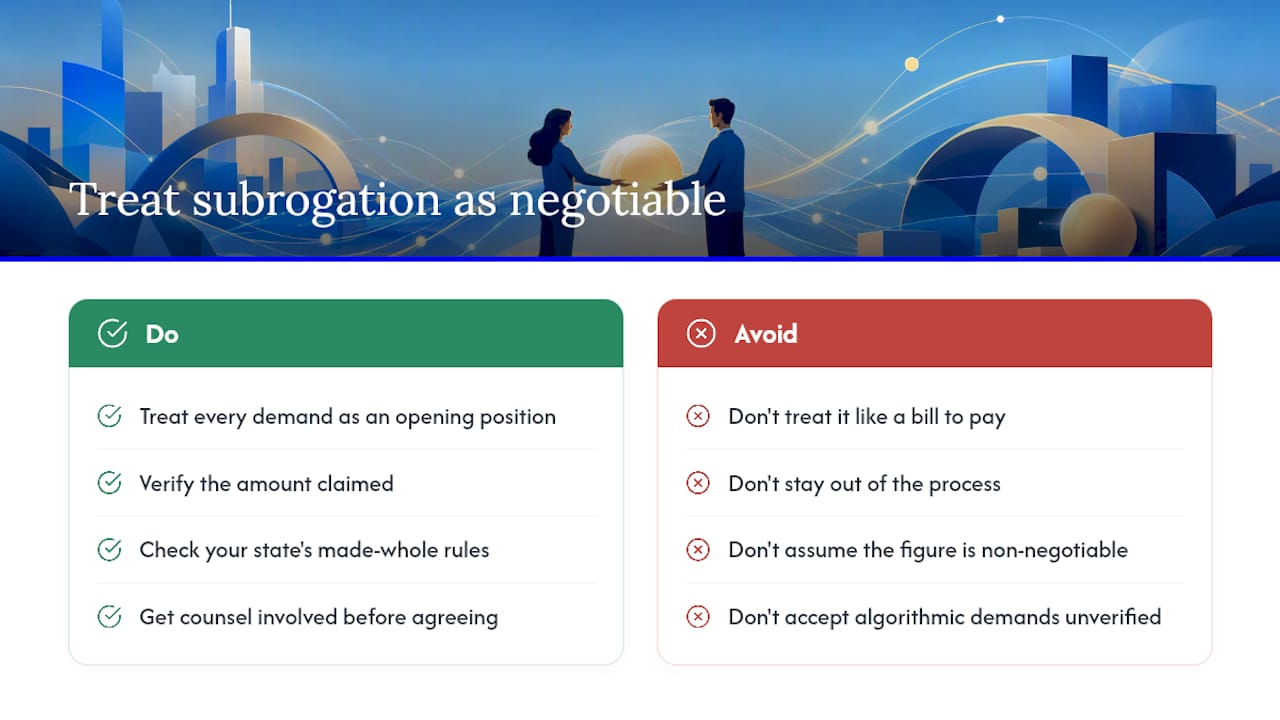
Most people who receive a subrogation letter treat it like a bill they have to pay or a process they have to stay out of. Both instincts are wrong, and the cost of getting it wrong can be significant.
The made-whole doctrine alone is underused. In states where it applies as a default, an insurer asserting subrogation against a claimant who was not fully compensated by the at-fault party's policy limits has a weak claim. Yet claimants routinely pay those demands in full because they do not know the doctrine exists or assume the insurer's opening figure is non-negotiable. It rarely is.
The AI shift makes this more urgent, not less. Automated systems generate demands based on data patterns, not case-by-case judgment. A letter produced by an algorithm may include amounts that do not belong, misattribute fault, or ignore comparative negligence facts that a human reviewer would have caught. The volume of these letters is increasing, and the average quality of the initial demand is not improving alongside it.
The practical takeaway: treat every subrogation demand as an opening position. Verify the amount, check your state's made-whole rules, and get counsel involved before you agree to anything large. The insurer has a recovery department working this full-time. You should have someone in your corner too.
Facing a subrogation dispute? Get a free case evaluation
When a subrogation demand threatens to reduce what you actually recover from an accident, the difference between accepting the first number and negotiating it down can be thousands of dollars. Carcollisionlawyer connects accident victims with vetted local attorneys who handle exactly these situations: disputed liability, Medicare lien complications, inflated insurer demands, and cases where the made-whole doctrine should limit what the insurer can take.
The evaluation is free, there is no commitment, and the intake process is built around your specific injury type and circumstances. Whether you were in a car, truck, or motorcycle accident, you get matched with an attorney who knows the subrogation rules in your state and can tell you quickly whether the demand you received is worth fighting.
Start your free case evaluation at Carcollisionlawyer and find out where you actually stand before you sign anything.
Useful sources and further reading
The following sources were used in preparing this article. Each covers a distinct aspect of subrogation law and practice.
- subrogation | Wex | US Law | LII / Legal Information Institute
- What is a subrogation letter and what should you do? - LegalClarity
- Insurance Subrogation and Policy Liens: Who Gets Paid First? - LegalClarity
- Policyholder considerations for insurance company subrogation - Risk & Insurance Magazine
- Billions left behind: How AI rewrites the economics of subrogation - InsuranceIndustry.ai
- NAIC CIPR/Journal article on subrogation and insurer recovery practices
- What to Do After Receiving a Letter of Subrogation - LA Law Group / BizLawPro
- SUBROGATION Definition & Meaning - Merriam-Webster