
Whether you should settle or take your case to trial comes down to one calculation: the expected value of trial (probability of winning times the likely verdict, minus costs and delay) compared against the certainty of the settlement check in front of you. If the math favors trial and the defendant can actually pay, trial may be worth the risk. If not, take the settlement. Ask your attorney for that expected-value number before you decide anything.
TL;DR:
- Most personal injury cases settle early, with only a small percentage reaching trial, making negotiation the primary leverage point.
- Settlement guarantees a payment without the risk of a zero verdict, often concluding within weeks or months, whereas trial can take years and involves higher costs.
- The expected value of trial should be calculated by considering win probability, verdict amount, and total costs, then compared to settlement offers before deciding.
- Litigation costs, including attorney fees, expert witnesses, and court expenses, often reduce net recovery and may equal or exceed settlement amounts even with a higher verdict.
- Decision-making should incorporate both the financial calculation and non-monetary factors such as privacy, certainty, and the potential for a larger verdict with egregious liability.
Table of Contents
- Settlement vs Trial: A Quick Side-by-Side Comparison
- What Is a Settlement in a Personal Injury Case?
- How Does a Trial Actually Work?
- Pros and Cons of Accepting a Settlement
- Pros and Cons of Taking Your Case to Trial
- What Does a Trial Actually Cost Compared to Settlement?
- How Long Does Each Path Actually Take?
- How to Decide: An Expected-Value Framework You Can Use
- Mediation, Arbitration, and the Rules That Push Cases Toward Settlement
- Working With Your Attorney: Questions and a Checklist
- A Candid Take on How This Decision Usually Plays Out
- Get a Free Case Evaluation Before You Decide
- Sources
- FAQ
Settlement vs Trial: A Quick Side-by-Side Comparison
Most personal injury cases never reach a jury. Roughly 97 to 99% of federal civil cases end before trial, and state courts show similarly small trial rates. That statistic alone tells you where the leverage usually sits: with negotiation, not verdicts.
Here's how the two paths stack up on the factors that matter most to someone deciding right now:
- Certainty: Settlement guarantees a payout amount; trial risks a $0 verdict.
- Timeline: Settlements often close in weeks to 18 months; trials frequently run 2 to 4 years, longer with appeals.
- Attorney fees: Contingency rates commonly run around 33% for pretrial settlements versus roughly 40% if the case goes to trial.
- Out-of-pocket costs: Settlement tracks stay lean; trial adds expert witnesses, depositions, and exhibit prep, often tens of thousands of dollars.
- Collectability: A settlement is funded money in hand; a verdict is only as good as the defendant's ability to pay it.
If your case has strong liability, serious permanent injury, and a defendant with real assets or high policy limits, trial deserves a hard look. Otherwise, ask your lawyer for the expected-value comparison before you sign anything or file a demand for trial.
What Is a Settlement in a Personal Injury Case?
A settlement is a voluntary agreement between you and the defendant (usually their insurer) that resolves your claim without a judge or jury deciding anything. It's a private deal, not a public verdict, and that privacy is part of its appeal.
Settlements can happen at almost any point in the process, and this surprises a lot of first-time claimants. They commonly occur:
- Before a lawsuit is even filed, during initial insurance negotiations.
- During discovery, once both sides have seen the medical records and evidence.
- At a formal mediation or settlement conference.
- Mid-trial, sometimes after opening statements or even while a jury is deliberating.
Once you agree to terms, the deal is typically documented through a signed stipulation of settlement, and the court often "so-orders" it, which gives the agreement the weight of a court order. Courts describe this process on their own self-help pages, and it includes remedies if the other side defaults on payment, similar to what New York's court system outlines for settlements. The Cornell Law School Wex definition frames it the same way: a resolution reached without adjudication, finalized by agreement rather than judgment.
Payout timing varies. Some settlements pay in a lump sum within 30 to 60 days. Others, especially larger claims involving minors or catastrophic injury, get structured into periodic payments over years, which can also carry tax advantages on certain damages.
How Does a Trial Actually Work?
A trial puts your case in front of either a jury or a judge alone (a bench trial), and the process is slower and more procedural than most people expect.
It typically unfolds in stages: jury selection (voir dire), opening statements, presentation of evidence and witness testimony, closing arguments, and finally a verdict. In a jury trial, twelve (or sometimes six) people you've never met decide how much your pain, your medical bills, and your lost income are worth. In a bench trial, the judge makes that call alone, which some plaintiffs prefer when the case turns on technical or legal nuance rather than sympathy.
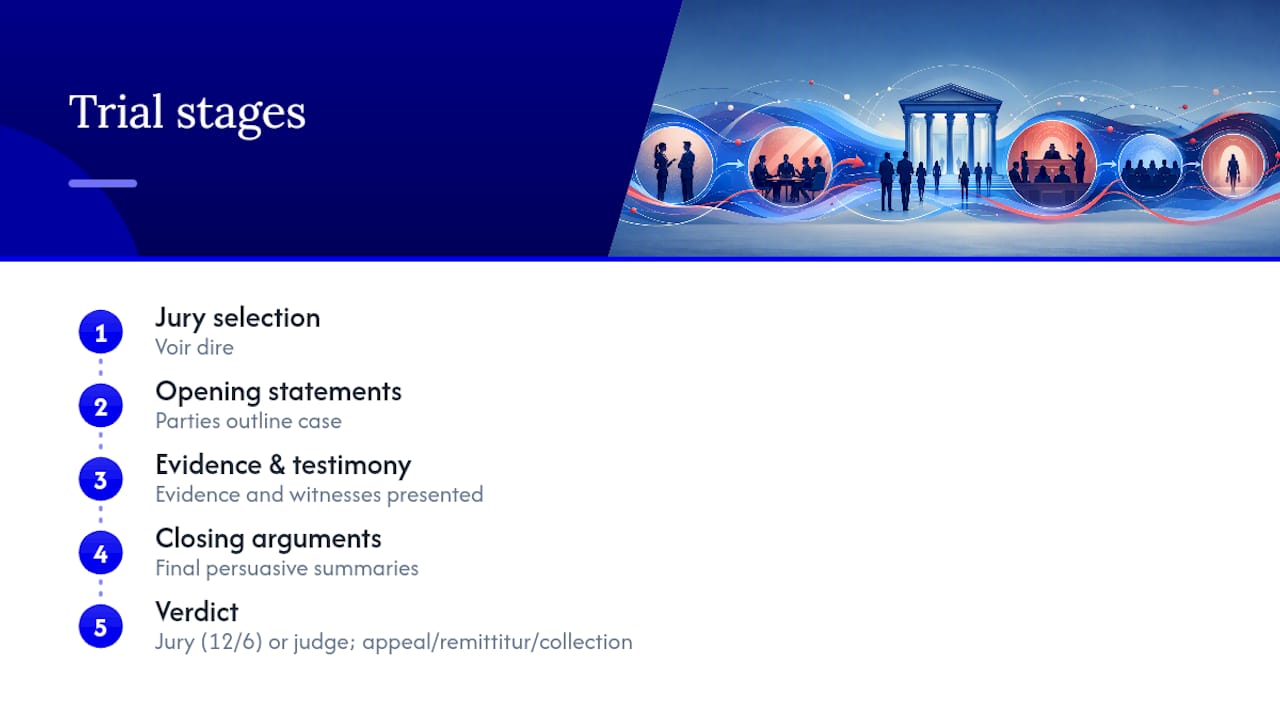
A verdict is not always the end of the story. The losing side can appeal, which adds months or years before any money changes hands. A judge can also order remittitur, reducing a jury's award if it's deemed excessive. And even after all that, if the defendant is uninsured or under-resourced, you may face real collection challenges getting the judgment actually paid.
Win rates vary sharply by case type. Cases with disputed liability, like some rear-end collisions with conflicting witness accounts, carry more trial risk than cases with a police report clearly assigning fault. This variability is exactly why a blanket "trial is better" or "settlement is better" answer doesn't hold up. It depends entirely on your facts.
Pros and Cons of Accepting a Settlement
Settlement offers solve a specific problem: uncertainty. Here's what you're weighing when an offer lands on the table.
- You get paid faster. Money in weeks or months beats money in years, especially if you're behind on rent or medical bills right now.
- You lock in certainty. A jury could award more, or it could award nothing. Settlement removes that coin flip entirely.
- Costs stay lower. No expert witness fees, no extended discovery, no trial prep bills eating into your recovery.
- Your case stays private. No public court record detailing your injuries, your finances, or your medical history.
- You waive future claims. Once signed, you generally can't come back later if your injury worsens or new damages emerge, and you give up any right to appeal.
Pro Tip: If you're on the fence, ask your attorney what percentage of similar cases settled for more than the current offer at trial. That number, not your gut feeling, should drive the decision.
Settlement tends to make the most sense when you need funds quickly, your injuries are moderate rather than catastrophic, or the evidence on liability is mixed. When any of those apply, a guaranteed number usually beats a gamble.
Pros and Cons of Taking Your Case to Trial
Trial is the higher-variance play, and it can pay off, but the downside is real and often underestimated.
The upside includes:
- A jury verdict can exceed any settlement offer, sometimes substantially, particularly with clear liability and serious injury.
- Punitive damages are only available through a verdict, not a negotiated settlement.
- Some plaintiffs want the public accountability a courtroom provides, especially against defendants who acted recklessly or with obvious disregard for safety.
The risks are just as concrete:
- You could win nothing. A sympathetic story doesn't guarantee a favorable verdict.
- Attorney fees typically climb once a case goes to trial, and litigation costs (experts, court reporters, exhibits) come out of your recovery.
- Appeals can stretch payment out for years even after you win.
- If the defendant lacks assets or adequate insurance, a big verdict can be functionally worthless.
Trial tends to fit best when liability is clear-cut, the injury is severe and permanent, and the defendant's conduct was egregious enough that a jury is likely to respond with a larger number than any insurer would offer to settle.
What Does a Trial Actually Cost Compared to Settlement?
Money talks here, and the numbers matter more than most people realize when they're deciding whether to hold out.
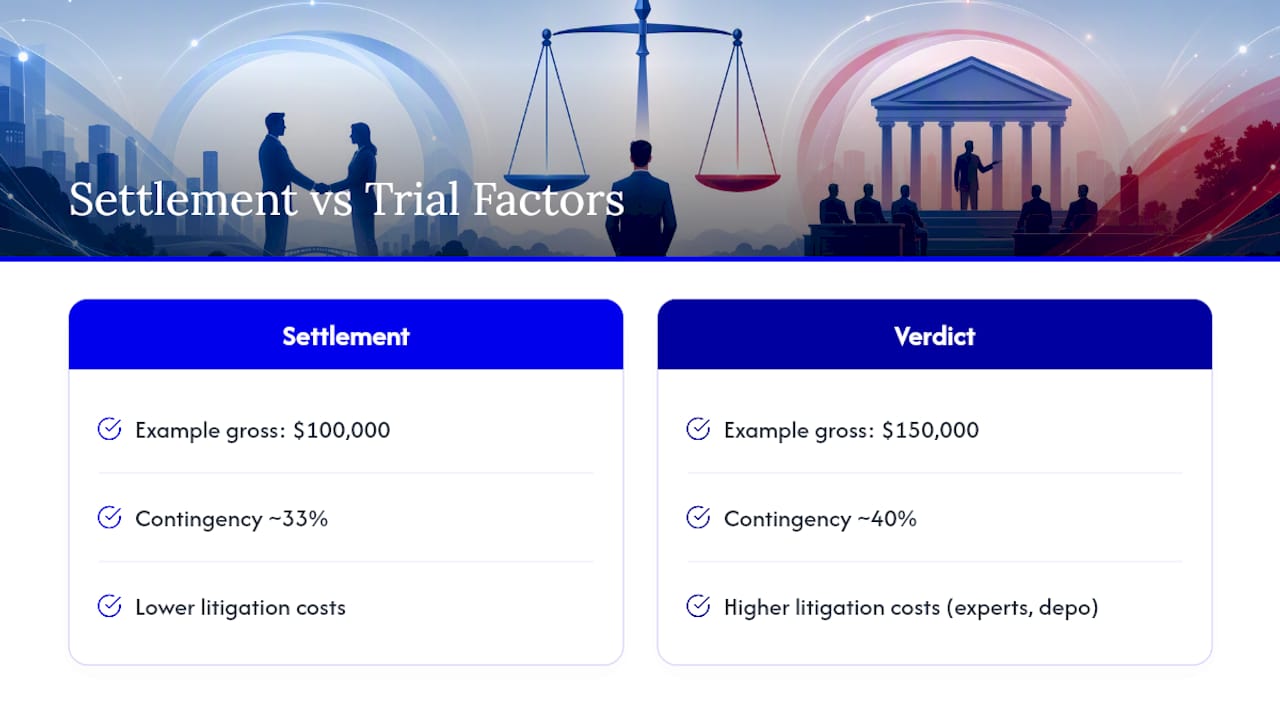
Attorney fees shift. Contingency arrangements often run around 33% if the case resolves before trial, climbing to roughly 40% if the case goes to verdict, reflecting the added time and risk your attorney absorbs.
Litigation costs add up fast at trial. Expert witnesses (medical, accident reconstruction, economic) can run several thousand dollars each. Depositions, court filing fees, and exhibit preparation stack on top. LegalClarity's cost breakdown notes that these expenses accumulate quickly and eat directly into your net recovery, regardless of the verdict size.
Here's a worked comparison that shows why a bigger number on paper doesn't always mean more money in your pocket:
A $150,000 verdict and a $100,000 settlement can land at nearly the same net number once fees and costs are subtracted, and that's before factoring in delay or appeal risk. This is the math your attorney should be running for you before you turn down an offer.
One more piece nobody skips: a verdict is only worth what you can actually collect. Check policy limits and available assets before assuming a bigger number at trial beats a smaller, funded settlement now.
How Long Does Each Path Actually Take?
Timing shapes this decision as much as dollar amounts do.
Settlements can close in a matter of weeks if liability is clear and both sides want to avoid litigation. More contested claims typically settle somewhere between six months and eighteen months, often once discovery has forced both sides to see the real strength (or weakness) of the case. You can see how this plays out stage by stage in a typical car accident claim timeline.
Trial is a different animal entirely. Expect two to four years from filing to verdict in most jurisdictions, and tack on additional time if either side appeals. Mediation and settlement conferences usually get scheduled somewhere in that middle stretch, often court-ordered before a trial date locks in, and that's frequently where a case actually resolves even after months of litigation posturing.
Time has a cost of its own. Money now is worth more than the same amount three years from now, both practically (unpaid bills don't wait) and financially. That's part of why structured settlements exist: they let you capture a fair number today while still spreading payments to match long-term needs.
How to Decide: An Expected-Value Framework You Can Use
Here's the actual formula lawyers use, stripped of jargon: Expected trial value = (probability of winning × likely verdict amount) minus expected costs and delay. Compare that number to the settlement offer on the table. Whichever is higher, adjusted for how confident you are in the inputs, is the better financial choice.
Getting those inputs right takes your attorney's input, not guesswork. Here's how to build the estimate:
- Ask for a probability estimate. Based on comparable verdicts in your jurisdiction and case type, what's the realistic win percentage?
- Get a litigation budget. Have your attorney itemize expected expert fees, deposition costs, and trial prep expenses.
- Check collectability. Confirm the defendant's insurance policy limits and whether alternative sources, like your own underinsured motorist (UM/UIM) coverage, could fill any gap.
- Run the math side by side. Put the settlement offer next to the probability-adjusted trial value minus costs, and see which number actually wins.
- Weigh the non-financial factors. Privacy, how badly you need funds now, and the emotional toll of a multi-year case all belong in the decision, even if they don't show up in the spreadsheet.
Pro Tip: Ask your attorney this exact question: "What's your realistic probability of winning at trial, and what would our net recovery be after fees and costs if we win?" A competent attorney should be able to answer both parts specifically, not vaguely.
Recommended approaches to the settle-or-trial decision consistently point back to this same expected-value method, because it strips emotion out of a decision that's otherwise easy to make on gut feeling alone. Your attorney should be willing to walk through this calculation with you, not just hand you a number and ask for a signature. Reviewing your documented evidence strength alongside this math will also tell you how confident that probability estimate really is.
Mediation, Arbitration, and the Rules That Push Cases Toward Settlement
Mediation and arbitration sit between negotiation and full trial, and both are worth understanding before you commit to either extreme.
Mediation uses a neutral third party to facilitate negotiation, and it works more often than people expect. Success rates commonly run 60% to 75%, with modest mediator fees split between parties, far cheaper than a trial. Arbitration, by contrast, has a neutral decision maker actually rule on the case, similar to a trial but faster and typically less formal.
Procedural rules add real financial pressure too. Under Federal Rule of Civil Procedure 68, a defendant can serve a formal offer of judgment. If you reject it and later win less at trial than the offer, you may be stuck paying the defendant's post-offer costs. Many states have similar statutes, and these offers frequently show up 12 to 18 months before a scheduled trial date specifically to apply pressure.
Two tactical tools worth asking your attorney about:
- High-low agreements, which cap the range of a possible verdict for both sides before trial even starts.
- Mid-trial settlements, which can happen once a jury's early reactions or a judge's rulings make the likely outcome clearer to both sides.
Working With Your Attorney: Questions and a Checklist
The single most useful thing you can do before deciding is ask your attorney for a written litigation budget and expected-value estimate. If they can't produce one, or won't, that's worth noting.
Bring these to your next conversation:
- Request the probability-of-success estimate and how it was calculated (comparable verdicts, jury tendencies in your venue, strength of liability evidence).
- Ask for an itemized litigation budget covering expert witnesses, depositions, and trial prep.
- Confirm the defendant's insurance policy limits and any other sources of recovery, including your own UM/UIM coverage.
- Review your documented settlement factors to see how your case compares to typical outcomes for similar injuries.
- Ask about your attorney's actual trial experience, not just settlement experience. Someone who has never picked a jury may lean toward settlement regardless of your case's merits.
If any of these answers feel vague or rehearsed, it's reasonable to seek a second opinion or a fresh, no-obligation case evaluation before committing to either path.
A Candid Take on How This Decision Usually Plays Out
Most people who come to us weighing settlement against trial already know, deep down, which one they want. What they don't have is the math to justify it, or the courage to override their gut with a cold expected-value calculation when the number says otherwise.
Here's the uncomfortable truth: certainty is worth more to most injured people than the spreadsheet suggests, and that's not irrational. If you're behind on medical bills, a guaranteed check beats a coin flip with better average odds; for guidance on navigating insurance payments, see our tips on how to file a health insurance claim in Florida. But a small number of cases, the ones with a clearly reckless defendant and permanent injury, genuinely deserve the fight. The only way to know which category you're in is to force your attorney to run the numbers instead of just recommending a gut call. A confidential evaluation is a low-cost way to get a second set of eyes on that math before you sign anything.
— Gerard
Get a Free Case Evaluation Before You Decide
You don't need to run the expected-value math alone. You can connect with an attorney who can walk through your specific numbers, probability of success, litigation costs, and collectability, at no cost and with no obligation to move forward.

The free evaluation is built specifically around your injury type and the facts of your accident, whether that's a car, truck, motorcycle, or bicycle collision. Nothing about the process locks you into anything: you get matched with an attorney, hear a realistic read on your case, and decide from there whether settlement or trial is the smarter financial move. If you're staring at a settlement offer right now and don't know whether it's fair, that's exactly the conversation worth having before any deadline to respond passes. Start your free case evaluation today and get the numbers you need to decide with confidence.
FAQ
Is It Better to Take a Settlement or Go to Trial?
It depends on your case's expected value after costs, not a universal rule. If the probability-adjusted trial outcome minus expenses exceeds the settlement offer, and the defendant can actually pay a judgment, trial may be worth pursuing. Otherwise, settlement is usually the stronger financial choice.
How Much Will I Get From a $100,000 Settlement?
Your net recovery depends on your attorney's contingency percentage and any litigation costs already incurred. With a common 33% contingency rate and minimal case expenses, you'd typically net somewhere around $65,000, though your specific fee agreement and costs will change that number.
Why Do People Choose to Settle Instead of Going to Trial?
Settlement offers certainty, faster payment, lower legal costs, and privacy, all of which matter when someone needs funds now rather than in two or three years. It also avoids the real risk that a jury awards nothing at all.
Do Most Lawsuits Settle Before Trial?
Yes. Roughly 97 to 99% of federal civil cases resolve before reaching a jury verdict, and state courts report similarly high settlement rates. Trial is the exception, not the norm, in personal injury litigation.