
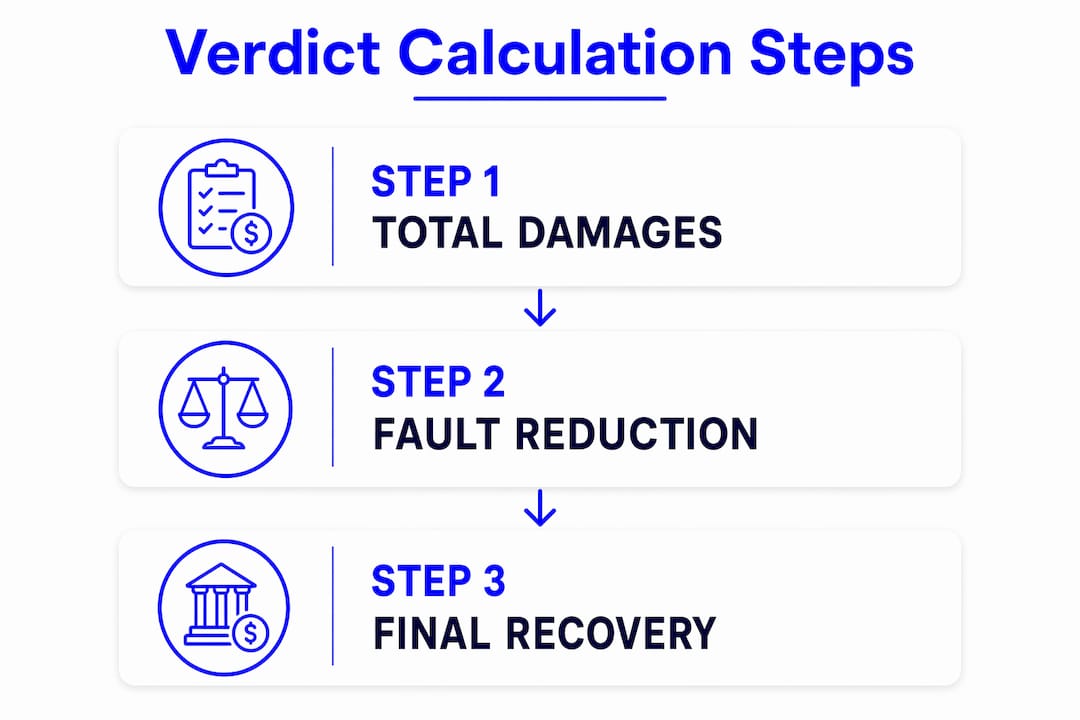
Car accident verdicts are calculated by first totaling all economic and non-economic damages, then reducing that amount based on the injured party's share of fault and the practical limits of available insurance coverage. Understanding how car accident verdicts are calculated gives you a real advantage when evaluating a settlement offer or preparing for trial. The process follows a clear sequence: damages are established, fault is assigned, and insurance limits shape what you can actually collect. Each step involves legal standards, jury judgment, and policy constraints that directly affect your final recovery.
How car accident verdicts are calculated: the two-step process
Damage calculation is a two-step process: courts and juries first determine total damages, then apply a fault-based reduction to produce the final recoverable amount. That sequence matters because the two steps are legally separate. A jury can find your total damages are $200,000 but still cut your award to $140,000 if it decides you were 30% responsible for the crash. Knowing this structure helps you understand why the number your attorney argues for in court often differs from what you ultimately collect.
What are economic and non-economic damages in car accident cases?
Economic damages are the financial losses you can document with receipts, bills, and pay stubs. Non-economic damages cover the human cost of the injury, which is harder to quantify but often larger than the economic total.
Economic damages: what counts and how it adds up
Economic damages in a car accident case include:
- Medical costs: Emergency care, surgery, physical therapy, prescription medications, and future treatment if your injury is permanent.
- Lost wages: Income you missed while recovering, calculated from pay records or tax returns.
- Future earning capacity: If your injury limits your ability to work long-term, an economist or vocational expert projects the lifetime income loss.
- Property damage: Repair or replacement cost for your vehicle and any personal property destroyed in the crash.
These figures are added together to form the economic base. That base then feeds directly into the non-economic calculation.
Non-economic damages: the multiplier and per diem methods
Non-economic damages use a multiplier or per diem method to estimate pain and suffering, emotional distress, and loss of enjoyment of life. The multiplier method takes your total economic damages and multiplies them by a number, typically between 1.5 and 5, based on injury severity. A broken wrist that heals in six weeks might draw a 1.5 multiplier. A spinal cord injury causing permanent disability could justify a 4 or 5 multiplier.

The per diem method assigns a daily dollar rate to your suffering and multiplies it by the number of days from the accident until you reach maximum medical improvement. Gaps in treatment or inconsistent symptom reporting reduce the accepted duration and lower the final number. Consistent, well-documented medical care protects both methods.
Pro Tip: Keep a daily pain journal from the day of the accident. Specific entries about how your injury affects sleep, work, and daily activities give your attorney concrete material to support a higher multiplier or a longer per diem period.
How does fault allocation and comparative negligence impact verdict calculations?
Comparative negligence is the legal rule that reduces your damages by the percentage of fault assigned to you. Most states use one of two versions.
- Pure comparative negligence: You can recover damages no matter how high your fault percentage. If you are 80% at fault and your damages total $100,000, you collect $20,000.
- Modified comparative negligence: Recovery is allowed only if your fault falls below a threshold, typically 50% or 51%. Nevada's modified comparative negligence law bars recovery entirely if your fault reaches 50% or higher.
How juries assign fault percentages
Juries separately evaluate fault and damages, applying the legal reduction only after both determinations are complete. They weigh police reports, witness statements, accident reconstruction experts, and traffic camera footage. The fault percentage is not a precise science. Two juries hearing the same facts can reach different conclusions.
Here is how the math works across different fault scenarios:
| Your fault % | Total damages | Your recovery |
|---|---|---|
| 0% | $100,000 | $100,000 |
| 20% | $100,000 | $80,000 |
| 30% | $100,000 | $70,000 |
| 50% (modified state) | $100,000 | $0 |
If total damages are $100,000 and you are 30% responsible, you collect $70,000 under typical state rules. That single percentage point can mean tens of thousands of dollars in real money.
Pro Tip: Never admit fault at the scene, even casually. Statements like "I didn't see you" can be used to argue contributory negligence and raise your fault percentage at trial.
What role do insurance policy limits and coverage play in calculating verdict amounts?
A jury verdict is not a check. Insurance policy limits frequently cap recoverable damages even when the verdict amount is higher. If the at-fault driver carries only $50,000 in liability coverage and your verdict is $200,000, collecting the remaining $150,000 requires pursuing the driver's personal assets, which is often impractical.
Three types of coverage directly shape what you can realistically recover:
- Liability coverage: The at-fault driver's policy pays your damages up to its limit. Most state minimums are far below what serious injuries cost.
- Underinsured motorist (UIM) coverage: Your own policy fills the gap when the at-fault driver's coverage is insufficient. This is one of the most valuable protections you can carry.
- MedPay coverage: Pays your medical bills regardless of fault, providing immediate cash flow while the liability dispute resolves.
Insurance companies use valuation software like Colossus and Claims Outcome Advisor to generate settlement ranges. These tools input medical and injury data but rarely capture the full impact of the injury on your life. The result is an opening offer that is almost always lower than what a skilled attorney can negotiate.
How do juries decide subjective damages like pain and suffering?
Juries use reasonable judgment without fixed formulas for pain and suffering, guided by the multiplier and per diem frameworks attorneys present. The decision is subjective, which means your credibility as a plaintiff carries enormous weight.
Jurors pay close attention to several factors:
- Consistency: Does your testimony match your medical records? Contradictions between what you say and what your doctors documented destroy credibility.
- Coherence: Can you describe how the injury changed your daily life in specific, believable terms? Vague claims of "constant pain" are less persuasive than concrete examples.
- Medical evidence: Imaging results, treatment frequency, and physician notes all support the duration and severity of suffering.
- Behavior evidence: Social media posts showing physical activity that contradicts your injury claims are routinely used by defense attorneys to undercut your case.
"Plaintiff credibility, internal consistency, and trustworthy medical documentation strongly influence jury awards for subjective damages." — KVA Law
Perceived case strength influences liability decisions heavily. Jurors assess competing narratives rather than just raw facts. A plaintiff who presents a clear, consistent story supported by organized medical records is far more likely to receive a full non-economic award than one whose account shifts under cross-examination.
What other damages might affect a verdict, such as punitive damages?
Punitive damages are separate from compensatory damages and serve a different purpose. Compensatory damages replace what you lost. Punitive damages punish the defendant for conduct so reckless or intentional that the court wants to deter it.
The bar for punitive damages is significantly higher:
- Egregious conduct required: Drunk driving at extreme blood alcohol levels, street racing, or deliberately running a red light at high speed can qualify. Simple negligence does not.
- Higher proof standard: Most states require clear and convincing evidence, a stricter standard than the preponderance of evidence used for compensatory claims.
- Statutory caps: Punitive damages are subject to statutory caps, often set at 2–4 times the compensatory award or a fixed dollar limit depending on the state.
| Damage type | Purpose | Proof standard | Typical cap |
|---|---|---|---|
| Compensatory | Replace losses | Preponderance of evidence | None in most states |
| Punitive | Punish misconduct | Clear and convincing evidence | 2–4x compensatory or fixed limit |
Punitive damages are rare in standard car accident cases. When they apply, they can substantially increase the total verdict, but collecting them still depends on the defendant's ability to pay.
Key takeaways
Car accident verdicts follow a defined legal sequence: total damages are established first, fault reduces that total, and insurance limits determine what you can actually collect.
| Point | Details |
|---|---|
| Two-step calculation | Juries set total damages first, then apply fault reduction to reach the final award. |
| Multiplier range matters | Non-economic damages use a 1.5–5 multiplier based on injury severity and documentation quality. |
| Fault percentage is money | A 30% fault finding on a $100,000 verdict costs you $30,000 in real recovery. |
| Insurance limits cap recovery | Policy limits often prevent full collection even after a favorable verdict. |
| Credibility drives subjective awards | Consistent testimony and organized medical records directly increase pain and suffering awards. |
What I've learned about verdicts that most claimants miss
The part of verdict calculation that surprises claimants most is not the math. It is the fault allocation. People walk into a case believing they were 0% responsible and walk out of a jury room with a 25% fault finding they never anticipated. That reduction is often the difference between a life-changing recovery and a settlement that barely covers medical bills.
Documentation is the single most controllable factor in your case. Treating your medical timeline as a structured record, not just a series of appointments, changes how juries and insurers evaluate your claim. Every gap in treatment becomes an argument that you were not seriously hurt. Every inconsistency in your story becomes a tool for the defense.
Insurance coverage is the other practical reality that catches claimants off guard. A $300,000 verdict against a driver with $50,000 in liability coverage is a moral victory, not a financial one, unless you have strong UIM coverage on your own policy. Reviewing your own policy before an accident happens is the kind of preparation most people skip and later regret.
The legal system gives you tools to recover fairly. Using them well requires experienced legal guidance, thorough records, and a clear understanding of how each step in the process affects the next.
— Gerard
Getting the compensation your case actually deserves
Understanding the calculation is one thing. Building a case that maximizes every component is another.

Carcollisionlawyer connects accident victims with attorneys who know how to document economic losses accurately, argue for the right multiplier, and push back against low insurance offers. A skilled attorney evaluates your total injury compensation across every damage category, challenges unfair fault assignments, and negotiates with insurers who use software designed to minimize payouts. If you were injured in a car, motorcycle, or truck accident, a free evaluation through Carcollisionlawyer costs you nothing and shows you what your case may actually be worth.
FAQ
How are car accident verdicts calculated?
Verdicts are calculated by totaling economic and non-economic damages, then reducing that total by the injured party's fault percentage under comparative negligence rules. Insurance policy limits further cap the amount practically collectible.
What is the multiplier method for pain and suffering?
The multiplier method takes your total economic damages and multiplies them by a number between 1.5 and 5, depending on injury severity. A more serious or permanent injury justifies a higher multiplier.
Can you collect more than the at-fault driver's insurance limit?
You can win a verdict above the policy limit, but collecting the excess requires pursuing the driver's personal assets or using your own underinsured motorist coverage. Most attorneys investigate all available coverage before trial.
What is comparative negligence and how does it affect my recovery?
Comparative negligence assigns a fault percentage to each party and reduces your damages by your share. In modified comparative negligence states, you recover nothing if your fault reaches the statutory threshold, often 50%.
Do punitive damages apply in most car accident cases?
Punitive damages apply only when the defendant's conduct was egregious, such as drunk driving or intentional recklessness. They require a higher proof standard and are subject to statutory caps in most states.