
A toxicology report supplies laboratory evidence about what substances were in a person's body and how those findings may support or undermine causation, impairment, or contributory-factor arguments in personal injury and wrongful death claims. That sentence is the whole point. Everything else is about knowing when the report is reliable enough to use and when it needs to be challenged.
Three legal touchpoints determine how much weight a toxicology result actually carries in court:
- Daubert admissibility: Under Daubert v. Merrell Dow Pharmaceuticals, courts assess whether the expert's methodology is reliable, peer-reviewed, and grounded in accepted standards. A positive lab result alone does not get an expert's opinion admitted.
- Postmortem redistribution (PMR): In death cases, drug concentrations measured after death can differ substantially from concentrations at the time of the incident. Sampling site and postmortem interval are not footnotes; they are threshold questions.
- Integration with other evidence: The Reference Manual on Scientific Evidence is direct on this point: toxicology evidence contributes to the weight of evidence for causation but rarely establishes specific causation for a single individual on its own.
Before you rely on any toxicology result, confirm three things: (1) whether the result is confirmed by GC-MS or LC-MS/MS rather than a screening assay only, (2) the specimen type, sampling site, and exact collection time, and (3) whether a documented chain of custody exists from collection to analysis.
Key Takeaways
Toxicology reports carry real evidentiary weight in claims only when the results are confirmed, the sampling details are documented, and the findings are integrated with medical and exposure evidence rather than read in isolation.
| Point | Details |
|---|---|
| Confirmatory testing is required | Screening results are presumptive only; GC-MS or LC-MS/MS confirmation is needed before litigation use. |
| Sampling site and timing matter | In postmortem cases, cardiac vs. femoral blood and postmortem interval directly affect whether a concentration is reliable. |
| Pair toxicology with other evidence | Toxicology rarely establishes specific causation alone; integrate with medical records, autopsy, and exposure data. |
| Prepare Daubert challenges early | Challenge method validation, lab accreditation, SOP adherence, and chain of custody before trial, not during it. |
| Carcollisionlawyer matches you with counsel | Submit your incident summary and available records for a free evaluation and attorney match suited to your claim. |
Table of Contents
- What a toxicology report is and how screening differs from confirmatory testing
- How toxicology testing is performed and what lab terms mean for litigation
- How to read a toxicology report: entries, concentrations, qualifiers, and red flags
- Key interpretation challenges: PMR, detection windows, false positives, and polydrug effects
- How attorneys use toxicology reports in personal injury, wrongful death, and impairment claims
- Admissibility under Daubert and Frye, and how to challenge toxicology evidence
- Documents and data to request from labs, coroners, hospitals, and custodians
- How to brief a toxicology expert and use their report effectively
- How long toxicology reports take and what "preliminary" means for your case schedule
- Three scenarios showing how toxicology changed the claim
- The mistake most attorneys and claimants make with toxicology evidence
- Toxicology evidence in your claim: how Carcollisionlawyer can help
- Sources
What a toxicology report is and how screening differs from confirmatory testing
A toxicology report is a laboratory document that identifies and, in many cases, quantifies substances detected in a biological specimen. The specimen can be blood, urine, vitreous humor, hair, or tissue. The report reflects a two-step workflow: first a screen, then confirmation.
The screening step uses immunoassay technology. Immunoassays are fast and inexpensive, but they react to drug classes rather than specific compounds. A positive immunoassay result is called presumptive or screening positive for exactly that reason: cross-reactivity can trigger a positive result for a substance that is not actually present.
The confirmatory step uses chromatography-based methods, primarily GC-MS (gas chromatography-mass spectrometry) or LC-MS/MS (liquid chromatography-tandem mass spectrometry). These methods identify specific compounds and their metabolites at defined concentrations. A result produced this way is labeled confirmed. Courts and opposing experts treat confirmed results as the defensible basis for identification and quantitation.
Common report labels you will encounter:
- Negative / Not Detected (ND): The analyte was not found above the reporting limit. This does not mean the substance was absent; it means it was below the threshold the lab tests for.
- Presumptive Positive / Screening Positive: An immunoassay flagged the specimen. Requires confirmation before litigation use.
- Confirmed: Identified and quantified by GC-MS or LC-MS/MS. The method should be stated in the report.
- Preliminary: The lab has issued partial results; confirmatory testing is still pending.
- Supplemental / Amended: Additional testing was performed or a prior result was corrected.
State forensic programs formalize these definitions. The New York State Division of Criminal Justice Services guidance specifies that a lab's SOP should define each report term and that report language must align with those SOPs. When a report uses a term inconsistently with the lab's own SOP, that gap is a cross-examination point.
How toxicology testing is performed and what lab terms mean for litigation
Understanding the method behind a result tells you how hard it is to attack. Immunoassay screens are designed for throughput, not precision. They produce qualitative results (positive or negative relative to a cutoff) and are prone to cross-reactivity. A positive immunoassay for opioids, for example, can be triggered by poppy seeds or certain antihistamines.
GC-MS and LC-MS/MS resolve that problem. Both methods separate compounds physically before measuring their mass-to-charge ratios, producing a compound-specific fingerprint. LC-MS/MS handles a broader range of polar and thermally labile compounds, which is why it has become the standard for many clinical and forensic labs. The result is both qualitative (what the substance is) and quantitative (how much was present).
Concentration reporting matters because it affects the inference you can draw. A confirmed result at a concentration well below a therapeutic range supports a very different argument than a result at a toxic or lethal range. The Texas Autopsy Services practitioner guide explains this two-step gold standard and notes that concentrations must be interpreted against therapeutic versus toxic ranges, not read in isolation.
Terms like "confirmed by history" are red flags. That phrase means the lab noted the substance based on reported medication use, not analytical detection. It is not a laboratory finding.
Pro Tip: Insist on seeing the lab's SOP and method validation documentation for any confirmatory method cited in the report. A lab that cannot produce validation data for its GC-MS or LC-MS/MS method has handed you a strong admissibility argument and a productive line of cross-examination.
How to read a toxicology report: entries, concentrations, qualifiers, and red flags
A standard toxicology report entry contains several fields. Knowing what each one means prevents misreading a result as stronger or weaker than it is.
- Specimen type and collection details: Blood (peripheral vs. cardiac), urine, vitreous humor, hair, or tissue. Collection date and time are critical for timing inferences.
- Analyte name: The substance tested for. Pay attention to whether the report lists a parent drug, a metabolite, or both. Metabolites often persist longer than the parent compound, which affects timing arguments.
- Concentration and units: Typically expressed as mg/L, ng/mL, or µg/dL. The unit matters; a result of 0.08 mg/dL is not the same as 0.08 mg/L.
- Reporting limit: The lowest concentration the method reliably detects. A "not detected" result means below this threshold, not zero.
- Confirmation method: GC-MS, LC-MS/MS, or none stated. If none is stated for a positive result, that is a problem.
- Qualifier codes: Symbols or abbreviations that modify the result. Common ones include "ND" (not detected), "POS" (positive, often screening only), and "CONF" (confirmed).
Red flags that require immediate follow-up:
- No chain-of-custody documentation attached or referenced
- Postmortem blood with no sampling-site notation (cardiac vs. femoral)
- Positive results with no confirmation method listed
- "Preliminary" label with no indication of when the final report will issue
- Metabolite detected without the parent drug (may indicate prior rather than recent use)
Key interpretation challenges: PMR, detection windows, false positives, and polydrug effects
This is where toxicology most often gets misused in litigation, on both sides.
Postmortem redistribution (PMR) is the single most important limitation in death cases. After death, drugs redistribute from organs and tissues into surrounding blood, which means postmortem blood concentrations can be substantially higher than concentrations at the time of death. The Journal of Analytical Toxicology review on PMR mechanisms establishes that sampling site and postmortem interval materially affect reported concentrations, and recommends femoral (peripheral) blood over cardiac blood to reduce redistribution artifacts. An expert who cites a cardiac blood concentration without addressing PMR is presenting an incomplete opinion.
Practitioners should demand PMR-aware reasoning rather than single-number comparisons. Any concentration-based opinion must address sampling site, postmortem interval, and the specific redistribution potential of the drug in question before it can be treated as reliable evidence of what was in the person's system at the time of the incident.
Detection windows vary by matrix and drug. Blood reflects recent exposure and is the best proxy for effect at a given time. Urine shows prior use, sometimes days earlier, and a positive urine result does not establish impairment at the time of an accident. Hair analysis can detect exposure over months but cannot pinpoint when use occurred within that window. Matching the matrix to the litigation question is not optional.
False positives and cross-reactivity are real in immunoassay screens. Certain antibiotics, antidepressants, and over-the-counter medications trigger positive screens for controlled substances. Clinical toxicology guidance from NCBI notes that serum testing is often more clinically meaningful than urine for acute exposures and that screening results must be interpreted in clinical context.
Polydrug interactions add another layer. Two substances at individually sub-therapeutic concentrations can produce synergistic impairment. A report showing two substances at "low" levels is not automatically benign; a pharmacokinetics expert may need to address the combined effect.
Pro Tip: When a report shows a positive urine screen with no blood confirmation, do not assume impairment at the time of the incident. Request blood testing results separately, and if none exist, that absence is itself an argument about what the evidence can and cannot prove.
How attorneys use toxicology reports in personal injury, wrongful death, and impairment claims
The role of a toxicology report in claims is not to prove a case by itself. It is to answer specific litigation questions when paired with the right supporting evidence.
Common uses in litigation:
- Impairment at the time of an accident: Blood alcohol or drug concentration from a blood draw taken close in time to the incident, combined with officer observations or witness accounts, supports an impairment argument. Urine alone does not.
- Contribution to cause of death: In wrongful death cases, toxicology findings integrated with autopsy findings and medical history can support or rebut a cause-of-death opinion.
- Workplace or environmental exposure causation: Repeated elevated biomarkers over time, correlated with documented exposure sources, support a causation narrative in toxic-tort claims.
- Insurance subrogation and dram-shop liability: A confirmed blood alcohol result from a driver, combined with purchase records and witness testimony about service, supports an overservice claim against a licensed establishment.
The weight-of-evidence approach is the correct frame. Rimkus toxicology litigation guidance makes the point directly: toxicology review is most persuasive when it targets the specific litigation questions counsel needs answered, such as impairment timing, blood versus urine interpretation, and overservice, rather than presenting uncontextualized positives.
Toxicology in insurance claims follows the same logic. An insurer or claimant relying on a screening-only positive to establish contributory fault is on weak ground. A confirmed result with pharmacokinetic context is a different matter.
A note on evidentiary limits: The Reference Manual on Scientific Evidence is unambiguous that toxicology evidence rarely establishes specific causation for a single individual without exposure assessment, medical records, and other corroborating evidence. Build the causation narrative around the toxicology finding, not on top of it.
Admissibility under Daubert and Frye, and how to challenge toxicology evidence
Daubert directs federal courts and most state courts to assess the reliability of an expert's methodology, not just the expert's credentials or the fact that a lab produced a result. The practical focus is on whether the method is testable, peer-reviewed, has known error rates, and is generally accepted in the relevant scientific community. Frye, still applied in a minority of states including California and New York, asks only whether the method is generally accepted, which is a narrower but still meaningful gate.
Daubert/Frye challenge checklist:
- Was the confirmatory method (GC-MS, LC-MS/MS) validated for this specimen type and analyte?
- Does the lab hold current accreditation (ISO 17025, ANAB, or equivalent)?
- Did the analyst follow the lab's SOP, and is that SOP documented and producible?
- What are the method's known false-positive and false-negative rates?
- Has the expert's interpretive methodology been peer-reviewed?
- Is the chain of custody complete from collection to analysis?
- Did the expert address PMR, detection windows, and interfering substances?
Beyond admissibility, cross-examination themes that attack interpretation:
- Sampling site: "Where exactly was this blood drawn, and when relative to death or the incident?"
- Stabilization and preservation: "What preservatives were in the collection tube, and were they appropriate for this analyte?"
- Confirmation status: "Was this result confirmed by GC-MS or LC-MS/MS, or is this a screening result only?"
- Interfering substances: "Did you test for compounds known to cross-react with this immunoassay?"
- Pharmacokinetic context: "At this concentration, what does the literature say about expected behavioral effects, and did you consult it?"
A 2026 academic review on drug toxicology and the law notes that courts and practitioners frequently struggle with the interface between scientific standards of proof and legal standards, and that toxicology is misapplied more often when practitioners lack interdisciplinary training. That gap is your opportunity on cross.
Documents and data to request from labs, coroners, hospitals, and custodians
Getting the right documents early prevents the situation where a case turns on a lab result that cannot be fully evaluated because the underlying data was never requested.
Priority requests from the laboratory:
- Complete chain-of-custody documentation from specimen collection through final analysis
- Raw chromatograms and instrument printouts for all confirmed results
- Method SOPs and validation data for each analytical method used
- Lab accreditation certificates (ISO 17025, ANAB, or state equivalent) current at the time of testing
- Analyst worksheets, bench notes, and quality-control records for the run
From the coroner or medical examiner:
- Full autopsy report including cause-of-death and manner-of-death opinions
- Sampling-site notation for each specimen collected (femoral vs. cardiac blood, vitreous humor)
- Time of death estimate and postmortem interval documentation
- Any histology, radiology, or neuropathology reports that bear on the cause-of-death opinion
From medical providers and custodians:
- Current medication list and prescription history from the decedent's or claimant's pharmacy
- Emergency department notes documenting observed symptoms, vital signs, and any clinical toxicology results
- Statements or records documenting timing of last ingestion or observed behavioral changes
- Medical release authorizations to obtain records from all treating providers
The NYS forensic toxicology standardization guidance confirms that report terms must align with lab SOPs, so requesting the SOP alongside the report is not optional. If the lab's SOP defines "Confirmed" differently from how the report uses the term, that inconsistency is a discovery and admissibility issue.
How to brief a toxicology expert and use their report effectively
Retaining a qualified forensic toxicologist or forensic pathologist is not enough. The expert's opinion is only as useful as the questions you ask them to answer.
Briefing template for a toxicology expert:
- Provide a complete case-facts summary: incident date and time, specimen collection time, specimen type and sampling site, and the chain-of-custody record.
- State the specific opinions you need: Was the subject impaired at the time of the incident? Did the detected substance contribute to death? Is the concentration consistent with therapeutic use or with toxic effect?
- Identify all documents for the expert to review: toxicology report, autopsy report, medical records, pharmacy records, raw chromatograms, and lab SOPs.
- Set a deadline for a written report that addresses each opinion, the basis for it, and the limitations of the analysis.
Expert deliverables to request:
- A written report that addresses exposure timing, pharmacokinetic analysis, and the specific litigation question
- An exhibit packet with annotated chromatograms and concentration-range reference charts suitable for jury presentation
- A deposition prep memo that anticipates opposing Daubert arguments and prepares the expert to address PMR, detection windows, and cross-reactivity
Litigation integration tips:
- Use a rebuttal expert when the opposing toxicologist's report lacks PMR analysis in a death case or relies solely on a screening result for an impairment opinion.
- Move for exclusion under Daubert when the expert's methodology is not documented, the lab lacks accreditation, or the chain of custody has a gap.
- Translate the expert's opinion into jury-friendly demonstratives: a timeline showing specimen collection relative to the incident, a concentration chart showing where the result falls relative to therapeutic and toxic ranges.
The NDAA Drug Toxicology for Prosecutors guidance cautions that analysts should not testify to impairment based solely on lab results. That principle applies equally in civil litigation: the expert's opinion on impairment must integrate the lab result with behavioral observations, pharmacokinetics, and clinical context.
Pro Tip: Retain your toxicology expert before the close of fact discovery, not after. Early involvement lets the expert identify what additional testing or sampling-site documentation is needed while specimens and records are still available.
For claims involving psychological injury alongside physical evidence, the same early-retention principle applies to the full expert team.
How long toxicology reports take and what "preliminary" means for your case schedule
Turnaround time depends on the type of testing and the lab's workflow. Preliminary reports are not final reports, and treating them as such creates scheduling problems.
| Testing Type | Typical Turnaround | Key Process Notes |
|---|---|---|
| Emergency / rapid screen (immunoassay) | Hours to 1–2 days | Qualitative only; requires confirmation before litigation use |
| Standard confirmatory testing (GC-MS/LC-MS/MS) | 2–6 weeks | Produces confirmed, quantitative results; this is the litigation-grade result |
| Postmortem / coronial toxicology | 4 weeks or longer | Delayed by specimen backlog, PMR analysis, and cause-of-death integration |
| Supplemental or amended reports | Variable; weeks to months after initial | Triggered by additional testing requests or quality-review corrections |
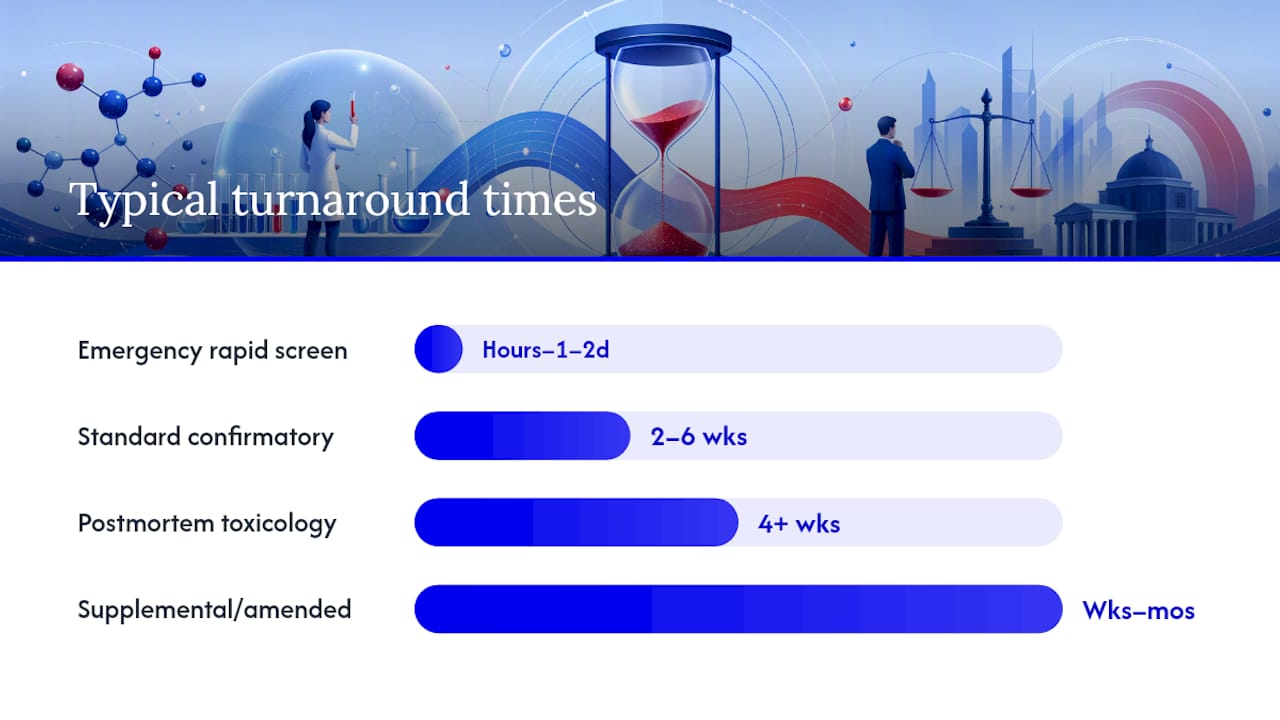
A preliminary report means the lab has completed initial screening but confirmatory testing is pending. Do not use a preliminary result to anchor a causation argument. A PMC study of postmortem toxicology mandates found that coroner practices around testing and certification vary significantly by training and resources, which means turnaround times in coronial cases are genuinely unpredictable.
When a report is delayed, take these steps: file a motion for preservation of biological specimens if there is any risk they will be destroyed or degraded; serve targeted discovery requests to the lab or medical examiner for interim data and collection records; and retain your expert early enough that they can review the final report before your expert disclosure deadline.
Three scenarios showing how toxicology changed the claim
1. Motor vehicle accident and dram-shop liability
A driver involved in a fatal collision had a blood alcohol concentration confirmed by GC-MS at a level above the legal limit. The critical document was not the lab report alone. It was the combination of the confirmed blood result, the time-stamped receipt from the bar where the driver was served, witness statements about visible intoxication, and the officer's field sobriety notes. The blood result anchored the timeline; the other records established overservice. Without the confirmed blood result, the dram-shop claim had no quantitative anchor. Without the other records, the blood result was a number without context.
Key documents: confirmed blood toxicology, chain of custody, bar receipts, officer report, witness statements.
2. Slip and fall with a positive medication screen
A plaintiff fell on a commercial property and the defense obtained a urine screen showing a positive result for a benzodiazepine. The defense argued the plaintiff was impaired. The plaintiff's attorney requested the pharmacy records, which showed a long-standing prescription at a stable therapeutic dose, and retained a pharmacologist who testified that the detected metabolite was consistent with chronic therapeutic use, not acute intoxication. The urine screen was a screening result only; no blood confirmation existed. The court gave the result limited weight.
Key documents: urine toxicology report, pharmacy records, prescribing physician records, pharmacologist opinion on therapeutic range.
3. Workplace chemical exposure
A worker developed neurological symptoms after years of solvent exposure. Toxicology showed elevated urinary metabolites of the relevant solvent on multiple occasions. The employer argued the levels were within "acceptable" ranges. The plaintiff's expert paired the biomarker data with industrial hygiene records showing repeated exposure events above permissible limits, medical records documenting symptom onset correlated with high-exposure periods, and peer-reviewed literature on the neurological effects of chronic low-level exposure. The toxicology results were not dispositive alone; they became persuasive as part of a documented exposure timeline.
Key documents: serial biomarker results, industrial hygiene records, OSHA exposure logs, treating neurologist records, peer-reviewed literature.
For cases involving rear-end collisions where impairment is disputed, the same document-pairing principle applies.
The mistake most attorneys and claimants make with toxicology evidence
The most common error is treating a toxicology line item as the end of the analysis rather than the beginning of it. A confirmed positive result tells you a substance was present at a measured concentration at the time of collection. It does not tell you the person was impaired, that the substance caused the injury, or that the concentration at collection reflects what was present at the time of the incident. Those inferences require additional work.
Three specific mistakes come up repeatedly. First, relying on a screening result without confirmation. A presumptive positive is a reason to order confirmatory testing, not a fact to put in a brief. Second, failing to obtain sampling-site and collection-time details in postmortem cases. A cardiac blood result with no PMR analysis is a number that an opposing expert will dismantle in deposition. Third, assuming that a postmortem concentration equals the antemortem concentration at the time of death. PMR is not a theoretical concern; it is a documented phenomenon with well-studied mechanisms.
Early expert involvement prevents all three mistakes. A forensic toxicologist retained before discovery closes can identify what additional testing is needed, flag whether the lab's methods are documentable, and frame the questions so the lab performs the right confirmatory analyses while specimens are still viable. Waiting until the expert disclosure deadline to engage a toxicologist is how cases get lost on evidence that was always available.
Toxicology evidence in your claim: how Carcollisionlawyer can help
When a toxicology report is part of your case, the attorney you work with needs to understand how to use it, not just that it exists. Carcollisionlawyer connects accident victims and their families with attorneys who handle personal injury and wrongful death claims where forensic evidence is in play, at no cost to you for the initial evaluation.
To get matched quickly, submit your incident summary, any medical records or toxicology reports you have, the autopsy report if applicable, and a timeline of events. Carcollisionlawyer's intake process reviews what you submit and matches you with a vetted attorney suited to your specific claim type. Your submission is handled confidentially; review the privacy policy for details on how your information is protected.
Before your evaluation, take these steps: preserve any medication packaging or prescription bottles, avoid discarding biological samples if you have been advised to retain them, and prepare signed medical release forms so your attorney can request records immediately. A matched attorney will follow up directly to discuss next steps. Start your free case evaluation now.
Sources
These are the primary references used throughout this article. Each one addresses a specific layer of the toxicology-in-claims analysis.
- Reference Manual on Scientific Evidence — Toxicology
- Toxicology — New York State Division of Criminal Justice Services
- Daubert v. Merrell Dow Pharmaceuticals, Inc., 509 U.S. 579 (1993)
This article is general information, not a substitute for advice from a qualified lawyer. Consult a qualified legal professional about your own circumstances before acting on anything here.