
A psychiatrist in an injury claim is an independent medical expert who evaluates mental health conditions caused or worsened by an accident to help courts determine liability and compensation. This role, formally called a medico-legal psychiatric expert, sits at the intersection of clinical medicine and law. The role of psychiatrist in injury claims covers four core functions: diagnosis, causation analysis, prognosis, and functional impact assessment. Mental health now accounts for up to 50% of long-term disability claims in some insurance sectors, which means psychiatric evidence carries real financial weight in legal proceedings. Understanding what a psychiatrist does, and why their findings matter, gives you a clearer picture of what to expect from your claim.
What responsibilities does a psychiatrist hold in injury claim assessments?
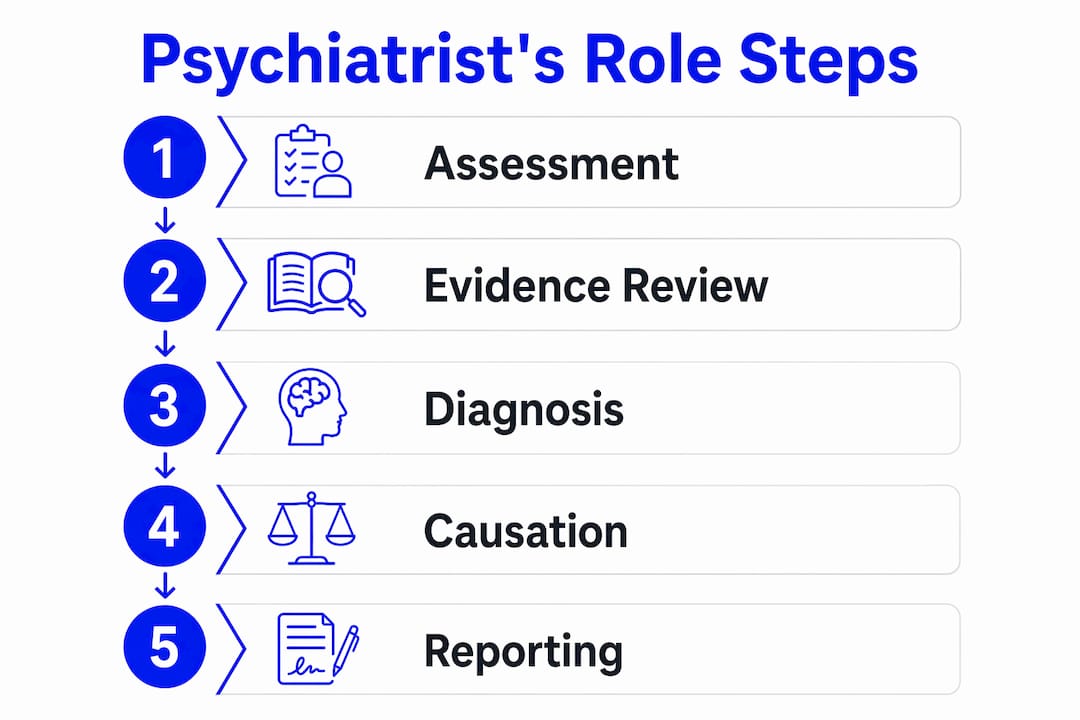
Consultant psychiatrists serve as independent expert witnesses providing diagnosis, causation analysis, and prognosis in claims involving PTSD, depression, and anxiety. Their work follows a structured process designed to produce findings that hold up in court. Each step builds toward a report that a judge or jury can rely on.
The standard responsibilities in a psychiatric injury evaluation include:
- Clinical interview. The psychiatrist conducts a detailed face-to-face interview covering the claimant's history, symptoms, and daily functioning before and after the injury.
- Records review. Medical records, GP notes, hospital reports, and legal documents are all reviewed to establish a factual baseline.
- Diagnosis. Conditions like PTSD, major depressive disorder, and generalized anxiety disorder are identified using recognized diagnostic criteria such as DSM-5 or ICD-11.
- Causation analysis. The psychiatrist links the diagnosed condition to the specific accident or event, distinguishing new conditions from pre-existing ones.
- Prognosis. A recovery outlook is provided, including whether the claimant will need ongoing treatment, therapy, or medication.
- Medico-legal report. All findings are compiled into a court-compliant document written for a legal audience, not a clinical one.
- Expert witness testimony. If the case goes to court, the psychiatrist may be called to defend their findings under cross-examination.
Forensic psychiatrists conduct mental status exams and review corroborating evidence to make their findings legally defensible. This level of rigor separates a medico-legal report from a standard clinical letter.
Pro Tip: Ask your attorney whether the psychiatrist instructed in your case has specific medico-legal experience. A clinician who regularly treats patients is not the same as one trained to produce court-compliant reports.

How do psychiatrists establish diagnosis and causation?
Establishing causation is the hardest part of any psychiatric injury evaluation. A diagnosis alone does not win a claim. The psychiatrist must show that the accident directly caused or materially worsened the mental health condition.
The key methods psychiatrists use to build a causation argument include:
- Symptom timeline. The psychiatrist maps when symptoms first appeared relative to the accident date. A clear onset after the event strengthens the causal link.
- Pre-existing vulnerability. Pre-existing mental health conditions do not automatically defeat a claim. Psychiatrists apply the "eggshell skull" principle, recognizing that a claimant with prior vulnerabilities may suffer more severely from the same event.
- Symptom consistency. Forensic psychiatrists assess symptom consistency with the claimed event, checking whether the pattern of symptoms matches what would be expected from that type of trauma.
- Mental status examination. Observations of mood, cognition, affect, and behavior during the interview add objective clinical data to the report.
- Collateral evidence. Third-party statements from friends, family, and colleagues are often essential in validating psychiatric findings. They help courts understand real-life impact beyond what the claimant reports directly.
The psychiatrist also considers psychosocial factors like job loss, relationship breakdown, or financial stress that may have followed the accident. These factors can amplify a mental health condition and are legitimate components of the overall injury picture.
Pro Tip: Gather statements from people who knew you well before and after the accident. A neighbor, coworker, or close friend who can describe changes in your behavior provides the kind of collateral evidence that strengthens a psychiatric report significantly.
For claimants dealing with PTSD after an accident, the causation analysis is especially detailed because PTSD requires a specific traumatic stressor to be identified and linked to the diagnosed symptoms.
What impact do psychiatric reports have on claim outcomes?
Psychiatric reports directly shape how much compensation a claimant receives. A well-constructed report clarifies the severity of the condition, its functional impact, and the likely cost of future treatment. Courts rely on this information to calculate damages.
The specific ways psychiatric reports influence claim outcomes include:
- Liability decisions. A credible psychiatric report can establish that the defendant's actions caused a recognized mental health condition, which is a prerequisite for compensation.
- Damages calculation. Reports quantify how the condition affects the claimant's ability to work, maintain relationships, and perform daily activities. These functional impacts translate directly into financial awards.
- Future care costs. Prognosis sections estimate the duration and cost of therapy, medication, and rehabilitation. This figure often represents a significant portion of the total settlement.
- Disputed claims. Psychiatric reports are decisive when symptoms are serious or disputed, helping ensure compensation reflects the true impact of the injury.
"The psychiatrist's primary duty is to the court, not the instructing party. That independence is what makes their testimony credible and their reports authoritative in legal proceedings."
The impartiality of the psychiatric expert is not just a procedural formality. A psychiatrist's duty to the court above all other parties is the foundation of their credibility. A report that appears biased toward the instructing side loses persuasive power and can be challenged effectively by opposing counsel.
Claimants sometimes underreport symptoms out of embarrassment or fear of judgment. This is a real problem. Understating the severity of your condition can directly reduce the compensation you receive, because the psychiatrist can only report what the evidence supports. Understanding why mental injuries deserve compensation helps claimants approach these evaluations with the seriousness they require.
What challenges surround mental health evaluations in injury claims?
Mental health evaluations are harder to conduct and harder to defend than physical injury assessments. There is no X-ray for depression and no blood test for PTSD. This creates real complexity for claimants, attorneys, and psychiatrists alike.
The main challenges in psychiatric injury evaluations are:
- Objective measurement. Psychiatric symptoms are self-reported and observed, not measured by instruments. This makes them easier to challenge in court and harder to quantify precisely.
- Stigma and underreporting. Claimants often hesitate to disclose symptoms due to stigma or concerns about career impact. A claimant who minimizes their symptoms during evaluation may receive a report that underestimates their condition.
- Pre-existing conditions. Defendants frequently argue that a claimant's mental health problems predated the accident. The psychiatrist must carefully distinguish between conditions caused by the accident and those that existed before it.
- Unpredictable recovery. Mental health claims involve unpredictable recovery timelines, which makes prognosis harder to pin down compared to a broken bone with a standard healing period.
- Cross-examination pressure. Psychiatric experts must be prepared to defend their methodology, diagnostic reasoning, and conclusions under rigorous cross-examination. A psychiatrist without medico-legal experience can struggle in this environment.
Research published in 2026 found that individuals in active claim adjudication report significantly worse mental health outcomes than those with accepted or resolved claims. The stress of the legal process itself worsens the very conditions being evaluated. This creates a feedback loop that both claimants and their legal teams need to understand.
Pro Tip: Be honest and thorough during your psychiatric evaluation. Describe your worst days, not just your average ones. Psychiatrists are trained to assess consistency, and an accurate picture of your full symptom range produces a more accurate report.
Legal systems also place strong emphasis on collateral evidence to support psychiatric reports, requiring witness testimony and supporting documentation beyond the clinical evaluation alone. Claimants who come prepared with this evidence give their psychiatrist more to work with.
Key Takeaways
A psychiatrist's independent, court-directed evaluation of diagnosis, causation, and prognosis is the single most influential factor in determining fair compensation for psychiatric injury claims.
| Point | Details |
|---|---|
| Core psychiatric functions | Psychiatrists assess diagnosis, causation, prognosis, and functional impact for courts. |
| Impartiality is decisive | The psychiatrist's duty is to the court, not the instructing party, which makes their report credible. |
| Collateral evidence matters | Third-party statements from family and colleagues strengthen causation arguments significantly. |
| Underreporting reduces awards | Claimants who minimize symptoms during evaluation risk receiving lower compensation than they deserve. |
| Mental health claims are complex | Unpredictable recovery timelines and stigma make psychiatric injury claims harder to resolve than physical ones. |
Why the psychiatrist's role surprised me more than I expected
Most claimants walk into a psychiatric evaluation expecting something close to a therapy session. They are wrong, and that misunderstanding costs them.
A medico-legal psychiatric assessment is a forensic exercise. The psychiatrist is not there to help you. They are there to form an independent opinion for the court. That is not a criticism of the process. It is the whole point. The moment a psychiatric expert starts advocating for the claimant, their report loses credibility and opposing counsel dismantles it.
What I find most underappreciated is how much weight collateral evidence carries. Claimants focus on their own interview performance, but the psychiatrist is also reading statements from your employer, your partner, your GP. A claimant who has documented their daily struggles through journals, medical visits, and honest conversations with people around them gives the psychiatrist far more to work with than one who has stayed silent.
The other thing claimants consistently overlook is the prognosis section. Most people focus on the diagnosis. But the prognosis, specifically the estimate of future treatment costs and recovery duration, often determines the largest portion of the financial award. A thorough, well-supported prognosis can mean the difference between a modest settlement and one that genuinely covers your long-term needs.
If you are dealing with invisible injury claims, the psychiatric report is often your only objective evidence. Treat the evaluation process with the same seriousness you would give a surgical consultation.
— Gerard
Carcollisionlawyer and psychiatric injury claims
Psychiatric injury claims require both medical expertise and legal precision. Carcollisionlawyer connects accident victims with attorneys who understand how to build claims around psychiatric evidence, from the initial evaluation through to settlement negotiations.
If your accident has affected your mental health, you may be entitled to compensation that covers therapy, lost income, and long-term care. Carcollisionlawyer offers a free evaluation to help you understand your options without any upfront commitment. Their network includes attorneys experienced in emotional and psychiatric injury cases, giving you access to specialized legal support tailored to the specific nature of your claim. Start with a free assessment and find out what your claim could be worth.
FAQ
What does a psychiatrist do in a personal injury claim?
A psychiatrist conducts a clinical interview, reviews medical and legal records, and produces a court-compliant report covering diagnosis, causation, prognosis, and functional impact. Their findings directly influence liability decisions and compensation awards.
How is psychiatric causation proven in an injury claim?
Causation is established through symptom timelines, mental status examinations, and collateral evidence from third parties. The psychiatrist must show that the accident directly caused or materially worsened the diagnosed mental health condition.
Can a pre-existing mental health condition affect my claim?
A pre-existing condition does not automatically defeat a claim. Psychiatrists apply the "eggshell skull" principle, which recognizes that a claimant with prior vulnerabilities may suffer more severely from the same event, and that additional harm is still compensable.
Why does the psychiatrist's impartiality matter?
The psychiatrist's primary duty is to the court, not the party who instructed them. This independence is what makes their testimony credible and gives their report authority in legal proceedings.
How do psychiatric reports affect settlement amounts?
Psychiatric reports clarify the severity and functional impact of a mental health condition, estimate future treatment costs, and support or dispute causation. These factors directly determine the damages awarded in both negotiated settlements and court judgments.