
Accident flashback disorder is a diagnosable psychiatric condition, formally recognized under Post-Traumatic Stress Disorder (PTSD) criteria in both the DSM-5 and ICD-11, that entitles accident victims to financial compensation when causation is properly established. The accident flashback disorder compensation steps require timely medical diagnosis, thorough documentation, and a structured legal claim process. Compensation covers both general damages for pain and suffering and special damages for therapy costs, lost earnings, and medication. Acting quickly after an accident protects your legal rights and strengthens the causation argument that courts and insurers demand.
What prerequisites and documentation are required before filing a claim?
Building a valid flashback disorder claim starts with one action: see a doctor immediately after the accident. Courts and insurers view delayed treatment as evidence that symptoms are either minor or unrelated to the accident. A general practitioner visit creates the first official record linking your psychological symptoms to the incident.
A formal psychiatric diagnosis is the foundation of every successful claim. The diagnosis must reference DSM-5 or ICD-11 criteria and include symptom severity, treatment recommendations, and a clear prognosis. Without this, no claims board or court will assign meaningful compensation.
Documentation you must gather before filing:
- Accident report filed with police or relevant authorities
- GP and mental health consultation records from the earliest possible date
- Formal psychiatric diagnosis referencing DSM-5 or ICD-11 criteria
- Contemporaneous symptom diary recording flashback frequency, sleep disturbances, and avoidance behaviors
- Witness statements from people present at the accident scene
- CCTV footage or photographs if available
- Receipts for therapy, medication, and travel related to treatment
- Employer statements documenting missed work or reduced capacity
Statutory time limits are strict and non-negotiable. Psychological injury claims carry a 3-year limitation period in England and Wales, and 2 years in Ireland, starting from the accident date or the "date of knowledge" when you first connected your symptoms to the accident. Missing these deadlines bars your claim permanently.
Understanding the two damage categories matters for building your claim file. General damages cover pain, suffering, and loss of enjoyment of life. Special damages cover every out-of-pocket cost: therapy sessions, prescription medication, and travel to appointments. Both require documented evidence, not estimates.
Pro Tip: Start a symptom diary within the first 1–2 weeks after the accident. Insurance adjusters treat contemporaneous records as far more credible than accounts written months later.
What are the step-by-step legal procedures to claim compensation for flashback disorder?
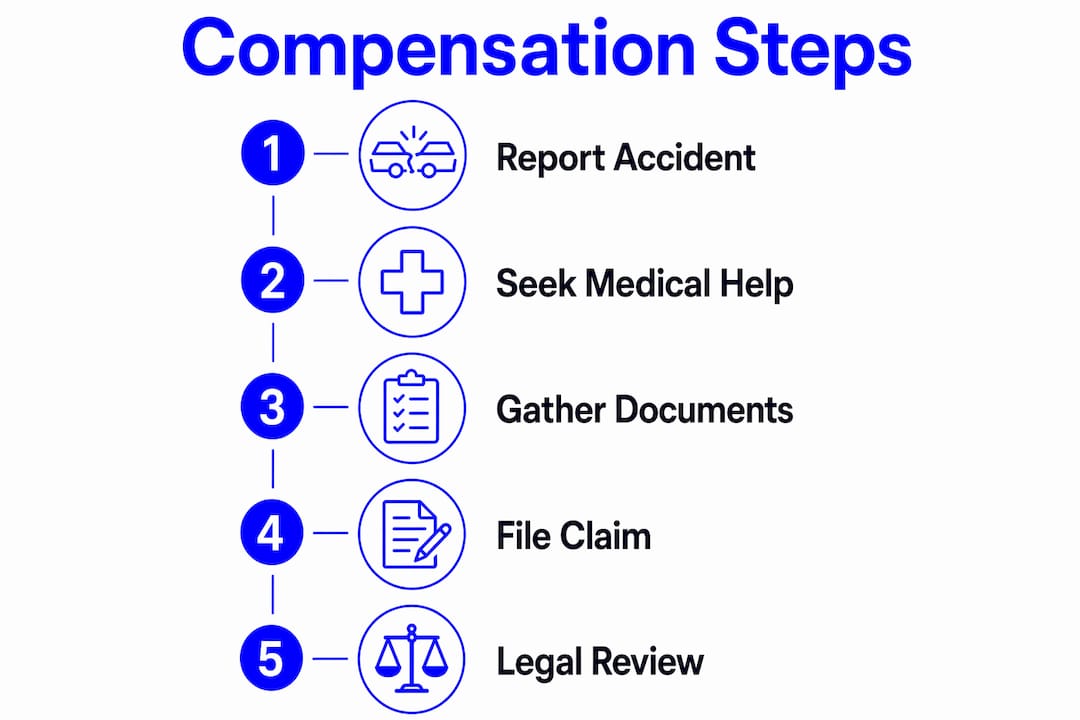
The legal process for accident PTSD compensation follows a defined sequence. Skipping or reordering steps creates procedural errors that delay or reduce your settlement.
- Report the accident formally. Notify police, your employer, or the relevant property owner depending on the accident type. This creates an official record that anchors your claim.
- Seek immediate medical attention. Visit a GP within days of the accident. Request that your psychological symptoms be documented in writing at this first appointment.
- Obtain a specialist psychiatric assessment. A consultant psychiatrist must produce a formal report that includes diagnosis, symptom severity, treatment plan, prognosis, and an explicit causation statement. The report must apply the "but for" test: but for the accident, the claimant would not have the disorder at this severity.
- Engage a personal injury attorney. Legal counsel reviews your evidence, identifies the correct claims body, and files the application with supporting medical reports. Carcollisionlawyer connects accident victims with attorneys who specialize in psychological injury claims through a free evaluation process.
- Submit to the Injuries Resolution Board (IRB) or equivalent body. In Ireland, the IRB assesses claims on paper when the respondent consents. In England and Wales, claims typically proceed through the pre-action protocol before court proceedings.
- Respond to correspondence during the assessment period. Both claimant and respondent exchange documents. Missing response deadlines can stall or invalidate your claim.
- Prepare for mediation or litigation if needed. If the respondent does not consent to IRB assessment, or if the assessment is rejected, court proceedings begin. Your attorney manages this stage.
- Keep all financial and treatment records updated. Ongoing therapy costs and lost earnings continue to accumulate. Every new receipt and employer statement strengthens your special damages figure.
| Stage | Action required | Typical timeline |
|---|---|---|
| Accident reporting | File police or incident report | Within 24–48 hours |
| Initial medical visit | GP consultation, symptom documentation | Within 1 week |
| Psychiatric assessment | Formal PTSD diagnosis report | Within 4–8 weeks |
| Claim submission | File with IRB or equivalent | Within statutory limit |
| Assessment period | Document exchange, IRB review | 3–9 months |
| Resolution | Settlement, mediation, or court | Varies by complexity |
Pro Tip: Request a copy of every medical report before it is submitted. Errors in causation language or missing symptom details are easier to correct before filing than after.

For a detailed look at how claim timelines unfold at each stage, Carcollisionlawyer's blog provides real-world breakdowns.
How to document and prove the impact of flashback disorder on daily life and work?
Proving flashback disorder in a legal claim requires translating invisible symptoms into measurable functional impairment. Courts focus on what you cannot do, not just what you feel. A diagnosis alone is not enough.
Your psychiatric report must explicitly connect symptoms to specific life disruptions. A report that states "patient experiences flashbacks" carries far less weight than one that states "patient cannot drive, has missed 14 days of work, and has withdrawn from social activities due to hypervigilance and intrusive memories." The functional impairment evidence is what courts use to assign compensation value.
Evidence that proves daily and occupational impact:
- Witness statements from family members describing behavioral changes since the accident
- Coworker or employer statements documenting concentration loss, absenteeism, or reduced output
- Therapy progress notes showing ongoing treatment and symptom persistence
- Medication records showing prescriptions for anxiety, sleep disorders, or depression
- A detailed symptom diary with specific dates, triggers, and functional consequences
"PTSD is an invisible disability. Courts focus on functional impairment evidence rather than visible symptoms, making documentation of daily impact the single most critical factor in claim valuation."
Under-documenting is the most common reason claims receive lower settlements than deserved. Vague descriptions like "I feel anxious" give insurers room to minimize your claim. Specific entries like "on March 4, I could not complete a work presentation due to a flashback triggered by a car horn" are far harder to dispute.
Carcollisionlawyer's guide on invisible injury claims explains exactly how courts evaluate psychological harm that has no visible physical component.
What common challenges and mistakes should claimants avoid?
Most flashback disorder claims that fail or settle low share the same preventable errors. Knowing these pitfalls before you file gives you a clear advantage.
The most damaging mistakes claimants make:
- Delaying medical treatment. Every week without a medical record weakens the causal link between the accident and your symptoms. Delayed or inconsistent records frequently lead to claim denial or reduced settlements.
- Missing statutory deadlines. The 3-year limit in England and Wales and the 2-year limit in Ireland are absolute. No extension applies unless the "date of knowledge" rule shifts the start date.
- Skipping specialist psychiatric assessment. A GP diagnosis alone does not satisfy legal causation requirements. A consultant psychiatrist's report is the standard courts and insurers require.
- Stopping documentation after the initial claim. Symptoms and treatment costs continue after filing. Gaps in your records suggest recovery, which insurers use to argue for lower general damages.
- Handling the claim without legal advice. Procedural errors in claim submissions, missed correspondence deadlines, and incorrect damage calculations are common when claimants self-represent.
Insurance companies challenge psychological injury claims more aggressively than physical ones. Insurers often argue that symptoms are exaggerated, pre-existing, or unrelated to the accident. A causation expert opinion from a consultant psychiatrist, stating to a reasonable degree of medical certainty that the accident caused the disorder, is the primary tool for overcoming this skepticism.
Pro Tip: Consult a personal injury attorney within the first month after the accident. Early legal advice prevents the procedural errors that are almost impossible to fix after the claim is filed.
Key Takeaways
Accident flashback disorder compensation requires early medical documentation, a formal psychiatric diagnosis with explicit causation language, and a structured legal process to secure fair general and special damages.
| Point | Details |
|---|---|
| Seek treatment immediately | Early GP and psychiatric visits create the causal record courts and insurers require. |
| Start a symptom diary fast | Contemporaneous records written within 1–2 weeks carry far more credibility than later accounts. |
| Obtain a specialist report | A consultant psychiatrist must explicitly link the accident to the disorder using the "but for" test. |
| Know your time limits | Claims must be filed within 3 years in England and Wales, or 2 years in Ireland, from the accident or date of knowledge. |
| Get legal advice early | An attorney prevents procedural errors and ensures special damages are fully documented and claimed. |
What I've learned about winning flashback disorder claims
After reviewing how these claims succeed and fail, one pattern stands out clearly. The claimants who receive fair compensation are not necessarily those with the most severe symptoms. They are the ones who documented everything from day one.
Insurers are trained to find gaps. A two-week delay in seeking treatment, a symptom diary that starts three months after the accident, or a psychiatric report that omits the causation statement. Any one of these gaps gives an adjuster a reason to reduce or deny the claim. The medical and legal systems are not designed to be hostile to PTSD claimants, but they do require precision.
The invisible nature of flashback disorder creates a real disadvantage. A broken arm shows on an X-ray. A flashback does not. That is why the functional evidence, what you cannot do at work, at home, and in relationships, carries more weight than the diagnosis itself. Judges and claims assessors need to see the disorder's impact translated into concrete, measurable terms.
My strongest advice: treat documentation as part of your recovery, not as a legal chore. Every therapy appointment you attend, every symptom you record, and every work absence you report to your employer becomes evidence. The claimants who approach this process with that mindset consistently achieve better outcomes than those who wait for their attorney to gather everything retrospectively.
— Gerard
Carcollisionlawyer: legal support for accident flashback disorder claims
Accident flashback disorder claims involve medical, legal, and procedural requirements that are difficult to manage without professional guidance.
Carcollisionlawyer specializes in connecting accident victims with attorneys who handle psychological injury claims, including PTSD and flashback disorder cases arising from car, motorcycle, and truck accidents. The free evaluation process lets you understand your compensation entitlement without any upfront commitment. Attorneys in the network assist with evidence gathering, psychiatric report coordination, claim filing, insurer negotiations, and court representation when needed. Early contact preserves your statutory rights and gives your attorney the maximum time to build a strong case. Start your free claim evaluation today and connect with a specialist who understands exactly what your claim requires.
FAQ
What is accident flashback disorder in legal terms?
Accident flashback disorder is the informal term for PTSD caused by a traumatic accident. Legally, it is a compensable psychiatric injury when diagnosed under DSM-5 or ICD-11 criteria and causally linked to the accident by a qualified psychiatrist.
How much compensation can I receive for flashback disorder?
Compensation varies by severity. Severe PTSD cases in the UK range from £73,000 to £125,000, while Irish cases range from €60,000 to €120,000, with lower bands for moderate and minor presentations. Special damages for therapy and lost earnings are calculated separately.
What is the time limit for filing a flashback disorder claim?
The limitation period is 3 years in England and Wales and 2 years in Ireland, starting from the accident date or the date you connected your symptoms to the accident.
Do I need a psychiatrist or can a GP diagnose my claim?
A GP consultation is the critical first step, but a consultant psychiatrist's formal assessment is required for claim approval. The psychiatric report must include diagnosis, severity, prognosis, and an explicit causation statement linking the accident to the disorder.
Can insurers reject psychological injury claims?
Insurers frequently challenge psychological injury claims by arguing symptoms are exaggerated or pre-existing. Thorough, contemporaneous medical records and a strong psychiatric causation report are the most effective tools for overcoming that challenge.