
An invisible injury is defined legally as a real, compensable harm that cannot be seen externally or detected by standard imaging, but is recognized by courts when proven through medical evidence and a clear causal link to the incident. The term "invisible injury" is not formal legal vocabulary. Attorneys and courts more commonly use terms like non-visible injury, psychological injury, or latent injury depending on the type of harm. Understanding what does invisible injury mean legally matters because these injuries appear in car accidents, truck collisions, and motorcycle crashes every day, yet many claimants abandon valid claims believing they cannot win without a visible wound. The law disagrees. Proof, not visibility, is the standard.
How are invisible injuries proven legally?
Proving an invisible injury in court requires a structured evidentiary record, not just a patient's word. Proving damages requires medical expert evidence, symptom documentation, and functional impact over time when clear physical evidence is absent. That combination is the foundation of every successful claim.
Courts look for four core elements when evaluating these claims:
- Qualified medical diagnosis. A licensed physician, neurologist, or mental health professional must formally diagnose the condition. Self-reported symptoms alone do not satisfy this requirement.
- Causal link to the incident. The diagnosis must be tied directly to the accident, not a pre-existing condition. Expert testimony establishes this connection with clinical reasoning.
- Documented symptom history. Consistent treatment records over weeks or months show that symptoms are real, persistent, and worsening or stable. Gaps in treatment hurt credibility.
- Functional impairment evidence. Courts want to see how the injury affects daily life. Journals, employer statements, and therapist notes documenting lost function carry significant weight.
Expert reports and therapy records demonstrate symptoms and daily life impact to establish a causal link to the incident. This is especially true for psychological injuries like PTSD and anxiety, where no X-ray will ever show the damage.
Pro Tip: Start a daily symptom journal the week after your accident. Note pain levels, sleep disruption, mood changes, and any tasks you could not complete. This record becomes powerful evidence months later when your attorney builds the causation narrative.

The defense will argue that symptoms are subjective and unverifiable. Claims without visible evidence require corroborated medical reasoning to counter attacks of subjectivity. Your attorney's job is to make the invisible visible through documentation.
What types of injuries are classified as invisible?
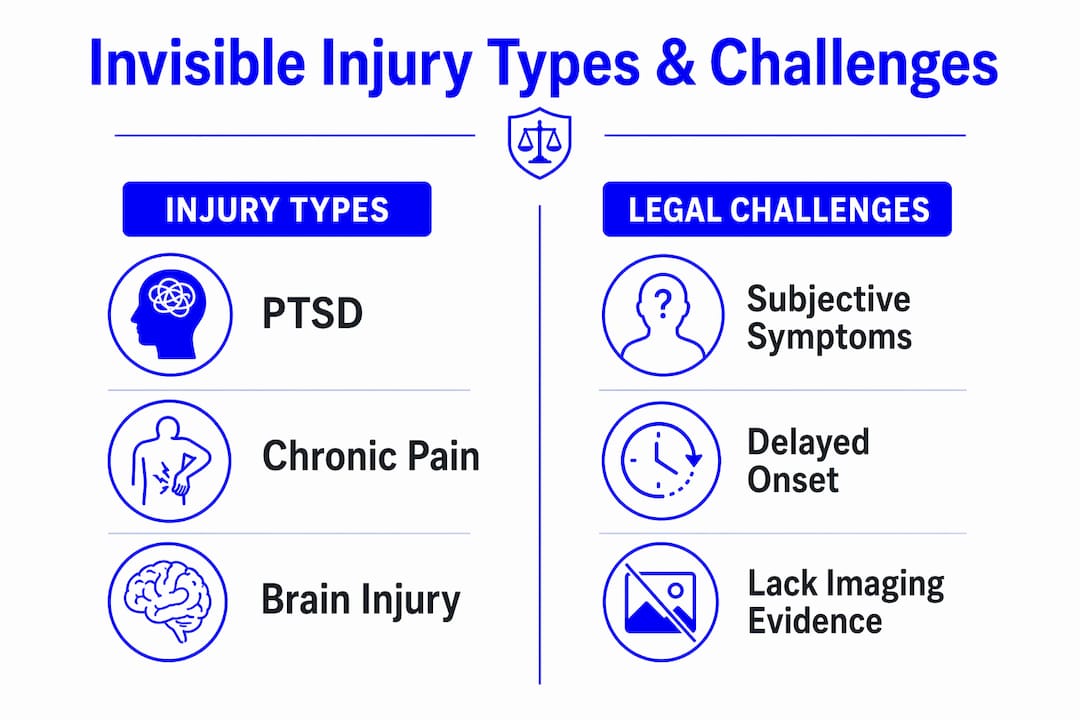
Invisible injuries include psychological harms like PTSD and physical injuries like mild traumatic brain injury (TBI), chronic pain, soft tissue damage, and latent injuries with delayed symptoms. None of these present visually, and most do not appear on standard MRI or CT scans.
Here are the most common categories you will encounter in personal injury claims:
- Post-Traumatic Stress Disorder (PTSD). Flashbacks, hypervigilance, and avoidance behaviors following a traumatic accident. Diagnosed by a licensed psychologist or psychiatrist.
- Anxiety and depression. Clinically significant mood disorders triggered or worsened by the accident. Requires documented treatment history.
- Mild traumatic brain injury (mild TBI). A concussion-level brain injury where absence of structural damage shifts focus to objective evidence of functional loss and causation. Cognitive testing and neuropsychological evaluation are the primary proof tools.
- Chronic pain conditions. Fibromyalgia, nerve pain, and persistent back pain that outlast the acute injury phase. Documented through pain specialist records and functional assessments.
- Soft tissue injuries. Whiplash, ligament sprains, and muscle tears that do not appear on imaging but cause measurable functional loss.
- Latent injuries. Injuries where symptoms emerge weeks, months, or even years after the incident.
| Injury Type | Common Symptoms | Primary Evidence Challenge |
|---|---|---|
| PTSD / Anxiety | Flashbacks, panic attacks, avoidance | No imaging evidence; requires psychiatric diagnosis |
| Mild TBI | Cognitive fog, memory loss, headaches | "Mild" label understates functional loss |
| Chronic Pain | Persistent pain, fatigue, limited mobility | Subjective reporting; pre-existing condition disputes |
| Soft Tissue Injury | Stiffness, swelling, reduced range of motion | Symptoms resolve on imaging; timing disputes |
| Latent Injury | Delayed symptom onset | Causation link weakens with time |
Latent injuries deserve special attention. Symptoms can emerge after a delay that lasts months or decades, and manifestation is when symptoms emerge and can be linked to the event by medical confirmation. This creates unique legal timing challenges covered in the next section.
What legal challenges are unique to invisible injuries?
Invisible injury legal claims face obstacles that broken-bone cases simply do not. The absence of visible proof creates skepticism at every stage, from the insurance adjuster's desk to the jury box.
The most common legal challenges include:
- Credibility attacks. Defense attorneys argue that injuries without imaging evidence are fabricated or exaggerated. Skepticism toward invisible injury claims is natural, and comprehensive expert testimony and treatment records are the best defense against doubt.
- Pre-existing condition disputes. Defendants argue the claimant had the condition before the accident. Your medical team must clearly document the change in baseline function caused by the incident.
- Statute of limitations complications. Standard filing deadlines begin on the date of the accident. For latent injuries, the discovery rule delays the statute of limitations start until the injury is discoverable. This protects claimants who did not know they were injured.
- Statute of repose. Even with the discovery rule, a hard filing deadline imposed by the statute of repose runs from the defendant's last act, regardless of when symptoms appeared. Missing this deadline ends the claim permanently.
- Diagnostic label minimization. In mild TBI cases, defense teams exploit the word "mild" to argue the injury is minor. Courts, however, focus on functional impairment and a medically grounded causal link more than diagnostic labels.
A persistent legal misconception holds that no MRI finding means no compensation. Courts rely on causation and reliable evidence, not only imaging. Knowing this distinction can change how you approach your entire claim.
Pro Tip: If your symptoms appeared days or weeks after the accident, tell your doctor immediately and document the exact date of onset. That timestamp protects your claim under the discovery rule and strengthens the causal link to the incident.
Practical steps to build a strong invisible injury claim
A strong invisible injury claim does not happen by accident. It is built deliberately, starting the day after the incident. Follow these steps to give your claim the best possible foundation.
- Seek qualified medical evaluation immediately. Visit a physician, neurologist, or mental health professional as soon as symptoms appear. Delayed treatment creates gaps that defense attorneys exploit. Early documentation establishes the timeline.
- Maintain consistent treatment records. Attend every appointment. Fill every prescription. A structured, medically grounded evidentiary record distinguishes your claim from subjective symptoms and alternative explanations.
- Request a formal written diagnosis. Ask your treating physician to document the diagnosis, the probable cause, and the functional limitations in writing. Verbal assessments do not hold up in discovery.
- Obtain expert legal and medical support. Your attorney should retain a medical expert who can explain your condition to a judge or jury in plain language. For psychological injury claims, a licensed psychiatrist or psychologist serves this role. For mild TBI, a neuropsychologist is the standard choice.
- Document functional impairments in daily life. Keep a written record of tasks you can no longer perform, work hours missed, and relationships affected. Statements from family members, coworkers, and supervisors add credibility.
- Understand your filing deadlines. Ask your attorney about both the standard statute of limitations and any applicable statute of repose in your state. Missing a deadline is the single most preventable reason valid claims fail.
- Counter the pre-existing condition argument proactively. Gather medical records from before the accident to establish your baseline health. Your attorney uses this to show the accident caused a measurable decline.
The causation narrative combines symptom chronology, qualified diagnosis, functional limitations, and expert medical explanations for symptoms without imaging evidence. Build each piece deliberately, and the narrative becomes hard to attack.
Key takeaways
Invisible injuries are legally compensable when proven through medical diagnosis, expert testimony, and documented functional impairment tied directly to the incident.
| Point | Details |
|---|---|
| Legal definition | An invisible injury is a real, compensable harm proven medically and causally linked to the incident, not a visible wound. |
| Proof standard | Courts require qualified diagnosis, expert testimony, consistent treatment records, and documented functional loss. |
| Injury types | PTSD, anxiety, mild TBI, chronic pain, soft tissue damage, and latent injuries all qualify as invisible injuries. |
| Timing rules | The discovery rule protects latent injury claimants, but statutes of repose impose hard filing deadlines regardless of symptom onset. |
| Defense strategy | Courts evaluate causation and evidentiary reliability, not just imaging results, so no MRI finding does not mean no compensation. |
What i have learned from watching these cases play out
After years of covering personal injury litigation, the pattern I see most often is not a weak case. It is a strong case that was never built properly in the first month after the accident.
Claimants with invisible injuries tend to minimize their symptoms early on. They tell themselves the headaches will pass, the anxiety is normal, the memory fog is stress. By the time they see an attorney, three months of undocumented suffering has already handed the defense its best argument: if it were that bad, why did you wait?
The other mistake I see constantly is treating the diagnostic label as the finish line. Getting a PTSD diagnosis or a mild TBI diagnosis is the starting point, not the victory. Courts care about what you cannot do now that you could do before. They care about the job you lost, the sleep you do not get, the drive to work you cannot make because the highway triggers a panic response. Functional impairment is the story that wins.
I also want to address the timing issue directly because it catches people off guard. The discovery rule sounds protective, and it is. But the statute of repose is a hard wall. I have seen claimants with legitimate latent injury claims lose everything because they waited too long after symptoms appeared, assuming the discovery rule gave them unlimited time. It does not. Talk to an attorney the moment you connect a symptom to a past accident.
The claimants who succeed are the ones who treat documentation as a daily discipline, not a one-time task. They show up to every appointment. They write down every bad day. They let their attorney build the narrative from real evidence rather than memory.
— Gerard
Get legal help for your invisible injury claim
If you suffered a car, truck, or motorcycle accident and your injuries do not show up on an X-ray, you still have a valid path to compensation. Invisible injuries are among the most misunderstood claims in personal injury law, and the right attorney makes the difference between a dismissed case and a full recovery.
Carcollisionlawyer connects accident victims with trusted attorneys who specialize in exactly these cases. The free evaluation process lets you understand your compensation options without any upfront commitment. Whether you are dealing with PTSD, chronic pain, a soft tissue injury, or a mild TBI, Carcollisionlawyer matches you with legal support built for your specific situation. Start your free injury evaluation today and find out what your claim is actually worth.
FAQ
What does invisible injury mean legally?
An invisible injury is defined legally as a real harm that cannot be seen externally or detected by standard imaging, but is recognized by courts when proven through medical diagnosis, expert testimony, and a causal link to the incident.
Are invisible injuries compensable under personal injury law?
Yes. Courts evaluate causation and evidentiary reliability, not just imaging results. A lack of MRI findings does not disqualify a claim when medical and expert evidence supports the injury.
What are common examples of invisible injuries in legal claims?
Common examples include PTSD, anxiety, depression, mild traumatic brain injury, chronic pain, soft tissue injuries like whiplash, and latent injuries with delayed symptom onset.
How does the discovery rule affect invisible injury claims?
The discovery rule starts the statute of limitations clock when the injury is discovered or reasonably should have been discovered, not on the accident date. However, statutes of repose impose hard filing deadlines that override this protection.
How do courts evaluate invisible injury and liability?
Courts focus on functional impairment and a medically grounded causal link rather than diagnostic labels alone. Expert testimony, consistent treatment records, and documented daily life impact are the primary factors in establishing liability.